Dear Claude README
The full upstream README, mirrored here for reference. Install config, tool schemas, adoption signals, and an original overview live on the Dear Claude listing page.
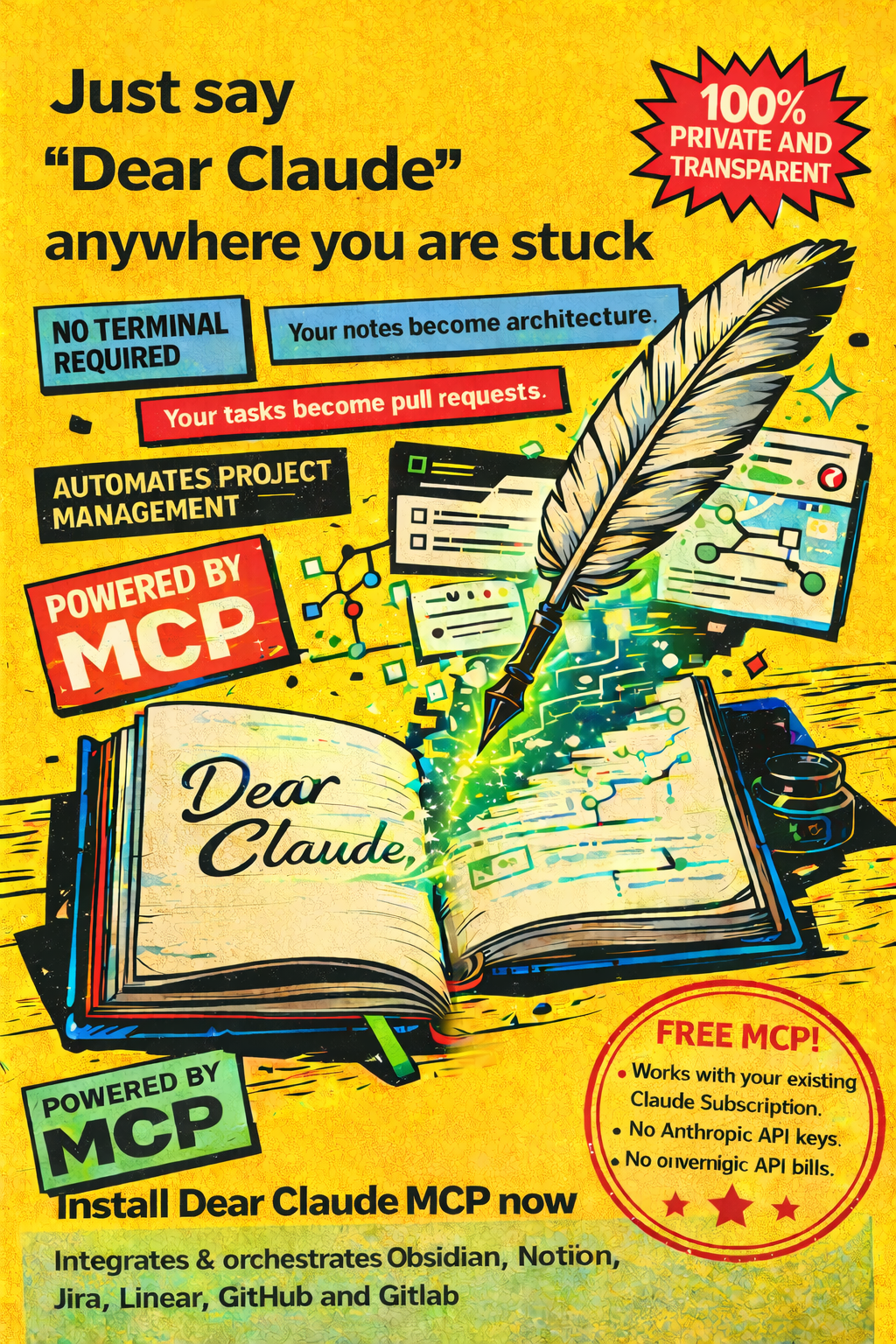
Dear Claude
MCP server that triggers local Claude Code instances from external platforms.
Say "Dear Claude" in Linear, GitHub, Jira, GitLab, Notion, or Obsidian — and a Claude Code instance spins up to handle it.
Your notes become architecture. Your tasks become pull requests.
What is this?
Dear Claude is an MCP (Model Context Protocol) server that watches your project management tools for the phrase "Dear Claude". When detected, it spawns a local Claude Code instance that:
- Reads the issue/comment/note context
- Executes the requested task (code, review, create tasks, etc.)
- Posts results back to the originating platform
- Persists sessions for 7 days so you can have multi-turn conversations
No Anthropic API keys needed. Works with your existing Claude Code subscription. 100% local and private — your code never leaves your machine.
Supported Platforms
| Platform | Trigger on issue/PR | Trigger on comment | Comment back | Emoji reactions | Sub-tasks | PR/MR review |
|---|---|---|---|---|---|---|
| GitHub | Yes | Yes | Yes | Yes | - | Yes |
| Linear | Yes | Yes | Yes | Yes | Yes | - |
| Jira | Yes | Yes | Yes | - | Yes | - |
| GitLab | Yes | Yes | Yes | Yes | - | Yes |
| Notion | Yes | Yes | Yes | - | - | - |
| Obsidian | Yes | - | Yes | - | - | - |
Cross-Platform Orchestration
Instances from any platform get API access to all configured platforms. This enables workflows like:
- Write a spec in Obsidian → "Dear Claude, create these tasks in Linear"
- Discuss on Linear → "Dear Claude, code this on GitHub"
- Review on GitHub → "Dear Claude, resolve the merge conflicts"
- Parallel coding → Claude spawns multiple instances, one per branch, using git worktrees
Quick Start
Install in one line
That's it. Start Claude Code and Dear Claude is ready.
Prerequisites
- Claude Code CLI installed (
claudecommand available) - Bun runtime (for
bunx) - Tailscale with Funnel enabled (for webhooks from external platforms)
Manual setup (alternative)
If you prefer manual configuration, add to ~/.claude.json under mcpServers:
Then start Claude Code:
The MCP server starts automatically, sets up Tailscale Funnel, and prints your public webhook URLs.
Platform Setup
Tailscale Funnel
Dear Claude uses Tailscale Funnel for stable public HTTPS URLs to receive webhooks. Setup is mostly automatic.
-
Install Tailscale:
-
Authenticate:
tailscale up -
Enable Funnel in the admin console: https://login.tailscale.com/admin/acls
- Add the
"funnel"capability to your ACL policy
- Add the
-
The server auto-configures Funnel on startup. Your public URL will be:
Tip: Run
tailscale serve status --jsonto verify your config. The health check auto-repairs the Funnel config every 10 seconds.
GitHub
Option A: GitHub App (recommended)
- Go to GitHub Settings → Developer settings → GitHub Apps → New GitHub App
- Set these fields:
- Homepage URL:
https://<your-hostname>.ts.net/dc - Callback URL:
https://<your-hostname>.ts.net/dc/oauth/callback/github - Webhook URL:
https://<your-hostname>.ts.net/dc/webhook/github - Webhook secret: generate a random string
- Homepage URL:
- Under Permissions:
- Repository: Issues (Read & Write), Pull Requests (Read & Write), Contents (Read & Write)
- Under Subscribe to events:
- Issue comments, Pull request review comments
- Copy credentials and set env vars:
- Install the app on your repos
- Complete OAuth: visit
https://<your-hostname>.ts.net/dc/setup/github
Option B: Personal Access Token (simpler, no webhooks)
- Go to GitHub Settings → Developer settings → Personal access tokens → Tokens (classic)
- Create a token with scopes:
repo,write:discussion - Set:
GITHUB_ACCESS_TOKEN=ghp_...
Note: With a PAT alone you won't get webhook-triggered instances. You'd use the
spawn_instanceMCP tool or/api/spawnendpoint instead.
| Environment Variable | Description |
|---|---|
GITHUB_CLIENT_ID | GitHub App client ID |
GITHUB_CLIENT_SECRET | GitHub App client secret |
GITHUB_WEBHOOK_SECRET | Webhook signature verification secret |
GITHUB_ACCESS_TOKEN | Personal access token (alternative to OAuth) |
Linear
- Go to Linear Settings → API → OAuth Applications → New Application
- Set the callback URL:
https://<your-hostname>.ts.net/dc/oauth/callback/linear - Copy Client ID and Client Secret
- Enable the Webhooks toggle on the OAuth app
- Go to Linear Settings → API → Webhooks → New Webhook:
- URL:
https://<your-hostname>.ts.net/dc/webhook/linear - Copy the Signing Secret
- Enable events: Comments (create), Issues (create, update)
- URL:
- Set env vars:
- Complete OAuth: visit
https://<your-hostname>.ts.net/dc/setup/linear
After OAuth, only issues/comments from your authenticated Linear account trigger Claude.
Alternative: Use a Personal API Key (LINEAR_ACCESS_TOKEN=lin_api_...) from Linear Settings → Account → API.
| Environment Variable | Description |
|---|---|
LINEAR_CLIENT_ID | OAuth client ID |
LINEAR_CLIENT_SECRET | OAuth client secret |
LINEAR_WEBHOOK_SECRET | Webhook signing secret |
LINEAR_ACCESS_TOKEN | Personal API key (alternative to OAuth) |
Jira Cloud
- Create an API token at https://id.atlassian.com/manage-profile/security/api-tokens
- Set env vars:
- Create a webhook in Jira:
- Go to Jira Admin → System → Webhooks → Create webhook
- URL:
https://<your-hostname>.ts.net/dc/webhook/jira- If using
JIRA_WEBHOOK_SECRET, append it:?secret=YOUR_SECRET
- If using
- Select events:
issue_created,issue_updated,comment_created
- Save the webhook
Claude can create sub-tasks, transition issue status, and add comments via the Jira REST API v2.
| Environment Variable | Description |
|---|---|
JIRA_DOMAIN | Jira subdomain (e.g. mycompany for mycompany.atlassian.net) |
JIRA_USER_EMAIL | Your Atlassian email |
JIRA_API_TOKEN | API token from Atlassian |
JIRA_WEBHOOK_SECRET | Optional shared secret for webhook verification |
GitLab
- Create a Personal Access Token at GitLab → Settings → Access Tokens
- Scopes:
api,read_repository,write_repository
- Scopes:
- Set env vars:
- Add a webhook to your project (or group):
- Go to Settings → Webhooks
- URL:
https://<your-hostname>.ts.net/dc/webhook/gitlab - Secret token: same as
GITLAB_WEBHOOK_SECRET - Trigger events: Comments, Issues events, Merge request events
- Save
For self-hosted GitLab, also set GITLAB_URL=https://your-gitlab-instance.com.
| Environment Variable | Description |
|---|---|
GITLAB_ACCESS_TOKEN | Personal access token |
GITLAB_WEBHOOK_SECRET | Webhook secret token |
GITLAB_URL | GitLab instance URL (default: https://gitlab.com) |
Notion
Option A: Internal Integration (simpler)
- Go to https://www.notion.so/my-integrations → New integration
- Give it a name, select your workspace
- Copy the Internal Integration Secret
- Set:
NOTION_ACCESS_TOKEN=ntn_... - Share pages/databases with the integration (click "..." on a page → Connections → Add your integration)
Option B: OAuth (public app)
- Create an OAuth integration at https://www.notion.so/my-integrations
- Set callback URL:
https://<your-hostname>.ts.net/dc/oauth/callback/notion - Set env vars:
- Complete OAuth: visit
https://<your-hostname>.ts.net/dc/setup/notion
Webhook setup
Notion doesn't have native webhooks yet. To trigger Claude from Notion:
- Use Notion's automation rules with a webhook action (if available)
- Or use a third-party service like Zapier/Make to POST to
https://<your-hostname>.ts.net/dc/webhook/notion - Set
NOTION_WEBHOOK_SECRETif you want signature verification
| Environment Variable | Description |
|---|---|
NOTION_ACCESS_TOKEN | Internal integration token |
NOTION_CLIENT_ID | OAuth client ID |
NOTION_CLIENT_SECRET | OAuth client secret |
NOTION_WEBHOOK_SECRET | Webhook verification secret |
Obsidian
Obsidian integration works via filesystem watching — no webhooks needed. Claude watches your vault for files containing "Dear Claude" and responds by appending to the same file.
- Set env var with the absolute path to your vault:
- That's it! Write "Dear Claude, ..." in any
.mdfile and save.
Claude's response appears as a callout block appended to the same note. The frontmatter gets a claude-status field (processing → done / error).
How it works:
- Watches for
.mdfile changes in the vault - Ignores files in
.obsidian/,.trash/, and dotfile directories - 2-second debounce to avoid triggering on every keystroke
- Supports wikilink references (
[[other-note]]) — Claude resolves and reads them - Supports embedded images — Claude can see and analyze them
| Environment Variable | Description |
|---|---|
OBSIDIAN_VAULT_PATH | Absolute path to your Obsidian vault |
OBSIDIAN_WATCH_DEBOUNCE_MS | Debounce delay in ms (default: 2000) |
Usage
Trigger Format
Write "Dear Claude" (case-insensitive, with a space) anywhere in:
- GitHub issue/PR comments
- Linear issue descriptions or comments
- Jira issue descriptions or comments
- GitLab issue/MR descriptions or comments
- Notion page comments
- Obsidian
.mdfiles
Example
GitHub PR Comment:
Claude responds on GitHub:
Claude Instance Started (Instance:
abc12345) Processing your request...
Task Completed Found 2 issues:
- SQL injection in
user.ts:45- Missing input validation in
api.ts:102Created PR #15 with fixes.
Instance Orchestration
Claude instances can spawn other instances for parallel work:
Claude will:
- Parse the tasks
- Spawn 5 child instances via the
/api/spawnendpoint - Each child works in its own git worktree (same repo, different branch)
- Each child creates a PR when done
- Parent polls child statuses
All Environment Variables
CLI Commands
MCP Tools
When running as an MCP server inside Claude Code, these tools are available:
| Tool | Description |
|---|---|
list_platforms | List configured platforms and their status |
list_instances | List all Claude instances (filter by status) |
get_instance_status | Get detailed status of a specific instance |
get_instance_messages | Get conversation history for an instance |
kill_instance | Terminate a running instance |
get_running_instances | List currently running instance IDs |
spawn_instance | Spawn a new Claude instance for a task |
get_project_instances | List all instances in a project group |
HTTP API
The server also exposes REST endpoints on localhost:3334:
| Endpoint | Method | Description |
|---|---|---|
/health | GET | Health check + platform status |
/webhook/:platform | POST | Webhook receiver |
/api/instances | GET | List instances (?project_id= filter) |
/api/instances/:id | GET | Get instance details + children |
/api/instances/:id/kill | POST | Kill a running instance |
/api/spawn | POST | Spawn a new instance programmatically |
/api/platforms | GET | List configured platforms |
/setup/:platform | GET | Start OAuth flow |
/oauth/callback/:platform | GET | OAuth callback |
POST /api/spawn
Architecture
Instance Lifecycle
- PENDING: Trigger detected, instance queued
- RUNNING: Claude Code actively processing
- IDLE: Waiting for follow-up "Dear Claude" mentions
- COMPLETED: Task finished successfully
- FAILED: Error occurred
- EXPIRED: 7-day TTL exceeded, instance cleaned up
Development
Troubleshooting
Tailscale
- "Tailscale not running": Open the Tailscale app (macOS) or
sudo systemctl start tailscaled && tailscale up(Linux) - "Funnel not enabled": Visit https://login.tailscale.com/admin/acls and add Funnel capability
- Funnel disappears: Another
tailscale serve/tailscale funnelcommand may have overwritten it. The health check auto-repairs within 10 seconds. Verify withtailscale serve status --json.
Webhooks
- Not triggering: Check
bun run src/index.ts statusto verify the server is up. Test withcurl https://<your-hostname>.ts.net/dc/health. - "Invalid signature": Verify the webhook secret matches in both the platform config and your env vars.
- GitHub: The app subscribes to
issue_commentevents. To trigger on a new PR, post a comment — PR descriptions alone won't trigger.
OAuth
- Token expired: Re-visit
https://<your-hostname>.ts.net/dc/setup/<platform>to re-authenticate. - 401 errors: The stored OAuth token may have been revoked. Delete the stale token from
data/dear-claude.dband re-authenticate.
Instances
- Stuck in PENDING: Check that Claude Code CLI (
claude) is installed and accessible in your PATH. - Working directory issues: Instances create workspaces under
data/workspaces/. Ensure write permissions.
Capability attestation
This repo ships a smithmark capability manifest at smithmark.yaml, alongside a static tool listing at tools.json. The manifest declares, in one place, the full external surface this MCP server touches when it runs:
- Network egress: every host it talks to (
api.github.com,github.com,api.linear.app,linear.app,gitlab.com,*.atlassian.net,api.notion.com,api.giphy.com,api.anthropic.com) and why. - Filesystem: the paths it reads or writes (
~/.dear-claude/**,data/**,~/.claude.json, the debug log) and the access level. - Exec: subprocesses it spawns (
claude,tailscale,which,open,sudo,pkill). - Env vars and secrets: every credential-shaped environment variable it consumes, tagged by kind (access token, client secret, webhook secret, API key, private key).
On every GitHub release, .github/workflows/smithmark-attest.yml produces a keyless Sigstore attestation over the published npm tarball: GitHub's OIDC token is exchanged for a short-lived Fulcio signing certificate, the attestation is signed with it, and the signature is recorded in the public Rekor transparency log. There are no signing keys and no secrets involved. The resulting smithmark-attestation.sigstore.json is attached to the GitHub release.
Verify a published version with:
(substitute the actual release tag for v1.1.0)
The manifest is the authoritative record of this server's capability surface. smithmark's lint is deliberately host-unaware and advisory: it flags every fetch() call site and every exec as "undeclared" regardless of what's in the manifest, so it will show findings on this codebase (and on any real MCP server) even though the egress above is fully declared. Treat lint output as a discovery aid, not a drift signal, until --strict or a host-aware successor ships.
License
MIT