knowledge-managementmemorysemantic-searchmulti-agent
Persistent, searchable operational knowledge for engineering teams and multi-agent systems.
Quick Install
Automated & IDE SetupCopy the AI prompt to install this server into Claude Code, Cursor, or another agent — or use 1-click editor setup below.
Not yet automatically verified
We haven't yet run this listing's install command through our automated sandbox check. This isn't a red flag — we're steadily working through the catalog.
Manual Client & Custom JSON ConfigExpand JSON ▾
Client Config & Setup
Choose your client or environment
Target File:
💡 Paste the JSON block into your client's configuration file under mcpServers, then restart the application.
Overview
Use cases
Store runbooks, architecture decisions, deployment details, and operational gotchas
Track incidents through symptoms, hypotheses, tests, and findings
Search prior knowledge by exact terms or meaning
Record milestones and decisions for future engineers and agents
Attribute entries to humans or agents and mark their verification status
Key features
Knowledge base with author, source type, and verification metadata
Structured investigation tracking
Persistent journal for milestones and decisions
SQLite, PostgreSQL, and Supabase storage
FTS, semantic, and hybrid search modes
Local sentence-transformers embeddings with optional backfill
Capabilities & Tool Schemas (33)
Inspect callable tools, capabilities, and parameters exposed to AI agents by Lore MCP.
kb_addAdd an entry. Accepts `author`, `source_type` for attribution.
kb_searchSemantic / hybrid / FTS search with optional topic filter.
kb_getFetch full entry by ID.
kb_get_batchFetch multiple entries by ID in a single call (re-keyed by `kb_id`).
kb_listList entries, filter by topic.
kb_updateUpdate content, tags, or set `verified` flag.
Documentation Overview
Lore
lore-knowledge-mcp · Operational knowledge layer for engineering teams and their AI agents.





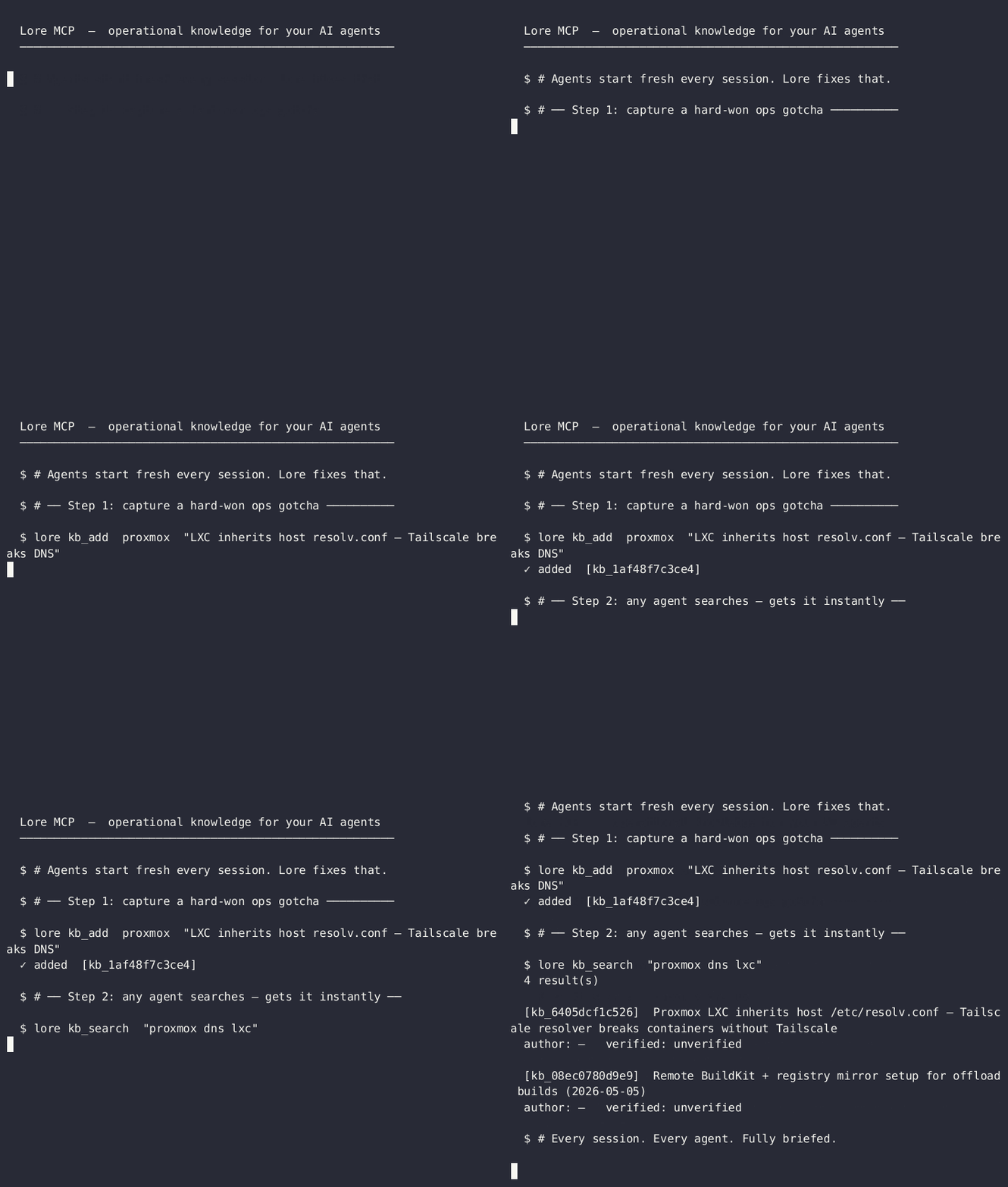
The Problem
Your agents start every session knowing nothing about your systems. Every runbook you've written. Every gotcha you've hit. Every incident you've debugged. None of it carries forward.
You re-explain. They re-discover. Context vanishes when the session ends.
Lore fixes that.
How It's Different
| Tool | Built for | What it remembers | Agent-native |
|---|---|---|---|
| OB1 / personal memory | One person | Your thoughts and captures | No |
| Mem0 / Zep | App developers | User preferences, conversations | Partially |
| Confluence / Notion | Human teams | Documentation (human-browsed) | No |
| Lore | Engineering teams + AI agents | How your systems actually work — searchable by meaning, not just keywords | Yes |
Lore is not a second brain. It's the operational intelligence your agents need to work in your environment — not just any environment.
What Lore Does
Knowledge Base
Your team's operational knowledge — always queryable by any agent. Capture the things that matter: runbooks, hard-won gotchas, architecture decisions, deployment state. Every entry carries attribution so agents know who wrote it and whether a human has verified it.
Investigations
When something breaks, open a structured investigation. Document the symptom, test hypotheses, record what you tried and what you found. Six months later when the same issue resurfaces — different engineer, different agent — the trail is there.
Journal
A permanent record of milestones, architecture decisions, and buying decisions. The kind of thing that lives in someone's head until they leave the team.
Built for Multi-Agent Systems
In a multi-agent environment, provenance matters. Every Lore entry carries author, source_type, and verified.
Your agents know: result 1 is production-safe. Result 2, spot-check before acting. Result 3, review first.
Semantic Search
Lore finds entries by meaning, not just keywords. Search "DNS broken in containers" and it returns an entry titled "LXC containers inherit resolv.conf from the host" — no keyword overlap required.
Powered by local sentence-transformers embeddings (no API key, no external calls), combined with lexical full-text search and Reciprocal Rank Fusion. The same model used by mcp-memory-service, fully self-hosted. On SQLite the lexical leg uses FTS5; on PostgreSQL it uses a GIN full-text index plus pgvector for the semantic leg.
Enable it
Search modes
kb_search resolves its mode from (in order): an explicit search_mode/semantic/hybrid argument, then LORE_SEARCH_MODE_DEFAULT, then the built-in default of hybrid. Every search response echoes requested_mode (the caller's intent) alongside search_mode (the mode actually executed, after any degradation).
| Mode | When to use |
|---|---|
fts | Exact term matches. |
semantic | Meaning-based retrieval, no keyword overlap needed. |
hybrid | Best of both — lexical + vector via RRF (default). |
The
summarymode was removed — passingsearch_mode="summary"now returns a validation error. Lore is LLM-free by design; summarisation is the caller's responsibility.
Backfill existing KB
If you already have entries, generate embeddings for them:
Configuration
| Variable | Default | Notes |
|---|---|---|
LORE_SEMANTIC_SEARCH | false | Master switch — off = lexical-only behaviour. |
LORE_SEARCH_MODE_DEFAULT | hybrid | Default mode for kb_search when no mode is passed (fts, semantic, or hybrid). |
LORE_EMBEDDING_MODEL | all-MiniLM-L6-v2 | 384d, ~90MB, English-optimized. |
LORE_RRF_K | 10 | Increase to 30–60 for corpora >10k entries. |
For multilingual content, set LORE_EMBEDDING_MODEL=paraphrase-multilingual-MiniLM-L12-v2 (same 384d, no schema change).
Automatic Memory Extraction
Lore can extract durable memories from agent conversations automatically. At the end of a session, conversation turns are sent asynchronously to a fast LLM, which extracts facts, preferences, goals, events, and system facts — then deduplicates them against the existing KB before writing.
- Opt-in — disabled by default (
auto_extract.enabled: false). - Two providers — OpenRouter (default, simple setup) or Cerebras direct API (gpt-oss-120b, 300+ TPS, high prompt-cache hit rate).
- Graceful degradation — a missing API key, HTTP error, or bad JSON returns an empty result silently; it never raises and never blocks the session.
- Auditable — every auto-extracted entry is tagged
source:auto-extracted, with an optional review queue (topic="auto-memory-pending") for human approval.
Set OPENROUTER_API_KEY (or CEREBRAS_API_KEY) and enable it in your plugin config.
→ Full setup guide: docs/auto-extraction-setup.md — API keys, provider config, tuning thresholds, review mode, and inspecting or removing extracted entries.
Automating Lore in Your Workflow
Add one line to every agent's system prompt and one entry to ~/.mcp.json — that's the entire integration. Each phase of your engineering workflow reads prior knowledge from Lore and writes its findings back, so nothing is re-discovered from scratch.
→ How to wire Lore into a 6-phase multi-agent pipeline — full walkthrough with code examples for every phase: research, architecture review, implementation, adversarial code review, QA, and documentation.
Quick Start
No database setup required. Lore runs out of the box with SQLite.
1. Install
Optional: semantic search
Then set LORE_SEMANTIC_SEARCH=true. See Semantic Search for details.
2. Start the server
Authentication (LORE_API_KEY)
HTTP auth is opt-in and off by default:
LORE_API_KEYunset → the HTTP server is open (no auth), exactly as before. This keeps existing no-auth deployments working. When you bind to a non-localhost host (0.0.0.0or a LAN IP) without a key, Lore logs a prominent startup WARNING that the server is reachable on your network with no authentication.LORE_API_KEYset → every HTTP/SSE request must includeAuthorization: Bearer <key>. Missing or wrong tokens get401 {"error":"unauthorized"}(token compared in constant time). Health endpoints (/health,/healthz,/) stay open so liveness probes keep working. stdio mode is never affected — it has no network surface.
The same rule applies to the HTTP entry point (lore-mcp --host/--port,
which invokes the FastMCP server).
CORS: origins default to * with credentials disabled (the spec forbids
* + credentials). Set LORE_CORS_ORIGINS to a comma-separated allow-list
(e.g. https://app.example.com,https://admin.example.com) to restrict origins;
credentialed CORS is enabled automatically when origins are explicit.
3. Add to your MCP client
Claude Code / Claude Desktop — add to ~/.mcp.json:
Or for HTTP mode (recommended for teams). When the server is started with
LORE_API_KEY set, include a matching bearer token in the client config:
If the server is started without LORE_API_KEY, omit the headers block — the
endpoint is open.
That’s it. Lore is ready.
Tool Reference
Related MCP Servers
Adoption & maintenance
Factual signals from GitHub, npm, and our automated checks — not a rating.
GitHub stars
4
Stargazers on the source repository.
Last commit
3mo ago
Most recent push to the default branch.
Tools exposed
33
Callable tools this server registers over MCP.
Directory activity
2 views
Config copies, upvotes, and views on AllMCPs.
Reviews
No reviews yet — be the first to share how this listing worked for you.
Frequently Asked Questions about Lore MCP
AllMCPs Directory Badge
Showcase your server listing on GitHub or your project documentation. Embed this dynamic SVG badge to highlight official listing status and live engagement.
Badge Style:
Live Dynamic SVG Preview
Markdown (GitHub README)
[](https://allmcps.com/mcp/davidgut1982-lore-mcp)HTML Embed
<a href="https://allmcps.com/mcp/davidgut1982-lore-mcp"><img src="https://allmcps.com/api/badge/davidgut1982-lore-mcp?style=directory" alt="Lore MCP on AllMCPs" /></a>Technical Specs & Signals
CategoryKnowledge & Memory
PricingFree
11/11 checks healthy over the last 33d
52Quality signal: Good · 52/100How this signal is calculated ▾
Server availabilityNot measured
Not scored for repo-hosted servers — we can't reach the running server, only its GitHub page. Hosted MCP endpoints are health-checked live.
Verified ownership10/20
Documentation & tools27/30
Adoption & activity2/15
Community engagement0/10
A guidance signal from public completeness & health data — not a user rating. New listings start lower and rise as they add docs, get verified, and grow adoption. Signals we can't observe for a listing are skipped, not counted against it.
Supply-chain signal
No high-severity advisories surfaced by our automated scan.
Critical 0High 0Medium 0Low 0
Scanned 23d ago via OSV.dev · lore-knowledge-mcp (PyPI)
Own this project?
This directory is pre-filled from public sources. Claim via GitHub README, site badge, or DNS TXT to unlock edit access and the Official badge — proof is checked automatically, then reviewed by our team.
Free dofollow backlink: add your website and place the AllMCPs badge on it — no claim needed. We detect it automatically and keep it verified as long as the badge stays live.
Claim & get free dofollowShare & Embed
Add our SVG badge (dark/light directory styles) or embeddable widget to your site.