Deterministic, offline root-cause analysis and pre-commit fix verification for coding agents.
Quick Install
Automated & IDE SetupCopy the AI prompt to install this server into Claude Code, Cursor, or another agent — or use 1-click editor setup below.
Manual Client & Custom JSON ConfigExpand JSON ▾
Client Config & Setup
Choose your client or environment
Target File:
💡 Paste the JSON block into your client's configuration file under mcpServers, then restart the application.
Documentation Overview
culprit




Root-cause analysis for agent-driven development.
Your coding agent finds what introduced a bug, and verifies its own fix is complete before it commits.
Quick start · Tools · Accuracy · Architecture · MCP registry

A real run. The fix patched one caller of parse_config and missed two, so it scores partial.
Why an agent needs this
An agent can dig through git history to find what broke, and it is good at it. What it will not reliably do is spend a dozen tool calls on that every time, or stop and check whether the helper it just changed has three other callers before it commits. culprit turns both into one deterministic call that returns structured JSON it can act on:
| The agent asks | culprit answers |
|---|---|
| "What introduced this bug?" | Ranked suspect commits, the author's intent, the releases it shipped in |
| "Is my fix complete?" | verify_fix: missed call sites, whether a test shipped, a risk level |
| "What could this change break?" | Reverse-import dependents, covering tests, high-risk shared modules |
- ⚡️ Instant. No test runs, no bisect. Benchmarked at 41% fewer agent tool calls.
- 🔒 Read-only and offline. Never writes to your repo or PR. No API key, no network.
- 🔌 MCP-native. 11 tools over stdio, on the official MCP registry, plus a one-command plugin.
- 🗣️ Language-agnostic. Suspects work anywhere git does. Blast radius reads 12 language families.
Does it actually work?
Benchmarked against 50 real regressions, 25 from git and 25 from
systemd, where the introducing commit is known from each
fix's Fixes: trailer (author-verified ground truth). Given only the fix commit, culprit blames
the removed lines to rank the commits that introduced the bug.
| Metric | Result |
|---|---|
| Introducing commit ranked #1 | 50% (25/50) |
| Introducing commit in the top-5 suspect set | 66% (33/50) |
Deterministic and offline, on large C codebases the engine has never seen. Reproduce with
python benchmarks/run.py, which clones the repos and scores every case.
But an agent can run git blame itself
It can, and it is good at it. So the honest question is not whether culprit is accurate, but whether it beats or helps an agent that has git and no culprit. Same 10 regressions, three arms, isolated so no arm can read the answer from the fix commit:
| culprit alone | agent alone | agent + culprit | |
|---|---|---|---|
| Introducing commit ranked #1 | 80% | 90% | 90% |
| Introducing commit in top 5 | 90% | 100% | 100% |
| Mean tool calls to get there | 1 | 14.9 | 8.8 (-41%) |
| Mean tokens to get there | ~0 | 55,534 | 47,616 (-14%) |
The agent wins on accuracy, and culprit does not make it more accurate. What culprit does is get it there in roughly half the steps for about 8,000 fewer tokens per investigation. Tool calls dropped in 10 of 10 cases, tokens in 7 of 10. On the hardest case the agent needed 42 tool calls and 124k tokens alone, against 16 calls and 84k with culprit.
Those savings are already net of reading culprit's output, which is counted in the third column. culprit's own run is one deterministic call, no model, under a second.
So culprit is an accelerator for an agent, not a replacement for one, and not a smarter
blamer than one. Method, caveats (n=10, and this slice is easier than the full 50), and
reproduction: benchmarks/agent/.
Quick start
Claude Code plugin (installs the MCP server plus a skill that tells the agent when to use it):
Any MCP client (Cursor, Windsurf, VS Code, Codex CLI, Zed, Continue, Cline, Amazon Q, Goose):
CLI, no agent required:
Needs Python 3.10+ and uv for the MCP server. The CLI runs on 3.9+.
The tools
| Tool | What it answers |
|---|---|
analyze | Full RCA in one call: classify, suspects or blast radius, risk, test impact |
verify_fix | Is this diff safe to commit? complete / partial / risky, plus the missed call sites |
find_suspects | Rank the commits that introduced the bug |
check_completeness | Call sites of the changed symbol the fix did not touch |
get_intent | The introducing commit's message, linked PR, referenced issues |
get_evolution | Per-commit history of the buggy lines via git log -L |
get_risk_score | QA gate score (0 to 100, low/medium/high) with contributing factors |
get_blast_radius | Feature impact: dependents, covering tests, high-risk files |
get_test_impact | Minimal test set to run for this change |
classify_change | Bugfix vs feature, with evidence |
from_trace | RCA straight from a stack trace, no diff or PR needed |
verify_fix, the pre-commit gate
The agent runs this on its own diff before committing:
verdict:completewhen no untouched call site is left behind,partialwhen one was missed,riskywhen risk is high. The verdict is the completeness axis; test coverage is the separate confidence axis onrisk_level.untouched_references: the exact files that still use the changed symbol. This is the list the agent goes and patches.skipped_symbols,adds_test,notes: what was too widely used to check, whether a test shipped, and what to do next.
Loop until complete, then commit. That is the whole idea.
CLI and CI
CI gate: risk via exit code only, no PR comments, no writes. Copy
examples/github-actions/culprit-pr.yml into
.github/workflows/:
HTML report
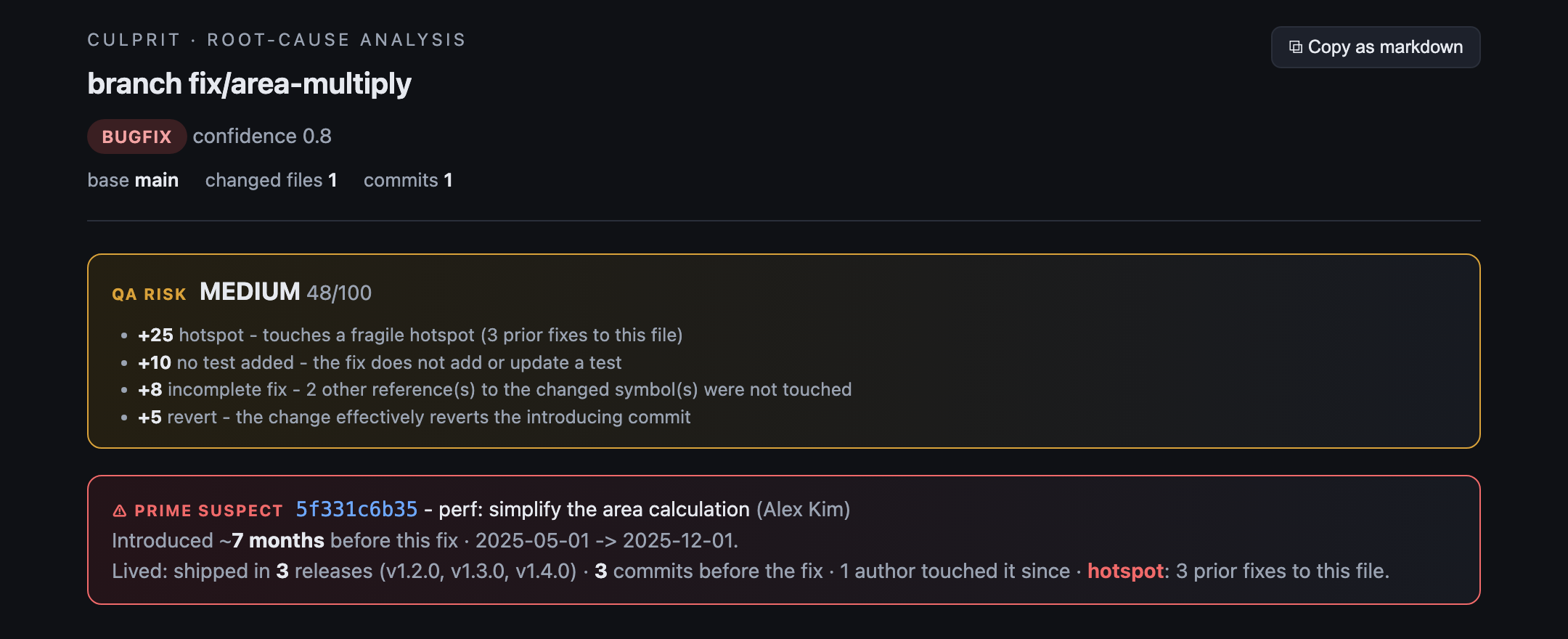
--html writes one self-contained file. No CDN, opens offline, attaches to CI. It opens with the
verdict: a scored QA risk with the factors behind it, and the prime suspect with how long the bug
lived.
Then it reconstructs how the bug got there. Every commit that touched the buggy line, from creation through the commit that broke it (red, with the exact diff) to the fix (green):
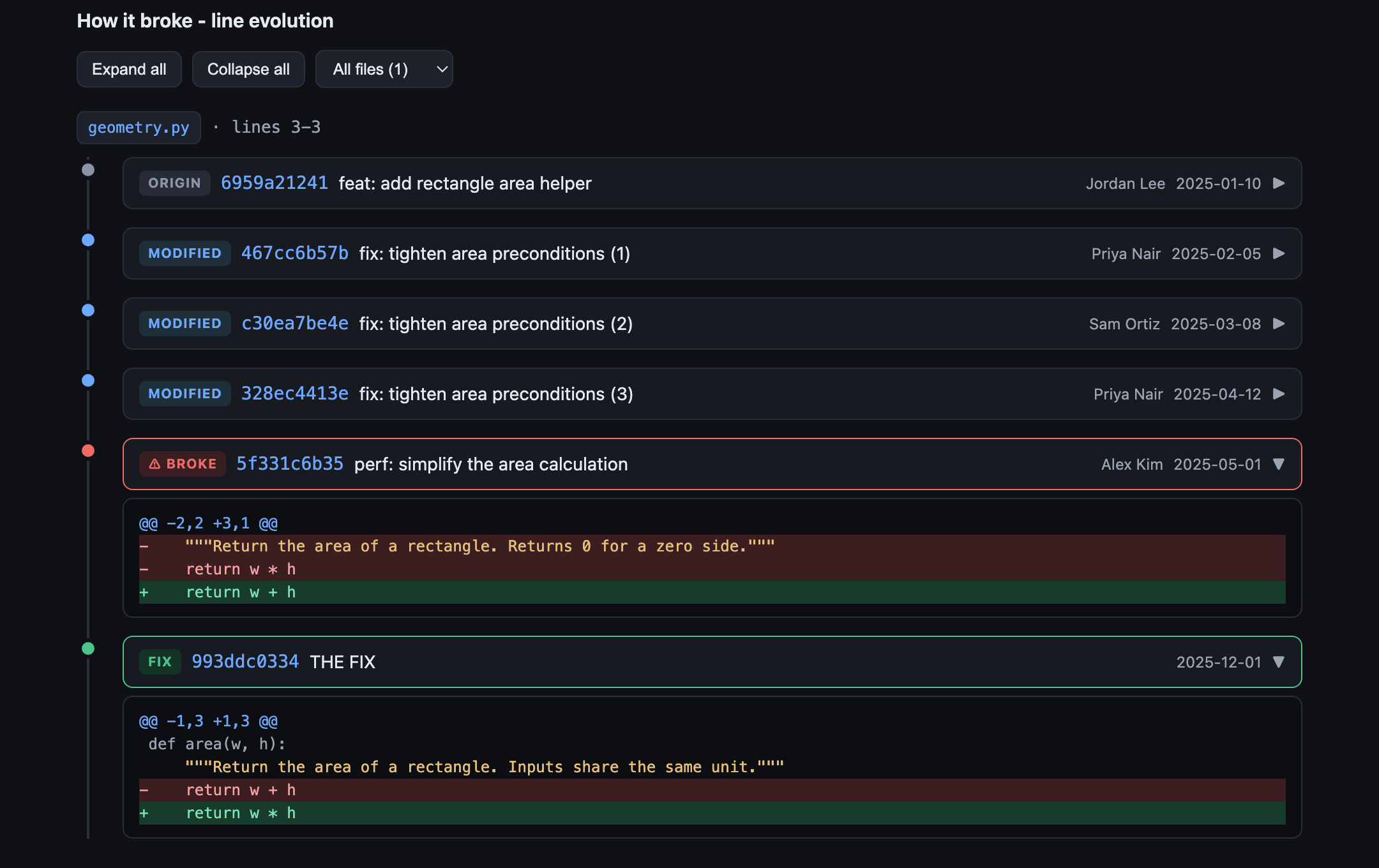
Every node expands to its diff. See the full report.
vs git bisect
git bisect | culprit | |
|---|---|---|
| Input | A reliable failing test | The fix diff (or a stack trace) |
| Method | Checks out commits and runs the test | Blames the fix's lines plus git log -L |
| Speed | Minutes (about log2(N) test runs) | Instant |
| Output | First bad commit | Suspect set, intent, lifecycle, completeness, risk |
| Confidence | Proof | Strong heuristic |
--bisect "<cmd>" runs a real bisect as an optional confirmation layer, in a throwaway
git worktree so your checkout is never touched. When the first failing commit matches the
blamed suspect, the report stamps it confirmed by git bisect.
Architecture
One normalized context in, one structured JSON result out. The only non-deterministic step is the optional LLM narrative, isolated behind an adapter so the engine runs with no API key.

Related MCP Servers
Reviews
No reviews yet — be the first to share how this listing worked for you.
Frequently Asked Questions about Culprit
AllMCPs Directory Badge
Showcase your server listing on GitHub or your project documentation. Embed this dynamic SVG badge to highlight official listing status and live engagement.
Badge Style:
Live Dynamic SVG Preview
Markdown (GitHub README)
[](https://allmcps.com/mcp/culprit)HTML Embed
<a href="https://allmcps.com/mcp/culprit"><img src="https://allmcps.com/api/badge/culprit?style=directory" alt="Culprit on AllMCPs" /></a>Technical Specs & Signals
CategoryDeveloper Tools
27Quality signal: Emerging · 27/100How this signal is calculated ▾
Server availabilityNot measured
Not scored for repo-hosted servers — we can't reach the running server, only its GitHub page. Hosted MCP endpoints are health-checked live.
Verified ownership8/20
Documentation & tools11/30
Adoption & activity1/15
Community engagement0/10
A guidance signal from public completeness & health data — not a user rating. New listings start lower and rise as they add docs, get verified, and grow adoption. Signals we can't observe for a listing are skipped, not counted against it.
Own this project?
This directory is pre-filled from public sources. Claim via GitHub README, site badge, or DNS TXT to unlock edit access and the Official badge and attach your website — proof is checked automatically, then reviewed by our team.
Free dofollow backlink: add your website and place the AllMCPs badge on it — no claim needed. We detect it automatically and keep it verified as long as the badge stays live.
Claim & get free dofollowShare & Embed
Add our SVG badge (dark/light directory styles) or embeddable widget to your site.