Chapa README
The full upstream README, mirrored here for reference. Install config, tool schemas, adoption signals, and an original overview live on the Chapa listing page.
Chapa — Developer Impact Badge


Generate a live, embeddable, animated SVG badge that showcases your developer impact from GitHub, Bitbucket, Codeberg, and GitLab activity — with multi-dimensional scoring, verification, and one-click sharing.
WebMCP
Chapa adds a WebMCP layer to four surfaces: the landing page, the Creator Studio, and the public profile and verification pages. The landing page is the front door, where get_site_capabilities returns a map of every route and the tools it carries, so an agent can find the right page instead of guessing at one. Studio tools reuse the existing command registry, so agent actions update the same preview and terminal that the user sees. Saving is always human-gated; in judge demo mode (/studio?demo=1), confirmed saves stay local and never write production data. Landing, public profile, and verification tools are read-only.
Registration uses the current document.modelContext.registerTool(tool, { signal }) contract, an AbortController for cleanup, feature detection for unsupported clients, and a remote feature-flag kill switch.
See the WebMCP tool catalog and judge guide and the under-three-minute demo script and submission checklist.
The write-up WebMCP, Explained. And What Happened When I Shipped It (published on X, LinkedIn and Medium) covers the design framework, the tested tool-map contract, and the rules that came out of shipping it. The production demo transcript (2026-09-01, Chrome 151 with the WebMCP flag) records an agent driving all four surfaces end to end, and is linked from the landing page as the agent-tested proof. A companion note, The WebMCP directories made me use a mouse, records what the directory submissions taught.
The catalog's Design methodology documents each user goal, initial state, role-play, and recovery path.
Runtime status: a preview-only chapa_hello spike passed native registration, discovery, and execution in flagged Chrome 151 on 2026-08-27, and the production preflight on 2026-09-01 found all 19 registrations across 18 distinct names on four surfaces (see the transcript above). Chapa is listed on webmcp.com, in the official MCP Registry as io.github.juan294/chapa, and as an ownership-verified Glama connector. The ChatGPT in-app client was unavailable for the spike, so this README does not claim ChatGPT runtime validation.
Prior work and submission-period work
For this submission, all work through 2026-08-24 is prior work. The badge, scoring engine, share and verification pages, CLI, admin surfaces, and earlier Studio foundation already existed. The released baselines are v2.22.0 (2026-08-19) and v2.22.1 (2026-08-23).
Submission-period work started after that cutoff:
- The Creator Studio revival and hardening landed on 2026-08-26 and was released as v2.23.0.
- The pre-launch audit remediation — 73 findings across two waves, including both launch-blockers — landed on 2026-08-27 and was released as v2.24.0.
- Two follow-up releases landed on 2026-08-28: v2.24.1 (EMU handles no longer pollute the warm-cache registry) and v2.25.0, which flipped the signal-less default locale to English and fixed the feature-flag cache bug that made Creator Studio unreachable in a real browser.
- The WebMCP layer runs from 3156fcaa through 699f94b0. The local receipt is
git log --oneline 3156fcaa^..699f94b0:
- The layer has continued since that first contiguous block, so later WebMCP commits are no longer one range. The receipt for them is
git log --oneline -E --grep='^[a-z]+\(webmcp\):' 699f94b0..HEAD:
What It Does
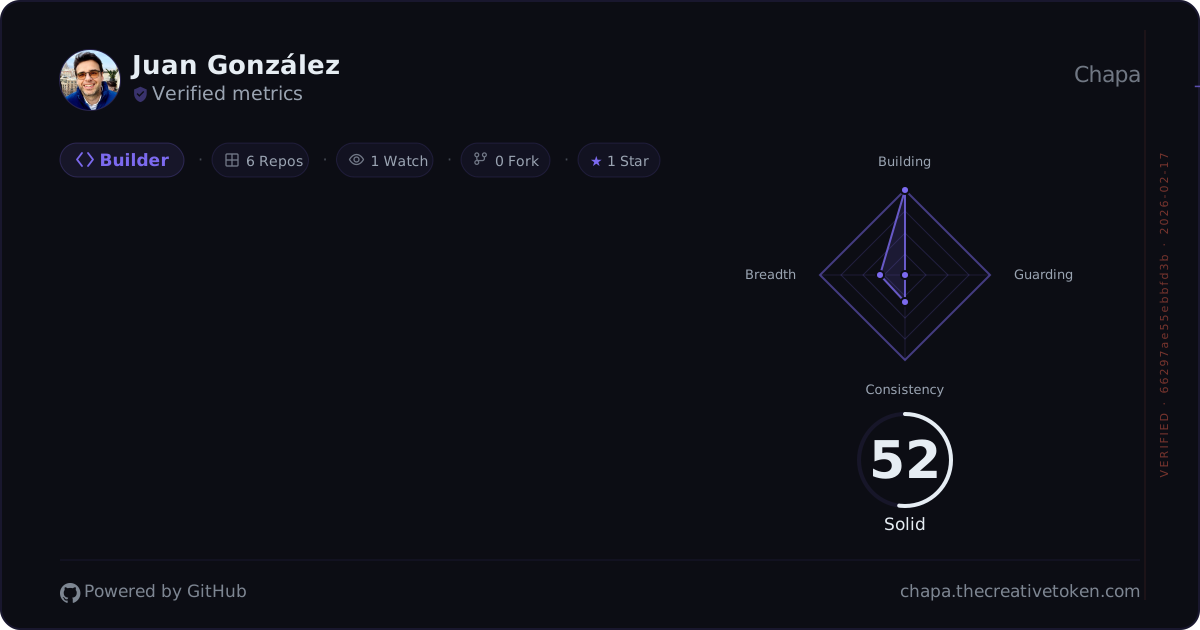
Chapa analyzes your last 12 months of activity across connected platforms and generates a badge with:
- Impact Score (0–100) with tier (Emerging → Solid → High → Elite)
- 4–5 Dimension Profile — Delivery, Quality, Consistency, Breadth + optional Craft (AI tool insights)
- Developer Archetype — Builder, Quality Champion, Marathoner, Polymath, Artificer, Balanced, or Emerging
- Activity Timeline — 13-week daily contribution dot visualization
- Radar Chart — pentagon (5 dimensions) or diamond (4 dimensions) breakdown
- Verification Hash — HMAC-SHA256 watermark proving badge authenticity
Features
Multi-Platform Support
Connect GitHub (primary), Bitbucket, Codeberg, and GitLab to aggregate your impact across platforms. Stats are merged automatically — repos are summed, social metrics take the max to avoid double-counting mirrors.
Embeddable Badge (/u/:handle/badge.svg)
A 1200×630 animated SVG you can embed anywhere — GitHub profile READMEs, personal sites, portfolios. Cached at the CDN edge for 6 hours.
Share Page (/u/:handle)
Public profile page with full score breakdown, interactive radar chart, dimension details with explanatory tooltips, embed snippets (Markdown + HTML), and one-click sharing to X, LinkedIn, and Bluesky.
Creator Studio (/studio)
Terminal-first Studio design playground with seven visual categories, live preview, and saved Studio configuration. Requires GitHub login. A saved Studio configuration changes the public SVG badge and share page and invalidates the badge cache.
CLI Tool (chapa-cli)
For developers on GitHub Enterprise (EMU) — merge your work contributions into your personal Chapa badge via a secure device auth flow.
Supports --insecure for corporate networks with TLS interception and --verbose for diagnostics.
Bilingual UI (EN / ES)
Chapa's interface is available in English and Spanish. A language picker (globe icon, next to the theme toggle in the nav bar) saves your preference in a cookie. Your locale is resolved in that order — the chapa-locale cookie first, then your browser's Accept-Language header — so a Spanish visitor gets Spanish. English is the fallback only when a request carries no locale signal at all, which is the normal case for an embedded badge in a README. The main content pages (landing, about, privacy, terms, archetype guides) are server-rendered per locale — both languages are pre-built, so there's no flash of the wrong language while the page loads.
Admin Dashboard (/admin)
Admin-only dashboard with user management, agent fleet monitoring, feature flags, engagement controls, campaign management, and a command bar. Access controlled by the ADMIN_HANDLES environment variable.
Badge Verification
Badges marked Verified metrics include a 32-character HMAC-SHA256 hash. Anyone can look up the original stored verification record at /api/verify/:hash and compare its returned fields with the badge. The lookup does not scan or re-sign an SVG.
Quick Start
Project Structure
Impact v6 Scoring
Chapa computes a multi-dimensional developer profile from commits, PRs, code reviews, and activity patterns:
| Dimension | What it measures |
|---|---|
| Delivery | PRs merged, issues closed, commits, lead time modifier (±5%) |
| Quality | Code reviews + review ratio (collaborative) or PR hygiene (solo), batch size score |
| Consistency | Active days, heatmap evenness, week coverage |
| Breadth | Repository diversity, cross-project influence, community signals |
| Craft (optional) | AI tool usage patterns via Claude Code insights |
An internal confidence score (50–100) reflects data completeness and gently adjusts the composite score to produce the final tier. Confidence is not shown on developer-facing pages — it works behind the scenes to ensure fair scoring.
Tech Stack
| Layer | Technology |
|---|---|
| Framework | Next.js 16 (App Router), React 19, TypeScript |
| Styling | Tailwind CSS v4 (dark theme, purple accent) |
| Caching | Upstash Redis |
| Database | Supabase (PostgreSQL) |
| Data | GitHub GraphQL API, Bitbucket REST API, Codeberg/Gitea API, GitLab REST API |
| Analytics | PostHog |
| Resend | |
| CLI | Node.js, tsup, device auth flow |
| Hosting | Vercel |
| Testing | Vitest with a TDD workflow |
Environment Variables
| Variable | Required | Description |
|---|---|---|
GITHUB_CLIENT_ID | Yes | GitHub OAuth App client ID |
GITHUB_CLIENT_SECRET | Yes | GitHub OAuth App client secret |
NEXTAUTH_SECRET | Yes | Session signing / token encryption secret |
NEXT_PUBLIC_BASE_URL | Yes | Base URL for OAuth redirects |
UPSTASH_REDIS_REST_URL | Yes | Upstash Redis REST URL |
UPSTASH_REDIS_REST_TOKEN | Yes | Upstash Redis REST token |
SUPABASE_URL | No | Supabase project URL (DB features degrade gracefully) |
SUPABASE_SERVICE_ROLE_KEY | No | Supabase service role key (server-side only) |
NEXT_PUBLIC_POSTHOG_KEY | No | PostHog project API key |
NEXT_PUBLIC_POSTHOG_HOST | No | PostHog ingestion host |
CHAPA_ALERT_WEBHOOK_URL | No | Active operational alert webhook for health, badge, OAuth, and cron failures |
RESEND_API_KEY | No | Resend email service |
BITBUCKET_CLIENT_ID | No | Bitbucket OAuth consumer key |
BITBUCKET_CLIENT_SECRET | No | Bitbucket OAuth consumer secret |
CODEBERG_CLIENT_ID | No | Codeberg OAuth app client ID |
CODEBERG_CLIENT_SECRET | No | Codeberg OAuth app secret |
GITLAB_CLIENT_ID | No | GitLab OAuth app client ID |
GITLAB_CLIENT_SECRET | No | GitLab OAuth app secret |
NEXT_PUBLIC_GITLAB_ENABLED | No | Set to "true" to enable GitLab link/unlink in User Menu |
CHAPA_VERIFICATION_SECRET | No | Required in production for /api/verify; when unset outside production, verification is disabled |
ADMIN_HANDLES | No | Comma-separated admin GitHub handles |
CRON_SECRET | No | Required anywhere /api/cron/* should run; cron routes return 503 when it is unset |
See .env.example for the full list with descriptions.
Scripts
| Command | Description |
|---|---|
pnpm run dev | Start dev server (port 3001) |
pnpm run build | Production build |
pnpm run test | Run all tests |
pnpm run test:watch | Tests in watch mode |
pnpm run test:coverage | Tests with coverage report |
pnpm run typecheck | TypeScript check (all workspaces) |
pnpm run lint | ESLint check |
Key Endpoints
| Endpoint | Description |
|---|---|
GET / | Landing page |
GET /u/:handle | Share page — badge preview, breakdown, embed snippets |
GET /u/:handle/badge.svg | Embeddable SVG badge (CDN-cached) |
GET /studio | Creator Studio (auth required) |
GET /admin | Admin dashboard (admin handles only) |
GET /about | About page (scoring explainer, archetype showcase) |
GET /api/health | Health check (status, timestamp, and Redis/Supabase/GitHub dependency probes) |
GET /api/version | No-store deployment identity for release verification |
GET /api/verify/:hash | Badge verification |
POST /api/refresh?handle= | Force refresh (rate-limited) |
GET /api/history/:handle | Score history, trend, and diff |
Embed Your Badge
Markdown:
HTML:
License
Chapa is available under the MIT License.