Cabal Hunter README
The full upstream README, mirrored here for reference. Install config, tool schemas, adoption signals, and an original overview live on the Cabal Hunter listing page.
Solana Safe Sniper — MCP Template








🌐 Available in 9 languages: English · Español · Português · Français · Deutsch · Nederlands · 中文 · 日本語 · 한국어
Stop your AI trading agents getting rugged by coordinated wallet cabals. Drop-in template for Claude Code, Cursor, and ElizaOS.
▶ Try it now: live 3D holder map of any Solana token → — no signup.
Cabal-Hunter is a free on-chain Solana token safety scanner and rug checker. It detects coordinated wallet cabals, same-block bundle buys, serial-launcher deployers and same-block coordinated selling on any Solana mint (pump.fun, PumpSwap, Raydium, Orca, Meteora) — and answers the one question that matters before you ape: are you the exit liquidity? Use it via MCP (Claude, Cursor, ElizaOS), a REST API, or a free interactive 3D holder map.
The Problem
Your autonomous trading agent is reading rug.check scores, liquidity locks, and contract audits.
None of that catches a cabal.
A handful of wallets take the bottom of a launch, the chart looks clean — contract fine, LP burned, everything green — and then they sell into whoever bought after them. You are the exit liquidity.
This template integrates Cabal-Hunter as a pre-trade safety check, so your agent can see who is holding and who has already positioned to sell before it signs a swap.
A note on what we do and don't claim. This README used to open with "15 fresh wallets funded from the same master wallet, accumulating 25-40% of supply." We went looking for that pattern and could not find it. Tracing 323 pump.fun launches at the bonding curve turned up zero coordinated funding clusters, and showed why: the median launch has about five successful buyers, because on one representative token 1,260 of the curve's 1,266 transactions failed. Launch capture is a sniper race between competing bots, not a quiet cabal. The detection layers below are the ones we can actually evidence — holder concentration, same-block bundles, coordinated selling and deployer history. The pre-launch funding tracer was withdrawn; the full write-up is here.
The one question it answers: are YOU the exit liquidity?
The classic pump.fun exit-liquidity setup: wallets positioned before the crowd take the bottom of a launch, then dump on the retail (and bots) that pile in after. Cabal-Hunter's headline output is a single Exit-Liquidity Risk verdict — risk_level, one of LOW_SIGNAL | ELEVATED | HIGH that synthesises every signal below into the only thing that matters before you sign a swap: are the insiders positioned to dump on you?
What Cabal-Hunter Does
The deployer layer is the one cabals can't dodge: wallets rotate, deployers leave a paper trail. A response of "deployer": {"reputation": "SERIAL_RUGGER", "tokens_launched": 22, "best_peak_usd": 728432, "pump_and_dumps": 2} shows the dev's full track record before the first candle — including whether this "dead" dev has quietly run tokens to six figures and dumped them on holders before. (Honest context: most prolific pump.fun creators have high dead-token rates, so this signal is capped — it flags a token for review but never drives a HIGH verdict on its own.)
FIRST_LAUNCH and UNKNOWN are not the same answer. deployer.verdict of
FIRST_LAUNCH means we walked this creator's history and found no earlier tokens.
UNKNOWN means the history could not be established at all — that is an absence of
evidence, not a clean record, and an agent must not treat it as one. Where a deployer
cannot be resolved the scan says so in words rather than returning a confident silence.
Receipts, not magic. Every wallet cluster carries evidence_txs[] — the raw signatures behind that cluster, checkable on Solscan, and holders carry funding_tx where we resolved one. Holder concentration, deployer history and the honeypot checks are read from chain state, so they carry no transaction of their own: a token can come back HIGH with no clusters at all. Verify what is there rather than trusting a score.
Response in <100ms for a mint traced in the last 8 hours — computed_at (unix seconds) says exactly when that trace ran. Any other mint runs a live on-chain trace and takes 15-20s, so allow a 30s timeout.
Free tier: 5 scans/month with no account, or 250/month with a free key (one email). Then $0.001 per scan — priced at cost (it covers the Helius RPC calls behind each live on-chain trace). Pay by card, in USDC on Solana, or via x402 — same price through every door. $9/month buys unlimited fair-use scans; by card that renews automatically and can be cancelled anytime at cabal-hunter.com/billing.
Quick Start
1. Claude Code / Claude Desktop
Add to your MCP config (~/.claude/mcp.json or project .mcp.json):
That's it. Claude will now call check_cabal_risk automatically when you ask it to analyse a Solana token.
Example prompt:
"Before we buy into this token, check if there are any coordinated wallets:
EPjFWdd5AufqSSqeM2qN1xzybapC8G4wEGGkZwyTDt1v"
Claude calls the tool, pays $0.001 USDC from your connected wallet, and returns the full analysis.
2. Cursor
Add to .cursor/mcp.json in your project root:
3. ElizaOS (with automatic x402 payment)
If you're using ElizaOS with @hugen/plugin-x402-solana, payment is handled automatically. Add to your agent config:
Your agent will call check_cabal_risk(mintAddress) before any swap and abort if cabalScore >= 35 or isControlled === true.
4. Direct REST API
For headless scripts, custom bots, or any language. The first 5 calls/month are free — no key, no signup. A free key (one email) raises that to 250/month. Just call it:
You get the full analysis back immediately, with free_queries_remaining so you always know where you stand. Machine-readable contract: /openapi.json.
Once the free tier is used up, calls are $0.001 USDC via x402 — your agent just pays, no billing setup:
Step 1 — Request analysis (get payment instructions):
Response (HTTP 402):
Step 2 — Pay & resubmit:
Response (HTTP 200):
5. Run the MCP server locally (Docker / Node)
Fastest — no clone needed: npx cabal-hunter-mcp — the same stdio server, published to npm (cabal-hunter-mcp · npm). Or run it from this repo:
Prefer to run the connector yourself instead of hitting the hosted /mcp
endpoint? This repo ships a thin stdio MCP server that exposes
check_cabal_risk(mintAddress) and proxies to the Cabal-Hunter API (free tier
works with no key; paid scans use x402 at call time):
Then point any MCP client at the local command:
Integrate into Your Trading Logic
Interactive 3D Holder Map (Free)
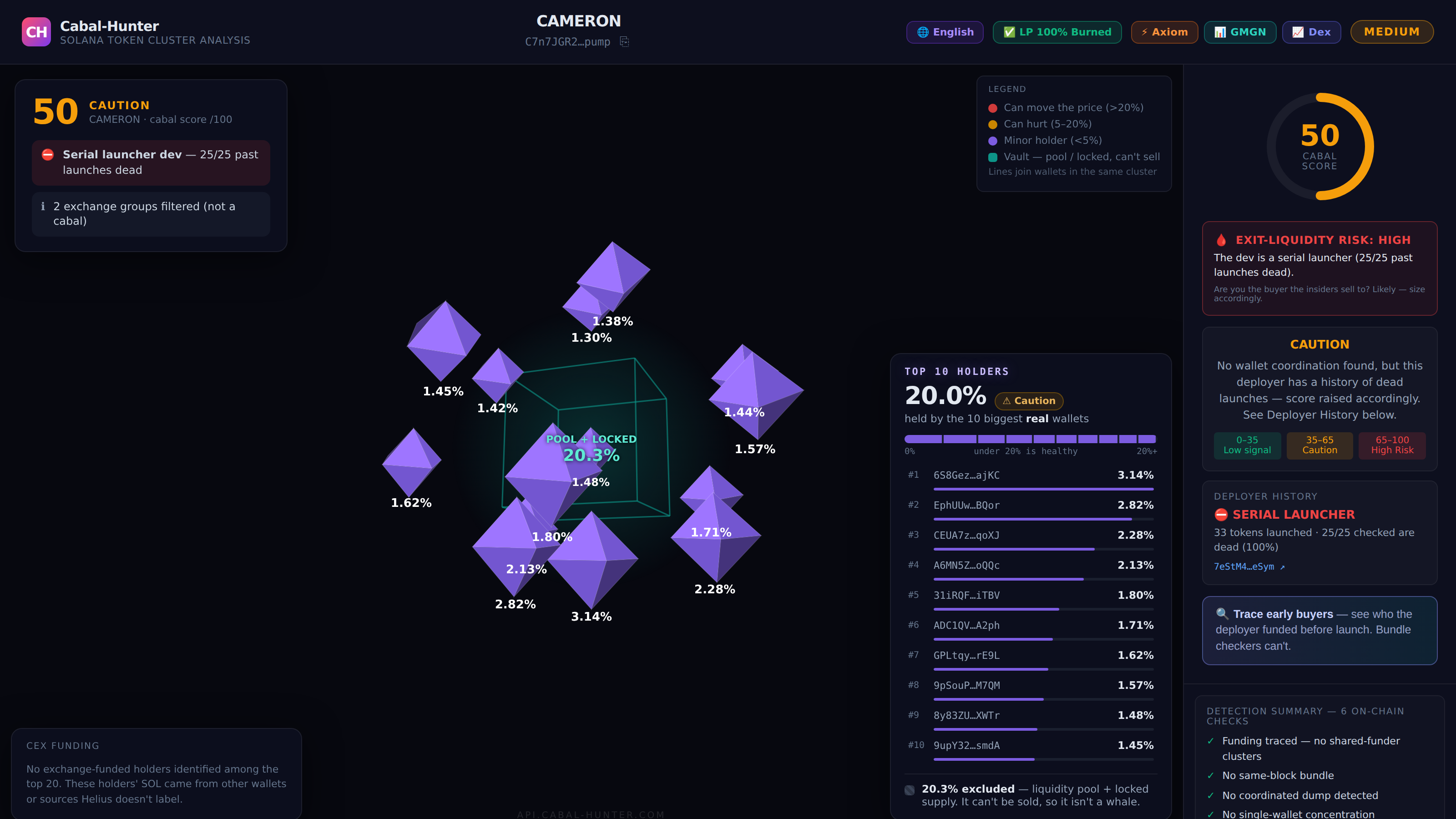
See exactly what the analysis found. Every real holder is a faceted crystal sized by its share of supply; wallets in the same cluster are joined by light beams, and the liquidity pool and locked supply sit apart in a wireframe vault because they cannot be sold. Drag to rotate, hover for the wallet, click through to Solscan:
Free to view, in 9 languages. Share this URL when you catch a rug. Every crystal is clickable and links to Solscan for deep-dive research.
Cabal-Hunter everywhere
Same detection engine, wherever your stack lives:
npx cabal-hunter-mcp— standalone MCP server for Claude · Cursor · VS Code · any MCP client: cabal-hunter-mcp · npm- ElizaOS plugin:
npm i elizaos-plugin-cabal-hunter— plugin-cabal-hunter · npm - REST API + OpenAPI: api.cabal-hunter.com · /openapi.json
Pricing
First 5 scans every month are free — no signup, no API key. A free key (one email) raises that to 250/month.
After that, pick whatever matches how hard your bot works (priced at cost — it covers the Helius RPC behind each live on-chain trace):
| Plan | Price | What you get |
|---|---|---|
| Unlimited ⭐ | $9 USDC / month | Scan all you want — fair use: 50,000/mo, more than any bot needs |
| Pay as you go | $0.001 USDC / scan | Only what you use — prepaid or per-call, no commitment |
Prepaid keys: send USDC once → POST /api/buy-key with the tx signature → use header X-API-Key on every scan. Or pay per-call via x402 (X-Payment-Signature header). No credit card, no account, no lock-in.
Does it pay for itself? Work it out with your own numbers rather than ours: the Unlimited tier is $9 a month, so it pays for itself the first time it keeps you out of a position bigger than $9 that goes to zero. Whether that happens once a month or once a week depends on what you trade and how often — we are not going to invent an average for you.
Payment is native on Solana — no credit card, no account, no subscription lock-in.
Live dashboard badge
Drop a live safety badge into your own bot's dashboard — two lines of HTML, and every token shows its verdict as it trades:
It renders the 0–100 score, the plain-English verdict, and the active flags (bundled launch, coordinated selling, whale concentration, serial-launcher deployer, honeypot). Add data-refresh="120" to re-scan live as you trade, and data-api-key="..." once you're past your free scans. Works anywhere — React, plain HTML, any site.
API Reference
| Endpoint | Description | Auth |
|---|---|---|
POST /api/scan-cabal | Full cabal analysis | $0.001 USDC |
GET /api/scan-cabal?mintAddress= | GET version | $0.001 USDC |
GET /map?mint= | Interactive 3D holder map | Free |
GET /api/cex-funding?mint= | Per-exchange funding breakdown (which CEXes funded holders, % each) | Free |
GET /api/trade-analysis?mint= | Cohort PnL (Team/Snipers/Insiders) + wash-trading score + exit-liquidity price impact, one call | Free |
POST /api/watch | Register an emergency dump webhook for a mint (push on dump/rug start) | Free |
GET /api/info | Pricing, endpoints | Free |
GET /health | Uptime check | Free |
POST /mcp | MCP tool endpoint | $0.001 USDC per call |
Emergency dump webhook (auto-exit)
Instead of polling, let your bot subscribe to a token it holds — we push the moment a coordinated dump or liquidity drain starts:
Your endpoint receives:
Infrastructure
- RPC: Helius (Frankfurt)
- Hosting: AWS EC2 Frankfurt — low latency for EU/global
- Analysis: read from the chain, never scraped from another scanner. A
completed trace is cached for 8 hours and
computed_atalways says when it ran;fresh=1forces a new one - Uptime: 99.9% target — monitored, auto-restart via systemd
FAQ
What is a Solana cabal? A group of wallets — often funded from the same source and buying in the same block — that quietly accumulate a large share of a token's supply before retail, then dump simultaneously into everyone who buys after launch.
How do I check if a Solana token is a rug?
Scan the mint with Cabal-Hunter (MCP, REST API, or the free 3D holder map). It traces holder funding back one hop to shared sources, detects same-block bundle buys, flags serial-launcher deployers and same-block coordinated selling, and returns an Exit-Liquidity Risk verdict — risk_level: LOW_SIGNAL, ELEVATED or HIGH.
Is it free? Yes — 5 scans/month with no signup or API key, and 250/month with a free key (one email). Beyond that it's $0.001 USDC per scan — which just covers the Helius RPC cost of the live trace — paid natively on Solana.
Is there a way to use it without writing code? Yes — @TheCabalHunter_Bot on Telegram. Paste a mint, get the same scan as a card, and ask it to watch a token you hold so it messages you when a dump starts. Scored tokens are posted to @CabalHunterAlerts.
Can AI trading agents use it?
Yes — that's the whole point. The MCP server (api.cabal-hunter.com/mcp) lets Claude, Cursor and ElizaOS agents call check_cabal_risk(mintAddress) automatically before any swap, and a REST API covers any other language.
License
MIT — fork it, build on it, integrate it. If you build something with this, share it.
Built by Cabal Hunter · Powered by Helius · Contact: api.cabal-hunter.com/api/info