Cabal Hunter
Solana pre-trade safety for AI agents: cabal, bundle, dump, deployer & honeypot in one verdict.
Install Cabal Hunter
Pick your client, then add it in one click or paste the config.
~/Library/Application Support/Claude/claude_desktop_config.json{
"mcpServers": {
"cabal-hunter": {
"command": "npx",
"args": [
"-y",
"cabal-hunter-mcp"
]
}
}
}
Settings → Developer → Edit Config, merge this into mcpServers, then fully quit and reopen Claude Desktop.
Install not yet sandbox-tested— we haven't run this command through our automated sandbox yet. Not a red flag; we're working through the catalog.
Overview
From the project README
Solana Safe Sniper — MCP Template








🌐 Available in 9 languages: English · Español · Português · Français · Deutsch · Nederlands · 中文 · 日本語 · 한국어
Stop your AI trading agents getting rugged by coordinated wallet cabals. Drop-in template for Claude Code, Cursor, and ElizaOS.
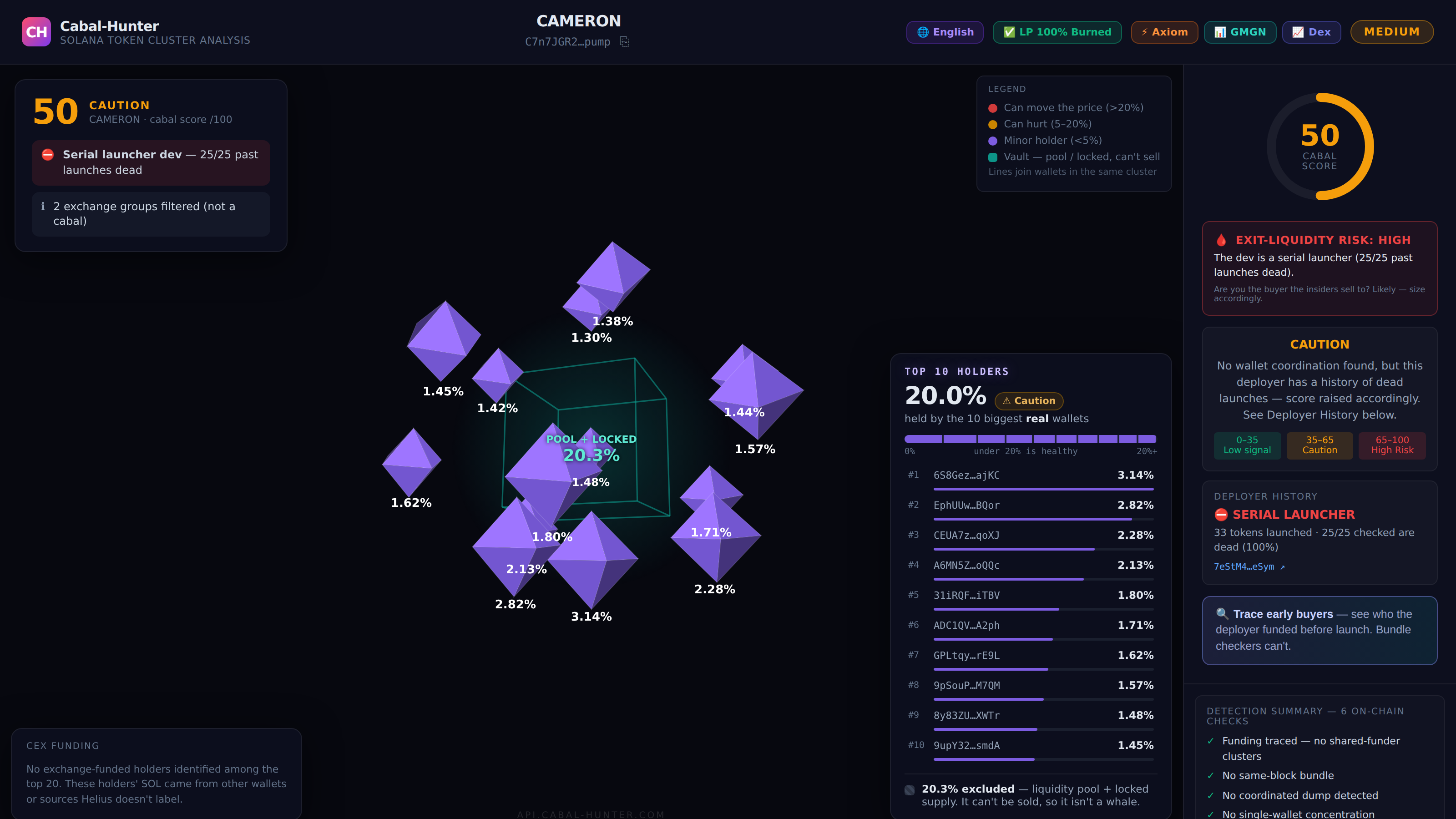
▶ Try it now: live 3D holder map of any Solana token → — no signup.
Cabal-Hunter is a free on-chain Solana token safety scanner and rug checker. It detects coordinated wallet cabals, same-block bundle buys, serial-launcher deployers and same-block coordinated selling on any Solana mint (pump.fun, PumpSwap, Raydium, Orca, Meteora) — and answers the one question that matters before you ape: are you the exit liquidity? Use it via MCP (Claude, Cursor, ElizaOS), a REST API, or a free interactive 3D holder map.
The Problem
Your autonomous trading agent is reading rug.check scores, liquidity locks, and contract audits.
None of that catches a cabal.
A handful of wallets take the bottom of a launch, the chart looks clean — contract fine, LP burned, everything green — and then they sell into whoever bought after them. You are the exit liquidity.
This template integrates Cabal-Hunter as a pre-trade safety check, so your agent can see who is holding and who has already positioned to sell before it signs a swap.
A note on what we do and don't claim. This README used to open with "15 fresh wallets funded from the same master wallet, accumulating 25-40% of supply." We went looking for that pattern and could not find it. Tracing 323 pump.fun launches at the bonding curve turned up zero coordinated funding clusters, and showed why: the median launch has about five successful buyers, because on one representative token 1,260 of the curve's 1,266 transactions failed. Launch capture is a sniper race between competing bots, not a quiet cabal. The detection layers below are the ones we can actually evidence — holder concentration, same-block bundles, coordinated selling and deployer history. The pre-launch funding tracer was withdrawn; the full write-up is here.
The one question it answers: are YOU the exit liquidity?
The classic pump.fun exit-liquidity setup: wallets positioned before the crowd take the bottom of a launch, then dump on the retail (and bots) that pile in after. Cabal-Hunter's headline output is a single Exit-Liquidity Risk verdict — risk_level, one of LOW_SIGNAL | ELEVATED | HIGH that synthesises every signal below into the only thing that matters before you sign a swap: are the insiders positioned to dump on you?
What Cabal-Hunter Does
Token mint address
      ↓
0. EXIT-LIQUIDITY RISK — the headline verdict. Synthesises the layers
   below (bundle, concentration, shared funder, coordinated selling,
   serial-launcher dev) into risk_level: LOW_SIGNAL | ELEVATED | HIGH.
   Are insiders set up to dump on a buyer? The one field an agent needs.
      ↓
1. HOLDER FUNDING TRACE (ONE HOP) — the CURRENT top holders walked back
   one funding hop: were they seeded by the same wallet? ONE hop, not a
   lineage — we do not claim to follow money through a chain of
   wallets. Only System-owned accounts count as
   a funder, so pools, vaults and routers can never be mistaken for a
   person (that mistake is exactly what got our pre-launch tracer
   withdrawn). Every cluster carries evidence_txs[] — the actual
   funding transactions on Solscan. This layer is genuinely rare to
   fire; treat a hit as significant and its absence as no evidence
   either way.
      ↓
2. SAME-BLOCK BUNDLE DETECTION — holders whose token accounts were
   created in the EXACT same slot - a Jito bundle is one way to do that, not
   the only one. Catches
   stealth launches that route funding through intermediaries to
   evade layer 1. Returned as `time_sync: true`.
      ↓
3. COORDINATED SELLING DETECTION — ≥2 holders that SOLD a meaningful
   chunk (≥25% of their bag each) in the EXACT same block.
   `coordinated_exit: true`, with sold_pct = % of supply sold and the
   signatures in evidence_txs[]. Same-slot + meaningful-size + distinct
   wallets = near-zero false positives. It reads the CURRENT holder set
   at scan time, so a bundle that already sold and left the top holders
   is not visible here — that is what the launch-block check is for.
   For a token you already hold, POST /api/watch pushes you a webhook
   the moment a dump or liquidity drain STARTS.
      ↓
4. DEV TRACK RECORD — the creator wallet is resolved on-chain (bonding
   curve pre-graduation, pump-amm pool after — works on any age token),
   and their launch history is pulled WITH THE PEAK MARKET CAP each
   past token hit. `sampled` says how many of those launches we actually
   walked — a very prolific wallet is sampled, not exhausted, so read
   `tokens_launched` as a floor, never as a complete history.
   Launch detection is venue-agnostic: pump.fun, Raydium,
   Orca, Meteora and PumpSwap. A launch is only counted where the
   transaction actually CREATED the mint, so minting more supply of a
   token that already exists is never miscounted as a launch.
   A dead-count alone hides a pump-and-dump: a dev whose
   tokens all died at $4k is a nobody, but one who ran a token to $728k
   then dumped it to dust has done it to holders before. Reputation:
   FIRST_LAUNCH | PROVEN | MIXED | DEAD_ON_ARRIVAL | SERIAL_RUGGER |
   UNKNOWN, with per-launch peak → now (paid tier returns the full
   launches[] array). UNKNOWN means the history could not be
   established — never read it as a clean record.
      ↓
5. CEX-NOISE FILTER — holders funded from a shared exchange or
   high-volume infra wallet are NOT a cabal. They're excluded from the
   score and surfaced transparently in filtered_clusters[], so you never
   get a false positive from people who just withdrew from Binance.
      ↓
6. HONEYPOT CHECK (Solana-native) — one RPC read of the mint account:
   is the FREEZE authority live (issuer can freeze your tokens — the
   sell-block lever)? is the MINT authority live (supply can be
   inflated)? any Token-2022 traps (transfer fees up to 100%, transfer
   hooks that block sells, permanent-delegate clawback)? On Solana a
   "honeypot" is built from these — tokens have no per-token contract
   code to audit. Returns `honeypot_risk: LOW | HIGH` +
   `freeze_authority_revoked` / `mint_authority_revoked` /
   `token2022_risks[]`.
      ↓
Returns: Cabal Score (0-100) + cluster map + deployer verdict
         + honeypot verdict + on-chain receipts + hard verdict
The deployer layer is the one cabals can't dodge: wallets rotate, deployers leave a paper trail. A response of "deployer": {"reputation": "SERIAL_RUGGER", "tokens_launched": 22, "best_peak_usd": 728432, "pump_and_dumps": 2} shows the dev's full track record before the first candle — including whether this "dead" dev has quietly run tokens to six figures and dumped them on holders before. (Honest context: most prolific pump.fun creators have high dead-token rates, so this signal is capped — it flags a token for review but never drives a HIGH verdict on its own.)
FIRST_LAUNCH and UNKNOWN are not the same answer. deployer.verdict of
FIRST_LAUNCH means we walked this creator's history and found no earlier tokens.
UNKNOWN means the history could not be established at all — that is an absence of
evidence, not a clean record, and an agent must not treat it as one. Where a deployer
cannot be resolved the scan says so in words rather than returning a confident silence.
Receipts, not magic. Every wallet cluster carries evidence_txs[] — the raw signatures behind that cluster, checkable on Solscan, and holders carry funding_tx where we resolved one. Holder concentration, deployer history and the honeypot checks are read from chain state, so they carry no transaction of their own: a token can come back HIGH with no clusters at all. Verify what is there rather than trusting a score.
Security & health
What it can reach and how reliably it runs — from our own checks, not the maintainer’s claims.
ActiveLast checked 6d ago
Recent health check succeeded.
9/9 checks healthy over the last 65d
Supply-chain signal
No high-severity advisories surfaced by our automated scan.
Critical 0High 0Medium 0Low 0
Scanned 12d ago via OSV.dev · cabal-hunter-mcp (npm)
Adoption & maintenance
Factual signals from GitHub, npm, and our automated checks — not a rating.
GitHub stars1Stargazers on the source repository.
npm downloads479Package downloads in the last 30 days.
Last commit13d agoMost recent push to the default branch.
Directory activity1 viewsConfig copies, upvotes, and views on AllMCPs.
Reviews
No reviews yet — be the first to share how it worked for you.
Frequently Asked Questions about Cabal Hunter
cabal-hunter is an MCP server that provides Solana pre-trade safety analysis for AI agents. It evaluates token holder concentration, same-block bundle buys, coordinated selling, deployer history, and honeypot risk in one verdict. It is available through MCP, REST API, and an interactive 3D holder map.
cabal-hunter checks for coordinated wallet cabals, holder concentration, same-block bundle buys, serial-launcher deployers, coordinated selling, deployer history, and honeypot risk. Its purpose is to help determine whether a trader could become exit liquidity before signing a swap.
Connect to the HTTP MCP endpoint at https://api.cabal-hunter.com/mcp. The README provides one-click installation links for VS Code and Cursor, and describes support for Claude, Cursor, and ElizaOS.
Yes. cabal-hunter analyzes Solana mints associated with pump.fun, PumpSwap, Raydium, Orca, and Meteora, using on-chain holder and transaction patterns for its safety analysis.
cabal-hunter offers a free tier of five uses per month, with up to 250 uses using an API key. Its interactive holder map is available without signup.
Related MCP servers
Add a badge to your READMEShow it’s listed — live SVG, Markdown or HTML.
AllMCPs Directory Badge
Showcase your server listing on GitHub or your project documentation. Embed this dynamic SVG badge to highlight official listing status and live engagement.
Badge Style:
Live Dynamic SVG Preview
Markdown (GitHub README)
[](https://allmcps.com/mcp/cabal-hunter)HTML Embed
<a href="https://allmcps.com/mcp/cabal-hunter"><img src="https://allmcps.com/api/badge/cabal-hunter?style=directory" alt="Cabal Hunter on AllMCPs" /></a>