MCP server for Anthropic's Claude Fable, Opus 5, and multi-model reasoning councils.
Quick Install
Automated & IDE SetupCopy the AI prompt to install this server into Claude Code, Cursor, or another agent — or use 1-click editor setup below.
One-click editor setup isn’t available for this listing yet — we don’t have a confirmed install command, and we’d rather show nothing than point your editor at the wrong package or host. Follow the project’s own setup instructions, linked above.
Manual Client & Custom JSON ConfigExpand JSON ▾
No confirmed setup config for this listing yet. We only publish a config block when the install details come from the project itself — its README, its docs, or a verified owner. We haven’t found those for ask-fable, and we’d rather show nothing than a guess you’d paste into your client. Follow the project’s own setup instructions for the current steps.
Documentation Overview
ask-fable: Multi-Model Reasoning MCP Server
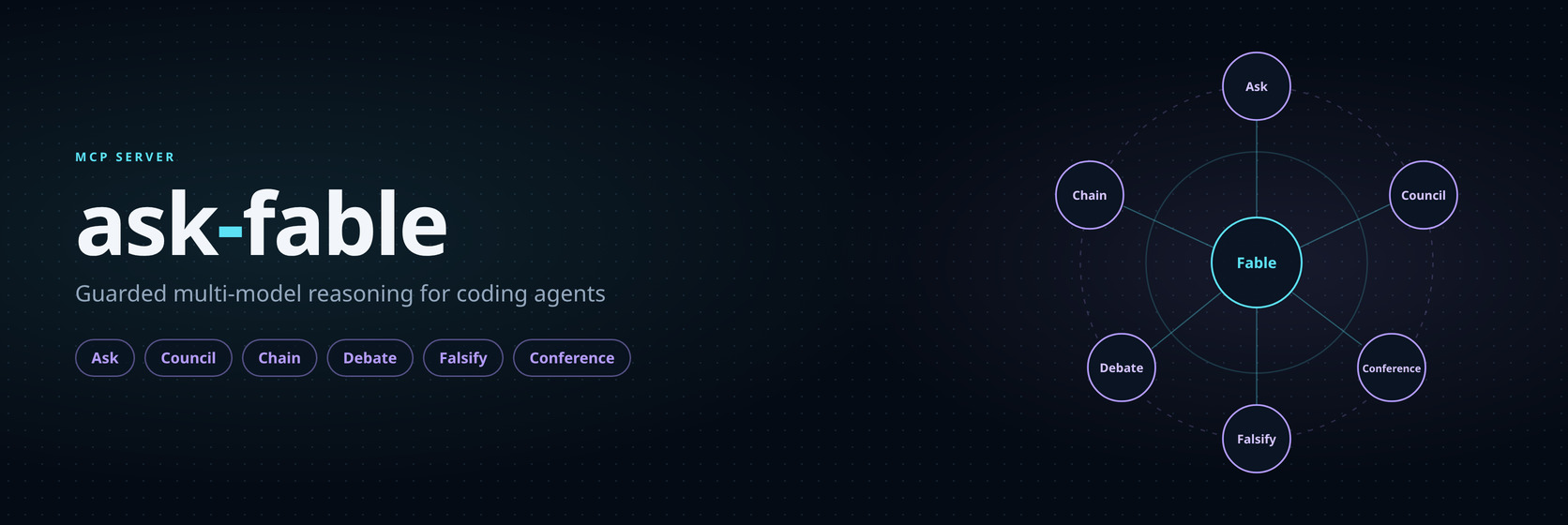
ask-fable is a portable, installable MCP (Model Context Protocol) server for AI coding agents. It works in Claude Code, OpenCode, Kimi Code, Grok, Cursor, Codex, and any other harness that can spawn a local MCP server.
It gives those agents guarded code and architecture reasoning from Anthropic's Claude Fable (the newest claude-fable-*), Claude Opus 5 (claude-opus-5), MiniMax (MiniMax-M3), Gemini, Codex, GLM, DeepSeek, Grok, Kimi, Ollama Cloud models, and any model on your own LM Studio server. It can query one backend, synthesize a parallel council, run an ordered refinement chain, or stage a structured adversarial debate.
Fable and Opus 5 use Claude Code's existing OAuth session (through the Agent SDK,
with the claude CLI as a fallback). MiniMax, Gemini, Codex, Grok, and local Ollama
similarly reuse authenticated local CLIs. LM Studio is a LAN backend that needs no
key: ask_model(provider="lmstudio") loads a model on demand with a real context window and does not
evict a resident model. GLM, DeepSeek, and Atlas Cloud are
optional HTTP backends that need server-side API keys.
Start here
| If you need to… | Use |
|---|---|
| Ask one trusted coding model, with follow-up memory | ask (Fable; add oracle="opus" for Claude Opus) |
| Ask a cheap, fast Anthropic model (high-volume, single-turn) | ask_model(provider="sonnet") (Claude Sonnet 5) |
| Compare independent answers in parallel | ask_council |
| Draft, critique, then decide in order | ask_chain |
| Stress-test a high-impact decision | ask_debate |
| Check an answer you already have | ask_verify |
| Grind a claim down to what survives evidence | ask_falsify |
| Brainstorm an open question, models arguing to divergence | ask_conference |
| Select a task-matched Atlas Cloud model | list_models(provider="atlas") → ask_model(provider="atlas") |
| Atlas council with GPT-5.6 Sol adjudicating | ask_council(provider="atlas") |
| Ask a model on your LAN LM Studio server | ask_model(provider="lmstudio") (one model) / ask_council(provider="lmstudio") (local panel, Fable synthesizes) |
| Check the GPU or free a local model | host_status / unload_lms_model |
| Reuse large code context without pasting it again | context(op="write", …) + context_ref |
| Investigate a request after it ran | trace_list + trace_get |
Start with ask for one hard question. Escalate to a council, chain, or
debate only when the decision warrants the extra latency and cost.
What it gives you
ask-fable gives an MCP client six ways to reason:
| Mode | What happens | Best for |
|---|---|---|
| Ask | One model answers directly; Fable can remember a session | Everyday debugging and design questions |
| Council | Several models answer in parallel; Fable reconciles them | Comparing independent opinions |
| Chain | Models work in order: draft → critique → decide | Deliberate refinement and cost-tiered escalation |
| Debate | A proposer and opponent test claims; Fable adjudicates | Contentious, hard-to-reverse decisions |
| Falsify | Claims are asserted, attacked, and resolved by a code clerk; the ledger persists across calls | Grinding a checkable claim down to what receipts actually support |
| Conference | Models argue together over rounds; a rapporteur maps the disagreement | Open-ended ideation |
The same guard, context bus, cache, audit trail, and tracing layer wrap every mode. Backends are optional: use Fable alone, call a specific provider, or mix Fable, Opus 5, MiniMax, Gemini, Codex, Grok, GLM, DeepSeek, Kimi, Ollama, LM Studio, Atlas Cloud, and OpenRouter. Unavailable council members are reported and skipped instead of failing the whole request.
A real example — ask_debate, lazy token bucket vs. background refill task
for a per-user rate limiter (resolution: adjudicated):
Use the lazy token bucket. Do not build the background refill task — the timer only approximates at tick granularity what the lazy design computes exactly.
The debate surfaced traps neither side opened with (a 100 req/min bucket permits ~199 requests in a worst-case rolling minute; TTL eviction alone doesn't bound memory) and closed with four ship-it fixes. More real calls, one per mode: docs/EXAMPLES.md.
The cheapest real second opinion is the twin token — the twin flames.
It expands to both Anthropic reasoners at once, Fable + Claude Opus 5, and
both ride the same OAuth session as ask, so a two-model cross-check costs you
no provider keys and no extra setup:
Five features make the result useful to an agent, not just readable by a human:
-
Structured sidecar — every answer carries a machine-readable
sidecar({recommendation: apply|investigate|reject|needs_more_context, confidence, needs_context}) next to the prose, so an agent acts on it directly. When the model needs more, afollowuptells it exactly what to paste, and a per-session terminator stops an unbounded re-ask loop (status:"context_exhausted"). -
Context bus —
context(op="write", …)a big codebase context ONCE under a key, then passcontext_refon any ask tool (or council) to pull it in instead of re-pasting. Shared by every agent on the server;context_read()lists what's stored andcontext_read(key=…)fetches a blob, whilecontext'spack/deleteops round it out. -
Council consensus — councils return a
consensussignal (strong|partial|divergent|unknown) +material_disagreementcomputed from the panel's recommendations, eachsourcesentry shows that model'srecommendation, and the synthesis is anonymized (Expert A/B, Fable last) to blunt self-preference bias. The signal counts labs, not models: a panel that agreed but spans one training lineage (e.g. several Anthropic models) is downgraded fromstrong, andindependent_labsreports how many distinct labs answered — same-lab models don't fail independently, so their agreement isn't independent evidence. -
Correlated traces — every call includes a
trace_id; inspect the ordered request timeline without storing raw prompts in the default safe mode. -
Session hub — successful turns from local MCP instances are mirrored into a shared, visibility-only dashboard. Agents can use the same label to coordinate work without that shared history ever becoming model context.
How it works
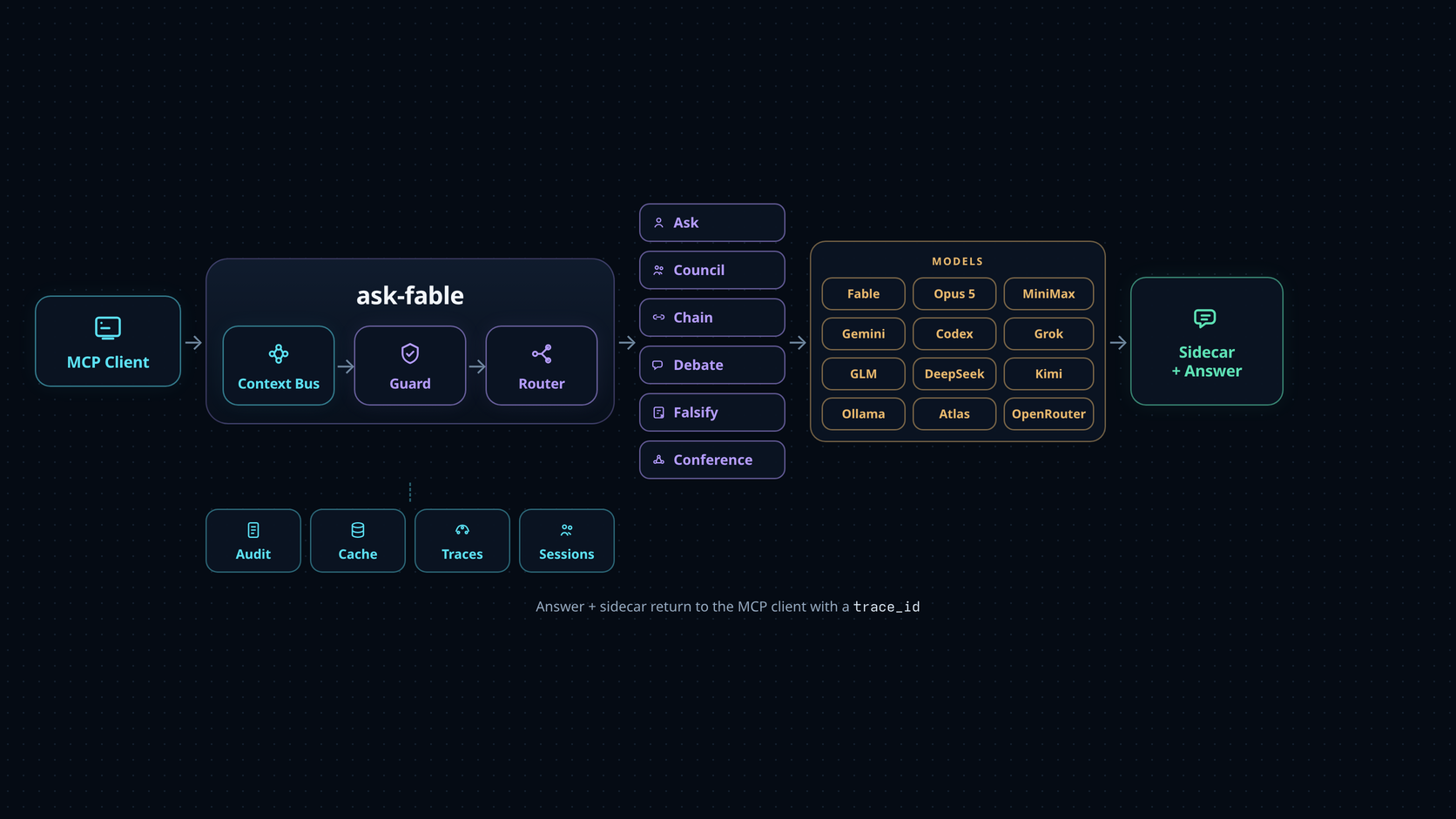
A request enters through MCP, resolves any reusable context_ref, passes the
guard, and is routed to the chosen reasoning mode. The result is normalized into
an answer plus a machine-readable sidecar, persisted to the configured
observability stores, and returned with a trace ID.
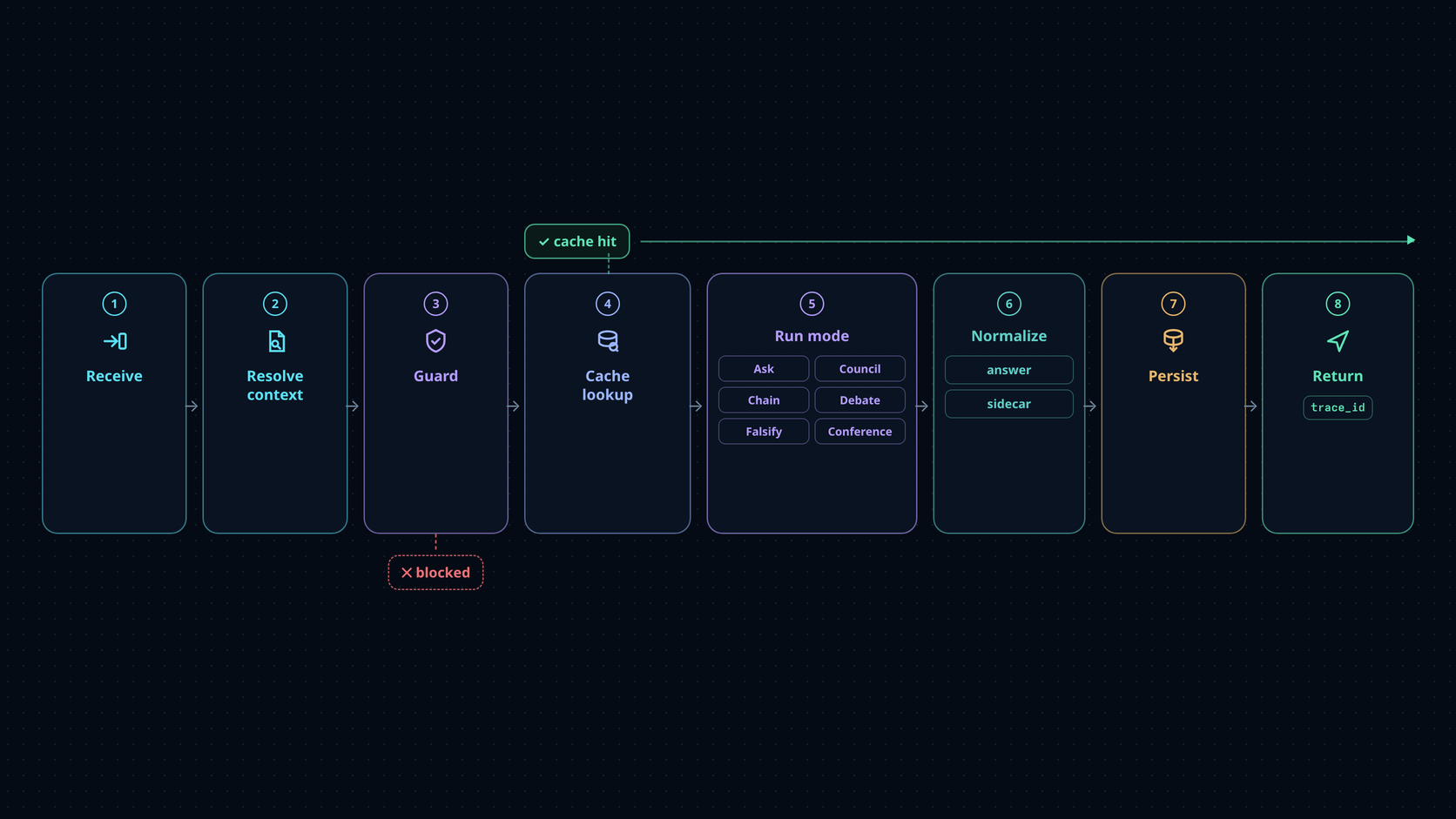
The project ships its own two-layer request gate: a size/sanity floor followed by a prohibited-use denylist. Fable's model prompt adds the final semantic scope contract. See The guard for the exact behavior.
The guard
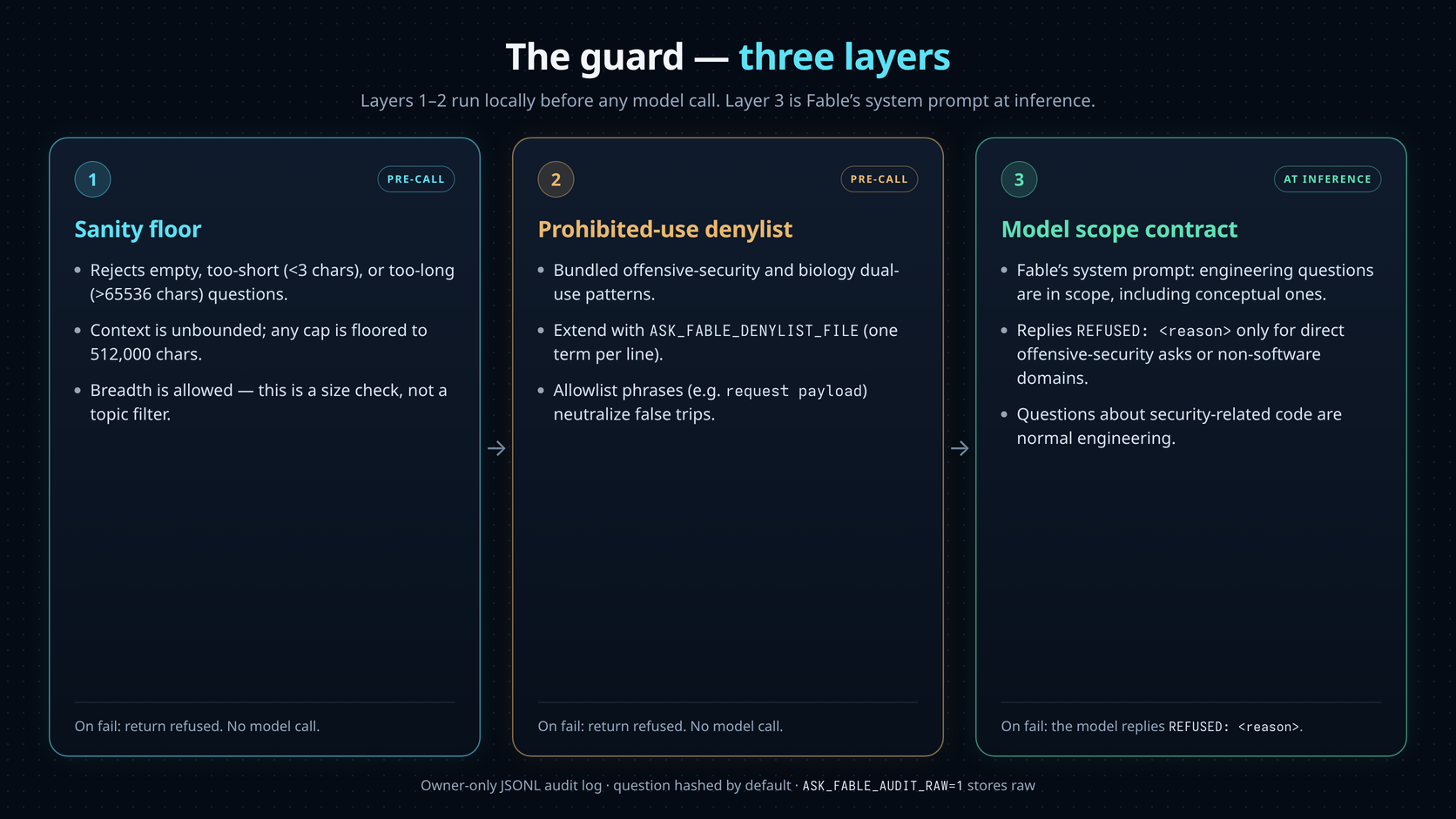
Every question is checked before any model call:
- Sanity floor — rejects only empty / too-short (
<3chars) / too-long (>65536chars) questions. Context is unbounded by default (any cap you set is floored to 512,000 chars). Breadth is allowed. - Prohibited-use denylist — ask-fable's bundled offensive-security and
biology dual-use patterns. It scans the question and
context(the context scan is on by default;ASK_FABLE_GUARD_SCAN_CONTEXT=0restricts it to the question) — the provider's own safeguard reads the whole payload, so a block is caught locally and deterministically instead of upstream. Extend it viaASK_FABLE_DENYLIST_FILE(one term per line). Benign multi-word phrases (e.g.request payload) are neutralized before matching so an ambiguous word likepayloadused in an ordinary engineering sense doesn't false-trip; add your own viaASK_FABLE_ALLOWLIST_FILE(one phrase per line). This only rescues the exact benign phrase — a bare prohibited term still rejects. Legitimate security-engineering work passestrusted=true(operator-authorized viaASK_FABLE_ALLOW_TRUSTED) to run the denylist log-only. - Model scope contract — Fable answers engineering questions, including
conceptual/brainstorming ones with no code context (breadth is fine), and
replies
REFUSED: <reason>only when the question itself directly asks for offensive-security work (exploit development, attack tooling) or non-software domain knowledge (e.g. biology). Questions about security-related code are normal engineering.
Every decision is appended to an owner-only JSONL audit log (question hashed by
default; ASK_FABLE_AUDIT_RAW=1 to store raw).
Quick start
1. Install
Related MCP Servers
Reviews
No reviews yet — be the first to share how this listing worked for you.
Frequently Asked Questions about Ask Fable
AllMCPs Directory Badge
Showcase your server listing on GitHub or your project documentation. Embed this dynamic SVG badge to highlight official listing status and live engagement.
Badge Style:
Live Dynamic SVG Preview
Markdown (GitHub README)
[](https://allmcps.com/mcp/ask-fable)HTML Embed
<a href="https://allmcps.com/mcp/ask-fable"><img src="https://allmcps.com/api/badge/ask-fable?style=directory" alt="Ask Fable on AllMCPs" /></a>