Arkgate README
The full upstream README, mirrored here for reference. Install config, tool schemas, adoption signals, and an original overview live on the Arkgate listing page.
ArkGate — Write. Check. Ship.
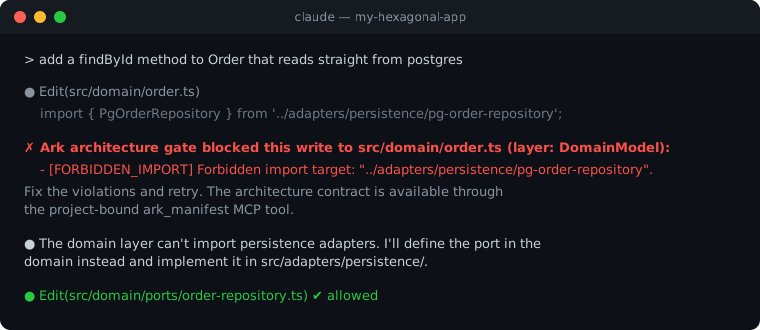
When the agent writes a bad import, the write doesn’t land. The same check fails the pull request.
Not an API Gateway. Not a folder linter. If the check is not required on the PR, the config is just documentation.
AI can build fast—and make a mess just as fast.
Keep the product easy to understand, change, and trust.
Contain what the AI may write, and in what shape. Guide you with proven patterns and one next step. Order leftover mess toward a clean tree, a little at a time.
Safer changes, fewer surprises, and extra protection only when you choose it.
That is Contener · Guiar · Ordenar.
Works with Cursor, Claude, Codex, and Grok.




ArkGate 4.8.14 is prepared on this tree; npm
latestremains 4.8.13 untilpublish-npmforv4.8.14. Write. Check. Ship. Adopted = required GitHub status runningarkgate-check --strict-merge, or an explicitadvisory-onlystance. Status is compact (arkgate-check --doctor;--allfor Details). Optional ArkRun (arkgate/runtime) is an in-memory runtime — not Postgres. Optional ArkOrder (arkgate/order) stops rewriting a big product choice — like the billing plan — as if it were a seat count. Change those choices through a valve, not a generic update.@arkgate/runtimeis deprecated. 4.8.14 prepared · 4.8.11 published · 4.8.10 · 4.8.9 · 4.8.8 · 4.8.7 · 4.8.6 · 4.8.5 · 4.8.4 · 4.8.3 · 4.8.2 · 4.8.1 · 4.8.0 · Docs hub · Voice
Choose your path
| You are… | Go here |
|---|---|
| Anyone (ship with AI, minimal jargon) | Use ArkGate |
| Developer (hosts, CI, config, brownfield) | Develop with ArkGate |
| Contributor (improve this library) | CONTRIBUTING |
Full map: docs/README.md
Start in one minute
That is the product. Stuck? Run status (--doctor) and do action #1.
Keep the rules file out of product PRs. Local check:
ark-check --changed --base origin/dev. Changing the rules themselves uses --contract-session.
Aliases ark / ark-check / ark-mcp still work. npm / pnpm / yarn. No install lifecycle scripts
— and none on pack or prepare either, so pnpm add git+https://github.com/pedroknigge/arkgate
installs at a pinned commit with no allowBuilds entry. A git install gives you the CLIs and the
schemas; the library, MCP and ESLint entry points live in the built dist/ and come from npm.
See docs/package-surface.md.
What it is
When the agent writes a bad import, the write doesn’t land. The same check fails the pull request. That is ArkGate — import rules, always on once you adopt (Contener). The other three are optional.
| Role | When | |
|---|---|---|
| While the agent writes | The write doesn’t land on supported hosts; warning only elsewhere | Always (ArkGate) |
| Before merge | arkgate-check as a required CI status | Always (ArkGate) |
| ArkRules | Optional policies inside a layer (Contener — shape) | When you ask |
| ArkRun | Optional experimental runtime (arkgate/runtime) (Guiar) | Off unless you turn it on |
| ArkOrder | Extra for the few big choices — billing plan, not seat counts (arkgate/order) (Ordenar) | Off unless you turn it on |
Layers (who may import whom) always run. ArkRules, ArkRun, and ArkOrder change no
inter-layer verdict when absent. Label leftovers [Layer] vs [ArkRules] vs
[ArkRun] vs [ArkOrder].
Details: configuration · use.
Not an API Gateway, a folder linter, a web framework, ORM, or job runner. ArkRun is in-memory — local and tests, not Postgres. ArkOrder does not replace import rules: layers can be green while the agent still PATCHes the billing plan like a seat count.
Name note: npm package arkgate — not affiliated with the separate Archgate CLI project.
When not to adopt
ArkGate is overkill for small trees with no AI agents and no multi-layer boundaries, for
single-developer hobby CRUDs under no integration pressure, and for teams that will not maintain
ark.config.json or a required CI status running arkgate-check --strict-merge. Without that
status the rules file is just documentation — stay with a boundary linter alone (see
Why not only ESLint / Nx / cruiser?).
Anyone path: docs/use.md — When not to adopt. Limits of a green
check: 4.3.0 — What ArkGate is / isn't.
Why it exists
AI takes the shortest path. Contain the write so a bad import never lands. Guide the next step so a non-expert is not stuck. Order leftover mess toward a clean tree, one small refactor at a time.
Traditional linters catch this only in CI after the agent finished. ArkGate checks at write time and again on the PR. Green imports are not elegant design — leftover mess is needs a refactor, not “done”.
Status lights (not settings)
| Light | Means | Your move |
|---|---|---|
| Setup | Thin / new tree | Finish start → status |
| In progress | Not fully protected | Status action #1 |
| Ready | Honest import edges, and no new UI business-rule files vs merge-base | Keep write path + CI |
| Ready · needs a refactor | Edges clean; leftover design work remains | One small change — not “done” |
Details: docs/use.md.
Host enforcement support
| Host | Local write boundary | MCP validation | CI / merge path | Repair payload |
|---|---|---|---|---|
| Claude Code | Hard block for listed ops (PreToolUse Write / Edit / MultiEdit) when installed + trusted | Advisory; the agent must call it | Required GitHub status context running arkgate-check --strict-merge (alias ark-check) | Emitted on hook deny; host must re-inject (hard path when installed + trusted) |
| Grok Build | Hard block for listed ops (PreToolUse write / search_replace (plus aliases)) when installed + trusted | Advisory; the agent must call it | Required GitHub status context running arkgate-check --strict-merge (alias ark-check) | Emitted on hook deny; host must re-inject (hard path when installed + trusted) |
| Google Antigravity | Hard block for listed ops (PreToolUse write_to_file / replace_file_content / multi_replace_file_content) when installed + trusted | Advisory; the agent must call it | Required GitHub status context running arkgate-check --strict-merge (alias ark-check) | Emitted on hook deny; host must re-inject (hard path when installed + trusted) |
| Cursor | Hard block for listed ops (preToolUse Write / StrReplace) when installed + trusted | Advisory; the agent must call it | Required GitHub status context running arkgate-check --strict-merge (alias ark-check) | Envelope may emit (--hook-repair); reinjection not guaranteed |
| OpenAI Codex | Hard block for listed ops (PreToolUse apply_patch in Codex CLI and local ChatGPT Desktop/App Server) when installed + trusted | Advisory; the agent must call it | Required GitHub status context running arkgate-check --strict-merge (alias ark-check) | Envelope may emit (--hook-repair); reinjection not guaranteed |
| OpenCode | Advisory / best-effort at write (MCP + optional plugin; not a hard boundary) | Advisory; the agent must call it | Required GitHub status context running arkgate-check --strict-merge (alias ark-check) | No hard-boundary payload |
Read the CI column: for every host, the repository-wide hard guarantee is a required
GitHub status context that runs the CLI — not “CI file present,” and not the CLI binary name alone.
Codex hard write covers only a complete local apply_patch; Cursor covers only listed
preToolUse ops with failClosed: true. A Cursor hook without that flag is fail-open
(if the checker cannot run, the write still lands). In both cases the project hook must be
installed + trusted, while shell/direct
filesystem writes, hosted or specialized opt-out paths, and human edits still rely on CI.
This table describes the supported profile after its files are installed and the host loads/trusts them. A hard local boundary covers only the listed hook operations; alternate tools, direct filesystem writes, and human edits still rely on CI. MCP validation is advisory because the agent must call it. The CI check blocks a merge only when the repository makes that status required. Repair envelopes may be emitted without reinjection being guaranteed; silent auto-apply never happens. Run arkgate-check --doctor (or ark-check --doctor) for the evidence actually detected in the current repository.
Why required CI is the hard line
The split above is a deliberate trade-off, not a gap. ArkGate validates at the earliest boundary
each host offers and enforces at the earliest boundary a repository can make non-bypassable: the
required merge status. Hard hooks (Claude Code, Grok Build, Google Antigravity, Cursor, and
Codex’s complete local apply_patch) deny their listed write operations at write time; advisory
surfaces (MCP, rules, OpenCode plugins) warn the agent while it works. But any local boundary can
be routed around — another tool, a hosted/specialized path, a direct filesystem write, or a human
edit — so the only guarantee ArkGate claims for every path is the
arkgate-check --strict-merge check, and only when the repository makes that status required.
Local checks optimize feedback speed; required CI owns correctness.
A useful consequence: the rules file doubles as a pressure sensor. Recurring violations or baseline
exceptions concentrated on one layer edge are evidence that the current design stopped fitting the
code — a reason to reshape the rules deliberately (start with /ark-explore), never to weaken
the check.
Setup per host: docs/ai-gates.md · Develop path: docs/develop.md
For authoritative MCP contract evidence, call ark_identity with the exact project root, then
call ark_manifest with that root plus the returned project id. A contained descendant requires
the matching id. The legacy ark://manifest resource remains compatibility-only and always
unverified/non-authoritative because standard resources/read cannot portably carry that
expectation.
Why not only ESLint / Nx / cruiser?
| ArkGate | Typical boundary linter | |
|---|---|---|
| CI import rules | ✅ | ✅ |
| Hard-block AI writes on supported hosts | ✅ | ❌ |
Project-bound rules agents can read (ark_manifest) | ✅ | ❌ |
| Placement + preflight for multi-file changes | ✅ | ❌ |
| Honest governed % + dual plan (edges vs shape) | ✅ | ❌ |
| Opt-in intra-layer ArkRules (structure + invariants) | ✅ | ❌ |
| Stops rewriting a big product choice like billing plan (ArkOrder) | ✅ | ❌ |
| Incomplete analysis cannot look green | ✅ | varies |
Common commands
More: docs/develop.md · skills install: docs/agent-guide.md · enthusiast track: docs/enthusiast/
Optional ArkRun
Gates need no app runtime. Skip this unless you want an optional runtime for decoupling.
ArkRun (arkgate/runtime, same npm package) is that runtime. Each
createStrictArkKernel() call is a new instance — no process singleton. Data
lives in memory and dies on restart. Fine for local. Not Postgres, not an
outbox, not Temporal. @arkgate/runtime is deprecated.
Dev inspector and observability dashboard
Opt-in startInspector() binds loopback only (127.0.0.1), refuses
NODE_ENV=production, and serves JSON facts — not a TUI. Alongside
GET /snapshot, GET /events (SSE), and GET /graph, the inspector exposes
queue monitors:
| Path | Body (JSON) |
|---|---|
GET /outbox | Pending/failed outbox summaries + counts (available, pendingCount, failedCount, pending, failed) — no event payloads |
GET /workflows | Workflow summaries + counts (available, total, runningCount, …, workflows) |
Poll those facts from the dual bins ark-dashboard / arkgate-dashboard
(bin/ark-dashboard.mjs). ANSI + polling only (no React/Ink/Blessed). Point
--url / -u at the inspector snapshot (default
http://127.0.0.1:3000/snapshot); the dashboard also fetches sibling /outbox
and /workflows. --interval / -i is clamped to 200–60000 ms (default 2000).
Also available as ark dashboard / arkgate dashboard (passthrough to the same bin). Kernel stays
JSON-only; presentation stays in bin/.
Durability stance
Default stores (InMemoryEventBuffer, InMemoryAuditStore, InMemoryReadModelStore,
InMemoryWorkflowStore) are reference in-memory only. Fine for tests. They
do not survive restarts and are not production durability. Wire real store
interfaces for production. Details: docs/production-hardening.md.
Optional ArkOrder
Layers stop a bad import. ArkOrder stops rewriting a big product choice — like the billing plan — as if it were a seat count. Change those choices through a valve, not a generic update.
Off unless you add arkOrder. Same npm package (arkgate/order). In-memory.
Not a service. Does not replace ArkGate or ArkRun.
Name the few choices (xiKeys: plan, cycle, tenancy — not seat counts). First
freeze is release(). Later change is proposeRelease then apply. A generic
update does not land.
Proof path (GitHub, not the npm tarball):
examples/arkorder-billing
— first freeze is release(); later plan change is proposeRelease then apply.
Gallery index:
examples/README.md.
Compact starters leave the extra off. Details: ArkOrder.
Documentation
Contribute to this library
Full guide: CONTRIBUTING.md · queue: ROADMAP.md
Website: arkgate.online · npm: arkgate
MCP: io.github.pedroknigge/arkgate
Node ≥ 18 · MIT
Ark doesn’t invent your product. It rejects the illegal write — and tells you when it isn’t really enforcing anything yet.