Deterministic verification for AI-generated analysis: run a spec, inspect or diff a workbook
Quick Install
Automated & IDE SetupCopy the AI prompt to install this server into Claude Code, Cursor, or another agent — or use 1-click editor setup below.
Manual Client & Custom JSON ConfigExpand JSON ▾
Client Config & Setup
Choose your client or environment
Target File:
💡 Paste the JSON block into your client's configuration file under mcpServers, then restart the application.
Documentation Overview
andon
Stop the line when the numbers don't add up.


andon re-checks the numbers in finished analysis — the report your AI agent just drafted, the workbook a colleague "quickly updated" — against the data they came from and against themselves. It does this with arithmetic, not with another LLM: reconciliation, internal consistency, schema contracts and Excel workbook integrity, written down as a small YAML spec and enforced with exit codes.
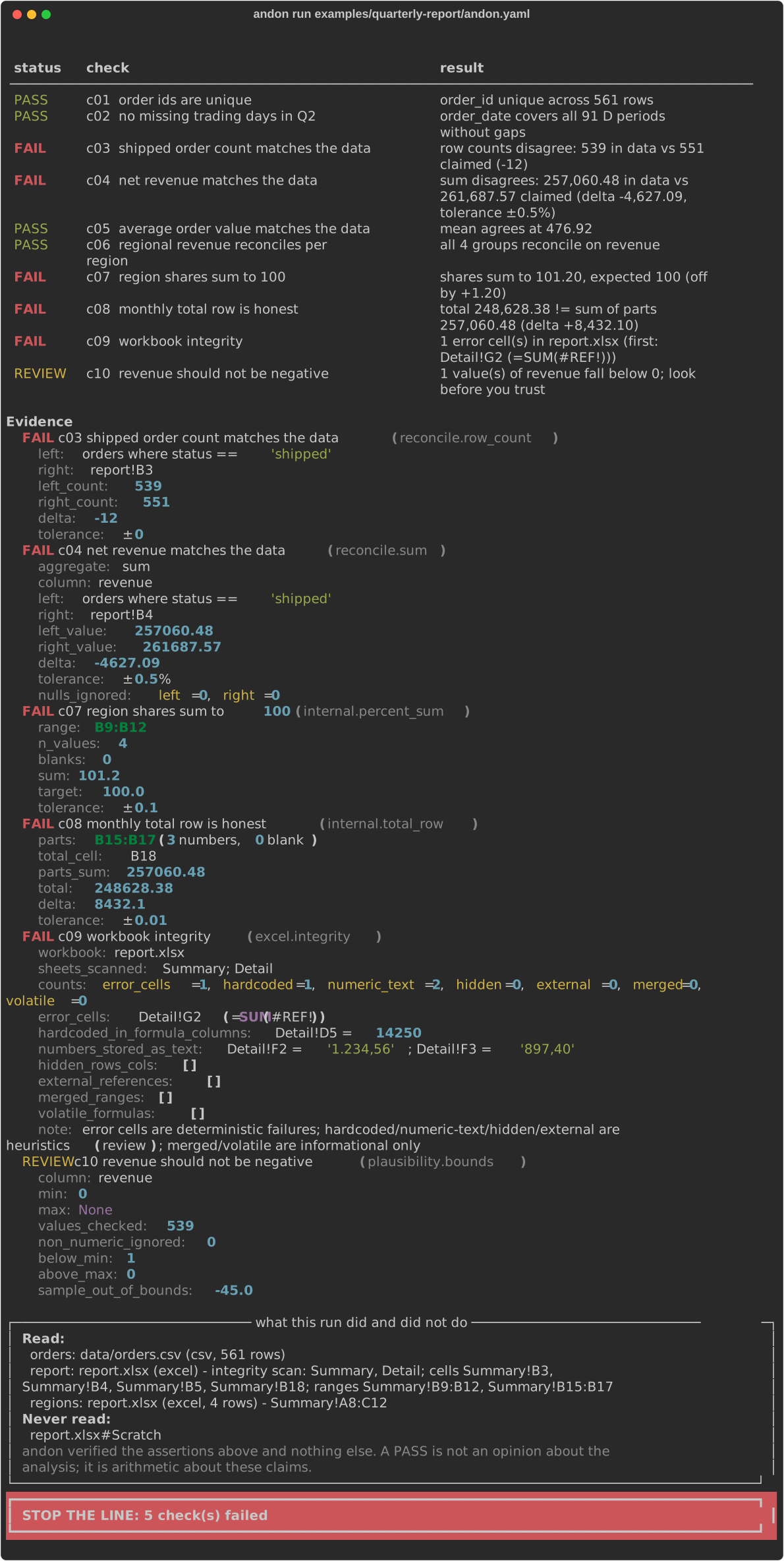
That screenshot is real output. The example it runs on is in
examples/quarterly-report/, staged by a script that
plants the defects I keep meeting in real reporting work: a count taken from a stale
snapshot, a revenue total typed over by hand, shares that sum to 101.2, a total row
nobody updated after a data refresh, a #REF!, and freight numbers stored as text.
Why this exists
I'm an industrial engineer. I build and run operations reporting — delivery KPIs, forecast accuracy, inventory analytics — and over the last two years an increasing share of the first drafts around me has been written by AI agents. They are fast, tireless, and confidently wrong in ways a tired human is not: the filter that silently dropped cancelled orders, the percentage column that almost sums to 100, the total row that survived three edits of its parts.
The common answer is to ask a second model to review the first one. I think that is the wrong tool. Whether 539 rows really sum to 257,060.48 is not a matter of opinion, and no amount of model capability makes an opinion the right instrument for it.
Manufacturing solved this problem decades ago. On a Toyota line, any worker who spots a defect pulls a cord — the andon — and the line stops until the problem is understood. The machine equivalent, jidoka, is a machine that stops itself when it detects an abnormal condition. This tool is that cord for spreadsheets and reports: a small, deterministic gate between "the analysis is written" and "the analysis is sent."
The iron rules
andon's behavior is easier to trust because it is constrained. These rules are enforced in code, not just promised here:
- Only arithmetic can fail the build. Heuristic checks (distribution shifts, plausibility bounds) can raise a REVIEW flag; the engine will not let them FAIL, even if a buggy check tries.
- No silent blessings. Every report ends with what was read, what was skipped, and which worksheets were never touched (the report calls this the honesty block). A PASS covers the listed assertions and nothing else.
- A check that can't run is a finding, not a pass. Missing file, unreadable range, text in a numeric column — the run continues, the check is recorded as ERROR, and the exit code is non-zero. "Not verified" must never be readable as "fine."
- Read-only by construction. There is no code path that writes to your data.
Install
The PyPI distribution is named andon-verify (the bare andon name was already
taken); the command and the import stay andon — andon run ..., import andon.
From source: pip install git+https://github.com/gulmezeren2-byte/andon.
Quick start
Point andon at data and claims:
Or try the sabotaged example in this repo:
What it checks
| Family | Checks | Question it answers | Can FAIL? |
|---|---|---|---|
reconcile | row_count, sum, aggregate, group_sum, keys | Does the report agree with the data it came from? | yes |
internal | total_row, percent_sum, recompute | Does the report agree with itself? | yes |
schema | columns, unique, not_null, allowed_values, date_continuity | Is the data shaped the way everyone assumes? | yes |
excel | integrity | Is the workbook mechanically sound? (#REF!, values typed over formulas, numbers stored as text — including the 1.234,56 flavor — hidden rows, external links) | on error cells |
plausibility | bounds, new_categories, mean_shift | Should a human look at this before anyone trusts it? | no — REVIEW at most |
Full parameter reference with examples: docs/checks.md.
Exit codes and CI
Exit codes are a contract:
| code | meaning |
|---|---|
| 0 | every check passed |
| 1 | at least one FAIL (with --strict: also on REVIEW/ERROR/nothing-ran) |
| 2 | no failures, but REVIEW flags were raised |
| 3 | nothing was verified — a check could not run, or every check was skipped |
| 4 | the spec itself is broken |
As a GitHub Action — one line, and the verdict lands in your job summary:
Or plainly, in any runner:
As a pre-commit hook
Stop a commit before a broken report leaves your machine:
Using andon with AI agents
andon is built to be driven by agents, not to contain one:
--jsonemits the full report with stable field names; the exit code alone is enough for a go/no-go decision.- Error messages name the sources, columns and sheets involved, so an agent can repair its own spec instead of guessing ("Column 'Revenue' not found. Columns are: region, share_pct, revenue").
skills/verify-with-andon/ships a skill for Claude Code and compatible harnesses that teaches an agent the discipline: after drafting any analysis, write the spec, run andon, and report the verdict — including the rule that loosening a tolerance to make a check pass must be declared, never silent.- MCP server.
pip install 'andon-verify[mcp]'and runandon-mcpto expose three tools to any MCP-speaking runtime:run(execute a spec),inspect(integrity-scan a workbook with no spec), anddiff(classify what changed between two versions). The agent gets the same structured verdict a human gets — not prose it has to parse back.
No local Python? The Dockerfile builds the same server:
docker build -t andon . && docker run --rm -i -v "$PWD:/work:ro" -w /work andon.
My working rule: the agent that wrote the analysis also writes the spec, and neither is
finished until andon run exits 0 — or a human has signed off on every flag it raised.
What andon is not
- Not a data-quality platform. Great Expectations and pandera validate data inside pipelines, in code, usually against a warehouse. andon verifies claims in finished artifacts — the report against its source — and treats Excel as a first-class citizen, because that is where analysis actually lives in most companies.
- Not an LLM evaluator. It doesn't score model outputs; it re-derives numbers.
- Not a replacement for reading the report. It removes a class of mechanical error so human review can spend itself on judgment.
Limitations, honestly
- Formula cells need cached values. andon reads the value Excel last calculated. A workbook produced by a library and never opened in Excel/LibreOffice carries no cached values for its formulas; andon refuses to guess and reports exactly that.
wherefilters are pandasquery()expressions. They are expressive, which means a spec can encode the same mistakes as any query. Specs are code — review them like code.- Heuristic checks have false positives by design. That is why they cannot fail a build.
- Scale is untested beyond mid-size files. Everyday operational workbooks and CSVs (hundreds of thousands of rows) are fine; nobody has benchmarked it against 10 GB of parquet. If you do, tell me what broke.
- Parquet sources need
pip install 'andon-verify[parquet]'.
CSV encoding, delimiter, and how numbers are punctuated
Related MCP Servers
Reviews
No reviews yet — be the first to share how this listing worked for you.
Frequently Asked Questions about Andon
AllMCPs Directory Badge
Showcase your server listing on GitHub or your project documentation. Embed this dynamic SVG badge to highlight official listing status and live engagement.
Badge Style:
Live Dynamic SVG Preview
Markdown (GitHub README)
[](https://allmcps.com/mcp/andon)HTML Embed
<a href="https://allmcps.com/mcp/andon"><img src="https://allmcps.com/api/badge/andon?style=directory" alt="Andon on AllMCPs" /></a>Technical Specs & Signals
CategoryDeveloper Tools
27Quality signal: Emerging · 27/100How this signal is calculated ▾
Server availabilityNot measured
Not scored for repo-hosted servers — we can't reach the running server, only its GitHub page. Hosted MCP endpoints are health-checked live.
Verified ownership8/20
Documentation & tools11/30
Adoption & activity1/15
Community engagement0/10
A guidance signal from public completeness & health data — not a user rating. New listings start lower and rise as they add docs, get verified, and grow adoption. Signals we can't observe for a listing are skipped, not counted against it.
Own this project?
This directory is pre-filled from public sources. Claim via GitHub README, site badge, or DNS TXT to unlock edit access and the Official badge and attach your website — proof is checked automatically, then reviewed by our team.
Free dofollow backlink: add your website and place the AllMCPs badge on it — no claim needed. We detect it automatically and keep it verified as long as the badge stays live.
Claim & get free dofollowShare & Embed
Add our SVG badge (dark/light directory styles) or embeddable widget to your site.