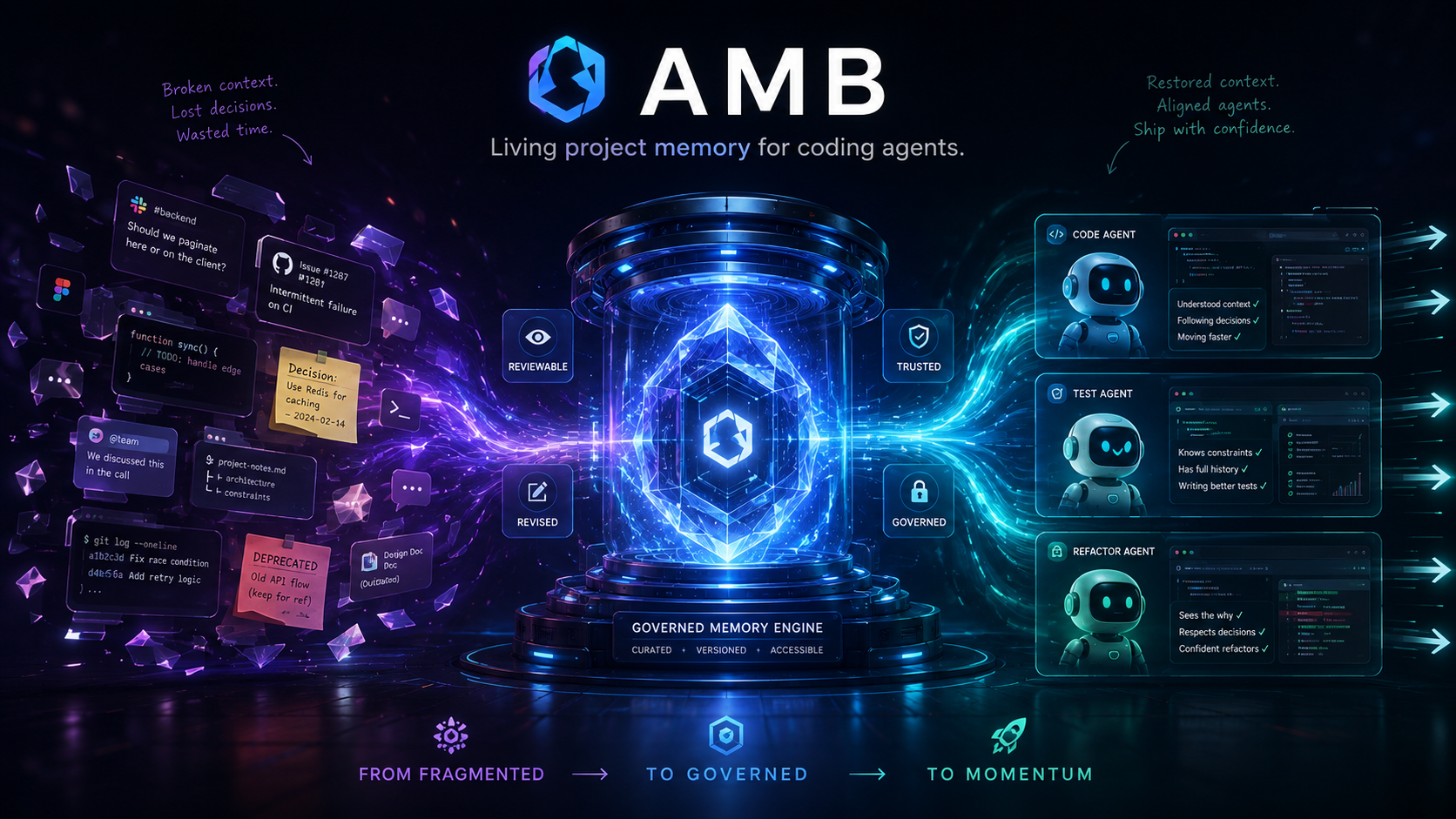
zzhang82/Agent-Memory-Bridge

🧠 Knowledge & Memory
0 Views
0 Installs

🐍 🏠 - MCP-native, local-first memory for coding agents that turns coding sessions into reusable engineering memory: decisions, gotchas, and domain knowledge.

Quick Install

One-Click IDE Configuration
claude_desktop_config.json
{
  "mcpServers": {
    "zzhang82-agent-memory-bridge": {
      "command": "npx",
      "args": [
        "-y",
        "zzhang82-agent-memory-bridge"
      ]
    }
  }
}
Or

Using an AI coding agent (Claude Code, Cursor, etc.)? Copy a ready-made prompt that tells it to fetch the setup instructions and install this server for you.

Documentation Overview

Agent Memory Bridge

įŽ€äŊ“中文

MCP Glama CI GitHub Release License: MIT Python 3.11+

Give coding agents one shared, governed record of project decisions across tools and sessions.

Agent Memory Bridge is shared engineering memory for developers and teams that use more than one coding agent. It complements AGENTS.md, CLAUDE.md, and client-native preference memory rather than replacing them. SQLite/WAL is the durable authority, with FTS5 and optional local embeddings as derived indexes for lexical, semantic, or hybrid retrieval.

0.25.1 is the cross-platform integrity patch for Trustworthy Adaptive Retrieval. It rejects non-canonical base64url receipt aliases and removes a Python 3.11 command-provider test race while preserving the 13-tool MCP surface and the shadow-only feedback boundary.

Codex is the reference workflow, not the product boundary. AMB uses local stdio MCP; client integrations are documented or locally verified only where labeled below.

Rendered workspace scene with three code workstations connected by bridges to a central cabinet holding cards and a scroll.

Conceptual visual only: a shared-memory workspace metaphor for AMB. It is not product evidence, identity evidence, certification, distribution, or use proof.

Try it locally after install: <venv-python> -m agent_mem_bridge first-run --client generic --example

Why It Exists

Most agent memory either feels too shallow or too heavy:

  • summaries become stale blobs
  • vector stores hide why something was recalled
  • every new session starts cold or gets a stale context dump
  • handoff state turns into ad hoc notes or a queue you did not want to build

AMB takes a smaller path: local SQLite authority, explicit namespaces, inspectable records, capability-labeled retrieval, and a signal lifecycle for lightweight coordination.

What You Get

  • Durable memory: decisions, gotchas, procedures, concepts, beliefs, and supporting records.
  • Coordination signals: claim -> extend -> ack / expire / reclaim without pretending to be a scheduler.
  • Review-first writeback: learning candidates can be staged for human review before explicit promotion into durable records.
  • Context assembly: startup and task-time context can be rendered from procedures, concepts, beliefs, gotchas, and linked support without adding more MCP tools.
  • Governed change: explicit deletion, supersession, changed premises, and task-domain applicability are checked before guidance becomes actionable.
  • Cross-client activation receipts: a read-only CLI receipt can show that two distinct declared client labels participated in one memory loop without exposing paths, content, session IDs, or model IDs.
  • Retrieval feedback: callers can mark a receipt-bound result as helpful, misleading, outdated, not_applicable, or not_used without changing ranking or memory.
  • Proof discipline: release contract checks, public-surface checks, onboarding checks, benchmark snapshots, visual inventory checks, and 604 tests collected.

How It Works

Agent Memory Bridge architecture: generic MCP-compatible coding agents use a small grouped tool surface backed by SQLite/WAL authority, derived indexes, governed change, and no-auto-writeback context and reports; proof gates remain outside runtime.

AMB keeps the runtime path small: MCP-compatible coding agents call 13 public MCP tools; SQLite/WAL remains the durable authority; FTS5 and optional local embeddings are derived indexes; governed context and CLI reports are rendered without automatic durable writeback. Release checks, benchmarks, and the visual claim inventory stay outside that runtime path.

Who It Is For

  • You use more than one coding agent and want project decisions, gotchas, and handoffs to remain shared across them.
  • You already use AGENTS.md, CLAUDE.md, or native preference memory and need a governed cross-agent layer alongside it.
  • You want memory that is local and inspectable instead of a hosted platform or opaque vector stack.
  • You run review, handoff, or multi-agent workflows and need coordination signals without building a full task queue.

Install

Requirements:

  • Python 3.11+
  • SQLite with FTS5 support; optional local embeddings are derived indexes, not durable authority
  • any MCP-compatible client that can launch a local stdio server
  • optional uv / uvx for a pinned one-command GitHub smoke test

Pinned GitHub install with Python:

python -m venv .amb-venv
python -c "import os; from pathlib import Path; print((Path('.amb-venv') / ('Scripts/python.exe' if os.name == 'nt' else 'bin/python')).absolute())"

Treat the printed value as <venv-python>. Keep that resolved local path out of commits and issue reports. In a POSIX shell, shell-quote that path when needed. In Windows PowerShell, invoke it as & "<venv-python>". Then run:

<venv-python> -m pip install "https://github.com/zzhang82/Agent-Memory-Bridge/archive/refs/tags/v0.25.1.zip"
<venv-python> -m agent_mem_bridge doctor
<venv-python> -m agent_mem_bridge verify

Optional pinned GitHub smoke test with uvx:

uvx --from git+https://github.com/zzhang82/Agent-Memory-Bridge@v0.25.1 agent-memory-bridge verify

Quick Start: Unified First-Run

Use first-run when you want a complete copy/paste setup guide for a client. It renders install steps, a placeholder-safe config snippet, verification commands, and a first Task Brief preview. It does not write client config files or durable memory records.

<venv-python> -m agent_mem_bridge first-run --client generic --example
<venv-python> -m agent_mem_bridge first-run --client codex --example
<venv-python> -m agent_mem_bridge first-run --client opencode --example
<venv-python> -m agent_mem_bridge first-run --client hermes --example

If you only need the config snippet, use config directly:

<venv-python> -m agent_mem_bridge config --client generic --example
<venv-python> -m agent_mem_bridge config --client codex --example
<venv-python> -m agent_mem_bridge config --client opencode --example
<venv-python> -m agent_mem_bridge config --client hermes --example
<venv-python> -m agent_mem_bridge config --client cursor --example

Dockerized stdio works too when you want an isolated runtime:

docker build -t agent-memory-bridge:local .
docker run --rm -i -e AGENT_MEMORY_BRIDGE_HOME=/data/agent-memory-bridge -v /path/to/bridge-home:/data/agent-memory-bridge agent-memory-bridge:local

Client-specific notes live in docs/INTEGRATIONS.md. Runtime configuration lives in docs/CONFIGURATION.md. Authority and correction rules live in docs/AUTHORITY-CONTRACT.md. Security guidance lives in SECURITY.md. Agents that are installing the bridge should start with INSTALL_FOR_AGENTS.md.

The First Useful Loop

Session 1 discovers a project rule:

store(
  namespace="project:demo",
  kind="memory",
  content="claim: Use WAL mode for concurrent SQLite readers."
)

Session 2 asks about the same project:

recall(namespace="project:demo", query="SQLite concurrent readers")

The agent gets the rule back without the user typing it again.

For coordination, use signals:

store(namespace="project:demo", kind="signal", content="release note review ready")
claim_signal(namespace="project:demo", consumer="reviewer-a", lease_seconds=300)
extend_signal_lease(id="<signal_id>", consumer="reviewer-a", lease_seconds=300)
ack_signal(id="<signal_id>", consumer="reviewer-a")

For polling, use an empty query with kind="signal" and pass the previous next_since value back as since. Polling returns later insertions in ascending order. Missing, deleted, or cross-namespace anchors fail explicitly. The cursor does not report later claim or ack transitions on older Signals. Text and memory recall return next_since: null.

For a cross-client activation receipt, keep one correlation id across both clients:

# Client A stores one reviewed project memory.
store(
  namespace="project:demo",
  kind="memory",
  title="Reviewed SQLite guidance",
  content="record_type: gotcha\nclaim: Use WAL mode for concurrent SQLite readers.",
  tags=["workflow:cross-client-activation", "activation-role:writer", "reviewed:true"],
  correlation_id="activation-demo-001",
  source_client="client-a"
)

# Client B recalls it, then records and acknowledges the read signal.
recall(namespace="project:demo", query="SQLite concurrent readers", correlation_id="activation-demo-001")
store(
  namespace="project:demo",
  kind="signal",
  content="{\"observed_memory_id\":\"<writer_memory_id>\"}",
  tags=["workflow:cross-client-activation", "activation-role:reader"],
  correlation_id="activation-demo-001",
  source_client="client-b"
)
ack_signal(id="<reader_signal_id>")

Then render the local receipt:

<venv-python> -m agent_mem_bridge activation-receipt --namespace project:demo --correlation-id activation-demo-001 --format markdown

The receipt reports hashes and pass/review status. It does not print raw memory content, private paths, session ids, model ids, or authenticated identity claims.

The short version:

WITHOUT AMB
user> We hit this last time too: run the generator after schema edits.

WITH AMB
agent> I found the previous gotcha: run the generator after schema edits.

Task Briefs do not require Agent Memory Harness (AMH). The AMB CLI can render a derived task context report over recalled records, including what context was used, ignored, or marked for review. That brief is a derived view over AMB memory; it is not a second durable store and does not add MCP tools.

The terminal demo and the before/after gotcha story are in examples/demo, with the story source at examples/demo/before-after-gotcha.cast.md.

Client Support

Status labels are intentionally narrow.

ClientStatusNotes
Generic stdio MCPsupportedAny client that can launch a local stdio server
CodexverifiedReference workflow and deepest dogfood path
Claude CodedocumentedCLI or project-level stdio MCP config
Claude DesktopdocumentedLocal stdio server config; remote/extension flows are separate
CursordocumentedJSON mcpServers config
ClinedocumentedJSON mcpServers config
Antigravitylocally testedExercised in a local setup; UI/config details can vary
OpenCodelocally testedJSON mcp config shape for local commands
Hermeslocally testedYAML mcp_servers shape in local profiles; adapter workflows remain manual

MCP Tools

The bridge exposes 13 public MCP tools:

ToolLaneBoundary
storememory/signal writeDurable memories may deduplicate; Signals stay coordination events.
recallretrievalExplicit memory text recall can include a short-lived receipt.
browseinspectionFiltered namespace view without text-ranking claims.
statsinspectionCounts and derived health signals, not durable authority changes.
forgetgoverned mutationExplicit deletion with audit boundaries.
feedbackretrieval evidenceReceipt-bound, append-only, shadow-only; no ranking or memory mutation.
promotegoverned mutationReview-only path into durable authority.
annotatemetadata mutationAdds non-policy tags and provenance without rewriting content.
revisegoverned mutationCreates a successor plus supersession receipt in one transaction.
claim_signalsignal lifecycleClaims one pending or expired Signal for a local consumer.
extend_signal_leasesignal lifecycleExtends the current owner lease.
ack_signalsignal lifecycleAcknowledges with owner checks for active claims.
exportinspectionSanitized export over existing records.

Same tools by group:

  • store, recall, browse, stats
  • forget, feedback, promote, annotate, revise, export
  • claim_signal, extend_signal_lease, ack_signal

annotate adds non-policy tags and provenance without rewriting the original content. revise creates a successor record and an auditable supersession receipt in one transaction. Both operations preserve the review boundary: callers cannot mint reserved governance tags or revise hidden learning candidates into authority.

The richer behavior stays behind that surface: reviewed promotion helpers, consolidation, startup/task-time assembly, procedure policies, telemetry summaries, signal contention checks, learning-candidate review queues, Task Brief reports, human review workflows, and activation receipts. There are no separate task_packet, startup_packet, learning_candidate, task_brief, review_queue, review_workflow, or activation_receipt MCP tools, and no rerank, auth, ACL, ANN, graph, or auto-policy interface.

For normal service use, log capture helpers, promotion helpers, and strong consolidation are disabled by default. During each cycle, every enabled lane has its own exception boundary: one lane failure is reported with a failure count and bounded retry delay without stopping its siblings. The lanes still execute sequentially, so a slow call can delay later lanes; lane duration and slow-lane warnings make that delay visible. Watcher, reflex, consolidation, governance, and embedding scheduler state use tolerant atomic JSON and reset when a restored database has a different epoch. The service writes service-health.json, holds a local bridge-home singleton lock, exits 1 from service --once when any enabled lane fails, and exits 3 when another service owns the lock. Use --allow-multiple-services only when duplicate processing is deliberate.

Restore is an offline maintenance operation. Stop the service and every MCP/client process that can write the database before restoring, and reopen clients only after verification completes. The service lock excludes the background daemon; arbitrary MCP writers do not participate in that lock.

Operator review work is available as CLI reports, not MCP tools:

<venv-python> -m agent_mem_bridge review-queue --namespace project:demo --format markdown
<venv-python> -m agent_mem_bridge review-workflow --namespace project:demo --format markdown
<venv-python> -m agent_mem_bridge task-brief --namespace project:demo --query "release handoff" --format markdown
<venv-python> -m agent_mem_bridge activation-receipt --namespace project:demo --correlation-id activation-demo-001 --format markdown

review-queue shows staged candidates, review receipts, tombstones, stale records, and quarantined claims. review-workflow turns those queue items into explicit human decision prompts and manual steps. task-brief composes existing task-memory assembly, review queue items, and active signals into Used, Ignored, and Needs Review sections. activation-receipt reads existing rows for one namespace and correlation id and emits a sanitized declared-provenance receipt. These reports perform no automatic durable writeback.

Static-schema client compatibility

Some MCP clients generate one static input schema per tool and may send signal-only fields on kind="memory" paths: for example ttl_seconds or expires_at on store, and signal_status on recall, browse, or export. AMB drops those fields at the MCP transport boundary before creating or querying memory records. The lower-level memory store contract stays strict: durable memory and coordination signals remain separate lanes, and real signal lifecycle fields still belong only to kind="signal" operations.

Proof Snapshot

0.25.1 hardens Trustworthy Adaptive Retrieval. Retrieval reports whether it is operating as lexical, hashed_lexical, or true semantic; explicit memory text recall can return a short-lived HMAC receipt; and feedback records receipt-bound retrieval outcomes as append-only shadow evidence. The patch additionally rejects non-canonical base64url receipt aliases and stabilizes command-provider validation on Python 3.11. Feedback is not a reranker, memory editor, authentication layer, ACL system, ANN index, graph engine, or automatic policy path.

TrackCurrent signal
Retrievalmemory_expected_top1_accuracy = 1.0, file_scan_expected_top1_accuracy = 0.636
Calibrationclassifier_exact_match_rate = 0.875, fallback_exact_match_rate = 0.062
Procedure governancegoverned_case_pass_rate = 1.0, governed_blocked_procedure_leak_rate = 0.0
Learning candidatespolicy-gated staging records are suppressed from normal recall, browse, export, and stats unless explicitly queried with review tags; candidates are not durable authority until reviewed/promoted
Signal contentionserialized lifecycle benchmark: signal_contention_case_pass_rate = 1.0, duplicate_active_claim_count = 0; multiprocessing exact-ID claim test: 8 processes, 1 winner
Current correctness patchschema v4 exact_content_hash; read-only semantic/hybrid recall over precomputed vectors; degraded completeness metadata; warmed benchmark/proof embeddings; service-locked index rebuild; documented cooperative trust boundary
Inherited Signal correctness10,000-Signal polling acceptance: exact insertion order, missing = 0, unexpected = 0, unique = 10000; owner-matched active-claim ack and promotion-preservation regressions included in the suite
Adversarial memory governanceadversarial_case_count = 6, adversarial_task_count = 7, adversarial_governed_task_pass_rate = 1.0, adversarial_governed_blocked_record_leak_rate = 0.0
Reviewed memory evolutionmemory_evolution_case_count = 6, memory_evolution_task_count = 7, memory_evolution_governed_task_pass_rate = 1.0, memory_evolution_governed_blocked_record_leak_rate = 0.0
Reviewed memory operationsreview_queue_item_count = 6, review_queue_actionable_count = 6, review_queue_no_auto_mutation = true, review_queue_public_mcp_surface_change = false
Human review workflowreview_workflow_item_count = 6, review_workflow_manual_step_count = 27, review_workflow_auto_write_count = 0, review_workflow_public_mcp_surface_change = false
Task Brieftask_brief_used_count = 2, task_brief_ignored_count = 1, task_brief_needs_review_count = 4, task_brief_no_auto_writeback = true, task_brief_public_mcp_surface_change = false
v0.19 adoption proofsynthetic fixture proof only, not clean-room external adoption: v019_case_count = 12, v019_pass_rate = 1.0, v019_public_mcp_surface_change = false, v019_client_config_write_count = 0
v0.20 clean-room prooflocal reproducible proof only, not vendor certification: v020_case_count = 6, v020_pass_rate = 1.0, v020_stdio_round_trip_pass = true, v020_client_config_write_count = 0, v020_external_vendor_adoption_claim = false
v0.21 governed change prooffixed local executable proof: v021_case_count = 20, v021_flat_baseline_hazards = 17, v021_governed_failures = 0, v021_governed_checkpoint_passes = 40, v021_auto_writeback_count = 0
v0.22 activation receiptdeclared-provenance local receipt only; requires distinct declared source_client labels and an acked reader signal; public_mcp_surface_change = false, durable_writeback_count = 0, config_write_count = 0
v0.22 visual assetsmachine inventory: examples/diagrams/visual-claims.json; native-size and README-width raster render gate requires no clipping, overlap, or crossed labels; hero PNG is marked conceptual with semantic validation not performed; SVG assets carry title/desc metadata
v0.25 retrieval receipts and feedbackexplicit memory text recall emits redacted, short-lived HMAC receipts; feedback accepts five declared outcomes and stays append-only, shadow-only, and ordering-neutral
Test suite604 tests collected; full run result: 601 pass, 3 skip
Release contract facts

Snapshot facts checked by the release contract:

question_count = 11
memory_expected_top1_accuracy = 1.0
memory_mrr = 1.0
file_scan_expected_top1_accuracy = 0.636
file_scan_mrr = 0.909

sample_count = 16
classifier_exact_match_rate = 0.875
fallback_exact_match_rate = 0.062
classifier_better_count = 13
fallback_better_count = 2
classifier_filtered_low_confidence_count = 2

case_count = 7
flat_case_pass_rate = 0.429
governed_case_pass_rate = 1.0
flat_blocked_procedure_leak_rate = 1.0
governed_blocked_procedure_leak_rate = 0.0
governed_governance_field_completeness = 1.0

signal_contention_case_count = 5
signal_contention_case_pass_rate = 1.0
unique_active_claim_rate = 1.0
duplicate_active_claim_count = 0
active_reclaim_block_rate = 1.0
stale_ack_blocked_rate = 1.0
stale_reclaim_success_rate = 1.0
pending_under_pressure_claim_rate = 1.0
initial_hard_expiry_cap_rate = 1.0

adversarial_case_count = 6
adversarial_task_count = 7
adversarial_governed_task_pass_rate = 1.0
adversarial_governed_blocked_record_leak_rate = 0.0

memory_evolution_case_count = 6
memory_evolution_task_count = 7
memory_evolution_governed_task_pass_rate = 1.0
memory_evolution_governed_blocked_record_leak_rate = 0.0
memory_evolution_governed_disposition_reason_hit_rate = 1.0

review_queue_item_count = 6
review_queue_actionable_count = 6
review_queue_hidden_lane_count = 2
review_queue_writeback_plan_count = 6
review_queue_no_auto_mutation = true
review_queue_public_mcp_surface_change = false
review_queue_item_type_count = 6

review_workflow_source_queue_item_count = 6
review_workflow_item_count = 6
review_workflow_manual_step_count = 27
review_workflow_requires_human_count = 6
review_workflow_auto_write_count = 0
review_workflow_no_auto_writeback = true
review_workflow_public_mcp_surface_change = false
review_workflow_item_type_count = 6

task_brief_used_count = 2
task_brief_ignored_count = 1
task_brief_needs_review_count = 4
task_brief_review_queue_item_count = 2
task_brief_active_signal_count = 1
task_brief_no_auto_writeback = true
task_brief_public_mcp_surface_change = false
task_brief_needs_review_source_type_count = 3

v019_case_count = 12
v019_pass_count = 12
v019_pass_rate = 1.0
v019_retrieval_case_count = 4
v019_retrieval_pass_rate = 1.0
v019_task_brief_case_count = 4
v019_task_brief_pass_rate = 1.0
v019_first_run_adoption_case_count = 4
v019_first_run_adoption_pass_rate = 1.0
v019_public_mcp_tool_count = 10
v019_public_mcp_surface_change = false
v019_client_config_write_count = 0
v019_durable_writeback_count = 0
v019_amh_required = false
v019_native_memory_comparison_required = true

v020_case_count = 6
v020_pass_count = 6
v020_pass_rate = 1.0
v020_import_sanity_pass = true
v020_stdio_round_trip_pass = true
v020_first_run_pass = true
v020_task_brief_pass = true
v020_public_mcp_tool_count = 10
v020_public_mcp_surface_change = false
v020_client_config_write_count = 0
v020_explicit_demo_memory_write_count = 1
v020_explicit_demo_signal_write_count = 0
v020_non_demo_durable_writeback_count = 0
v020_amh_required = false
v020_external_vendor_adoption_claim = false

v021_case_count = 20
v021_category_count = 4
v021_flat_baseline_hazards = 17
v021_flat_baseline_hazards_expected = 17/20
v021_governed_case_pass_count = 20
v021_governed_failures = 0
v021_governed_failures_target = 0/20
v021_governed_checkpoint_passes = 40
v021_governed_checkpoint_passes_target = 40/40
v021_governed_checkpoint_result_count = 40
v021_useful_current_retention_pass = true
v021_suppress_all_can_pass = false
v021_public_mcp_tool_count = 10
v021_public_mcp_surface_change = false
v021_auto_writeback_count = 0
v021_config_write_count = 0
v021_durable_live_writeback_count = 0

Full proof details are in benchmark/README.md.

Boundaries

AMB is not a graph database, general unlearning system, hosted memory platform, scheduler, worker runtime, distributed lock, exactly-once coordination system, packet API, automatic policy engine, compliance certification, authenticated identity system, or unreviewed durable writeback path from raw transcripts. It is a small local bridge for reusable engineering memory and lightweight coordination. forget remains an explicit mutating operation; governed change makes that operation more conservative and auditable rather than automatic.

For alternatives and trade-offs, see docs/COMPARISON.md.

Docs

License

MIT. See LICENSE.

Related MCP Servers

modelcontextprotocol/server-memoryVerified

📇 🏠 - Knowledge graph-based persistent memory system for maintaining context

🧠 Knowledge & Memory2 views
0xshellming/mcp-summarizer

📕 â˜ī¸ - AI Summarization MCP Server, Support for multiple content types: Plain text, Web pages, PDF documents, EPUB books, HTML content

🧠 Knowledge & Memory0 views
20alexl/claude-engram

🐍 🏠 - Persistent memory and session intelligence for Claude Code. Auto-tracks mistakes, decisions, and context via hooks. Mines session history for patterns and cross-session search. Loop detection, pre-edit warnings, context compaction survival. Runs locally with Ollama.

🧠 Knowledge & Memory0 views
a2cr/a2cr

🐍 â˜ī¸ 🏠 🍎 đŸĒŸ 🐧 - MCP server for AI-agent handoffs. Saves client-encrypted WorkBaton checkpoints and WorkStash notes so Codex, Claude Code, Roo Code, and other MCP clients can resume work without passing full chat history.

🧠 Knowledge & Memory0 views

Engagement

Views
0
Installs
0
Upvotes
0

Views and upvotes are unique per visitor network (hashed IP). Installs count copy actions.

Status

Health: Not checked yet

We have not completed a health check for this listing yet.

No check timestamp yet.

Unclaimed listing (imported or pending owner verification). Claim it →
★ Spotlight Slot

Feature Your MCP Server

Get maximum visibility for your server across our directory, search results, and detail pages.

Spotlight Your Server

Own this project?

This directory is pre-filled from public sources. Claim via GitHub README, site badge, or DNS TXT to get the verified badge and attach your website.

Claim this listing

Promote this listing

Optional paid placement. Free listings stay free forever.

Share & Embed

Add our SVG badge (dark/light directory styles) or embeddable widget to your site.