memorymcpclideveloper-tools
CLI and hosted MCP endpoint for saving, searching, recalling, and managing user-owned AI memory.
Quick Install
Automated & IDE SetupCopy the AI prompt to install this server into Claude Code, Cursor, or another agent — or use 1-click editor setup below.
Automated check passed— started and listed 20 tools correctly (7d ago).
Manual Client & Custom JSON ConfigExpand JSON ▾
Client Config & Setup
Choose your client or environment
Target File:
💡 Paste the JSON block into your client's configuration file under mcpServers, then restart the application.
Overview
Use cases
Save durable memories for AI agents
Search and recall scoped memories
Configure MCP clients for XMemo
Diagnose authentication and connection issues
Manage memory connections across editors and CLIs
Key features
Hosted Streamable HTTP MCP endpoint
Local stdio MCP command
Authentication and credential management
Client setup and configuration generation
Diagnostics and smoke checks
Behavior profiles and native integrations for selected clients
Capabilities & Tool Schemas (20)
Inspect callable tools, capabilities, and parameters exposed to AI agents by Memory Os Cli.
get_mcp_identityCheck XMemo connection status and the connected account/agent.
rememberSave a memory so it can be recalled in future conversations.
recallRecall the most relevant saved memories before answering.
recall_contextRead a multi-memory context pack. Requires memory:read and does not change content. Use when many memories need explicit budgets; use recall for lightweight answer or get_project_context for project snapshot. max_items/max_tokens bound rendered output.
memory_statsShow aggregate statistics for XMemo memories.
update_memoryUpdate the content or metadata of an existing memory.
Documentation Overview
XMemo CLI

One private memory layer for every AI agent.
Install, authenticate, diagnose, and connect XMemo across editors, CLIs, and autonomous agents from one production-ready command line.










Quick start · Integrations · Connection modes · Commands · Versioning · Security
@xmemo/client is the official control plane for connecting AI tools to
XMemo. It makes setup repeatable, keeps credentials out of
project files, and gives every supported client a consistent path to durable,
user-owned memory.
The package is deliberately small: the CLI runtime, safe client configuration, behavior profiles, XMemo skills, and marketplace metadata. Server code, databases, deployment files, logs, and internal operations remain outside the npm distribution.
Architecture
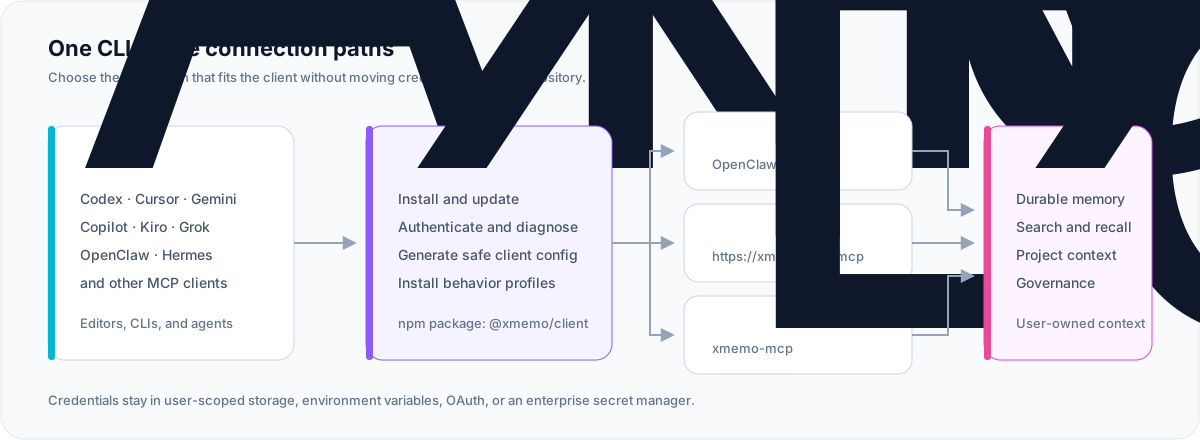
| Package | @xmemo/client |
| Primary command | xmemo |
| Local MCP command | xmemo-mcp |
| Hosted MCP | https://xmemo.dev/mcp |
| Runtime | Node.js 20 or later |
| License | MIT |
Why XMemo CLI
- One control plane — login, diagnostics, configuration, profiles, updates, and smoke checks share one predictable interface.
- Private by design — generated project configuration references a credential; it never embeds the credential value.
- Native where it matters — OpenClaw and Hermes use dedicated memory integrations instead of duplicating the same capability through MCP.
- Portable everywhere else — hosted Streamable HTTP MCP and local stdio cover modern editors, terminals, and agent runtimes.
- Safe automation — supported setup and removal paths offer preview, dry-run, or explicit confirmation before making changes.
- Small supply-chain surface — the npm package is governed by an explicit file allowlist and release provenance.
Quick start
Replace codex with your client. Preview a configuration before writing it:
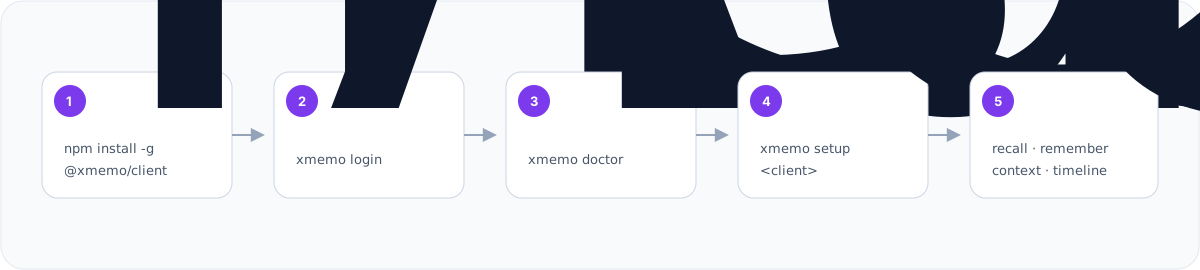
[!TIP] Start with
xmemo login,xmemo doctor, andxmemo setup <client>. Hand-edit MCP configuration only when a client has no verified setup path.
Supported integrations
| Client | Recommended command | Connection |
|---|---|---|
| Codex | xmemo setup codex | Hosted MCP + behavior profile |
| Cursor | xmemo setup cursor | Hosted MCP + Bearer Token + behavior profile |
| Copilot CLI | xmemo setup copilot | Local authenticated proxy |
| Gemini CLI | xmemo setup gemini | Hosted MCP + OAuth |
| Antigravity | xmemo setup antigravity | Hosted MCP + OAuth |
| OpenClaw | xmemo setup openclaw | Native memory plugin + Skill |
| Hermes | xmemo setup hermes | Native memory provider |
| Kiro | xmemo setup kiro | Native HTTP OAuth; --auth key for API Key |
| Grok | xmemo setup grok | Hosted MCP |
| Other MCP clients | xmemo mcp config --client generic | Generated template |
The client registry also covers Windsurf, Cline, Continue, Claude Desktop,
Claude Code, Kimi Code, Zed, JetBrains, OpenCode, Qwen, Trae, and compatible
MCP hosts. Run xmemo mcp list for the current machine-readable catalog.
Connection modes
Hosted MCP
The recommended universal path is the XMemo Streamable HTTP endpoint:
OAuth-capable clients complete authentication in the browser. Other clients
reference XMEMO_KEY without copying its value into repository files.
Generic configuration shape:
Client configuration keys differ; prefer xmemo setup <client> over copying
this generic example directly.
Local stdio MCP
xmemo-mcp is the dedicated stdio entry point for marketplaces and clients
that launch a local process. Safe discovery exposes 20 tools, three prompts,
and two documentation resources without a token. Tool execution still requires
authentication.
After a global installation:
Install-free MCP configuration:
xmemo mcp serve is equivalent when the CLI is already installed.
Native integrations
OpenClaw and Hermes have dedicated memory providers. Their default setup avoids installing a second, duplicate XMemo tool surface.
Add hosted MCP only when an explicit fallback is desired:
Use --mcp-only to skip the native integration and install only the hosted MCP
fallback.
Authentication
Browser login
Recommended for personal accounts:
The CLI uses the hosted device-login flow, waits for browser approval, and
asks once before storing the issued credential unencrypted in the current
user's XMemo config directory. The exact path is shown before approval, file
permissions are restricted where the operating system supports it, and the
credential value is never printed. Prefer XMEMO_KEY or a managed secret store
on shared systems.
For non-interactive automation, record the same decision explicitly:
Existing token
Pipe an existing token through stdin so it does not appear in command history:
PowerShell:
For CI and managed workstations, expose XMEMO_KEY through the platform's
secret manager. Do not commit it to .env, MCP configuration, logs, issue
reports, or chat transcripts.
Command reference
Lifecycle and diagnostics
Authentication
Client setup
Direct XMemo service client
Related MCP Servers
Adoption & maintenance
Factual signals from GitHub, npm, and our automated checks — not a rating.
GitHub stars
12
Stargazers on the source repository.
Last commit
5d ago
Most recent push to the default branch.
Availability
100%
Our rolling endpoint + install checks that succeeded.
Install check
Passed
Our sandbox started it and listed its tools.
Tools exposed
20
Callable tools this server registers over MCP.
Directory activity
2 views
Config copies, upvotes, and views on AllMCPs.
Reviews
No reviews yet — be the first to share how this listing worked for you.
Frequently Asked Questions about Memory Os Cli
AllMCPs Directory Badge
Showcase your server listing on GitHub or your project documentation. Embed this dynamic SVG badge to highlight official listing status and live engagement.
Badge Style:
Live Dynamic SVG Preview
Markdown (GitHub README)
[](https://allmcps.com/mcp/yonro-memory-os-cli)HTML Embed
<a href="https://allmcps.com/mcp/yonro-memory-os-cli"><img src="https://allmcps.com/api/badge/yonro-memory-os-cli?style=directory" alt="Memory Os Cli on AllMCPs" /></a>