Yandex search results, images, and SERP data via the Apify Yandex Search Scraper, hosted MCP.
Quick Install
Automated & IDE SetupCopy the AI prompt to install this server into Claude Code, Cursor, or another agent — or use 1-click editor setup below.
Not yet automatically verified
We haven't yet run this listing's install command through our automated sandbox check. This isn't a red flag — we're steadily working through the catalog.
Manual Client & Custom JSON ConfigExpand JSON ▾
Client Config & Setup
Choose your client or environment
Target File:
💡 Paste the JSON block into your client's configuration file under mcpServers, then restart the application.
Documentation Overview
English | Русский
🔎 Yandex API: Structured Yandex Search Results in Clean JSON
The most efficient, reliable, and developer-friendly way to use the Yandex API.
Actor page: apify.com/johnvc/Scrape-Yandex Input schema: apify.com/johnvc/Scrape-Yandex/input-schema
The Yandex API runs a Yandex search for any query and returns clean, structured JSON. Choose the result types you want a la carte (organic listings, paid ads, knowledge graph entity cards, inline image panels, inline video panels); each selected type comes back as its own item tagged with item_type, plus per-page metadata. It supports 6 Yandex domains, 19 languages, and region targeting across 123,000+ locations, with sort/recency filters and fast parallel pagination.
Video Walkthrough

Quick Start
Prerequisites
- Python 3.11 or higher
- An Apify account and API key (get a free key here)
-
Clone the repository
-
Install dependencies with UV
-
Configure your API key
-
Run the example
Alternative: set the API key directly
Why Use This Yandex API?
Full results-page coverage. One call returns the whole Yandex results page as structured data: organic listings, paid ads, knowledge graph entity cards, inline image panels, and inline video panels. You get the entire page, not just the organic links.
Built for Russian-speaking and CIS markets. Target 6 Yandex domains (yandex.com, yandex.ru, yandex.by, yandex.kz, yandex.uz, yandex.com.tr), 19 languages, and any of 123,000+ region IDs. That makes it practical for SEO, competitive intelligence, and brand monitoring across Russia, Eastern Europe, Central Asia, and beyond.
Predictable, pay-per-use pricing. Billing is per run plus per page processed, with no monthly rental. You pay for the searches you actually make, and you control cost directly with the page limit.
Clean, consistent JSON. Every page is a structured dataset item with the same shape, so you parse results once and reuse the code across queries, domains, and languages.
Easy to automate. Call it from Python in a few lines, or load it as an MCP tool so assistants like Claude and Cursor can run Yandex searches for you on demand.
Features
Core Capabilities
- Keyword search across Yandex with full results-page extraction
- A la carte result types: toggle organic results, ads, knowledge graph, inline images, and inline videos independently; each selected type is returned as its own item tagged with
item_type - Domain localization across 6 Yandex domains
- Language targeting with 19 supported languages
- Region targeting with 123,000+ location IDs (the
lrparameter) - Sort and recency filters:
sort_mode(relevance or date) andperiod(all, day, last_two_weeks, month) - Safe search and typo correction controls, plus fast parallel multi-page pagination
Data Quality
- Structured organic results with title, link, snippet, position, displayed link, date, and sitelinks
- Rich result blocks: ads, knowledge graph, inline images, inline videos, each with a
result_count - Per-page metadata with domain, language, location, and pagination details
- Consistent JSON shape across every query
- Per-page billing so larger searches stay transparent
Usage Examples
Basic Example
A single-page search for one keyword. This is the cheapest way to try the API.
Advanced Example
A Russian-domain search with Russian language, a region ID, more results per page, and two pages.
A la carte: collect ads and the knowledge graph
Enable just the result types you want. Here organic is off and only ads plus the knowledge graph are returned, each as its own item.
Fresh results: sort by date, last two weeks
Use sort_mode and period to focus on recent content. They apply to every selected result type.
Input Parameters
| Parameter | Type | Required | Default | Description |
|---|---|---|---|---|
text | string | Yes | - | The search query. Supports Yandex operators such as site:wikipedia.org python. |
include_organic_results | boolean | No | true | Return organic results (item_type organic). |
include_ads | boolean | No | false | Return paid ads when present (item_type ads). |
include_knowledge_graph | boolean | No | false | Return the knowledge graph card when present (item_type knowledge_graph). |
include_inline_images | boolean | No | false | Return the inline image strip (item_type inline_images). |
include_inline_videos | boolean | No | false | Return the inline video carousel (item_type inline_videos). |
yandex_domain | string | No | yandex.com | Yandex domain, e.g. yandex.ru, yandex.com.tr, yandex.kz (6 supported). |
lang | string | No | en | Language code, e.g. ru, en, tr, de (19 supported); null for unspecified. |
lr | integer | No | (domain default) | Region ID, e.g. 225 = Russia, 84 = United States, 149 = Belarus. 123,000+ IDs; see the Actor page for the full table. |
max_pages | integer | No | 2 | Maximum pages to fetch (0 = no limit). Applies to every selected result type. |
sort_mode | string | No | relevance | Result ordering: relevance or date (newest first). |
period | string | No | all | Recency window: all, day, last_two_weeks, month. |
groups_on_page | integer | No | 10 | Results per page (1 to 20). |
family_mode | integer | No | 1 | Safe search: 0 = off, 1 = moderate, 2 = strict. |
fix_typo | boolean | No | true | Auto-correct spelling errors in the query. |
output_file | string | No | (none) | Optional filename to save results; auto-generated if omitted. |
Output Format
Each selected result type present on a page is returned as its own dataset item, tagged with item_type (organic, ads, knowledge_graph, inline_images, or inline_videos) and a result_count. A representative organic item for the query Apple is shown below; arrays and some fields are trimmed here for readability.
Use as an MCP tool
You can load the Yandex API as an MCP tool so assistants call it for you. The MCP server URL preloads just this one Actor:
Authenticate with OAuth in the browser when offered, or with your Apify API token (the same APIFY_API_TOKEN used by the Python example). Get a token at https://console.apify.com/settings/integrations and a free Apify account at https://apify.com?fpr=9n7kx3 .
Install in Claude Cowork Desktop
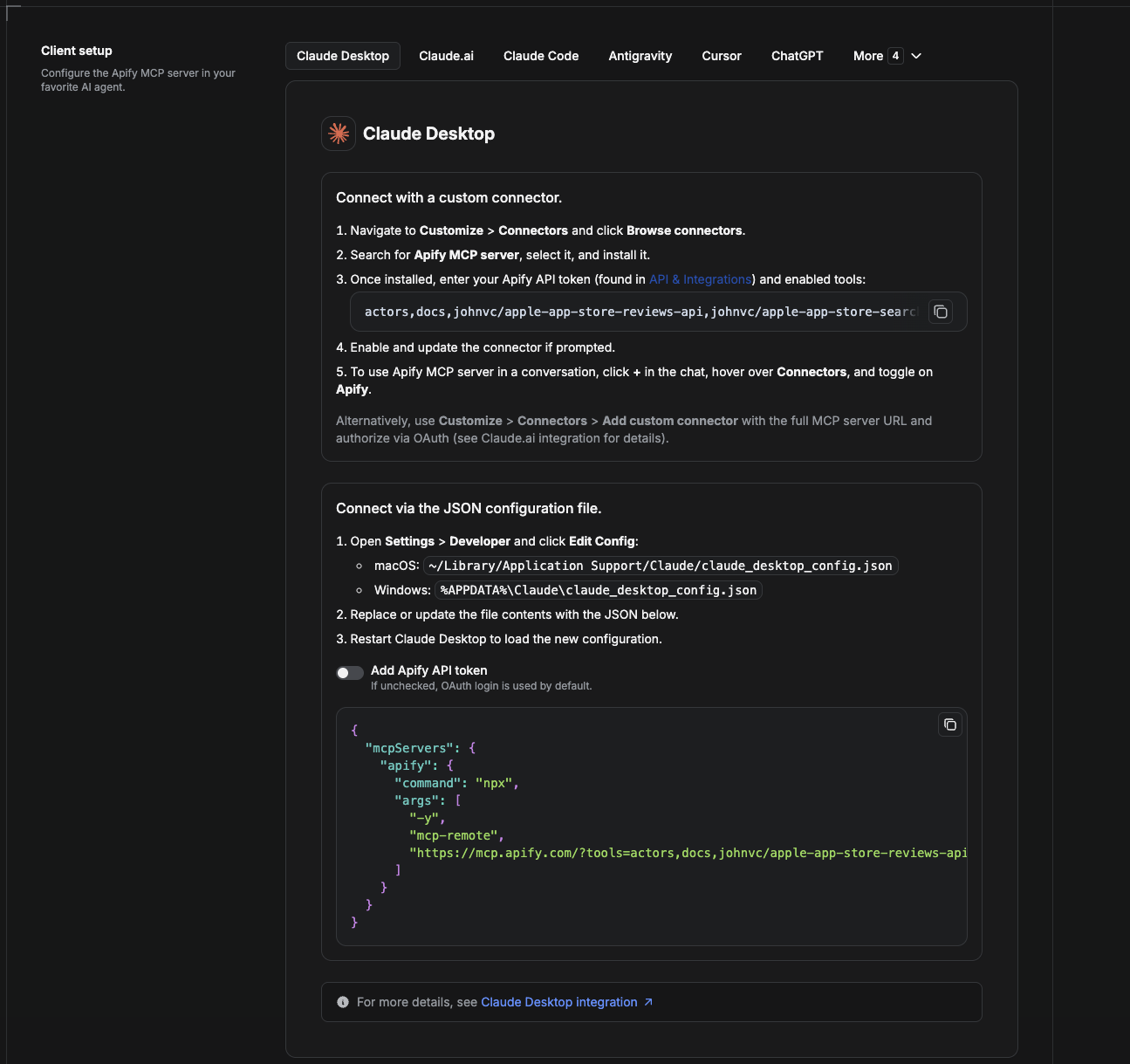
Cowork is the desktop app's automation mode. To give it the Yandex API as a tool, add the Apify MCP server as a connector.
Related MCP Servers
Reviews
No reviews yet — be the first to share how this listing worked for you.
Frequently Asked Questions about Yandex Search
AllMCPs Directory Badge
Showcase your server listing on GitHub or your project documentation. Embed this dynamic SVG badge to highlight official listing status and live engagement.
Badge Style:
Live Dynamic SVG Preview
Markdown (GitHub README)
[](https://allmcps.com/mcp/yandex-search)HTML Embed
<a href="https://allmcps.com/mcp/yandex-search"><img src="https://allmcps.com/api/badge/yandex-search?style=directory" alt="Yandex Search on AllMCPs" /></a>