Agent Memory OS README
The full upstream README, mirrored here for reference. Install config, tool schemas, adoption signals, and an original overview live on the Agent Memory OS listing page.




English · 繁體中文
A local-first memory system for AI-agent teams — not just giving one agent a memory, but a shared memory fabric for a fleet of agents working together: private, team, and project-scoped memories behind a hard ACL, associative recall, and federated sync that keeps a mesh of nodes (and their org structure) in agreement. One SQLite file, zero required dependencies, Apache-2.0.
Why · Compare · Install · Quickstart · Features · Federation · Web UI · User Guide
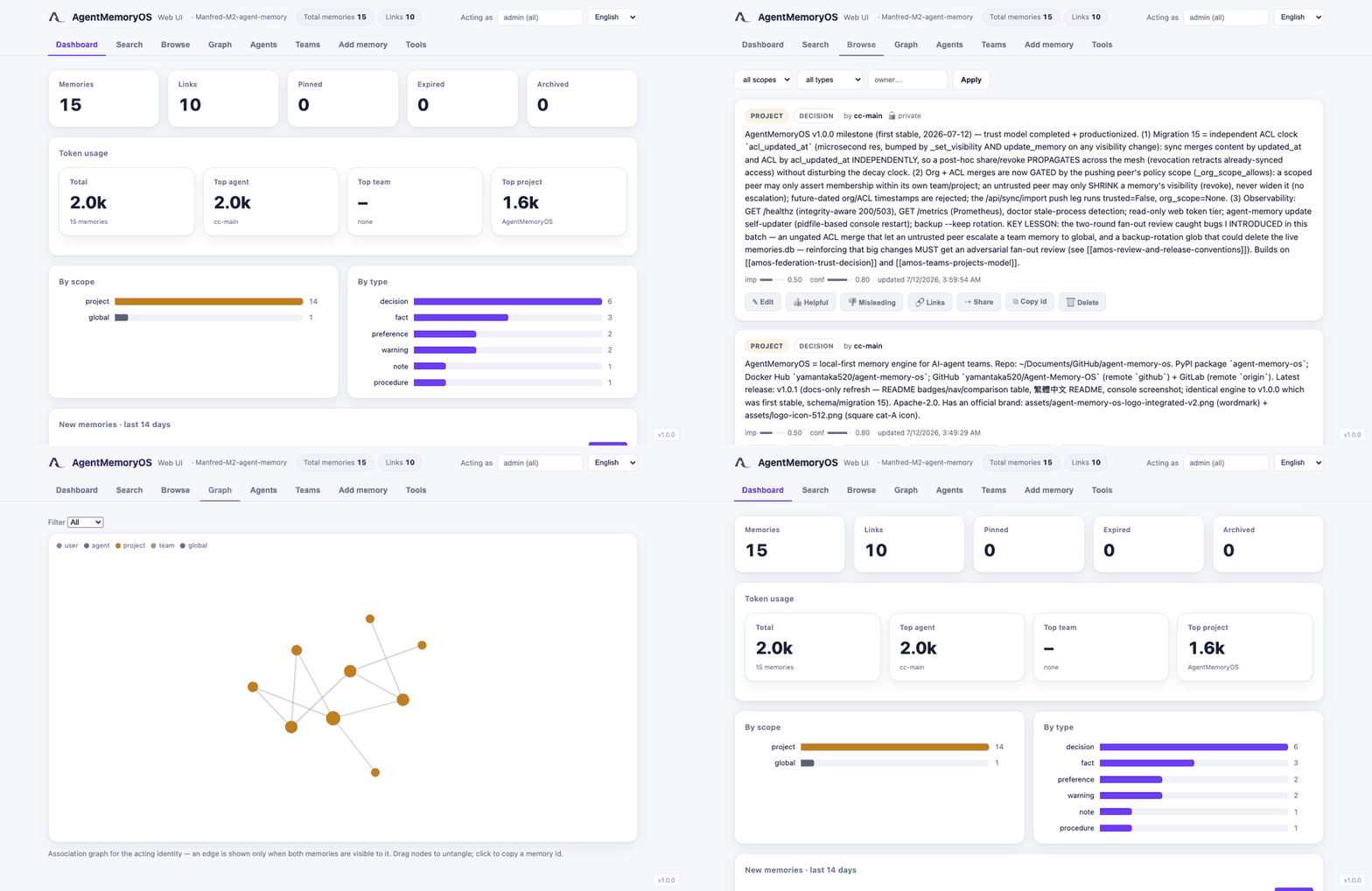
The built-in web console: token-usage by agent/team/project, memory browse, and the ACL-safe association graph.
Why
Real work happens in teams of agents — a project might mix Claude Code, Codex, OpenClaw, and several Hermes profiles, across multiple teams and projects, on one machine or many. They need to share the right knowledge with the right teammates and keep private what should stay private:
- Per-agent memory is the floor, not the ceiling: durable facts, preferences, procedures, and lessons that survive across sessions.
- Team & project memory is the point: a team sees
team:<id>memory; a project (a subset of the team) seesproject:<id>memory; nothing leaks across the boundary. Membership is first-class and manageable, and drives the ACL. - Federation keeps a mesh honest: memories and the org structure (teams/projects/memberships) converge across nodes, so
project:<id>means the same thing everywhere. - Local-first avoids the latency, cost, and privacy tradeoffs of cloud memory platforms — memories live in a local SQLite file, and each prompt receives only the relevant, budgeted slice.
Features
- Local-first, zero-dependency core — one SQLite file (FTS5), no server required.
pip installand go. - Teams & projects, first-class — teams are sets of node members; a project's members are a subset of its team.
team:<id>memory reaches the whole team,project:<id>memory only that project — a hard ACL, managed in the console/CLI/API. Removing a member re-scopes recall instantly; deleting a scope revokes its memory. - Federated across nodes, with a real trust model — portable bundles + peer sync converge memories, links, profiles, and the org structure (teams/projects/memberships) with last-writer-wins + tombstones. Per-peer policy (
shared/full/team:/project:) is an enforced authorization scope: a peer can only assert membership within its own scope and can only shrink a memory's visibility, never widen it — no cross-scope escalation from a bundle. - Revocation that propagates — an independent ACL clock carries a post-hoc share/revoke across the mesh, so revoking access actually retracts it on peers that already synced the memory — without disturbing the decay clock.
- Requester-aware ACL — every agent has private, agent, team, project, and global memories; visibility is a hard gate enforced before ranking, never a soft score. Candidate indexes return IDs only; content is re-read through the gate.
- Dynamic context packs — token-budgeted, auditable memory selection per prompt (
context_pack_report()explains every include/exclude decision). - Truth arbitration — duplicate suppression, contradiction detection (
CONFLICTmarkers), and reserved budget for core memories. - Associative recall (resonance) — an authoritative
memory_linksgraph lets related memories surface even when they share no query terms; traversal is ACL-safe (invisible nodes are untraversable). - Hebbian reinforcement — memories recalled together grow stronger links (
record_recall, orauto_reinforce=Trueon context packs); unhelpful recalls weaken links and confidence (helpful=False). - Per-agent recall profiles — different agent personas weight memory types differently (an engineer leans on
procedure, a companion onpreference); profiles persist in the database and re-weight ranking only, never bypassing ACL. - Memory lifecycle — exponential/linear decay, pinning, hard expiry, and a write-side
consolidate()pass that merges duplicates and synthesizes strongly co-recalled clusters into concept memories. - Optional sidecars — semantic vector candidates (turbovec), MCP server, and a FastAPI Web UI, all behind extras; every candidate rejoins SQLite and passes hard gates before use.
How it compares
Most agent-memory systems optimize for LLM-driven extraction at hosted scale. AgentMemoryOS optimizes for a different point: local-first, team-scoped, and federated — memory you run yourself, shared across a fleet under a hard ACL. This is a positioning comparison (architecture, not a benchmark); verify each row against the projects' current docs.
| AgentMemoryOS | Mem0 | Zep / Graphiti | |
|---|---|---|---|
| Run it | One SQLite file, pip install | Self-host (configure LLM + vector DB) or hosted | Zep Cloud, or self-host Graphiti on Neo4j/FalkorDB |
| Core needs an LLM | No (FTS5 + optional local vectors) | Yes (LLM extraction, e.g. gpt-5-mini) | Yes (LLM builds the temporal graph) |
| External services | None required | LLM API + vector store | Graph DB + LLM + embeddings (3+ systems to self-host) |
| Scope / ACL model | Private / agent / team / project / global — hard gate before ranking | Per user / agent / session id | Per user / session graph |
| Cross-node federation | Yes — memories and org structure converge; revocation propagates | Centralized store | Centralized (Cloud or your graph DB) |
| Built-in MCP server | Yes | Via SDK | Via SDK |
| License / self-host | Apache-2.0, fully OSS | OSS core; graph & advanced tiers paid | Community Edition deprecated; self-host = raw Graphiti |
Mem0 and Zep are strong at LLM-based extraction and managed-scale retrieval — things AgentMemoryOS deliberately doesn't do. Reach for AgentMemoryOS when you want a dependency-light memory you own, shared correctly across a team of agents, that keeps working offline and syncs on your terms.
Install
Or pick pieces: agent-memory-os (core, zero dependencies), [api] (Web UI), [mcp] (MCP server), [semantic] (turbovec vector recall).
Docker: the prebuilt multi-arch image is the complete AgentMemoryOS (web console + MCP server + CLI); the first argument picks the mode:
Or docker compose up -d. Console at http://localhost:8000, memories persist in a volume. See the Docker guide (Docker Hub image + a two-node sync mesh).
Requires Python 3.11+ with SQLite FTS5 (included in standard CPython builds).
After installing, run two commands:
The token is stored at <home>/web_token (mode 600); agent-memory-web picks
it up automatically and the console prompts for it on first use. Manage it
later with agent-memory token show|rotate|disable. Two narrower tiers exist:
--readonly (GET-only) and --sync (federation routes only — hand this to a
peer instead of the admin token).
Quickstart
Prefer a runnable script?
examples/team_memory.pyshows three agents sharing one store under a hard ACL in ~40 lines —python examples/team_memory.py.
Architecture
Design invariants:
- The SQLite
memoriestable is the single source of truth; FTS/vector indexes are disposable and rebuildable (rebuild_indexes()). - Candidate providers return IDs and scores only — content is always re-read through SQLite behind the ACL and expiry hard gates.
- Association edges (
memory_links) are authoritative data, survive index rebuilds, decay when unused, and never let an invisible memory bridge two visible ones.
See SPEC.md for the full contract.
Storage engines: SQLite + turbovec
AgentMemoryOS uses two storage layers with strictly different authority:
- SQLite (always on) is the single source of truth: memories, links,
profiles, and the FTS5 lexical index all live in one
memories.dbfile. - turbovec (installed with
[full]/[semantic]) is the semantic vector engine: an in-memory quantized index that recalls memories by meaning rather than keywords. It is deliberately disposable — it returns candidatememory_ids and scores only; every candidate rejoins SQLite and passes the ACL/expiry hard gates before its content can be used, and the index can be dropped and rebuilt at any time without touching the truth store.
Semantic recall works out of the box:
semantic="auto" wires in a self-syncing turbovec index over a built-in
deterministic hashing embedder (no model downloads; typo- and
morphology-tolerant lexical vectors). The index rebuilds itself whenever the
memories table changes and degrades silently to lexical + resonance recall
when the backend isn't installed. For deeper semantics, plug any embedding
model into TurbovecSemanticCandidateProvider.from_vectors(...) with your
own embed_query. agent-memory doctor confirms the backend is importable.
Memory lifecycle & retention
Archived memories leave recall entirely but stay restorable (Web UI → Tools →
Retention & archive, or POST /api/archive/{id}/restore). Pinned and
authority-track memories are never archived by decay. Databases self-migrate
through a versioned, forward-only migration table (agent-memory check
reports the schema version).
Backup & restore
Backups use SQLite's online backup API, so they are consistent even while
agents are writing. --keep N rotates out older backups in the same name
series (and can never delete the live database). Disposable indexes rebuild
automatically after a restore.
Upgrades & health. agent-memory update checks PyPI, upgrades, and restarts
the running console; --check reports only. Point health checks at GET /healthz
(200/503) and a Prometheus scraper at GET /metrics.
Multi-agent projects
One project can mix Claude Code, Codex, OpenClaw, and multiple Hermes
profiles against a single store. Register each agent with its teams —
in the console's Agents tab or via API — and team members automatically
see team:<project> memories with no extra wiring:
Or declare the whole fleet as code — <home>/agents.toml is re-applied
every time the store opens (file-listed agents are file-authoritative;
manually registered agents are untouched):
Each MCP server declares its identity with AGENT_MEMORY_AGENT_ID, so
memories default to that agent as owner and every recall carries its team
ACL. Ship one project's shared memory to another host with
agent-memory sync export apollo.jsonl --team apollo.
Federation (multi-host sync)
Peers are stored per-home; sync auto (or the console's "Sync mesh now")
converges bidirectionally with each peer — last-writer-wins on memories and
profiles, strongest-wins on links — and unreachable peers fail individually,
never fatally. File bundles (sync export/import) cover air-gapped moves.
Pair with agent-memory service install and a cron/timer entry for
continuous mesh sync.
Encrypt the wire. Give every node the same mesh key and sync bundles are encrypted app-layer (Fernet), so memory content stays confidential even over plain HTTP or through a proxy — the key is a separate secret that never travels on the wire:
The sync-scoped token still rides in the Authorization header, so prefer
https:// peer URLs (certificate-verified) for non-localhost peers to protect
the token too. See SECURITY.md for the exact guarantees.
Agent integrations
Step-by-step guides for wiring AgentMemoryOS into common agents — click a tile:




Hermes Agent gets a native memory-provider plugin (not just MCP):
pip install agent-memory-os && agent-memory hermes install, then pick
agent-memory-os in hermes memory setup — recall is injected every turn and
amos_* tools carry the team/project ACL. No API key, no LLM. See the
Hermes guide.
Any MCP-capable agent can use the same pattern: run
python -m agent_memory_os.mcp_server as a stdio MCP server pointing at a
shared AGENT_MEMORY_HOME.
MCP server

Wire it into Claude Code in one line (set the agent identity so memories are owned correctly):
Tools (12): memory_add (with a share arg for team/project/global), memory_search, memory_context_pack, memory_orchestrate_context, memory_link, memory_update, memory_share, memory_recall_feedback, memory_consolidate, memory_offload_context, memory_reload_context, memory_snapshot_diff. Set AGENT_MEMORY_AGENT_ID so each agent acts under its own identity — and two agents pointed at the same home instantly share team:/project: memories.
Web UI
The console speaks English, 繁體中文, 简体中文, 日本語, and 한국어 — auto-detected from the browser, switchable in the header. It ships with a stats dashboard (scope/type/relation breakdowns, 14-day activity, most-recalled memories), search and recency browsing (memory cards with in-place editing, feedback, links, and delete actions), an interactive association-graph view, a context-pack preview with per-memory decisions, and add/link/consolidate tools — all driven by a global "acting as" identity.
Endpoints: health/stats/dashboard/integrity · memories CRUD + browse · search / context-pack / orchestrate · links + graph · recall feedback · share / revoke / audit · consolidate / retention / archive+restore · agents registry · peers + mesh sync · bundle export/import · owner list / reassign / purge · fleet status/trigger (Ed25519-signed cross-node ops). Full table in the User Guide.
Search, browse, graph, recall feedback, and context-pack accept requester_agent_id and enforce the same ACL hard gates as the SDK. Requests without a requester run in unrestricted admin view — bind to localhost only, or require a bearer token on every API route with --token <secret> (or AGENT_MEMORY_WEB_TOKEN).
Note: keep the --home database on a local disk. Network filesystems (NFS/SMB) can fail SQLite FTS5 schema creation with database is locked.
Run as a login service (macOS / Linux / Windows)
install registers the console with the native service manager so it starts
automatically at login and restarts on failure — launchd LaunchAgent on
macOS, a systemd user unit on Linux, a Task Scheduler logon task on Windows.
No admin rights required; the service runs the exact Python environment it
was installed from, and logs to <home>/logs/web.log. On Linux, run
loginctl enable-linger $USER if it must start at boot without a login.
Add --dry-run to preview the actions. CI runs the full test suite on
Ubuntu, macOS, and Windows across Python 3.11–3.13.
Development
Status
Stable — 1.x. The contracts above are implemented, covered by the test
suite (300+ tests across a 3-OS CI matrix, plus a migration upgrade-path job),
and audited by repeated fan-out code + security reviews (reports under
docs/reviews/). Performance is verified at 10k memories (add
0.17 ms, search <1 ms, context-pack 7.8 ms). The database self-migrates forward;
see the CHANGELOG for what each release added.
Documentation
- User Guide — concepts, full CLI / HTTP API / MCP references, multi-agent and federation walkthroughs, ops checklist
- Docker guide —
docker/docker composestartup, config via env, two-node sync mesh - SPEC — contracts and invariants, by milestone
- Security & Threat model — disclosure policy, trust boundaries, and honest known limitations
- Embeddings & scale — plug in a real embedding model; behaviour from 10k to 1M memories
- Importers — migrate from Mem0 / Zep / ChatGPT · Compatibility — the 1.x semver promise
- Reviews & reports — fan-out code + security reviews (through the 1.x line), the performance/security report, and the validation harness (
scripts/validation_run.py) - CHANGELOG · Roadmap · Integration guides