WildDatum README
The full upstream README, mirrored here for reference. Install config, tool schemas, adoption signals, and an original overview live on the WildDatum listing page.
WildDatum



WildDatum is a local-first ecological data workbench exposed as a standard Model Context Protocol server. It lets Codex, Claude, and other MCP agents discover, materialize, query, visualize, select, and cite scientific data without putting credentials, private paths, or millions of rows into model context.
NEON plus public ERDDAP services from EMSO ERIC, ICOS Carbon Portal, and Euro-Argo/Ifremer are built-in remote providers. Local tabular, raster, vector, point-cloud, image, hyperspectral, and N-dimensional array sources use the same provider-independent manifest, query, view, selection, and provenance model.
“Compare this NEON LiDAR tile with its hyperspectral cube. Show them together, let me select an individual return or image pixel, then query the exact source point or spectrum behind my selection.”
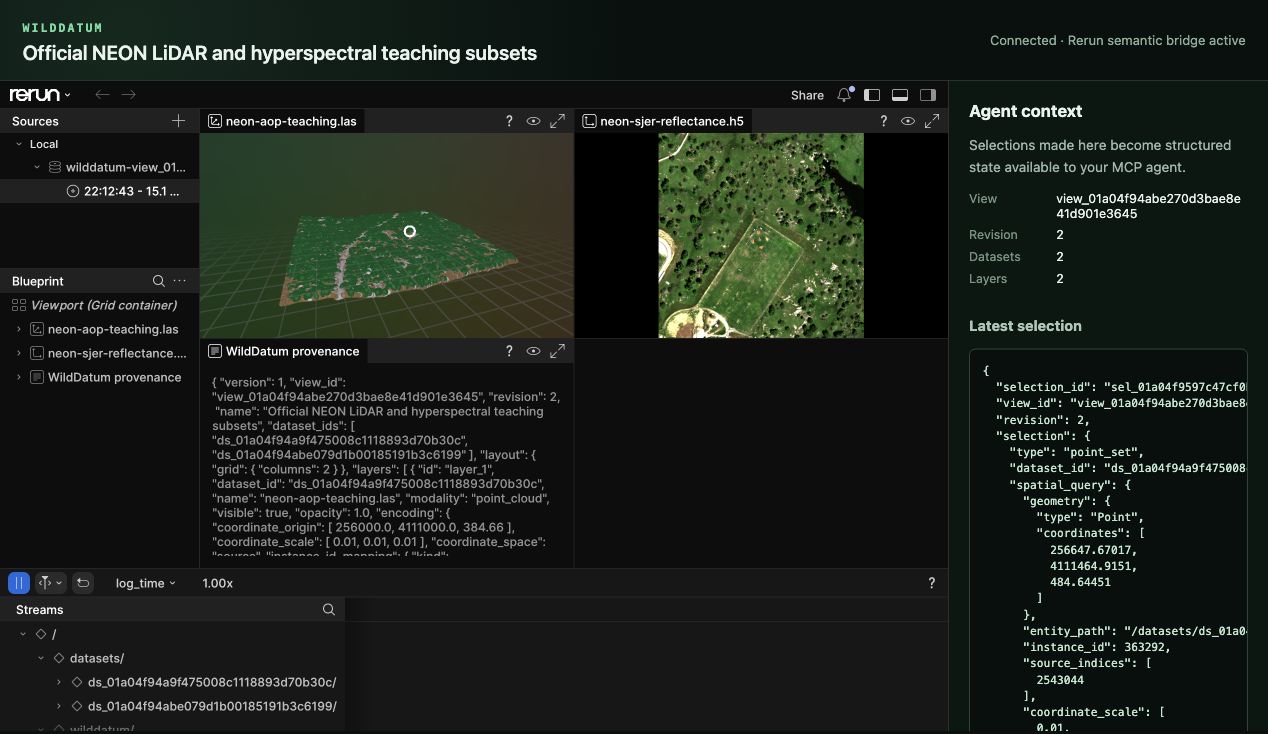
A real WildDatum browser session using Rerun Web Viewer: a 6.6-million-point NEON LAS tile, a 500×500×107 reflectance cube, immutable provenance, and a verified selection mapped back to LAS source row 2,543,044.
The human–agent loop
The visualization is not just a picture for the model to inspect. EcoViewSpec
is authoritative view state and SemanticSelection is authoritative interaction
state. A Rerun recording is a regenerable rendering artifact. For verified
WildDatum point batches, an instance pick maps back to an exact LAS/LAZ source
row; for a mapped cube, an image click maps back to the complete source spectrum.
For linked trajectories and vertical profiles, a map or profile point maps back
to the exact physical CSV/TSV, Parquet, or Arrow record, including
provider-native QC values.
What works in the alpha
- A normal MCP 2026-07-28 stdio server registerable with Codex and Claude Code.
- Public NEON catalog discovery plus reproducible plan, approval, background materialization, checksum, release, license, and citation handling.
- Public EMSO, ICOS ERDDAP, and Euro-Argo catalog discovery plus validated tabledap/griddap subsets, redirect-aware approval, streaming materialization, license, citation, and live-source provenance.
- Out-of-band local imports with streaming fingerprints and opaque agent-facing dataset IDs.
- Arrow/DataFusion tabular queries, spatial raster/vector queries, indexed COPC reads, and bounded HDF5/NetCDF/Zarr N-dimensional slices.
- Native and browser Rerun views for tables, images, GeoTIFFs, vectors, LiDAR, mapped scientific cubes, and linked geographic trajectories/vertical profiles.
- Durable human selections that can be converted into provenance-linked source queries and exported as CSV, Parquet, COG, or RO-Crate where applicable.
- Language-neutral community provider subprocesses with a provider-neutral v2 JSON-RPC contract; an RI contributor can work in Rust, Python, R, Go, or another language without adding provider-specific MCP tools.
Alpha.3: linked scientific views
The main branch can now inspect the scientific structure of an existing local or materialized dataset without exposing its private path:
The equivalent registered MCP tools are inspect_scientific_inventory and
suggest_views; create_view_from_suggestion accepts one of those opaque
suggestion IDs, and resolve_selection_links evaluates applicable rules after
a human selection. Inventories contain bounded fields, arrays, axes, units,
CF/QC relationships, evidence, and unresolved decisions. Suggestions remain
deterministic and side-effect free until accepted. On acceptance WildDatum
recomputes the suggestion, rejects client-invented IDs, and persists an
EcoViewSpec v2 with explicit scientific panels, encodings, and versioned link
rules. Existing v1 views remain readable.
For the official NEON teaching pair, WildDatum reads the 107 measured
wavelengths, selects bands nearest 650/550/450 nm, and ranks a 3D point-cloud +
RGB + spectrum workspace first. Cube-pixel → spectrum is marked exact. WildDatum
also extracts LAS WKT/GeoKey CRS metadata and the HDF5 EPSG, Map_Info, spatial
extent, scale factor, and no-data value. The teaching cube's Map_Info origin
disagrees with its declared reflectance extent by 500 m, and its footprint does
not overlap the teaching LAS tile, so point → image pixel correctly remains
unavailable for that pair instead of pretending that proximity is
registration.
Accepted point-cloud + spectral-cube views render through the same pinned Rerun adapter and browser explorer as manually created views. The browser reports the view-spec version and panel/link counts. A cube-pixel pick automatically materializes its exact wavelength-aware spectrum as a durable result with the selection and link rule in its provenance. Unavailable link rules remain visible structured state and create no result rather than becoming guessed interactions. Link evaluation refuses stale selections after the view revision changes.
For datasets with the same authoritative CRS, an internally consistent north-up affine transform, and overlapping footprints, an exact point pick can now derive the source cube pixel and immediately chain into the complete wavelength-aware spectrum. The derived pixel, both link decisions, and the spectrum result remain inspectable through the normal MCP, CLI, and browser interfaces.
After resolution, the browser regenerates the authoritative view as a complete Rerun recording with a magenta source/derived pixel marker and the linked wavelength/value series inside its spectrum panel. The structured selection and result provenance still drive the overlay; the browser does not reconstruct it from canvas coordinates.
Linked trajectory/profile views now accept CSV, TSV, Parquet, GeoParquet, Arrow IPC, and Feather sources. One map can drive up to eight QC-aware value profiles. Inclusive depth/pressure/height ranges and deterministic per-profile point budgets reduce visual load while transparent source slots preserve exact Rerun-instance → physical-record identity for every displayed format.
Detailed support and caveats are in the format matrix. Design boundaries are documented in architecture and implementation decisions. Planned Research Infrastructure, visualization, and deployment work is tracked in the public roadmap.
Install and see it work
The alpha ships self-contained macOS universal and Linux x86-64 packages. You do not need Rust, Node.js, CMake, or a separate Rerun installation:
The installer verifies the release SHA-256, installs under ~/.local by
default, and runs wilddatum setup. Set WILDDATUM_INSTALL_DIR to choose another
prefix. If ~/.local/bin is not already on your PATH, add it before continuing.
Existing EcoScope alpha installations remain readable. WildDatum falls back to
legacy ECOSCOPE_DATA_DIR, ECOSCOPE_CACHE_DIR, ECOSCOPE_WEB_DIST, default
application-data directories, and NEON keychain entries when their WildDatum
equivalents are absent. The installer also leaves an ecoscope command alias
when it can do so without replacing a user-owned file.
Create a deterministic LiDAR + hyperspectral demonstration and open it in the bundled Rerun browser viewer:
The generated LAS and HDF5 files pass through the same import, manifest, cube mapping, Rerun recording, and selection-query paths as user data. No network or credentials are needed. An opt-in official NEON teaching-data demonstration is also available (roughly 224 MiB):
Register the normal MCP server
WildDatum is published as io.github.krnzt/wilddatum in the official MCP
Registry. It is also a normal local stdio server: Codex, Claude Code, and any
compatible host launch the same wilddatum mcp process and discover its tools.
Both registration commands are safe to repeat and preserve an existing WildDatum entry. Platform-specific MCPB bundles are attached to every release for hosts and registries that install MCPB packages.
Equivalent host commands are:
Generic MCP configuration:
After registration, the host launches WildDatum like any other local MCP server, negotiates the protocol, discovers its tools, and receives bounded structured results rather than bulk scientific files.
Use local scientific files
Local paths are selected in the terminal, never passed as an MCP argument. The private SQLite registry retains the source path; agents receive an opaque ID, checksum, display name, scientific metadata, and provenance. The same path supports the raster, vector, point-cloud, image, and cube formats in the format matrix.
Linked trajectories and vertical profiles
Profile/trajectory rendering is a validated recipe over ordinary CSV, TSV, Parquet, GeoParquet, Arrow IPC, or Feather data, not a provider-specific renderer. Start locally with the deterministic demo:
The agent workflow is the same for a local import or materialized ERDDAP table:
The recipe explicitly names trajectory/profile identifiers, time, longitude, latitude, vertical coordinate and direction, one primary plus optional additional displayed values, units, fill values, and accepted native QC codes. It can also apply an inclusive source-coordinate vertical range and a per-profile display budget. WildDatum validates those fields against the source before authoring the exact-row mapping; the browser cannot declare a source index trusted, and sampling never changes the source instance slots.
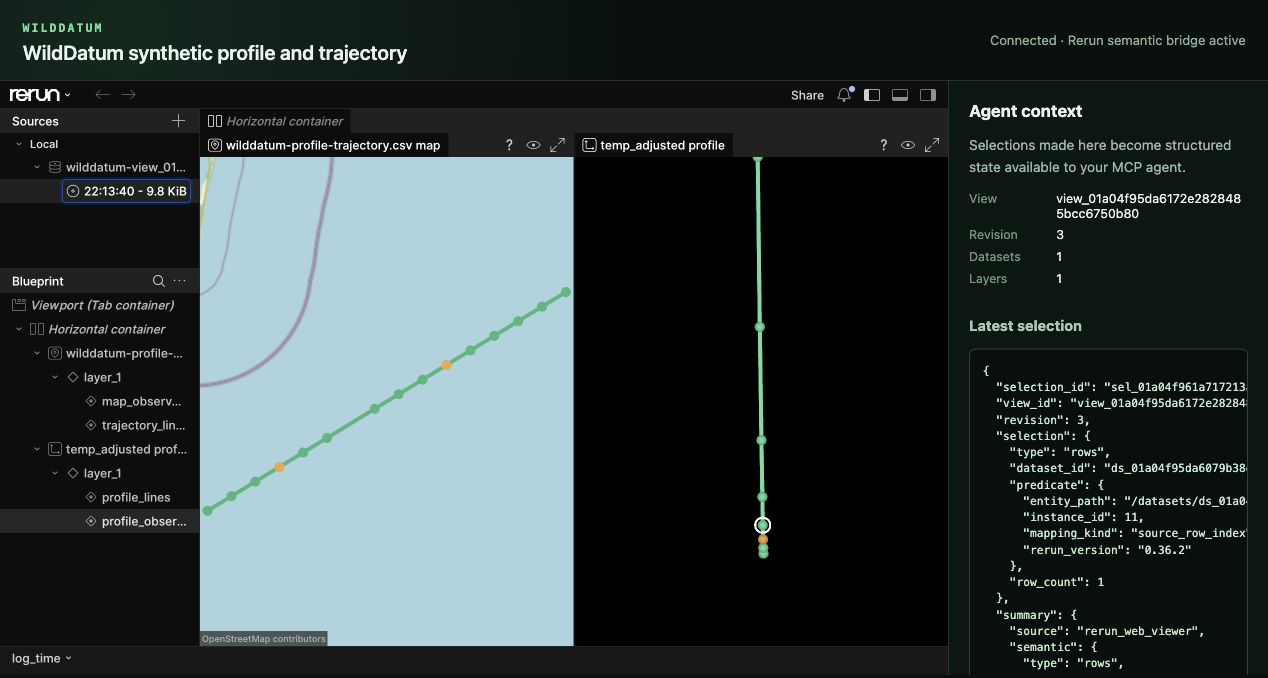
The shipped synthetic profile demo in Rerun Web Viewer. The selected profile
observation is persisted as a rows selection containing only its Rerun entity,
instance, mapping kind, and pinned version; the service independently resolves
that instance to the original delimited source row.
NEON
Metadata discovery does not require credentials. Exact file planning and downloads use a NEON API token stored outside model context:
The prompt does not echo the token. WildDatum stores it in the operating-system
keychain and sends it upstream only in the X-API-Token header. Headless systems
can inject NEON_API_TOKEN through their secret manager.
wilddatum doctor time-boxes its noninteractive keychain probe. A
neon_connected: null result with neon_credential_probe: "timed_out" means the
operating system did not answer the readiness probe; it does not expose or erase
the stored credential.
Public ERDDAP infrastructures
The normal registered MCP exposes three credential-free public presets through the same tools used for NEON and community providers:
| Provider ID | Public surface | Boundary |
|---|---|---|
emso | EMSO ERIC ERDDAP | Federated public datasets; approved redirect chains identify the regional server that returns the bytes |
icos-erddap | ICOS Carbon Portal ERDDAP | Public ERDDAP only; authenticated Carbon Portal objects are a separate future integration |
euro-argo | Ifremer ERDDAP | Catalog search is scoped to Argo/Euro-Argo data on the shared service |
An agent can call search_catalog and inspect_resource without credentials,
then construct a typed table subset:
That is the input to plan_materialization; planning does not download the
dataset. WildDatum validates every variable against ERDDAP info metadata,
translates neutral temporal bounds into time constraints for tabledap, probes
the exact redirect chain, and returns one URL for approval. Call approve_plan
with the returned hash and then materialize_dataset. The stored object is named
by its BLAKE3 digest, while the manifest retains the decoded query, redirect
chain, ETag, Last-Modified value, access time, server version, global attributes,
variable-level CF attributes, license, and citation. Downloads stream through a
configurable hard byte ceiling (512 MiB by default) and failed or oversized
partials are removed.
Grid subsets use protocol: "griddap" and explicit arrays. Each axis can use
integer indices or ERDDAP value coordinates:
ERDDAP subsets are live generated results rather than fixed releases. File size is generally unknown at approval time, so constrain variables, rows, time, and grid axes carefully. Materialization freezes the exact returned bytes locally; repeating the same upstream query later may produce a different checksum.
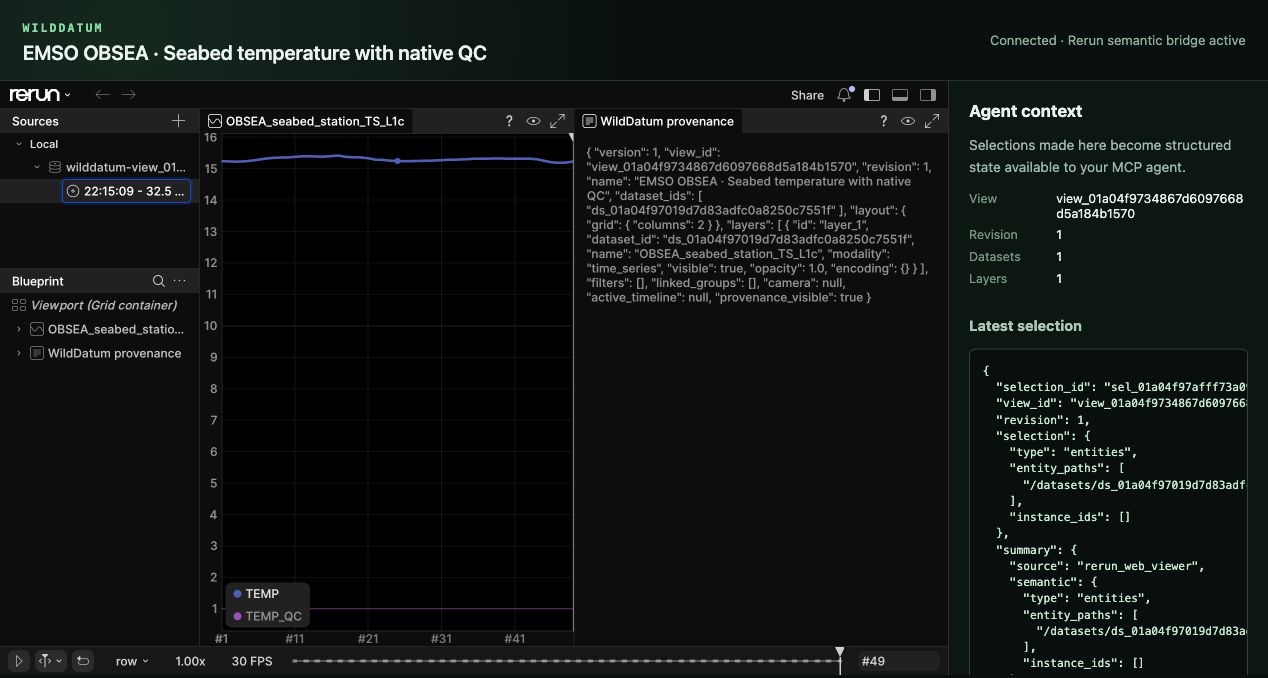
A real EMSO workflow executed through WildDatum's registered stdio MCP:
plan_materialization → approve_plan → materialize_dataset → create_view
→ render_view. The browser shows the public OBSEA temperature and native QC
channels, the regenerable EcoViewSpec, and selection events returned as
structured agent context.
Multidimensional data
WildDatum inventories cube arrays without guessing ambiguous scientific meaning. When X, Y, and spectral axes are unambiguous, common NEON reflectance conventions are inferred. Otherwise the mapping is explicit and revisioned:
The provider-neutral MCP equivalent is configure_cube_view.
Community providers
The maintained remote providers are built in, but the architecture is not institution-shaped. Install a trusted language-neutral provider executable with:
Installation performs a protocol handshake and validates provider identity,
capabilities, response bounds, and declared HTTPS origins. Provider executables
are trusted local code, not sandboxed plugins, and never receive credential
values. See the provider SDK for the complete wire
contract, conformance fixture, and security model. The canonical
DatasetRequest v2 and
provider manifest v2 schemas keep
RI-native names inside adapters while plan_materialization exposes one typed
MCP input across providers.
Known limitations
- WildDatum is local stdio MCP today; remote Streamable HTTP and OAuth are not implemented yet.
- The alpha macOS executables are not Apple-notarized. macOS may require an explicit first-run approval; release checksums still protect artifact integrity.
- The browser explorer uses Rerun's WebGL renderer for reliable software and CI support. Native Rerun remains the higher-ceiling surface for very large scenes.
- Rerun exposes entity/instance selection events, but not one universal brush
protocol for every view. Explicit interval, map, raster, spectral, and row
selections use the same
record_selection/query_selectionpath. - GeoParquet supports exact GeoDataFusion queries but not direct geometry logging into Rerun yet; GeoPackage currently has inspection but no query adapter.
- WildDatum-derived COPC indexes provide full-resolution spatial access but do not yet contain a provider-quality multiresolution hierarchy.
- Generic ERDDAP planning does not infer institution-specific station/location dimensions or translate arbitrary polygons. Use typed tabledap constraints or griddap slices. CF profile roles are preserved, but choosing the scientific value/QC policy remains an explicit recipe rather than an automatic guess.
- Linked profile rendering accepts up to eight displayed values from CSV/TSV, Parquet/GeoParquet, Arrow IPC, or Feather, but rejects sources above 100,000 rows rather than streaming or tiling them. Rerun's raw-value 2D aspect can make a narrow value range look horizontally compressed against a deep vertical range.
- The pure-Rust NetCDF-3 adapter bounds whole-variable decoding because its reader does not currently provide subset I/O.
Development
Building from source requires Rust 1.95, Node.js 22, CMake, and a C/C++ compiler. Linux uses a vendored static D-Bus client for keychain access.
Run the complete validation suite with:
An opt-in integration test exercises published NEON teaching subsets: a 6,609,829-point LAS tile and a 500×500×107 HDF5 reflectance cube.
The maintained ERDDAP presets also have opt-in live drift checks. They search and inspect all three services, materialize a tiny redirected EMSO subset, and run a bounded current Euro-Argo profile through CF discovery, materialization, recipe validation, and Rerun rendering:
Build local MCPB and archive artifacts after the Rust and browser builds with
scripts/package-release.sh target/release/wilddatum dist macos-arm64 darwin
(substitute linux-x86_64 linux on Linux). The tag workflow builds and combines
both macOS architectures, verifies the Linux linkage, publishes checksummed
release assets, and submits the generated server.json using GitHub OIDC.
Project status
WildDatum is an early public alpha. The scientific data model, provider contract, and Rerun boundary are designed for extension, but APIs and packaging may still change before the first stable release.
Contributions are welcome from ecological researchers, data stewards, Research Infrastructure teams, visualization developers, and scientific-format experts. Good first collaborations include representative metadata fixtures, format adapters, selection semantics, accessibility, and reproducible ecological demonstrations. Read CONTRIBUTING.md and open an issue before starting a large provider or viewer change.
WildDatum is MIT licensed. Rerun is used under its MIT/Apache-2.0 license; built bundles retain the required notices in THIRD_PARTY_NOTICES.md.