Hands your live Chrome tab to any MCP client — snapshot, navigate, click, type, extract.
Quick Install
Automated & IDE SetupCopy the AI prompt to install this server into Claude Code, Cursor, or another agent — or use 1-click editor setup below.
Manual Client & Custom JSON ConfigExpand JSON ▾
Client Config & Setup
Choose your client or environment
Target File:
💡 Paste the JSON block into your client's configuration file under mcpServers, then restart the application.
Documentation Overview
WebOperator — AI browser agent and MCP server for Chrome automation
Tell Chrome what you want done, in plain English, and let the agent do it.
Most browser agents bring their own browser. WebOperator works the one you are already in: the tab in front of you, with your sessions and logins intact — no separate profile, no re-login, no copying cookies around. The model behind it can be local, served by Ollama or MLX, so the pages you look at never have to leave the machine. And it works in both directions: the local bridge exposes that same live tab over MCP, so Hermes, OpenClaw, or any other agent client can borrow your browser as a tool.
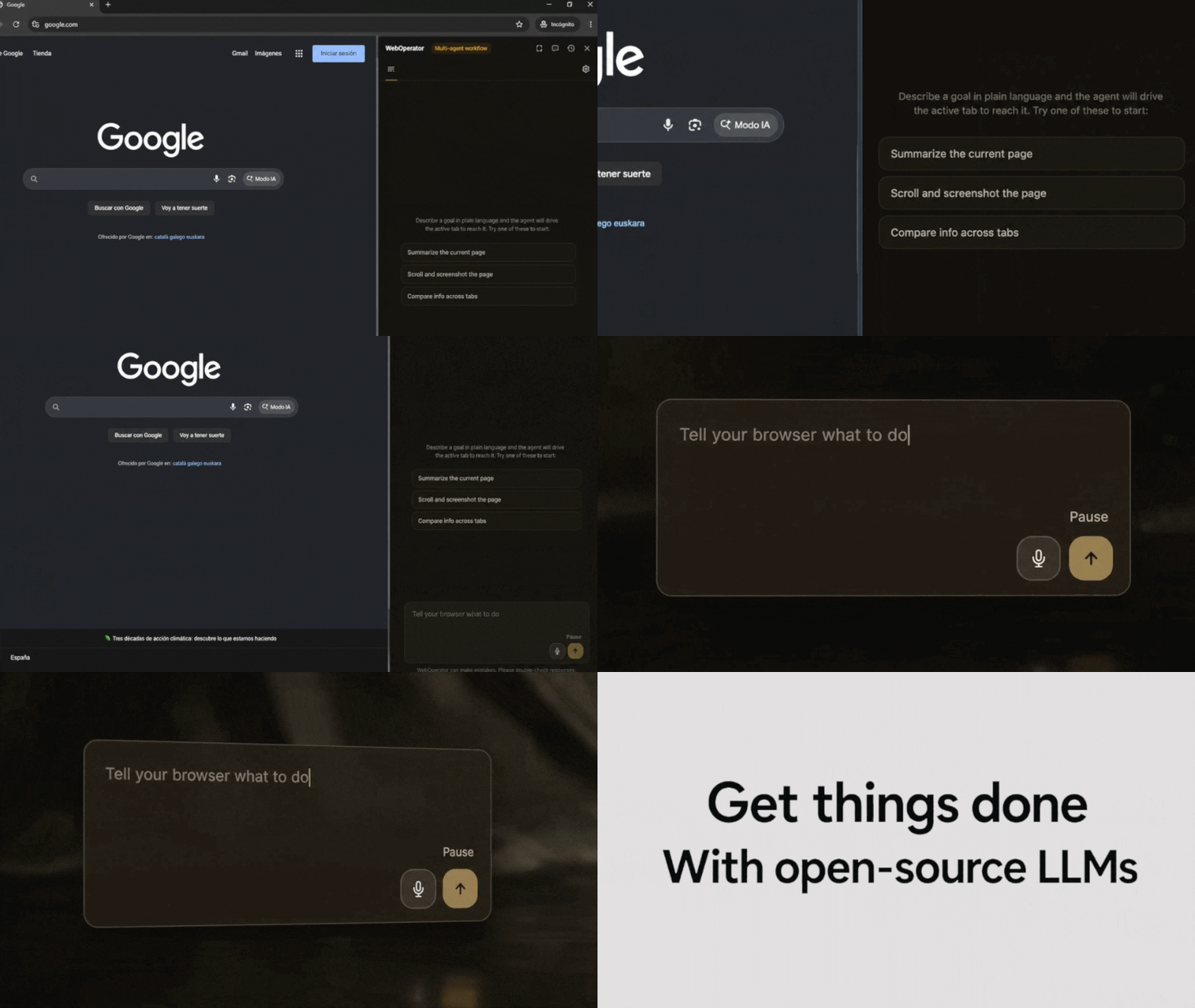
Your goal, typed once · The agent plans, acts, verifies · Every step visible
Quick start
Two ways in. If you would rather not touch Node, grab the
weboperator-1.5.0-chrome.zip archive from the
latest release and unzip it —
that folder is the built extension.
If you ran the commands above instead, the build lands in core/dist and finishes in
well under a second:
Either way, open chrome://extensions, enable Developer mode, click Load unpacked, and point it at the folder you just got. Press Cmd+Shift+K (Ctrl+Shift+K on Linux) to open the side panel, pick a provider under Settings, and type a goal.
Out of the box the agent talks to Ollama at http://127.0.0.1:11434, so have a tool-capable local model running before your first task — or paste an API key and use a remote provider instead.
Automate a multi-step task across your open Chrome tabs
WebOperator works the tab you are looking at in a plan → act → verify loop: it writes out a plan you can read, calls one browser tool at a time, and checks each result against a fresh snapshot of the page before moving on.
It can navigate, click, type, press keys, scroll, switch tabs, screenshot, and pull out structured text — so the same loop still works when the answer is scattered across half a dozen open tabs.
The side panel streams the plan, every action, and the final answer, and keeps the full trace; history, checkpoints, and scheduled runs each get their own tab. The flip side: the agent only knows what it can actually see in the browser, so anything hidden, paywalled, or geo-blocked simply will not show up in the answer.
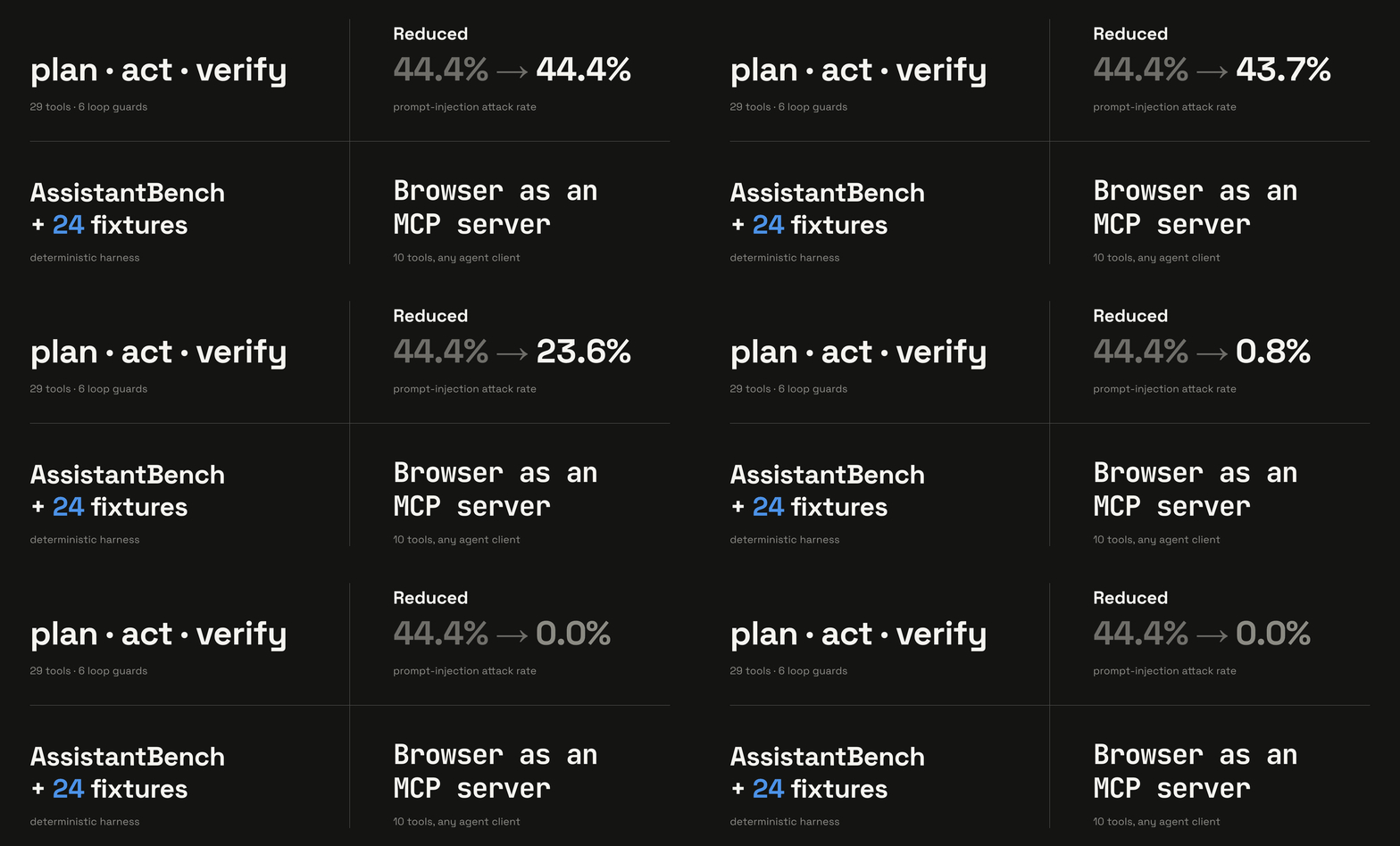
- Agent engineering — a plan, act and verify loop, 29 browser tools, 6 loop guards
- LLM security — the prompt-injection attack rate down from 44.4% to 0.0% across 9 adversarial fixtures
- LLM evaluation — AssistantBench and 24 fixtures in a deterministic harness, see docs/evals.md
- MCP — the browser exposed as an MCP server with 10 tools for any agent client
Schedule recurring browser automation in Chrome
Some tasks you want done whether or not you are at the keyboard. Give a schedule a start URL, a goal, and a cadence — once, hourly, daily, or weekly — and Chrome alarms wake the agent on time, even with the side panel closed.
Every run lands in History with its trace, so you can go back afterwards and see exactly what it did. If a run hits something only you can clear — a login wall, a verification challenge — it stops and marks itself needs_user rather than failing quietly.
Connect Hermes, OpenClaw, or another MCP agent
Your live browser can be somebody else's tool. The local bridge speaks MCP over stdio and exposes ten of them: browser_snapshot, browser_navigate, browser_click, browser_type, browser_press, browser_scroll, browser_screenshot, browser_extract, browser_solve_captcha, and weboperator_execute_goal.
install.sh registers the Native Messaging host that wires those calls to your active Chrome or Brave tab. Drop-in configs for Hermes and OpenClaw are already in weboperator-bridge/.
How it works
A goal arrives from the side panel or from an external MCP agent. From there the service worker runs the show — model calls, task state, retries, verification, schedules, storage. The content script does the hands-on part: it turns the page into an accessibility snapshot with stable element refs, then performs DOM actions against those refs. Whatever the page says is treated as data, never as instructions to follow. Twelve built-in skills sit on top as domain playbooks and kick in when the agent recognizes a matching site or task.
Permissions
To read and act on the page you point it at, the extension asks for <all_urls> plus activeTab/tabs/scripting, and for debugger to reach the DevTools Protocol actions the plain DOM API cannot do. The rest are housekeeping: sidePanel for the UI, storage for settings and history, alarms for scheduled runs, downloads for the file-downloader skill, and nativeMessaging for the MCP bridge. bookmarks and tabGroups are optional and only requested when something actually needs them.
The debugger permission is why Chrome shows a yellow "WebOperator started debugging this browser" bar while an action runs. That bar belongs to Chrome, not to the extension, and it goes away as soon as the agent detaches.
Configuration and requirements
Configuration
| Option | Default | What it does |
|---|---|---|
| Provider | ollama | Selects Ollama, Anthropic, DeepSeek, Gemini, MLX, OpenAI, an OpenAI-compatible endpoint of your own, OpenRouter, SiliconFlow, or xAI |
| Base URL (OpenAI-compatible) | http://127.0.0.1:8080/v1 | Points the OpenAI-compatible provider at llama.cpp, LM Studio, vLLM, LiteLLM, or any gateway |
| Ollama URL | http://127.0.0.1:11434 | Sets the local Ollama endpoint |
| Screenshot policy | auto | Controls automatic, always-on, or disabled vision |
| Action timeout | 10000 ms | Limits a single browser action attempt |
| Domain allowlist / blocklist | empty | Restricts or rejects tasks by domain when populated |
Bridge authentication
The bridge listens on 127.0.0.1:8765 and will accept unauthenticated calls until you set
WEBOPERATOR_API_TOKEN. Set it. Every bridge variable — bind host, port, socket and log
paths — is documented in docs/api.md.
Requirements
- Chrome 120 or newer, or a Chromium browser of the same generation
- Node.js and npm, if you build the extension yourself
- A model that can call tools, served locally by Ollama or MLX or reached through one of the remote providers in the table above. Tool calling is the one hard requirement, because tool calls are the only way the agent acts. Reasoning and vision are nice to have — without them the agent still runs, and the step trace tells you which one it went without
- The extension is not on the Chrome Web Store, so you load it unpacked
- macOS or Linux, for the MCP bridge installer
shellcheck, only if you run the full local check gate
Limitations
- Dynamic, canvas-heavy, or infinite-scroll pages can invalidate element refs between the moment the agent looks and the moment it acts.
- Sites with bot detection or unusual focus handling can fail outright.
- Long tasks drift. Checkpoints and context compression hold it back, but do not cure it.
- Point it at a remote provider and that provider sees your page observations — text and screenshots included.
- Chrome and Brave are the browsers we test. Other Chromium builds and Windows are untested, and the bridge installer flatly refuses to run outside macOS and Linux.
Troubleshooting
Ollama 403— Ollama is refusing the extension's origin. Restart it withOLLAMA_ORIGINS="chrome-extension://phbohkmfojcjbmgfnaikenmgemgckdpg,http://localhost:*" ollama serve. The origin has to be spelled out: Ollama acceptschrome-extension://*into the list and then still answers 403. The id above is fixed by the manifest key, and the side panel's own error message repeats it.- "Model stopped issuing tool calls" — the model cannot call tools, or is too small to do it reliably. Swap it; tool calling is the one hard requirement.
- Chrome rejects the folder on Load unpacked — point it at
core/distor at the unzipped release folder, not at the repository root. - The bridge answers
401— you setWEBOPERATOR_API_TOKENon the bridge but the client is not sending it. AddAuthorization: Bearer $WEBOPERATOR_API_TOKENto the request. - A task fails on a page that looks fine — check the step trace in the side panel first; a stale element ref or a bot-detection wall shows up there as the failing action.
Contributing
Related MCP Servers
Reviews
No reviews yet — be the first to share how this listing worked for you.
Frequently Asked Questions about Weboperator
AllMCPs Directory Badge
Showcase your server listing on GitHub or your project documentation. Embed this dynamic SVG badge to highlight official listing status and live engagement.
Badge Style:
Live Dynamic SVG Preview
Markdown (GitHub README)
[](https://allmcps.com/mcp/weboperator)HTML Embed
<a href="https://allmcps.com/mcp/weboperator"><img src="https://allmcps.com/api/badge/weboperator?style=directory" alt="Weboperator on AllMCPs" /></a>Technical Specs & Signals
CategoryDeveloper Tools
27Quality signal: Emerging · 27/100How this signal is calculated ▾
Server availabilityNot measured
Not scored for repo-hosted servers — we can't reach the running server, only its GitHub page. Hosted MCP endpoints are health-checked live.
Verified ownership8/20
Documentation & tools11/30
Adoption & activity1/15
Community engagement0/10
A guidance signal from public completeness & health data — not a user rating. New listings start lower and rise as they add docs, get verified, and grow adoption. Signals we can't observe for a listing are skipped, not counted against it.
Own this project?
This directory is pre-filled from public sources. Claim via GitHub README, site badge, or DNS TXT to unlock edit access and the Official badge and attach your website — proof is checked automatically, then reviewed by our team.
Free dofollow backlink: add your website and place the AllMCPs badge on it — no claim needed. We detect it automatically and keep it verified as long as the badge stays live.
Claim & get free dofollowShare & Embed
Add our SVG badge (dark/light directory styles) or embeddable widget to your site.