Self-hosted web search for LLM agents: search -> fetch -> rank pipeline with semantic caching
Quick Install
Automated & IDE SetupCopy the AI prompt to install this server into Claude Code, Cursor, or another agent — or use 1-click editor setup below.
Not yet automatically verified
We haven't yet run this listing's install command through our automated sandbox check. This isn't a red flag — we're steadily working through the catalog.
Manual Client & Custom JSON ConfigExpand JSON ▾
Client Config & Setup
Choose your client or environment
Target File:
💡 Paste the JSON block into your client's configuration file under mcpServers, then restart the application.
Documentation Overview
webfetch
Web search for LLM agents that you run yourself - up to 8x fewer input tokens and 3x lower cost than hosted web_search, at the same accuracy.
Hosted web-search tools charge $10 per thousand searches and then bill you
again for every token of retrieved content they push into your context
window. webfetch replaces them with a local pipeline - multi-engine
search, page fetching and extraction, semantic reranking, sentence-level
compression - exposed as a web_search tool your model calls like any
other. And unlike every hosted tool and search API we surveyed, repeated
and paraphrased queries are served from a semantic cache for free.
(Install with pip install webfetch-llm; the import name is webfetch.)
Jump to: The headline · What you get · Getting started · Check your setup · Full benchmark results · Claude Code · Agent loop · Savings report · How it works · Caveats
Same accuracy. A third of the cost. An eighth of the tokens.
One agent loop, one model, one judge, 50 SimpleQA questions. The only thing that changes between rows is the search tool:
| search tool | accuracy | input tok/query | cost/query |
|---|---|---|---|
| Anthropic hosted web_search | 96% | 17,408 | $0.108 |
| webfetch (4-engine fusion) | 92% | 3,467 | $0.035 |
| webfetch (DDG only, $0 in fees) | 84% | 3,623 | $0.026 |
Swap Opus for gpt-5.6-sol and the same webfetch tool hits 96% - hosted parity - at $0.040/query and 2,156 tokens: an eighth of what the hosted tool pushes into your context. Full results cover every arm we ran.
These numbers are the WORST case for webfetch - measured on an empty cache. In real use the gap widens on its own: repeats and rewords serve from cache for free, and the token advantage is paid again on every later turn that keeps search results in context. It adds up to receipts like this one, from an ordinary Claude Code session:
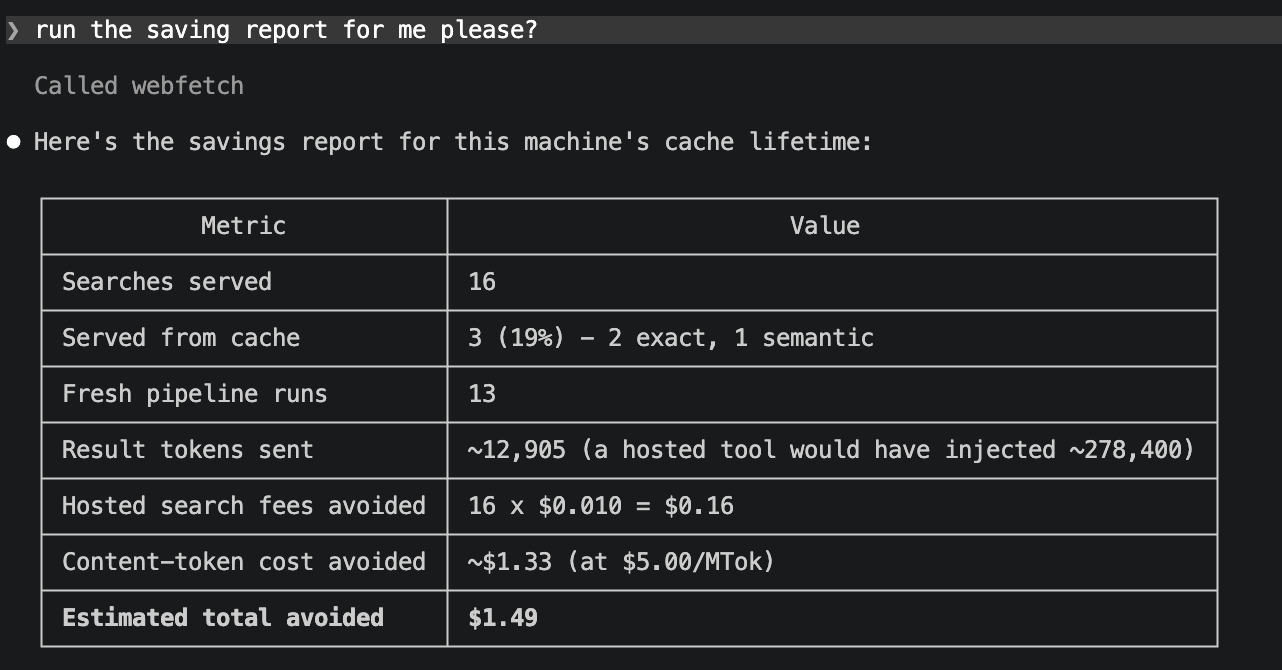
Every claim in this README is generated by an eval harness that ships in this repo - the question sets, per-question records, judging protocol, and the negative results are all in evals/, and every table can be regenerated with one command. Don't take our word for the grading: evals/results/README.md maps every table row to the raw result file that produced it, down to per-question judge verdicts.
What you get
A search pipeline you own (4-engine RRF fusion, local extraction, sentence-level compression). Results come from reciprocal-rank fusion across DuckDuckGo, Brave, Serper, and Tavily - whichever of them you have keys for. DDG needs no key, so the tool works at literally zero cost out of the box; every key you add joins the fusion automatically. Pages are fetched and extracted locally (trafilatura, readability, newspaper4k, Playwright rendering for JS pages and 403 walls), chunked, ranked by a hybrid BM25 + bi-encoder cascade with a cross-encoder on top, then compressed to the sentences that answer the query - measured 50% fewer tokens at zero recall loss.
Caching nobody else has (exact + semantic matching, volatility-aware
TTLs). Two layers in one sqlite file: page text by
URL, ranked results by query. Identical queries hit an exact cache.
Paraphrased queries hit a semantic cache - an embedding shortlist
verified by an NLI cross-encoder, tuned eval-first for precision (zero
wrong-target matches across every live run we have done). Cache lifetimes
adapt to the query: prices and scores expire in 15 minutes, current-ish
topics in 7 days, release notes and specs in 90 - classified by the
calling model's hint or a local classifier. The model sees provenance on
every cached result ([cache: semantic match to "...", 2h old, recent])
and can send force_fresh when it disagrees. No hosted tool or search
API we surveyed offers any client-visible caching at all.
The model can maintain its own cache (save_finding, labeled
UNVERIFIED, kill switch included). If a search comes up empty and
the model answers from some other source (a hosted search fallback, say),
it can call save_finding to store what it learned - marked
model-contributed, served with an explicit UNVERIFIED warning and a
force_fresh escape hatch, and aged out on the normal TTL rules. A kill
switch (SAVE_FINDING_ENABLED = False) exists for deployments that never
want unverified content cached.
Levers where models actually need them (full_results, fetch_url,
freshness, force_fresh). full_results returns
uncompressed excerpts for list and ranking queries (compression trims
parallel list items - we measured it). fetch_url pulls one cited page
in full, instantly if the pipeline has ever fetched it. freshness hints
control cache lifetime; force_fresh bypasses it.
Receipts (session and lifetime, exact counters). Usage counters
persist in the cache file;
webfetch-savings (or the savings_report tool) shows what you did not
pay hosted-search pricing for, split by this session and lifetime.
Sample below.
Getting started
The one-liner (uv installs the package on first launch, @latest picks
up new releases automatically):
Or manage the install yourself, two commands:
The slim install (webfetch-llm without extras) starts in seconds and
runs degraded: BM25 ranking, exact-only cache, lexical compression.
[all] pulls the semantic stack (torch - a few minutes once) plus
Playwright, PDF, and table extraction; it is the configuration every
benchmark number in this README was measured on. Needs pip >= 24 in fresh
venvs (python -m pip install -U pip - older pips crash on a duplicated
extra in our dependency tree). If you install into a venv, register the
absolute path to webfetch-mcp or keep the venv active.
Keys are optional (DDG works with none) but improve recall - all the engines have free tiers:
The console scripts and the MCP server pick up a .env from the
directory they run in; exported env vars and --env flags on
claude mcp add always take precedence. import webfetch as a library
never reads .env - your process env is yours.
Check your setup
webfetch-status (or asking the model to call the status tool) answers
"is my key being picked up, and what am I actually running?":
Key names only - values are never printed. Configuration is environment variables, read at server start:
| variable | effect |
|---|---|
BRAVE_API_KEY, SERPER_API_KEY, TAVILY_API_KEY | each key adds an engine to the fusion |
WEBFETCH_PROVIDER | multi (default: fuse everything keyed), fallback (DDG serves, keyed engines catch its blocks), or a single engine name |
WEBFETCH_CACHE_DB | relocate the cache file (default ~/.webfetch/cache.db) |
With zero keys the default resolves to plain DDG; the status output says
so honestly rather than calling it fusion. Library users can skip env
entirely: Pipeline(search=get_search_adapter("fallback"), cache=...).
Full benchmark results
Every arm, same 50 SimpleQA questions, same judge, one same-day run (2026-07-14). Agent-loop arms share an identical loop; only the search tool differs. Costs include model tokens plus each provider's published per-search fees; ours include estimated engine fees.
| search tool | model | accuracy | input tok/q | cost/q |
|---|---|---|---|---|
| OpenAI hosted web_search | gpt-5.6-sol | 100% | 10,027 | $0.066 |
| webfetch (4-engine fusion) | gpt-5.6-sol | 96% | 2,156 | $0.040 |
| Anthropic hosted web_search | Opus 4.7 | 96% | 17,408 | $0.108 |
| webfetch (4-engine fusion) | Opus 4.7 | 92% | 3,467 | $0.035 |
| Exa (search + contents) | Opus 4.7 | 90% | 5,496 | $0.053 |
| Tavily | Opus 4.7 | 88% | 6,387 | $0.047 |
| webfetch (DDG only) | Opus 4.7 | 84% | 3,623 | $0.026 |
| webfetch (4-engine fusion) | Haiku 4.5 | 76%* | 3,021 | $0.031 |
* Haiku's failures were mostly re-searching past the turn cap, and its last few questions ran on a degraded engine set after we exhausted a free tier mid-benchmark. Treat it as a floor.
Notice the token column: webfetch results cost half the input tokens of the snippet APIs and a fifth to an eighth of the hosted tools - which is why our cost stays lowest even where per-search fees are similar.
On a second dataset of 27 questions about events from the two weeks before the run (hand-written, never published, so no vendor could have tuned on them), webfetch scored 100% with fusion and 100% with DDG alone; the hosted tools also scored 100%. Fresh events are not the hard part - the date-injection trap is.
Related MCP Servers
Reviews
No reviews yet — be the first to share how this listing worked for you.
Frequently Asked Questions about Webfetch
AllMCPs Directory Badge
Showcase your server listing on GitHub or your project documentation. Embed this dynamic SVG badge to highlight official listing status and live engagement.
Badge Style:
Live Dynamic SVG Preview
Markdown (GitHub README)
[](https://allmcps.com/mcp/webfetch)HTML Embed
<a href="https://allmcps.com/mcp/webfetch"><img src="https://allmcps.com/api/badge/webfetch?style=directory" alt="Webfetch on AllMCPs" /></a>Technical Specs & Signals
CategoryDeveloper Tools
40Quality signal: Fair · 40/100How this signal is calculated ▾
Server availabilityNot measured
Not scored for repo-hosted servers — we can't reach the running server, only its GitHub page. Hosted MCP endpoints are health-checked live.
Verified ownership10/20
Documentation & tools16/30
Adoption & activity4/15
Community engagement0/10
A guidance signal from public completeness & health data — not a user rating. New listings start lower and rise as they add docs, get verified, and grow adoption. Signals we can't observe for a listing are skipped, not counted against it.
Own this project?
This directory is pre-filled from public sources. Claim via GitHub README, site badge, or DNS TXT to unlock edit access and the Official badge and attach your website — proof is checked automatically, then reviewed by our team.
Free dofollow backlink: add your website and place the AllMCPs badge on it — no claim needed. We detect it automatically and keep it verified as long as the badge stays live.
Claim & get free dofollowShare & Embed
Add our SVG badge (dark/light directory styles) or embeddable widget to your site.