Wasilah MCP
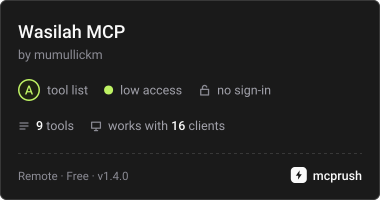
A remote Model Context Protocol server that exposes Wasilah's Islamic reference data to Claude as a custom connector. Add the URL in Claude and it can answer prayer-time, Qibla, Hijri-date, and Quran-audio questions directly.
Prayer times are computed with the same astronomy engine as the Wasilah app (ported from lib/features/prayer_times/prayer_astronomy.dart), so the connector and the app agree to the minute for the same location, date, method, and madhab.
Tools
| Tool | What it returns |
|---|---|
get_prayer_times | The five daily prayers plus sunrise for a city or coordinates. Marks Dhuhr as Jumu'ah on Fridays. |
get_next_prayer | The next upcoming prayer and time remaining. |
get_qibla | Compass bearing to the Kaaba. |
get_hijri_date | Islamic date for a given Gregorian date (Umm al-Qura, with a tabular fallback). |
get_hijri_calendar | A full Hijri month mapped to Gregorian dates, with the significant days in it. |
get_quran_audio | A streaming full-surah recitation URL plus surah name and ayah count. |
get_asma_ul_husna | The 99 Names of Allah in Arabic, transliteration, English and Bengali. |
get_ifb_district_offset | Islamic Foundation Bangladesh's published sehri and iftar offset from Dhaka for any of the 64 districts. |
get_tasbeeh | The six dhikr phrases from the Wasilah tasbeeh counter, with meaning and customary count. |
Every location tool accepts either a city name (resolved against a bundled offline database) or explicit latitude + longitude (with an optional timezone; if omitted, the zone is inferred from the nearest known city and the answer says so). Prayer tools also accept method (Karachi, ISNA, MWL, Umm al-Qura, and others) and asr (auto, shafii, hanafi). The connector makes no external network calls.
Run locally
npm install
npm test        # exercises every tool through the MCP endpoint, no server needed
npm run dev     # serves the worker on http://localhost:8787
With the dev server running, point the MCP Inspector at http://localhost:8787/mcp to browse and call the tools interactively.
Deploy (Cloudflare Workers)
npx wrangler login
npm run deploy
Wrangler prints the deployed URL, for example https://wasilah-mcp.<subdomain>.workers.dev. The connector endpoint is that URL plus /mcp. Visiting the root URL serves a short landing page with the connector URL and setup steps.
Add to Claude
- Settings, then Connectors.
- Add custom connector.
- Paste
https://<your-worker-url>/mcp. - Ask something like "What time is Maghrib in Dhaka today?" or "Which way is the Qibla from Madinah?"
This server is authless and stateless. It exposes only public reference data; it holds no personal information and needs no sign-in.
Notes
- Prayer parity. Calculation-method angles, the Asr shadow factors, and the solar geometry mirror the app exactly. The app's default is Karachi method with Hanafi Asr.
- Hijri source. Uses the Umm al-Qura calendar where the runtime's ICU supports it, and a tabular calculation otherwise. A tabular date can differ from a moon-sighting announcement by a day.
- Fully offline. The connector makes no external API calls. City lookups use a bundled offline database (a subset of GeoNames, CC BY 4.0: top cities per country plus every capital); prayer times, Qibla, and Hijri date are computed on the server. Pass coordinates directly for places not in the database.
- Personal data is out of scope. This server does not touch the on-device Salah tracker. Exposing per-user history would require a Wasilah backend with accounts and OAuth.