Workstation-local event bus: agents wait on or emit CI/pytest/Docker/filesystem events, no polling.
Quick Install
Automated & IDE SetupCopy the AI prompt to install this server into Claude Code, Cursor, or another agent — or use 1-click editor setup below.
Not yet automatically verified
We haven't yet run this listing's install command through our automated sandbox check. This isn't a red flag — we're steadily working through the catalog.
Manual Client & Custom JSON ConfigExpand JSON ▾
Client Config & Setup
Choose your client or environment
Target File:
💡 Paste the JSON block into your client's configuration file under mcpServers, then restart the application.
Documentation Overview
waitbus: the workstation-local, cross-harness status bus. D-Bus for agents, with a replay log and a wait primitive




One wait verb that blocks on, and queries across, every local source at once. When any agent, CI job, test, or container on your machine finishes or fails, every other tool on the box hears it: your Claude Code, your Cursor, your scripts, your CI. Clients that support server notifications get a push; the rest get one blocking waitbus wait. No waitbus cloud, no account, no telemetry; all processing stays on your machine.
Below: a Pydantic AI agent and a LangGraph agent, two different frameworks running as two separate OS processes, both wait on one local waitbus bus. One fails; the peer on the other framework, plus a live waitbus top view, react to the single failure broadcast.
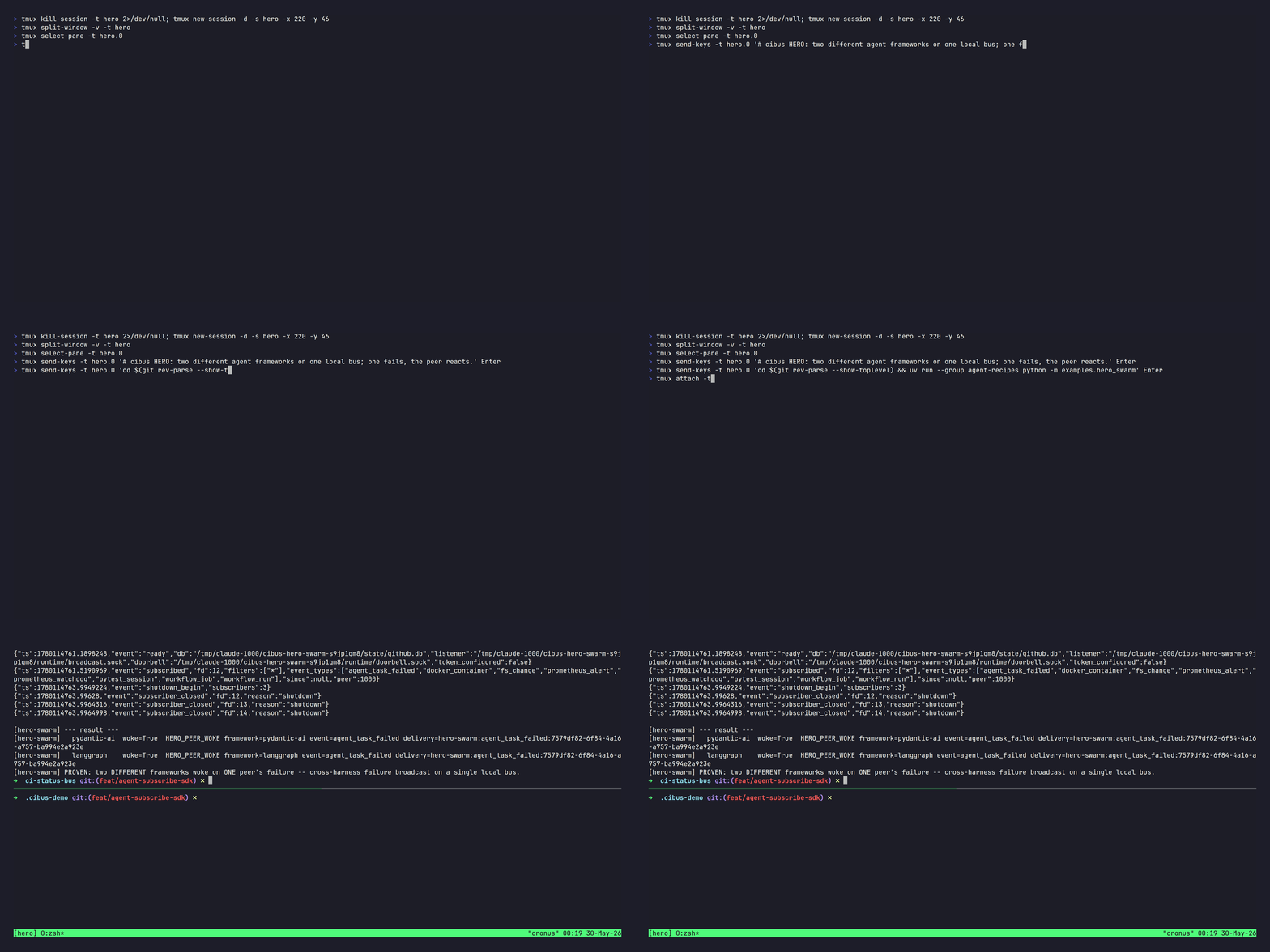
Real frameworks and real waitbus subscribe/emit; the agents' LLMs are deterministic fakes and the failure is an injected event, so the clip runs fully offline. Reproduce the claim (not just the recording): run uvx waitbus demo for the gentler single-agent walk-through (no clone, no install), or, for the exact two-framework proof shown above, clone the repo and run uv run --group agent-recipes python -m examples.hero_swarm (Linux-verified; prints PROVEN: two DIFFERENT frameworks woke on ONE peer's failure). Higher-quality MP4 at hero.mp4. Maintainers re-render this recording from docs/demo/.waitbus-demo/ with make hero (dev-only; needs vhs, ttyd, tmux, and JetBrains Mono).
Try it now, no install:
uvx waitbus demoboots a real local bus and returns the instant an event lands, fully offline (~8 s).
waitbus is the workstation-local, cross-harness status bus that lets the tools on one machine hear each other. It does three things: ingest events, broadcast them, and replay them.
Ingest: a blocking wait/emit primitive lets any agent or script
(across Cursor, Claude Code, and any tool on the box) wait on, or emit, events
from five built-in sources (GitHub Actions CI, pytest sessions, Docker
container lifecycle, filesystem changes, and Prometheus Alertmanager) plus any
plugin source registered under the waitbus.sources.v1 entry-point group.
Broadcast: events land in SQLite the moment they arrive, and a broadcast
daemon fans each row to every connected consumer within about a
millisecond on the local socket (measured; see benchmarks/BENCHMARKING.md). Your
agent blocks on waitbus wait (including across sources at once with
--all-of/--first-of) with zero agent-side polling and idle CPU until the thing it
cares about happens, and waitbus on <predicate> -- <command> runs a command
the moment it does (in the CLI process, not the daemon, via execve with no
shell; event values arrive as namespaced WAITBUS_* environment variables and
a $WAITBUS_EVENT_FILE, never as argv, so event content cannot inject flags
or overwrite PATH). Because every agent on the box shares that one bus, it
doubles as a same-machine coordination backplane: one agent emits, the others
wake.
Replay: a durable replay log (since=) means a consumer that was
offline catches up instead of missing the moment, and waitbus events analyze
queries what the bus stored. It is the local opt-in
event-broadcast model the OS already uses (D-Bus signals, inotify, journald),
with the replay log and a wait predicate added on top. (GitHub Actions was
the first source wired, which is why the examples lead with CI, but waitbus is
not CI-only.) The dependency stack is lean: typer, msgspec, platformdirs,
pydantic-settings, prometheus_client, stamina, and the mcp SDK, with no
heavy TUI or crypto dependency. The daemon idles at roughly 40 MB RSS measured
(p50 on the benchmark host, most of it the CPython interpreter baseline) over
a SQLite event store and an AF_UNIX SOCK_STREAM broadcast bus with
length-prefix framing. Runs on Linux (systemd-user) and macOS (launchd).
Who this is for
This is for you if…
- You run a heterogeneous agent fleet (Claude Code and Cursor and background scripts) on one workstation and want them to hear each other's finishes and failures.
- You wait across sources. "Block until the tests pass and the build is
done and CI is green," in one predicate, in a script
(
waitbus wait --all-of ...). Nothing else expresses this. - You want zero-LLM-token, zero-poll waiting as a daily habit across many local things, and you'll run a daemon to get it.
- You care that the daemon on your box is trustworthy: reproducible builds, offline, no cloud, no account, no telemetry.
This is NOT for you if…
- You wait on one GitHub repo's CI and nothing else. Use
gh run watch. It's zero-setup, and for that single job we don't beat it by enough to justify a daemon. - You only need to react to a file change. Use
inotifywait/entr. They're far faster on raw filesystem latency (our own benchmark says so) and need no daemon. - You want cloud, cross-machine, or team coordination. Out of scope for the local core by design.
- You want addressed agent-to-agent messaging as the product (threads,
inboxes, routing). The headline here is broadcast source-ingestion; the
request()/respond()facet exists, but a dedicated message queue serves that center of gravity better.
Try it in 60 seconds
waitbus demo allocates a temporary state directory and boots the
broadcast daemon, then runs two phases. Phase 1, the point: an
agent blocks on waitbus wait (the same egress engine the real command
uses) with zero polling and idle CPU; the moment a github
workflow_run event lands, the wait returns and the demo prints the
real measured event-to-unblock latency. Phase 2, breadth: the same
primitive delivers every source. pytest_session, docker_container,
and fs_change events fan out to a live subscriber. Nothing on your
machine outside the temporary directory is touched.

A recorded MP4 + GIF walkthrough lives at
docs/demo/.waitbus-demo/demo.mp4 and demo.gif
(the tape script is demo.tape). Re-rendering is reproducible
via make demo from that directory (requires
VHS ≥ 0.10.0, ttyd, and
ffmpeg); the Makefile enforces the VHS version floor and refuses
to render against an older binary that could silently change tape
semantics.
The four events the demo emits are synthesized in-process. There is no real HTTP listener, no real pytest run, no real Docker daemon, no real watchdog. A banner before each emit makes this explicit, mirroring the
waitbus statsoutput. To wire waitbus against real GitHub webhook deliveries, follow the Quick start below.
Quick start
Prove the primitive in ~10 seconds -- one foreground daemon, one event, no service install. Install the CLI and bootstrap state:
Then, in two terminals, watch a blocking wait return the instant an emit
lands on the bus:
That round trip -- block, emit, unblock, with zero polling -- is the whole primitive. Everything below wires it to real sources and, optionally, runs the daemons permanently under your service manager.
Run the fleet permanently (optional)
install-systemd is Linux-only; install-launchd is macOS-only.
Each command refuses to run on the other platform and points at the
right one.
Related MCP Servers
Adoption & maintenance
Factual signals from GitHub, npm, and our automated checks — not a rating.
GitHub stars
2
Stargazers on the source repository.
Last commit
3d ago
Most recent push to the default branch.
Reviews
No reviews yet — be the first to share how this listing worked for you.
Frequently Asked Questions about Waitbus
AllMCPs Directory Badge
Showcase your server listing on GitHub or your project documentation. Embed this dynamic SVG badge to highlight official listing status and live engagement.
Badge Style:
Live Dynamic SVG Preview
Markdown (GitHub README)
[](https://allmcps.com/mcp/waitbus)HTML Embed
<a href="https://allmcps.com/mcp/waitbus"><img src="https://allmcps.com/api/badge/waitbus?style=directory" alt="Waitbus on AllMCPs" /></a>