browser-automationdeveloper-toolsdebuggingreact-nativetesting
Correlates browser or native app activity with dev-server logs on a shared timeline for debugging and repro capture.
Quick Install
Automated & IDE SetupCopy the AI prompt to install this server into Claude Code, Cursor, or another agent — or use 1-click editor setup below.
Not yet automatically verified
We haven't yet run this listing's install command through our automated sandbox check. This isn't a red flag — we're steadily working through the catalog.
Manual Client & Custom JSON ConfigExpand JSON ▾
Client Config & Setup
Choose your client or environment
Target File:
💡 Paste the JSON block into your client's configuration file under mcpServers, then restart the application.
Overview
Use cases
Correlate browser console errors with backend stack traces
Capture and replay browser or native app reproduction steps
Inspect unified browser, server, network, and native logs
Drive Expo or React Native apps on iOS and Android
Monitor development servers while testing UI flows
Key features
Chrome control through Puppeteer
Expo and React Native iOS and Android support
Correlated timestamped event timeline
Unified log and network queries
Reproduction sequence builder
Electron cockpit with browser and log panes
Capabilities & Tool Schemas (68)
Inspect callable tools, capabilities, and parameters exposed to AI agents by Devloop.
projectCallable MCP tool function
cmdCallable MCP tool function
cwdCallable MCP tool function
package.jsonCallable MCP tool function
devCallable MCP tool function
developCallable MCP tool function
Documentation Overview

Browser control + dev-server logs on one correlated timeline — for AI agents and humans.




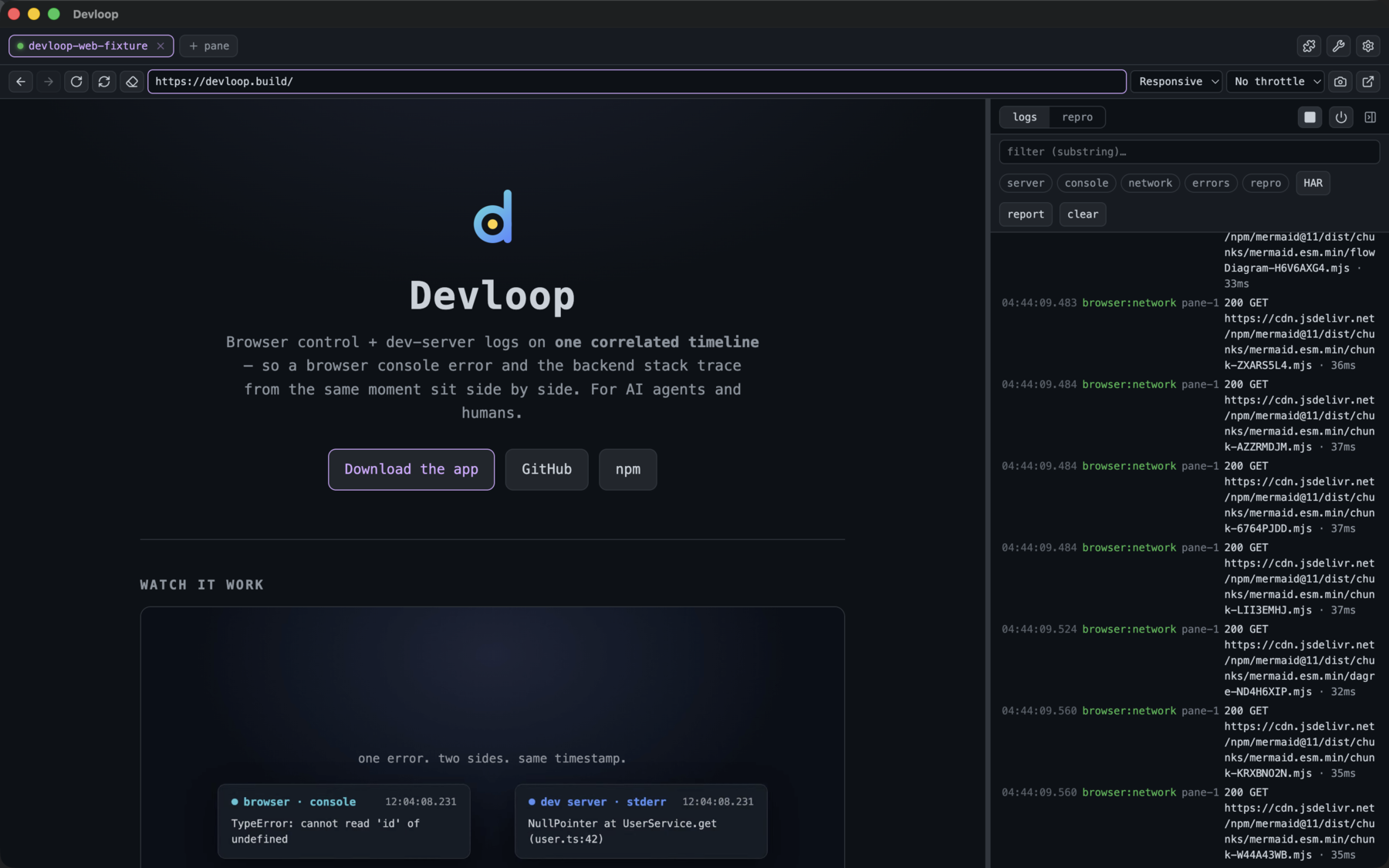
A unified dev-loop tool: it drives a browser and your dev server, pushing both sides into one timestamped buffer so you can correlate a browser console error with the backend stack trace from the same moment. It runs two ways from a shared core:
- Headless (stdio) — drives Chrome via Puppeteer, served over stdio. The lightweight mode Claude Code spawns per session. Run
devloop-mcp daemonto instead serve one shared, long-running instance over HTTP/SSE that many agents/sessions connect to (see Daemon mode). - Cockpit (Electron) — a single desktop window: tabbed browser panes (embedded
WebContentsViews driven via CDP) with a browser bar (back/forward/reload + address) beside a collapsible side panel that toggles between logs and a repro builder. Project picker, auto-navigate, pop-out targets. The renderer is React 19 + Tailwind v4 + Radix + lucide-react. Serves the same tools over HTTP.
Because every event (browser console/network/page-errors and server stdout/stderr) shares one monotonic clock, get_logs_around / repro return a correlated, cross-source slice of the timeline.
Native targets — Expo / React Native (iOS + Android)
The cockpit also drives Expo/React Native projects, not just web. Open a native project and you get one pane with a Web · iOS · Android target switcher, a bundler toggle (Metro) separate from a Build button (expo run:ios / expo run:android, with @expo/fingerprint staleness detection), and:
- JS console + errors over CDP via Metro's Hermes inspector (both platforms) — with source-mapped stacks (your bundled
index.bundle:1:…resolves to original.tsx). - RN network capture — an injected
XMLHttpRequesthook turns the app's fetch/XHR traffic into the samenetworktimeline rows as web (soget_network/export_har/ the network chip work for native too). - Native device logs merged onto the timeline as a
nativesource — iOSsimctl log stream, Androidlogcat. - A live, interactive device embedded in the pane — iOS via serve-sim (MJPEG, tap/scroll/type), Android via a polled
screencapmirror (~2fps) with click→tap + key input. Screenshots on both. - Agent-drivable interactions —
browser_snapshotreads the native accessibility tree (iOS via idb's UIKit a11y tree; Android viauiautomator dump) andbrowser_click/type/scroll/pressdrive the device by an element'spt:x,yref (from the snapshot) or its label — replayable throughrepro, openable over MCP vianative_open/native_build. The same agent tools as web, mapped onto native.
All of it lands on the same correlated timeline, app-scoped — the web dev-loop experience, for a native app. (macOS + Apple Silicon for the embedded iOS simulator; Android works wherever the Android SDK + an emulator do.)
iOS interactions need idb: brew install facebook/fb/idb-companion and pipx install fb-idb (use Python <3.14 — newer Python breaks fb-idb). Android interactions need the Android SDK platform-tools (adb) + a booted emulator. The cockpit's Settings → native readiness runs a per-platform preflight (iOS: idb · companion · booted sim; Android: adb · booted device) and shows the exact fix for anything missing; observation (logs/screenshots) works without the interaction tooling.
serve-sim is vendored into the cockpit and run via Electron's own Node, so the embedded simulator works out of the box — offline, no bun/node/npx or first-run fetch. (Running from source uses the copy in node_modules instead.)
Architecture
Three transports expose one shared core, which drives one of several substrates (a real browser, or — in the cockpit — a native device). Everything pushes onto a single timestamped timeline.
The tool layer never knows what's behind it — Puppeteer or Electron, stdio or HTTP, web page or native app. It's wired once at startup. The browser sits behind a single IBrowserController interface; the cockpit's pane manager implements the richer IBrowserManager (multiple panes, delegating browser_* to the active one — or to the native controller when an iOS/Android target is open). A capability layer gates tools by the active target, so an agent gets a clear message instead of a substrate error.
stdout is reserved for the MCP protocol in stdio mode; all human-facing output goes to stderr.
The layers
- Transports — three entrypoints over two protocols: stdio (one server per session) and HTTP/SSE (the long-running daemon, and the cockpit). All build the same MCP server bound to the tool layer; only the HTTP transports are multi-client (each connecting client gets its own session, one shared backend).
- Shared core — the tool layer (the MCP tools + a capability-gated dispatcher) over one unified, correlated timeline (server output, browser console/network/errors, native logs), backed by a separate full-capture network ring. The cross-cutting features the tools expose — a project registry, error diagnostics, source-map resolution, HAR export, and bug-report bundles — live here too.
- Browser substrates — a shared controller interface with two web implementations (Puppeteer/Chrome for headless; Electron
WebContentsViewpanes over CDP in the cockpit) and a native one (React Native over Hermes/Metro). Shared page-action + accessibility-snapshot logic and device/throttle emulation sit above them. - Native targets — an RN controller (JS/errors/network over Metro CDP) delegates taps + snapshots to a
NativeDriver(idb on iOS, adb on Android); native logs (simctl / logcat), screenshots + live mirrors, build orchestration (expo run), and a readiness preflight round it out. - State & isolation — an on-disk registry (projects / session / panes), per-project session partitions, and Chrome-extension management.
- Cockpit (Electron) — the desktop shell: a pane manager (per-project partitions, native routing), the React UI (timeline, browser bar, repro builder, target switch, Android mirror), the vendored serve-sim iOS mirror, the in-store "Add to Devloop" injection, and the in-app updater.
Install
Headless MCP (stdio) — no clone needed, register it with Claude Code:
(Published as devloop-mcp on npm; Puppeteer fetches Chromium on first install.)
Cockpit (desktop app) — grab the installer for your OS from Releases (.dmg / .exe / .AppImage). macOS ships both Apple Silicon (arm64) and Intel (x64) builds. The app checks GitHub for a newer release on launch and prompts before downloading or installing — or trigger it yourself from settings → updates → check for updates.
From source (dev) — requires bun:
Use it from your coding agent
Related MCP Servers
Adoption & maintenance
Factual signals from GitHub, npm, and our automated checks — not a rating.
GitHub stars
2
Stargazers on the source repository.
npm downloads
356
Package downloads in the last 30 days.
Last commit
5d ago
Most recent push to the default branch.
Tools exposed
68
Callable tools this server registers over MCP.
Directory activity
2 views
Config copies, upvotes, and views on AllMCPs.
Reviews
No reviews yet — be the first to share how this listing worked for you.
Frequently Asked Questions about Devloop
AllMCPs Directory Badge
Showcase your server listing on GitHub or your project documentation. Embed this dynamic SVG badge to highlight official listing status and live engagement.
Badge Style:
Live Dynamic SVG Preview
Markdown (GitHub README)
[](https://allmcps.com/mcp/vincentvella-devloop)HTML Embed
<a href="https://allmcps.com/mcp/vincentvella-devloop"><img src="https://allmcps.com/api/badge/vincentvella-devloop?style=directory" alt="Devloop on AllMCPs" /></a>Technical Specs & Signals
CategoryBrowser Automation
PricingFree
10/11 checks healthy over the last 32d
61Quality signal: Good · 61/100How this signal is calculated ▾
Server availabilityNot measured
Not scored for repo-hosted servers — we can't reach the running server, only its GitHub page. Hosted MCP endpoints are health-checked live.
Verified ownership10/20
Documentation & tools29/30
Adoption & activity7/15
Community engagement0/10
A guidance signal from public completeness & health data — not a user rating. New listings start lower and rise as they add docs, get verified, and grow adoption. Signals we can't observe for a listing are skipped, not counted against it.
Supply-chain signal
No high-severity advisories surfaced by our automated scan.
Critical 0High 0Medium 0Low 0
Scanned 22d ago via OSV.dev · devloop-mcp (npm)
Own this project?
This directory is pre-filled from public sources. Claim via GitHub README, site badge, or DNS TXT to unlock edit access and the Official badge — proof is checked automatically, then reviewed by our team.
Free dofollow backlink: add your website and place the AllMCPs badge on it — no claim needed. We detect it automatically and keep it verified as long as the badge stays live.
Claim & get free dofollowShare & Embed
Add our SVG badge (dark/light directory styles) or embeddable widget to your site.