Gate AI-written tests: heal safe drift, refuse to hide real bugs, sign a verifiable receipt.
Quick Install
Automated & IDE SetupCopy the AI prompt to install this server into Claude Code, Cursor, or another agent — or use 1-click editor setup below.
Manual Client & Custom JSON ConfigExpand JSON ▾
Client Config & Setup
Choose your client or environment
Target File:
💡 Paste the JSON block into your client's configuration file under mcpServers, then restart the application.
Documentation Overview
👁️ Vigilis
The QA gate for AI-written code.
It heals safe test drift, refuses real regressions, and signs every decision into an independent, verifiable receipt.


The problem
Tell any coding agent to "make CI pass" and the cheapest path to green is deleting the test that caught the bug. AI now writes and fixes tests on its own — so the only question that matters is: can you trust what it did?
Vigilis answers it. Point it at the Playwright, Cypress, or Selenium suite you already have. When a test breaks, it decides:
- Cosmetic drift (a renamed selector) → it heals the locator, re-runs to verify green, opens a PR.
- A real behaviour change (checkout total went from
$49to$0) → it refuses to touch the test, fails the gate, and surfaces the bug instead of burying it.
And every decision is sealed into a signed, offline-verifiable receipt by an independent notary — so a refusal is something you can prove, not just claim.
Self-healing is the wedge. Verifiable proof is the point.
Where teams point it: gate AI-written code · self-heal without hiding bugs · auditable test runs · audit-grade evidence for SOX / payment controls · agent-native (MCP). → see the use cases
See it refuse a real bug
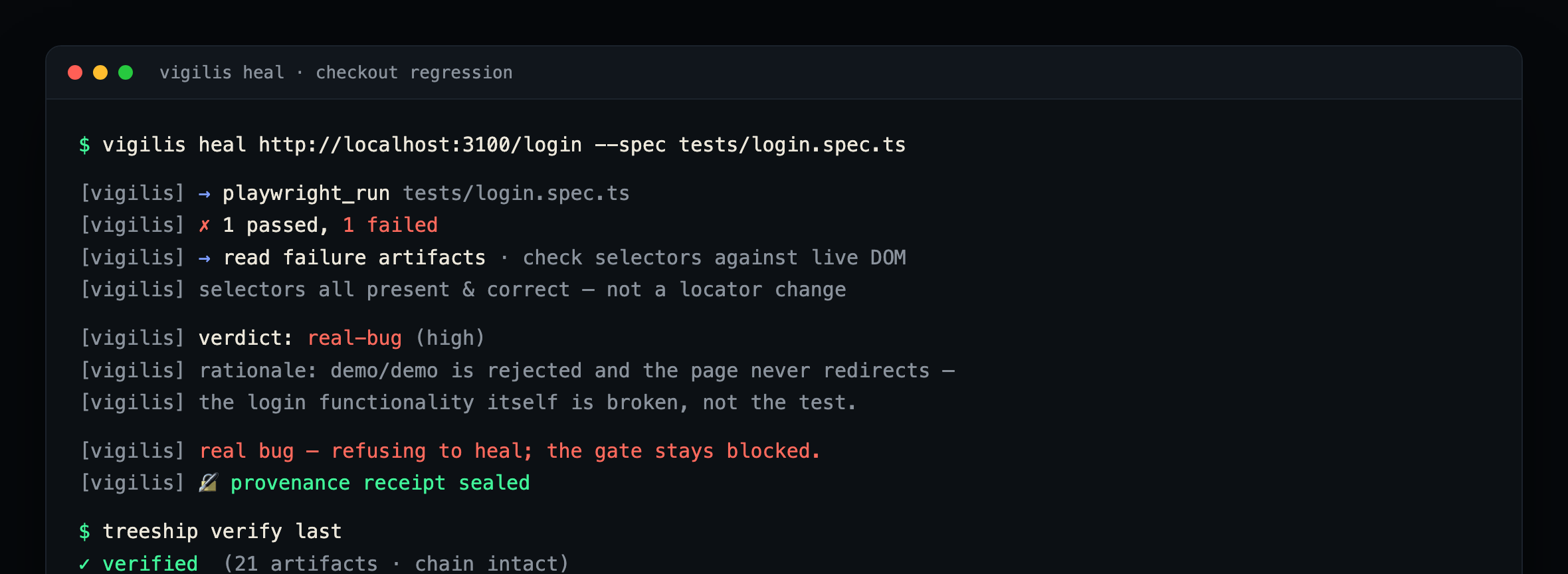
The agent ran the spec, saw it fail, checked that the selectors were all correct, concluded the app's login was genuinely broken, and refused to heal — then sealed a receipt anyone can verify offline.
Quickstart
Runs in your CI on your own key + chromium. About 10¢ per run on the fast model (--model claude-haiku-4-5); Opus by default for quality.
Why it's different
| Vigilis | |
|---|---|
| Heals | Rewrites the locator for cosmetic drift, re-verifies green, opens a PR. |
| Refuses | A real regression is a hard, fail-closed contract — it will not weaken the assertion that caught the bug. |
| Proves | Every heal and every refusal is sealed into an independent, offline-verifiable receipt (via Treeship). |
Attestation is verifiable and auditable — it proves what the agent did, in order, unaltered. It does not claim the agent's judgement was correct. That honesty is the point: Vigilis improves signal, it doesn't hide failures.
Why a refusal is credible: no layer grades its own work. The actor (any agent) writes the code and tests; Vigilis judges the behaviour and gates the deploy; an independent notary (Treeship) signs the verdict. Vigilis never signs its own homework — which is what makes the proof worth anything to someone who doesn't already trust you.
Optional: alert on a refusal
On a real-bug refusal, Vigilis can post a Slack alert and file a deduplicated Linear ticket — each linking the signed receipt. Off by default; a no-op until you set SLACK_WEBHOOK_URL / LINEAR_API_KEY. See docs/REFUSAL-ACTIONS.md.
Drive it from Claude (MCP)
The same tools ship as an MCP server (vigilis-mcp, in the official MCP registry) — generate / triage / heal straight from Claude Desktop, Claude Code, or Cursor. Add it to your MCP client config:
Full setup: docs/MCP.md.
Provenance receipts
Receipts work out of the box with zero secrets — no account, no API key, no network:
vigilis attest-run <report.json>seals any test run (not just Vigilis's own) into a receipt: it hash-chains the Playwright report's digest, the commit SHA, and the runner's exit code into a tamper-evident bundle under.vigilis/attestation/. Drop it after your existingplaywright teststep in CI and every run leaves evidence.vigilis healseals its whole triage-and-heal session the same way — every tool call and every decision, hash-chained in order.vigilis verify <bundle>re-walks the chain offline and reports chain intact or broken at record #N. Anyone holding the file can check it; editing or deleting any step breaks every hash after it.
When the Treeship CLI is present, heal receipts are additionally signed by an independent notary — verify with treeship verify last, or share the hosted URL. No hard dependency; --no-receipt to opt out. See docs/TREESHIP.md.
Local bundles are verifiable and auditable (they prove what the agent did, unaltered and in order — not that its judgment was correct); Treeship upgrades that to a signed, independently-notarized receipt.
Why I built this
I've spent my career in QA, and AI just rewrote the job: agents now write and fix tests on their own. Huge speed win — but it quietly breaks the one thing testing exists for. When an agent makes a red test green, did it fix the bug, or delete the test that caught it? At scale, nobody can check every change by hand.
So Vigilis isn't another self-healer — healing is becoming a commodity. It's the layer that decides honestly which failures to heal and which to refuse, and signs every call so you don't have to take its word for it.
The way I think about it: git is a ledger of your code; Vigilis is a ledger of your agent's decisions — proof you can hand to someone who doesn't already trust you.
— Piyush
How it's built
Vigilis defines its QA tools once and exposes them twice — as an MCP server and as a CLI — over one Claude agent loop:
The loop: Generate (explore a URL → write specs) → Triage (real-bug vs drift vs flake) → Heal (fix drift → verify green → PR, refuse real bugs). Author (plain-English intent → test plan) is on the roadmap.
Repo layout
Develop
Watch the full loop against the bundled demo app — see docs/DEMO.md.
Roadmap
- ✅ Generate · Triage · Heal (Playwright, Cypress & Selenium — all live-verified)
- ✅ GitHub Actions QA gate · signed provenance receipts · MCP server
- ✅ Refusal actions (Slack + Linear) · governance-cloud audit dashboard
- ✅ Zero-secret attestation:
attest-run+verify— receipts for any test run, no keys - 🚧 Author (intent → test plan) · broader agent-attestation surface
Credits
Provenance receipts are powered by Treeship — the independent attestation primitive — and governed memory by ZMem, both built by Zerker Labs. Thanks to the Zerker Labs team for the trust primitives Vigilis stands on.
License
MIT © Piyush Pathak
Related MCP Servers
Reviews
No reviews yet — be the first to share how this listing worked for you.
Frequently Asked Questions about Vigilis
AllMCPs Directory Badge
Showcase your server listing on GitHub or your project documentation. Embed this dynamic SVG badge to highlight official listing status and live engagement.
Badge Style:
Live Dynamic SVG Preview
Markdown (GitHub README)
[](https://allmcps.com/mcp/vigilis)HTML Embed
<a href="https://allmcps.com/mcp/vigilis"><img src="https://allmcps.com/api/badge/vigilis?style=directory" alt="Vigilis on AllMCPs" /></a>