Autoeq MCP README
The full upstream README, mirrored here for reference. Install config, tool schemas, adoption signals, and an original overview live on the Autoeq MCP listing page.
AutoEQ MCP Server





An MCP (Model Context Protocol) server that gives AI assistants access to the AutoEQ headphone equalization database — 8,800+ headphones and IEMs with parametric EQ settings, sound signature analysis, and Harman preference scores.
What It Does
Ask your AI assistant things like:
- "Get me the EQ settings for the HD650"
- "Compare the HE400se and HD600"
- "Recommend warm-sounding over-ear headphones"
- "What are the top-ranked IEMs by Harman score?"
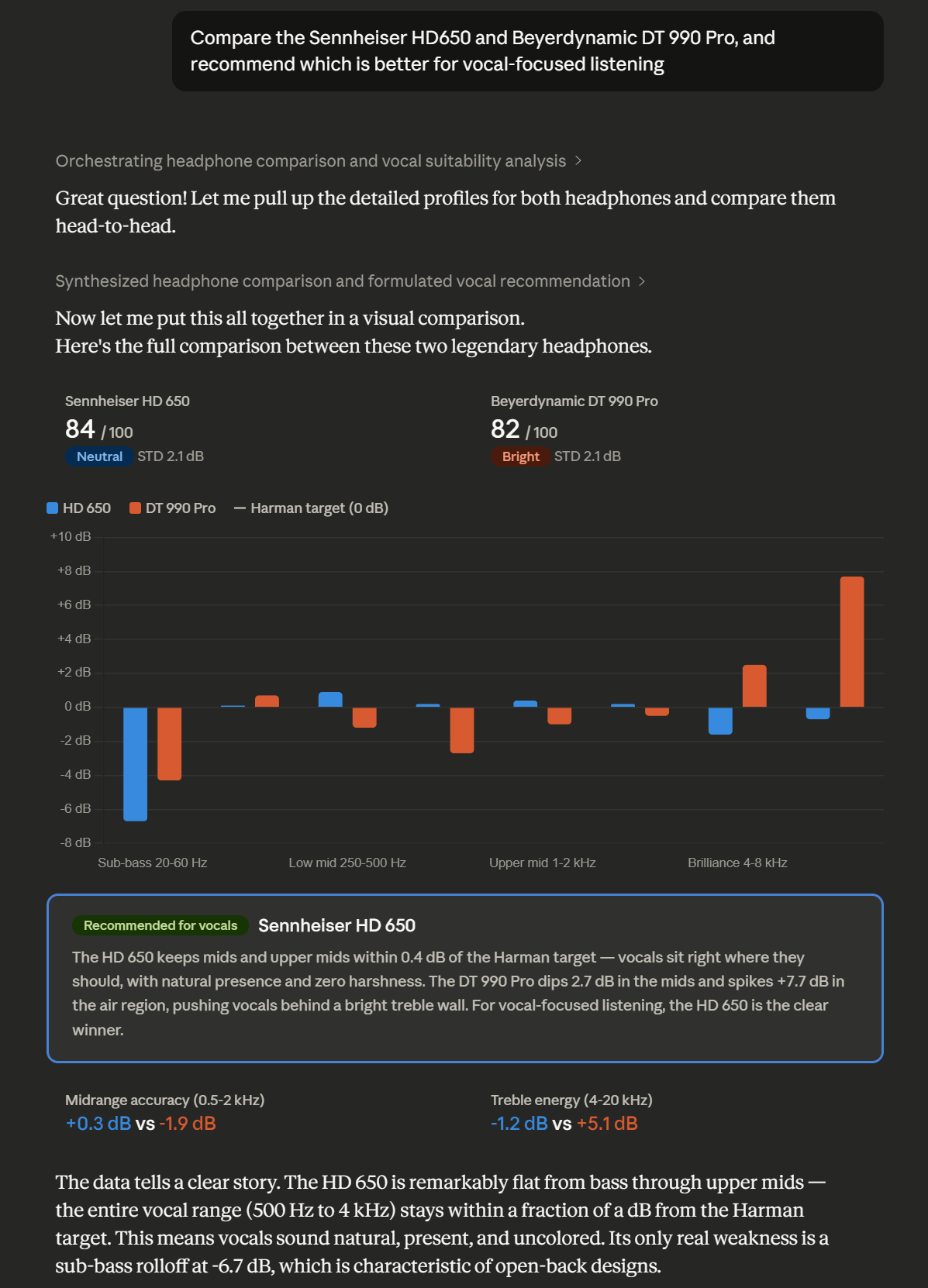
The server automatically analyzes frequency response measurements across 8 bands and classifies each headphone's sound signature (Neutral, Warm, Bright, Dark, V-shaped, etc.).
Demo
Headphone comparison with vocal suitability analysis
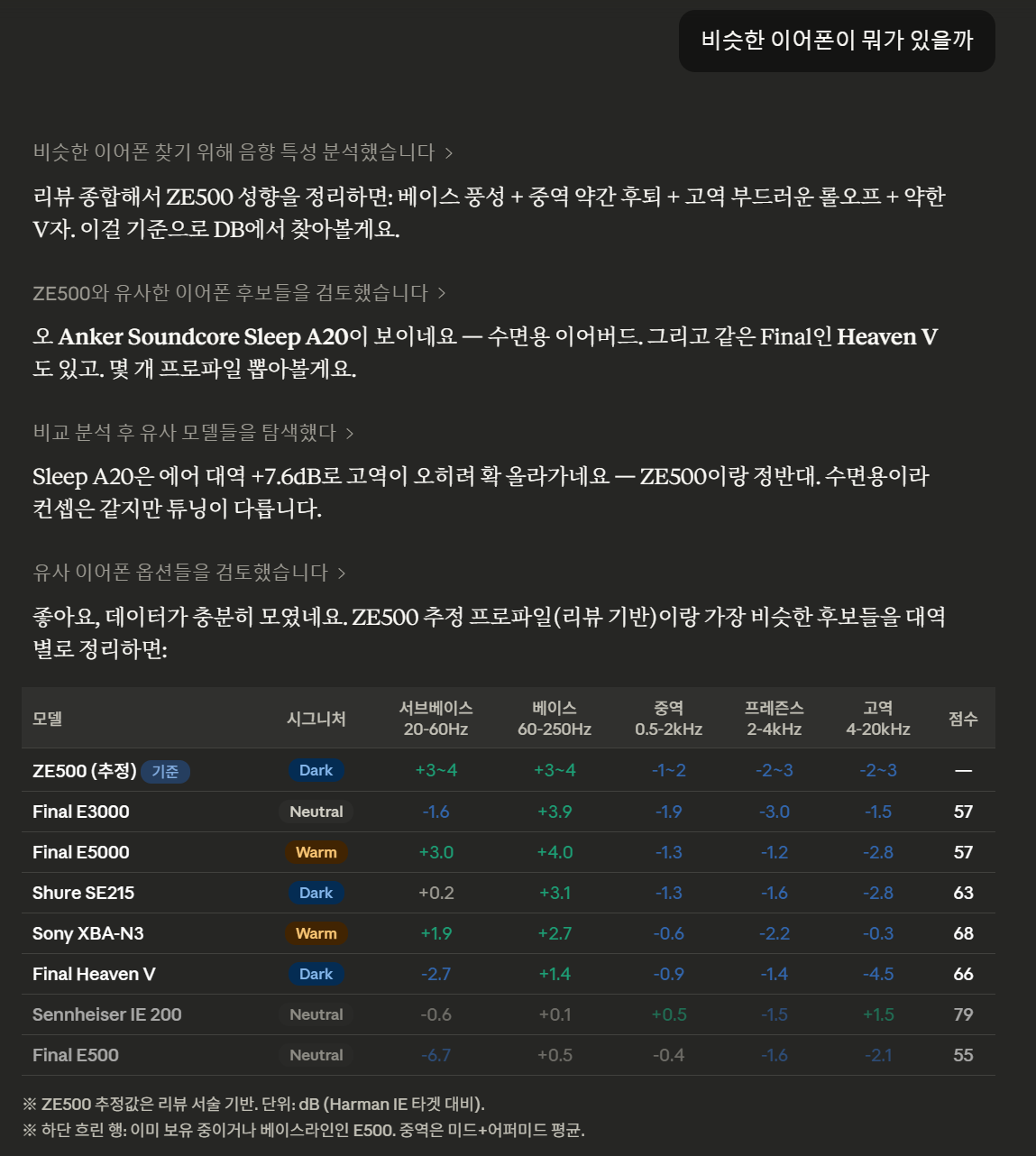
Finding similar IEMs by sound signature
Tools
| Tool | Description |
|---|---|
eq_search | Search by name, type (over-ear/in-ear/earbud), sound signature, or measurement source |
eq_profile | Get full EQ profile — parametric EQ, fixed band EQ, per-band analysis with visual bars |
eq_compare | Side-by-side comparison of two headphones across all frequency bands |
eq_recommend | Recommendations by preference (neutral, warm, bright, bass, vocal, fun, analytical) |
eq_ranking | Harman headphone listener preference score rankings |
eq_targets | List all 61 available target curves (Harman, Diffuse Field, etc.) |
eq_sync | Pull latest data from AutoEQ GitHub and rebuild the database |
Example Output
Installation
Claude Code / Claude Desktop (stdio)
For Claude Desktop, add to your config file:
SSE Mode (Remote / Multi-client)
From Source
Configuration
All configuration is via environment variables:
| Variable | Default | Description |
|---|---|---|
AUTOEQ_DATA_DIR | ~/.autoeq-mcp | Directory for repo clone and SQLite DB |
AUTOEQ_MCP_PORT | 3008 | SSE server port |
AUTOEQ_MCP_HOST | 0.0.0.0 | SSE server host |
AUTOEQ_MCP_ALLOWED_HOSTS | (none) | Comma-separated allowed hosts for SSE |
Data Source
All headphone data comes from AutoEQ by Jaakko Pasanen (MIT License).
- 8,800+ headphone/IEM profiles
- 22 measurement sources (oratory1990, crinacle, Rtings, and more)
- 61 target curves (Harman 2018/2019, Diffuse Field, etc.)
- 2,300+ Harman preference scores
The database syncs from the AutoEQ GitHub repository. Run eq_sync or autoeq-mcp --sync to update.
How Sound Signatures Work
The server analyzes each headphone's frequency response error (deviation from target) across 8 bands and classifies it:
| Signature | Characteristics |
|---|---|
| Neutral | All bands within ±2 dB of target |
| Warm | Elevated bass, flat/recessed treble |
| Bright | Elevated treble, flat/recessed bass |
| Dark | Recessed treble |
| V-shaped | Elevated bass + treble, recessed mids |
| U-shaped | Elevated bass + treble |
| Bass-heavy | Strongly elevated bass (>3 dB) |
| Mid-forward | Elevated mids, flat bass/treble |
| Harman-like | Total deviation < 1.5 dB average |
License
MIT — See LICENSE