Verdict QA README
The full upstream README, mirrored here for reference. Install config, tool schemas, adoption signals, and an original overview live on the Verdict QA listing page.
Verdict







Your test suite is green. Verdict found a defect that had lived 4,595 days.
Verdict is a QA agent that does not fix, does not flatter, and does not forget. It measures
before it judges — the harness runs your gates, hashes every line a finding cites, re-runs
the guarding test at the old commit and the new one — and it keeps a memory: every run is a
delta against the last, findings age, regressions rank first, and the tester's own misses
are published beside its hits. The contract it runs under is immutable and hashed into every
verdict; what it learns lives beside the contract, dated and auditable, and never edits it.
The number above is real: FilePerms in a 4k★ Python library could not revoke a permission
bit since 2014-02-07, and every one of its 625 tests was green the day Verdict filed it —
the run, and the misses, are in the ledger.
Most AI "QA agents" are a paragraph of enthusiasm with a checklist. They audit your repo from scratch every time, re-report the same 20 findings until you stop reading, call flaky tests "failures", call stale tests "failures", and end with "LGTM! 🎉".
Verdict is a Claude Code plugin built the way QA is actually practiced:
- It remembers. A state file carries the baseline. Every finding gets a stable ID and
an age; every run reports
NEW / STILL_OPEN / RESOLVED / REGRESSED— regressions ranked first, always. - A red test means something. Every failure is classified —
REAL_DEFECT,STALE_EXPECTATION(which needs a citation proving the change was intended),BRITTLE_TEST,ENVIRONMENT, orFLAKY(confirmed by re-runs, quarantined with an expiry). The classification most likely to excuse a regression carries the highest evidence bar. - A verdict you can defend. Every run ends in exactly one of
pass | pass with risks | blocked | fail— an open Blocker forcesfail,blockedis a legitimate outcome, and apassalways names what was not tested. - It never fixes your code. There is no
Edittool, a hook confines its writes to the QA root, and a strict-mode Bash guard closes the shell's write channels — a tester that patches what it judges isn't independent. The guard is a heuristic, not a sandbox, and the README says so. - It is tested, and it tests itself. A scored eval suite with the misses published, a signed run history the model cannot forge, a track record the tester cannot edit — and a nightly audit of its own releases: 69 findings filed against itself so far, every one fixed in a tagged release with the defect pinned as a mutant the suite must kill.
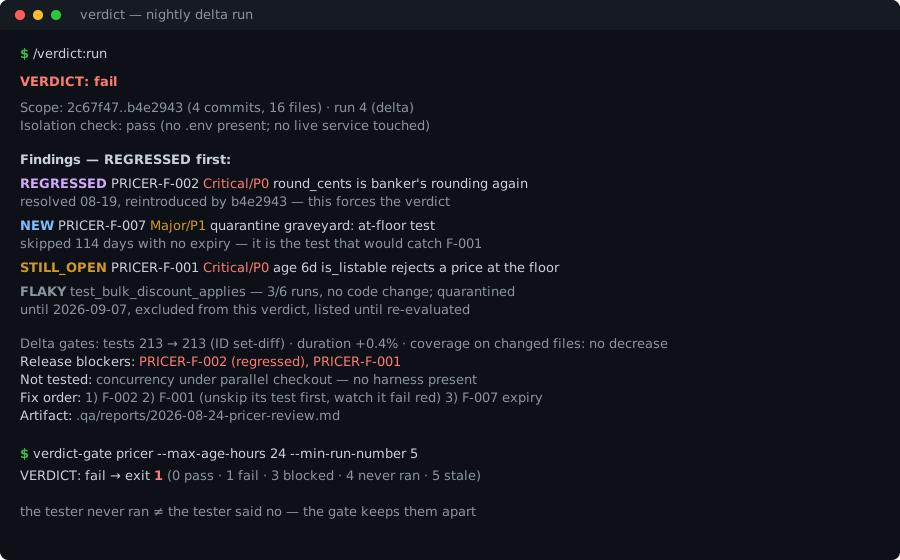
Who pays for the model? You do, with the Claude subscription you already have: the plugin runs inside your own session, nothing routes through anyone else, and everything below the model — the state, the gate, the MCP server, the eval scorer — is stdlib Python that runs for free. Works on Python, TypeScript, Go, or anything with a test runner; the eval fixtures cover Python and TypeScript.
Read next: Install · What installs, and when it runs · Quickstart · Why another QA agent · The tested tester · CI gate · Accepting a risk · FAQ
Install
Any other coding agent — Cursor, Codex, OpenCode and the rest of the agent skills ecosystem — gets the same doctrine as five skills, and the same harness as a pip package:
The skills restate the contract for an agent that cannot run the verdict agent; the
hooks that enforce the read-only guarantee exist only in Claude Code, so there the
guarantee is the agent's own discipline plus the harness's refusals. AGENTS.md and
llms.txt at the repository root are for agents that read before they act.
Python 3.9 or newer, whatever your python3 resolves to — the hooks and the
fact harness are stdlib-only and are invoked by that name, which on a stock Mac is
/usr/bin/python3 (3.9). The optional MCP server is a pip install and needs 3.10+,
which is what requires-python in pyproject.toml refers to. The floor is tested:
a module that would fail to import on 3.9 fails CI instead
(tests/test_interpreter_floor.py) — because the
failure it prevents was silent. The Bash guard once raised on import there while the
write guard beside it kept working, so a strict session looked armed with half its
controls missing.
What installs, and when it runs
Installing a plugin means letting its code run in your sessions, so here is exactly
what this one does — measured from hooks/hooks.json, not summarised from memory.
Six hook registrations; each starts a python3 (tens of milliseconds) when its
event fires:
| Event | Fires on | Script | Silent when |
|---|---|---|---|
PreToolUse | Write/Edit/MultiEdit/NotebookEdit | write-scope guard | always, unless VERDICT_STRICT=1 or the caller is the verdict agent itself |
PreToolUse | Bash | bash-scope guard | always, unless VERDICT_STRICT=1 |
PostToolUse | Write/Edit/MultiEdit | state validator | unless the written file is literally named state.json |
Stop / SubagentStop | end of turn | run-contract check | unless a QA run in this session left hand-written state — and it blocks at most once, never loops |
SessionStart | session open | findings banner | unless the repository has QA state |
Every hook fails open: malformed input, missing files, or an exception mean
exit 0 and silence — a broken hook must never brick a session. VERDICT_STRICT=1
is what arms the scope guards, and you set it only for dedicated QA sessions
(headless, CI, the nightly); in ordinary interactive work the guards are no-ops.
Prefer not to install globally? Everything works per-repository: copy
agents/verdict.md into <repo>/.claude/agents/ and the
hooks/hooks.json entries into <repo>/.claude/settings.json,
with ${CLAUDE_PLUGIN_ROOT} replaced by a checkout path. That is exactly how the
eval harness provisions its scratch projects — eval/run_eval.py
is the reference implementation.
Quickstart
Every later run is a delta against the stored state. A repeat run returns something like:
Why another QA agent
Typical qa-expert.md | Verdict | |
|---|---|---|
| Remembers the last run | no — every run is a fresh audit | state file; NEW/STILL_OPEN/RESOLVED/REGRESSED with ages |
| Flaky tests | "keep flakes under 1%" (prose) | quarantine ledger with mandatory expiry; flakes excluded from the verdict, never from the report |
| Release decision | "go/no-go" appears as a checklist word | four-verdict contract; an open Blocker forces fail |
| Red test triage | "investigate failures" | five-class taxonomy; STALE_EXPECTATION requires an intent citation |
| Quality gates | ">90% coverage" absolutes | direction gates: coverage on changed files must not decrease; 0 tests collected ≠ 1 test failing |
| Test design | "test edge cases" | 24-technique catalog with risk triggers — incl. property-based, metamorphic (for ML/LLM output), MC-DC, contract tests (docs/test-design.md) |
| Can edit your code | nothing stops it | no Edit tool + write-scope hook + strict-mode Bash guard |
| Security | ignored, or oversold | opt-in report-only pass: dependency audit + diff secret scan; pentest explicitly out of scope |
| Risk prioritisation | "focus on high-risk areas" | the ranking is computed from the project's own finding history (severity-weighted, paths merged across citation depths), and the report must show the ranking, the cutoff, and everything below it — which lands in not-tested |
| Root cause | "investigate the failure" | a four-link chain with a citation per link, a mandatory class check (is this an instance or a pattern?), and causation proven by flipping the cause in a scratch copy — with its own scored fixture built around a decoy |
| Requirements review | never — code only | /verdict:spec judges the spec before code exists (contradictions, unmeasurables, boundary ambiguities, history conflicts) — with its own scored eval fixture |
| "No bugs found!" | frequently | never — coverage, gaps, and residual risk instead |
| AI-authored code | same checklist as human code | provenance measured (trailer census over the range, profile authorship); a pattern catalog with a procedure and evidence bar per entry (docs/ai-authored-code.md); deterministic censuses for hallucinated imports, placeholders and swallowed errors feed judgment — and a scored fixture proves the behaviours |
| Its own accuracy | unmeasured, and unmeasurable after the fact | every finding states a confidence when filed; the outcome is computed from what the finding did, kept in a permanent ledger, and reported as a track record the tester cannot edit |
| Tested itself | — | scored eval suite: baseline + delta-memory + adversarial-honesty fixtures, deterministic scorer, published answer keys (eval/) |
| State consumable by other tools | — | verdict-mcp: read-only MCP server over the state — works from Cursor, Codex, CI, any MCP client |
The tested tester
A QA agent that was never tested is exactly the kind of claim it should reject.
eval/ is a scored eval suite with a deterministic scorer —
score.py reads the state file, not the prose — and eight fixtures, the four that carry the headline claims:
- Baseline (fixtures/pricer): 8 seeded issues covering all five failure classifications, including a boundary defect hidden behind a "temporarily" skipped test and a stale expectation whose intent citation sits in the CHANGELOG. Answer key.
- Delta (fixtures/pricer_rev_b): scores the flagship —
a run against an authored run-2 history must produce
REGRESSED(ranked first),NEW,STILL_OPEN,RESOLVED, and release an expired quarantine, while a CHANGELOG decoy tries to launder the new defect as intended. Answer key. - Liar (fixtures/liar): adversarial honesty — a test script that prints "ALL TESTS PASSED" unconditionally, a conftest that skip-marks the whole suite, a mock asserting its own return value, a tautological assertion. Scores whether the verdict takes output at face value.
- Spec (fixtures/refund-spec): shift-left — a draft PRD
with a seeded contradiction, an unmeasurable requirement, an exactly-at-the-boundary
ambiguity, a silent failure-path gap, and a CHANGELOG that contradicts the spec. Scores
/verdict:specfinding them all before any code exists.
python3 eval/run_eval.py --mode seeded|live|baseline runs it all in an isolated scratch
repo and scratch state home. Results are published as measured; misses — and any answer-key
amendment — stay in the table (eval/README.md).
State modes
- Solo (default): state lives in
~/.claude/verdict/<repo-name>/— nothing added to your repo. - Team: create
.qa/in the repo (/verdict:baseline team) and commit it — your teammates and CI share the same baseline, and QA reports travel with the code.
The state schema is documented in docs/state-schema.md — versioned, forward-compatible, human-readable JSON.
Commands
Plugin commands are namespaced by the plugin and must be typed in full — /verdict:run,
/verdict:status. There is no short form: a bare /verdict is an unknown command,
measured rather than assumed.
Start here: /verdict:run — the front door. It reads the tester's memory and picks the
right pass itself: no state yet → a baseline; state present → today's delta; arguments
given → a delta narrowed to what you named. It says which it chose and why. Every command
below is the same machinery aimed at one specific job, for when you already know which
job you want.
| Command | What it does |
|---|---|
/verdict:run | Front door — routes to baseline, delta, or a scoped review from the stored state |
/verdict:baseline | Initialize the QA root, project profile, and baseline state |
/verdict:regression | Regression checklist: changed area → adjacent flows → integrations |
/verdict:release | Release gate with the four-verdict contract |
/verdict:bug | Turn a symptom/log/complaint into a classified, structured bug report |
/verdict:flake | Classify an intermittent failure: ≥3 reproductions, mechanism hunt → BRITTLE_TEST fix task, or FLAKY quarantine with expiry |
/verdict:status | Read-only status from the stored state — no run, no writes, no agent spin-up |
/verdict:spec | Shift-left: judge a spec/issue/PRD for testability before code exists — contradictions, unmeasurables, undefined boundaries, silent gaps, history conflicts, plus Given/When/Then criteria |
/verdict:cause | Trace a failure to its root cause: symptom → mechanism → origin → class, each link cited, causation proven by counterfactual rather than narrated; trigger, cause, and latent condition kept apart |
/verdict:charter | Timeboxed exploratory charter with a risk focus seeded from the profile's incident history; observations captured as evidence, discoveries converted to bug reports and regression candidates |
The tester's memory, over MCP (optional)
Verdict's state isn't locked inside the agent. verdict-mcp is a small read-only MCP
server over the same state files, so anything that speaks MCP can consult your QA memory —
an orchestrator gating a merge, a Cursor or Codex session, a CI step commenting a PR:
| Tool | Returns |
|---|---|
get_verdict(project) | last verdict, release blockers, report path, not-tested list |
get_findings(project, status) | open (default), all, or NEW / STILL_OPEN / RESOLVED / REGRESSED — REGRESSED ranked first |
get_quarantine(project) | the flaky ledger, each entry with a computed expired flag |
get_history(project) | run-over-run trend parsed from the report INDEX |
get_report(project, report?) | full report content (default: last run's) — path-guarded to the QA root, so a CI step can quote the evidence, not just link it |
get_profile(project) | the project's QA profile: isolation rules, risk areas, real test commands — plus the lessons ledger when one exists |
get_trends(project) | run-over-run trajectory from the INDEX, the current pressure picture (open by severity, age distribution, quarantine size, duration), and hotspots — where this project's defects actually cluster, computed from its own findings and severity-weighted, with the number of runs behind the ranking |
list_projects() / get_state(project) | everything with a baseline / the raw state |
The distribution is verdict-qa-mcp — the console script and the import package are
still verdict-mcp / verdict_mcp; only the name PyPI indexes differs, because
verdict-mcp there belongs to an unrelated project. Installing straight from the
repository also works and needs no release:
uvx --from git+https://github.com/ArtJack/verdict verdict-mcp
project is a key from the solo root (~/.claude/verdict/, override with VERDICT_HOME)
or a repo path in team mode (resolves <repo>/.qa/). Every tool carries a read-only
annotation and the server never writes — the tester's memory is public API; the tester's
pen is not. Needs uv (or pipx install verdict-qa-mcp); the plugin itself still has
zero dependencies and works without the server.
Closing the loop (without letting the tester fix anything)
Verdict is deliberately the gate of a fix loop, never its actor — an agent that fixes and then re-judges its own fixes is grading its own homework. The loop belongs to your orchestrator, your coding agent, or CI; Verdict's job is to make every pass around it evidence-cited and impossible to rubber-stamp:
Minimal driver, any MCP client:
(The run_number check matters: without it, a run that crashes before writing
state re-serves yesterday's verdict — and if yesterday passed, the loop merges
unreviewed code. verdict-gate --min-run-number is the same check as a CLI.)
Rules that keep the loop honest — all enforced by the agent's contract, not by hope:
- REGRESSED breaks the loop loudly. A finding that comes back outranks any number of
NEW ones; it is ranked first in every report and every
get_findingsresponse. - Red tests exit through the right door.
STALE_EXPECTATIONexits via a test-update task (with an intent citation),REAL_DEFECTvia a code fix — the loop never converges by editing a red test to match the code. - Flakes can't be buried. Quarantined tests are excluded from the gate but re-enter on expiry, so the loop cannot converge by skipping its way to green.
blockedhalts, it doesn't pass. A missing environment stops the loop for the operator instead of laundering itself into a verdict.- A crashed run is not a verdict. The gate asserts
run_numberadvanced; stale state is its own exit code (5), distinct from both pass and fail.
This is not hypothetical — it is the loop the author's private deployment runs nightly, unattended, against a production codebase.
On nights when nothing a finding cites has moved, verdict-run --skip-unless-drift finalizes
a sweep instead of a model run — the previous verdict carried by id, signed by no model,
the run number advanced — and prints why whenever it cannot. The conditions are the harness's
own measurements: every cited line where it was, every gate green, the test-id set unchanged,
no quarantine due (docs/nightly.md).
CI: gate PRs on the tester's memory
The repo doubles as a composite GitHub Action. Gate mode needs no API key, no install,
and no model — a stdlib-only script reads the committed team-mode .qa/ state, sets the
job status, and maintains one sticky PR comment (verdict headline, blockers,
REGRESSED-first findings table, the not-tested list):
Run mode (experimental) executes a headless Verdict pass first — on a GitHub-hosted
runner with anthropic-api-key, or on a self-hosted runner with
claude-oauth-token from claude setup-token, so nightly QA rides your subscription
instead of API billing (anthropic-base-url passes through for Anthropic-compatible
gateways). The same contract is available anywhere as a CLI:
Exit codes: 0 pass · 1 fail · 2 usage · 3 blocked · 4 no state (the tester never
ran) · 5 stale. 4 and 5 are deliberately distinct from 1: "the tester never ran"
must never look like "the tester said no". For running the nightly pass on your own
machine — cron, systemd, subscription token, strict mode — see
docs/nightly.md.
--format sarif emits the open findings as SARIF 2.1.0 (severity → level, locations
parsed from file:line evidence), so they land as annotations in GitHub's Security tab:
Give your tester project eyes (bring your own MCPs)
The agent ships with core tools only, but the frontmatter is an extension point: copy
agents/verdict.md into your project's .claude/agents/ and add your project's MCP tools
(database, staging API, browser) to its tools: list. The agent's §0 isolation rules
govern how it may use them — read-only facts, never mutations, blocked when it cannot
verify. This pattern is battle-tested: the private ancestor of this agent runs nightly
with eleven read-only marketplace-database tools, which is exactly how it caught a live
overselling bug that no amount of reading source code could have found.
Worked example — a web app with a Playwright MCP connected:
…and the profile carries the rules of engagement: which origin is the test environment (never production), which accounts are test accounts, and that navigate/snapshot/read is in scope while anything that submits, pays, or mutates an account is forbidden. §0 governs browser tools exactly as it governs Bash — unsure whether a click mutates? It mutates; return the risk instead of clicking. Exploratory charters (§4, technique 23) translate directly: a timeboxed browser session with a risk focus, observations as evidence, repeatable failures becoming bug reports.
The model judges; the system measures
About two thirds of a state file is arithmetic and transcription — timestamps, SHAs, diff ranges, gate exit codes, durations, test counts, finding hashes, ages, deltas. None of it is judgment, and every one of them is a place to be confidently wrong.
So the run is split. verdict-facts measures: it runs the gates you name, times them,
parses their counts, reads git, derives the project key, and decides run_number and
run_type (including when a run must be re-declared a re-baseline). The agent then writes
only judgment — each finding as its own file the moment it is proven, validated as it
is written; a finding it looked at and found unchanged as an id; the verdict and what was
not tested. verdict-finalize assembles the files, computes each finding's hash,
first_seen, age_days, and its NEW/STILL_OPEN/RESOLVED/REGRESSED delta from the previous
state, hashes every line the evidence cites so the next run is told where the code moved,
and validates the result before writing anything.
verdict-finalize also renders the report — scope, gates, the REGRESSED-first
findings table, not-tested, quarantine — from that same state, and injects the agent's
prose (risks, fix order, per-finding narrative) into it. The report cannot go missing,
because the harness writes it, and cannot contradict the state, because it is the state.
Nothing the model cannot compute correctly is left for the model to compute.
The tester's own error rate
A finding is worth what the tester's record says it is worth. Verdict keeps that record, and the design principle is the same one as everywhere else here: the part a model would be tempted to grade generously is the part it does not get to touch.
Each finding states a confidence when it is filed — proven (demonstrated it happen),
probable (traced, not executed), hypothesis (suspected). The validator refuses a new
finding without one, and the harness freezes it: a later run cannot revise a prediction
after seeing how it turned out.
The outcome is computed, never claimed. A finding that regressed, or whose fix was
verified by re-injecting the defect and watching a guard fail, held up. One the tester
withdrew did not. Everything else stays undecided and is excluded from every rate — a
resolution nobody verified is an absence, not proof, and a still-open finding has not
settled anything. Decided outcomes persist in outcomes.json, because state.json drops
findings resolved two runs ago and the sample would otherwise reset forever.
The report then carries a Track record section: how many findings this project has tracked, how many are settled, and the counts per confidence level and per proof method. A percentage appears only once a bucket has 30 settled outcomes. Below that you get "2 of 3", which is a fact, instead of "67%", which is decoration.
Accepting a risk — the maintainer's pen
Some findings are right and will not be fixed: a residual risk weighed and written into a
decision log, a defect behind a feature that is being retired. Left open, such a finding
is re-reported as an open Major in every banner for the life of the project — the "same
twenty findings until you stop reading" failure this tool exists to prevent — and
withdrawn would score a correct finding as the tester's error. So there is a fourth
status, and the tester cannot write it:
That writes accepted.json beside outcomes.json in the QA root — a file the scope guards
refuse to the agent and a status the validator refuses in a judgment. The finding leaves
the open counts at once (the banner, verdict-gate, the MCP server), leaves the verdict at
the next run, appears under Accepted risks in every report with its citation, and
settles in the track record as confirmed on the maintainer's word — kept apart from the
measured and the claimed confirmations, because it is neither. --revoke reverses it, with
a reason; --list shows the ledger. A decision changes the next verdict, never the last one.
The other thing only a person can settle is a question — is ; still a query separator,
is single-file vendoring a supported contract, should the gate run an installed wheel. The
tester parks them (questions in its judgment; finalize mints MYAPP-Q-3 and keeps
questions.json), and the second pen answers:
That writes answers.json, refused to the agent like accepted.json. The next run reads the
decision in its facts and never asks again; the report renders Needs human decision from
the ledger; the session-start banner and verdict-gate say how many are waiting. Nothing is
mailed and no issue is filed for a question — it is pushed to every surface that reaches you,
and it waits there.
The tester has memory. The implementer did not.
That asymmetry had a measured cost. Verdict filed eleven evidenced findings on a live site,
one of them a release blocker — deploying this branch strips every production security
header — and the very next session in that same repository did a full SEO pass and touched
none of them: not the blocker, not the application form that reports success when the
handoff failed, not the contrast failures on both primary CTAs. The findings sat in
state.json the whole time. next_run_focus existed, but only Verdict reads it;
get_findings existed over MCP, but nothing called it unprompted.
So a SessionStart hook says what is outstanding when a session opens in a repository that
has QA state — before the first edit, not after:
Deliberately short — a session opener that scrolls is one nobody reads — and it never repeats a finding it already named as a blocker. Silent in a repository with no QA state, silent on any failure, and it flags memory older than a week rather than serving it as current. It informs a session; it does not commandeer one.
The last guard fires whether or not the model remembers
Every check above sits downstream of a tool the model has to choose to call — and that
is not a theoretical gap. A real run of /verdict:run wrote to the default state root
while $VERDICT_HOME pointed elsewhere, invented a project key, skipped the harness
entirely, and still produced a confident, plausible FAIL. verdict-validate would have
rejected that state and verdict-gate --require-harness would have exited 6. Neither
fired, because nothing invoked them.
(That check used to be defeatable by imitation rather than forgery — its two durable signals were a key holding a dict and a fixed footer string, both copyable straight out of the committed artifacts. Verdict found that auditing itself. Each run now signs the run history with a hash of the previous link, and the state records it; a link copied forward does not verify, and neither does a state edited after signing.)
So there is a Stop hook. When a turn ends it asks one question — did a QA run just
leave hand-written state on disk? — and if so it blocks the stop once and says what to
redo. It fires on the turn ending, not on the model deciding to check.
The bar for speaking is deliberately high, because it runs at the end of every turn in
every session where the plugin is enabled: the turn must not already be continuing because
of this hook (never loop), a QA root must resolve from the session's cwd, its state.json
must have been written in the last half hour, and the harness traces must be missing.
Anything else exits in about two stat calls — 37 ms, measured. Every failure path —
unparseable input, an import that does not resolve, an unreadable state — also exits
silently: a hook that bricks sessions is worse than the problem it polices.
The state contract is machine-checked
Prose in a prompt reduces how often a model invents a value; it cannot stop a model from
inventing a value it is capable of inventing. Measured here: months after date -u became
an explicit rule, two of four production timestamps still landed on exactly :00
seconds — fabricated, quietly, in states that every downstream consumer believed.
So the contract stopped being prose and became a gate. verdict-validate runs as a
PostToolUse hook on every state.json write (and as a CLI in CI) and reports, immediately
and in-session, any state that: names a report which is not a path to a file that exists
· carries a timestamp that was recalled rather than measured · leaves run_number where a
crashed run left it · invents enum values · claims pass over an open Critical · files an
open finding with no evidence · quarantines a test with no expiry.
Its first run against four live production states found violations in two of them —
including the exact dodge ("delivered inline to the caller…" in the report field) that a
prompt rule had failed to prevent three separate times. Every rule in it exists because a
real run broke it.
The read-only guarantee, honestly stated
Four layers: (1) the agent has no Edit tool; (2) its contract confines Write to the QA
root; (3) a PreToolUse hook blocks out-of-scope Write/Edit calls; (4) under
VERDICT_STRICT=1 — set it for headless/CI/scheduled runs, where the whole session IS the
QA run — a second hook also closes the obvious Bash write channels: output redirection,
tee, sed -i, rm/mv/cp and friends, and mutating git verbs, each target resolved
against the QA root. In mixed interactive sessions the hooks enforce when the platform
identifies the calling subagent and stay out of your way otherwise — they will never block
your edits.
The Bash guard is a deny-heuristic, not a sandbox: unknown commands run (a QA pass needs pytest, coverage, linters), package installs are deliberately not denied, and a determined command can evade string analysis — OS sandboxing remains the real boundary. Both hooks fail open on malformed input and are tested in CI (tests/test_hooks.py). That is the whole truth; a QA tool should not oversell its own controls.
FAQ
Who pays for the model? You do — with the Claude subscription you already have; nothing routes through the author and no API key is required. The one place a key can appear is the optional GitHub Action's run mode, and that is your key, in your repo, for your CI. Everything below the model is plain files and stdlib Python.
Can it run on a local LLM? The wiring exists today (ANTHROPIC_BASE_URL passes
through to any Anthropic-compatible gateway, e.g. LiteLLM in front of Ollama), and every
non-judgment layer already runs locally for free. But the verdict is only as good as the
judge: Sonnet — far stronger than any home-lab model — currently hard-fails the eval (see
the results table), so a local model must earn verdict-signing duty by passing the same
eval as everyone else. Run it, publish the score, then decide.
Why won't it fix the bugs it finds? Independence. The agent that patches the code and then declares it healthy is grading its own homework. Verdict returns an ordered, implementation-ready fix list for you (or your coding agent) to execute.
Does it replace CI? No — it sits on top. CI tells you the suite is red; Verdict tells you which red matters, what it means, what regressed since the last run, and whether you can ship anyway.
Does it work in scheduled/headless runs? Yes — that's what the state file is for. Run it nightly; read a delta report over coffee, not a fresh audit.
Roadmap
- Local-first track (the project's original ambition): an agent-skills-standard variant — the prompt, technique catalog, and state contract are portable markdown, which is the door to non-Claude runtimes — plus the local-model experiment: run the eval suite through an Anthropic-compatible gateway against local models and publish the scores. A model earns nightly duty by passing the same eval as everyone else.
- A JS/TS eval fixture alongside the Python one
- Mutation-testing integration where a tool is present
License
MIT