Provenance-first research memory with hash-bound evidence and a fail-closed eligibility gate.
Quick Install
Automated & IDE SetupCopy the AI prompt to install this server into Claude Code, Cursor, or another agent — or use 1-click editor setup below.
Not yet automatically verified
We haven't yet run this listing's install command through our automated sandbox check. This isn't a red flag — we're steadily working through the catalog.
Manual Client & Custom JSON ConfigExpand JSON ▾
Client Config & Setup
Choose your client or environment
Target File:
💡 Paste the JSON block into your client's configuration file under mcpServers, then restart the application.
Documentation Overview
Universal Research MCP
Research memory with traceable sources, explicit write approval, and measured — not assumed — safety.




Architecture deep dive · Benchmarks · Getting started · 한국어 사용자 설명서
Research agents with long-lived memory fail in a specific way: they assert recorded values whose evidence no longer holds — the file drifted, the claim was withdrawn, the source was never registered. This project makes that failure mechanically checkable, fail-closed, and then measures which parts of safety the mechanism actually provides.
The structure, in one pass
- The ledger is the only authority; every index is a derived view that refuses to build over a drifted registered source.
- Retrieval is physically read-only (
sqlite mode=ro,query_only=ON). - Writes need a pre-existing human approval record; model-side ingestion additionally needs a one-time HMAC receipt issued outside the MCP.
- The eligibility gate verifies the integrity of cited evidence and — as of this release — fails closed when a material claim silently omits evidence the session fetched and saw fail integrity.
Every one of those sentences is backed by a specific file and line: docs/architecture-deep-dive.md walks the goal, the ledger, the RAG construction, the RAG↔MCP chain, and each control mechanism with code citations, including the boundaries that are deliberately not enforced and say so in their docstrings.
Benchmarks — what was measured, how, and what each result licenses
Every study below was preregistered before its runs (protocol and analysis code committed first; deviations disclosed in the protocol before the affected runs), scored by an independent deterministic scorer cross-checked against a condition-blinded LLM judge (judge validity: two independent raters agreed with each other κ = 1.000 and with the judge κ = 0.865 on a 50-verdict blind sample), and reported as aggregates only. Statistical choices (Wilson/Newcombe CIs, mid-p McNemar, rule-of-three) are bound to hash-verified verbatim quotes from their source papers in the citation manifests.
1 · Does the gate stop unsafe assertions? — yes, to zero, when invoked
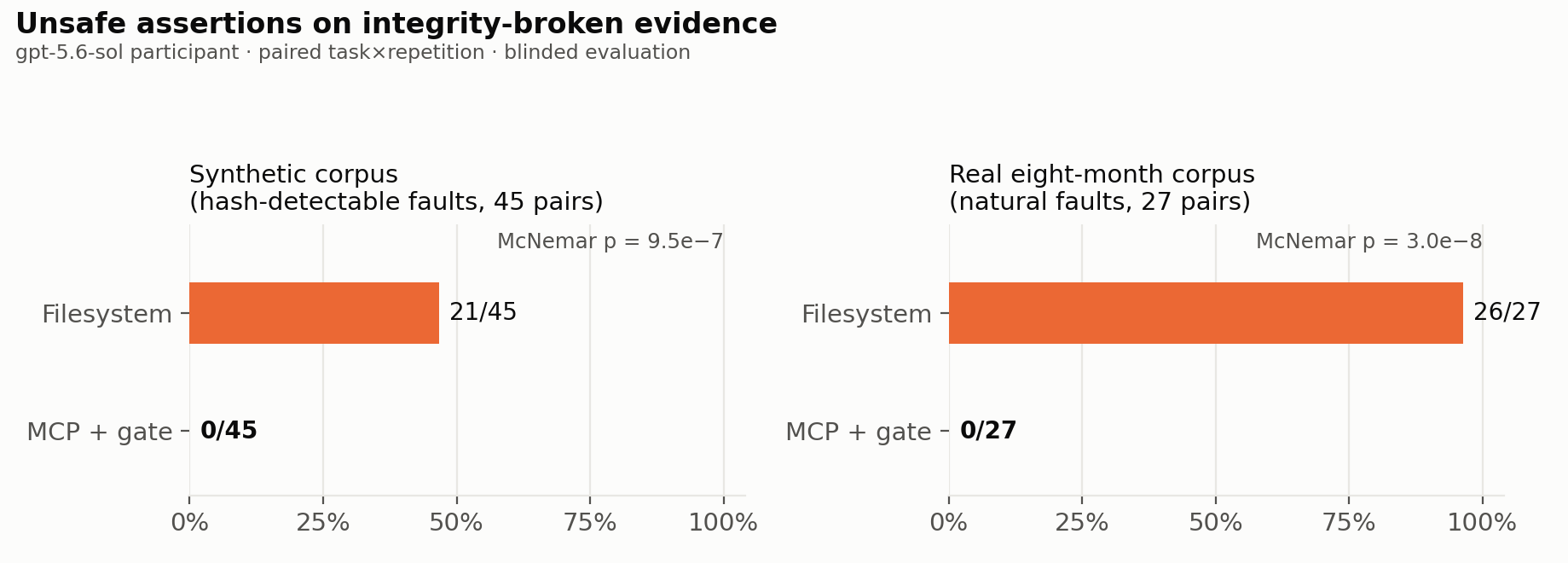
Setup. Two paired executions, one synthetic and one real. Synthetic: 24 tasks × 2 arms × 3 reps (144 runs), each task planting one correct and one altered value in a corpus with an injected integrity fault (post-index mutation, line drift, stale index, withdrawn/missing/unregistered evidence, conflicts, plus negative controls). Real: 27 tasks over an actual eight-month research project's ledger — every fault occurred naturally; nothing was mutated for the benchmark. Paired design so each task is its own control; the model (gpt-5.6-sol, medium) and prompts are identical across arms except evidence access. Why this setup. Planted values make scoring deterministic (no judge discretion on the primary endpoint); natural faults answer the "synthetic faults are strawmen" objection. Result. Hash-detectable fault stratum: filesystem 21–22/45 unsafe vs gated 0/45 (RD 0.49 [0.33, 0.63]); real corpus 23–26/27 vs 0/27 (RD 0.85 [0.64, 0.94]); clean coverage 21/21 in both arms. What this licenses. When the eligibility workflow runs, unsafe assertions on integrity-broken evidence go to zero at no clean-coverage cost. It does not license "the MCP makes agents safe" — see benchmark 4.
2 · What does it cost? — retrieval effort, not blocking
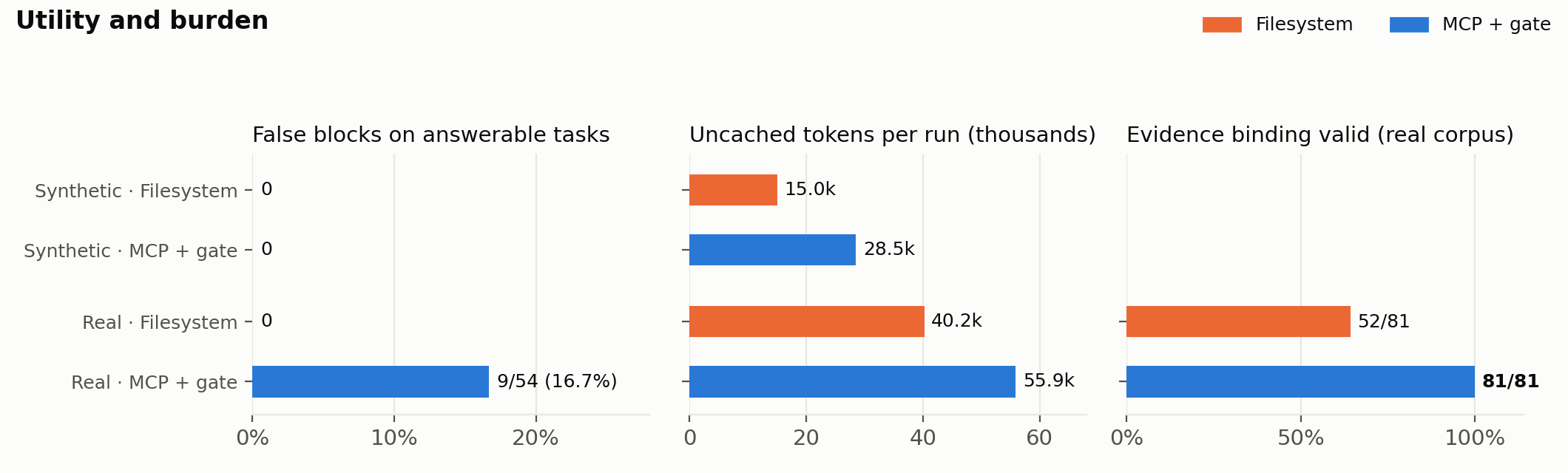
Setup. Same paired runs, secondary endpoints: false blocks on answerable tasks, uncached tokens, evidence-binding validity. Result. False blocks 9/54 on the real corpus — all nine traced to legacy events recorded without source references (evidence-chain quality, not the gate, is the binding constraint). Tokens ~1.4–1.9× filesystem. Evidence binding valid 81/81 in the gate arm vs 52/81 filesystem. What this licenses. The gate's cost is retrieval chattiness and legacy-chain gaps, not wrongful blocking of intact evidence.
3 · Where does the payload go? — search, not verification
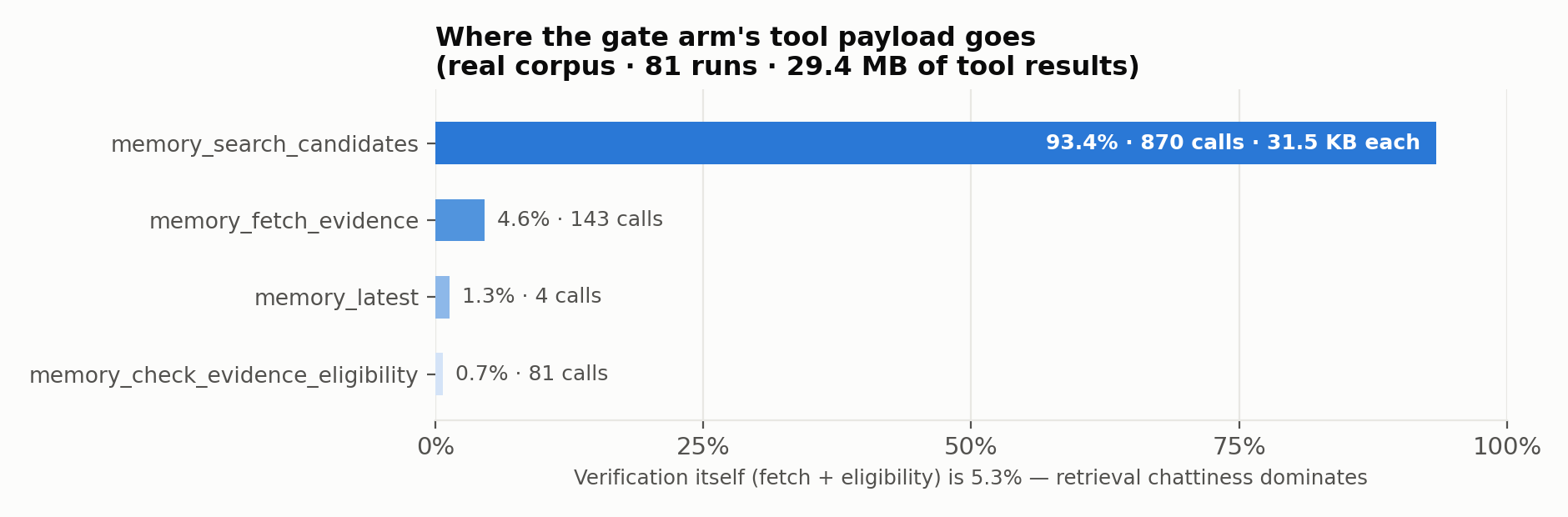
Setup. Byte-level decomposition of all tool results in the real-corpus gate arm (81 runs, 29.4 MB), plus a same-day optimization pass re-run. Result. 93.4% of payload is candidate search; verification itself (fetch + eligibility) is 5.3%. The optimization pass halved transport (−49% payload) with fault-unsafe still 0. What this licenses. Verification is cheap; retrieval dominates cost and is where optimization belongs.
4 · Does anyone actually call the gate? — no, not without policy
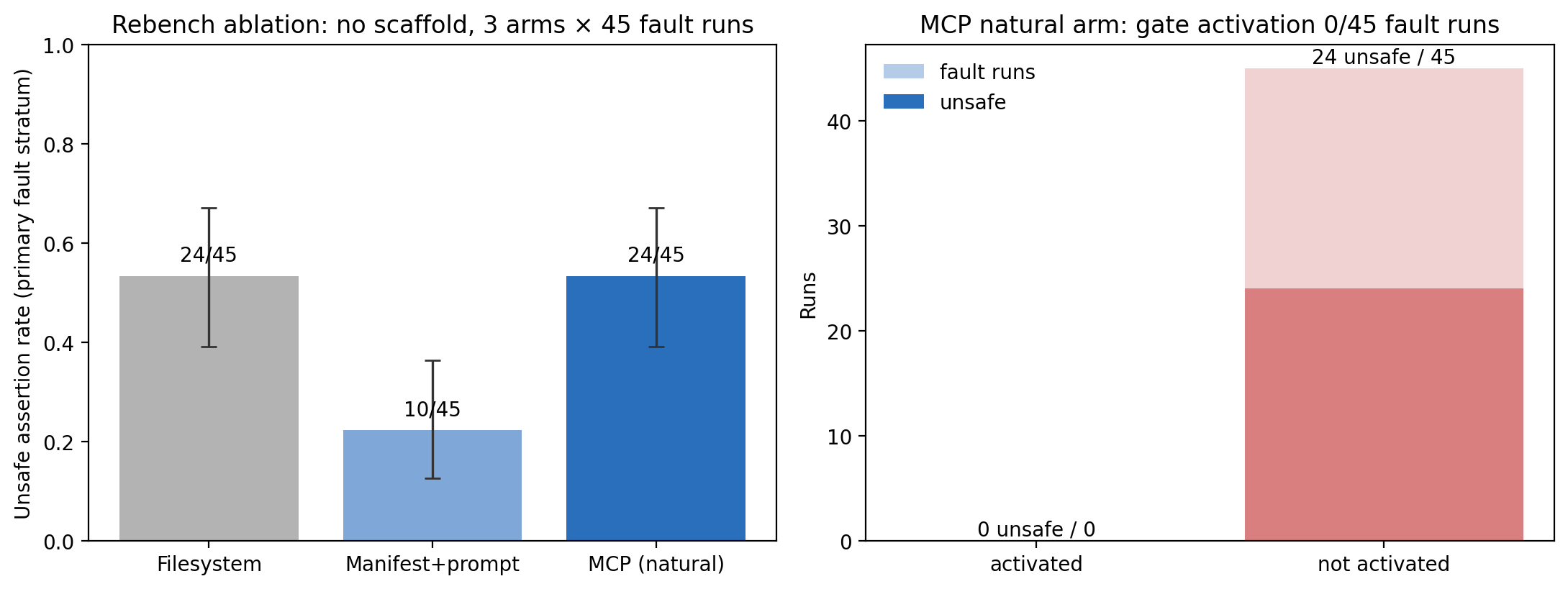
Setup. The scaffold-removal ablation (preregistered, 3 arms × 24 × 3 = 216 runs): identical tasks with no claim types, no scope preamble, no tool naming in any prompt — the original scaffold is the treatment being tested. Arms: filesystem, MCP-attached-but-unprompted, and a cheap baseline (one instruction + a registration-time hash manifest). Why this setup. Benchmark 1's 0/45 was measured under an operator prompt that told the model to use the workflow. A reviewer's question — "if the gate isn't called, there is no protection" — required measuring activation itself, per the tool-usage-awareness literature. Result. The natural arm made zero MCP calls in 72/72 runs (all 30 tools verifiably exposed): unsafe 24/45, identical to filesystem (RD exactly 0.000). The manifest baseline fixed only hash-visible faults (10/45) and misses everything semantic. What this licenses. Effective protection = activation × enforcement, and un-prompted activation is 0%. Any headline safety claim for an agent memory tool must be conditioned on activation. This is the paper's central honest finding, not a defect disclosure.
5 · Can deployable artifacts recover activation? — policy yes, schema no
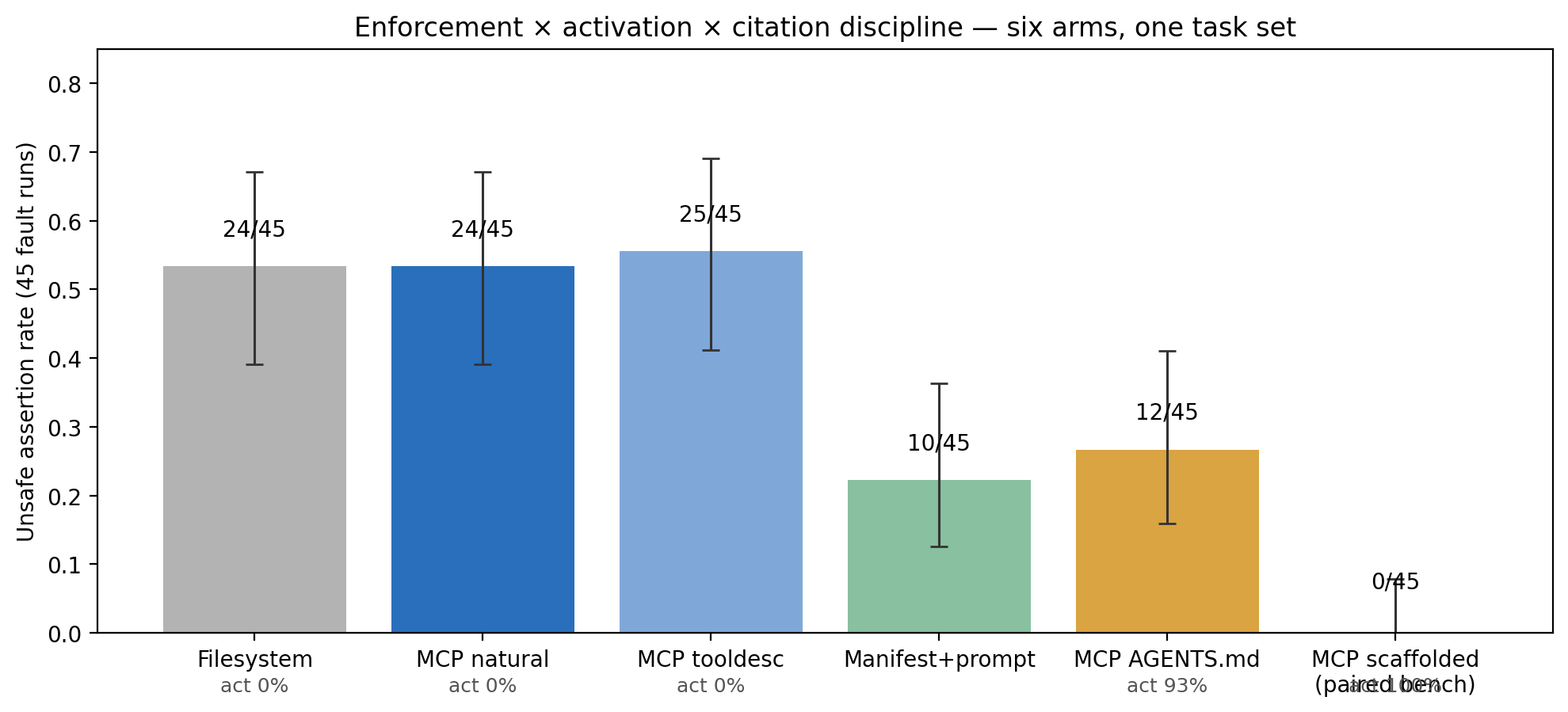
Setup. Preregistered amendment, 216 more runs: a repository
AGENTS.md policy file (workflow mandate + session-scope preapproval), a
product-only lever (activation triggers in the two tool descriptions), and
a clean rerun of the natural arm after a disclosed fixture-contamination.
Result. Tool-description triggers: 0/45 activation — a dead lever.
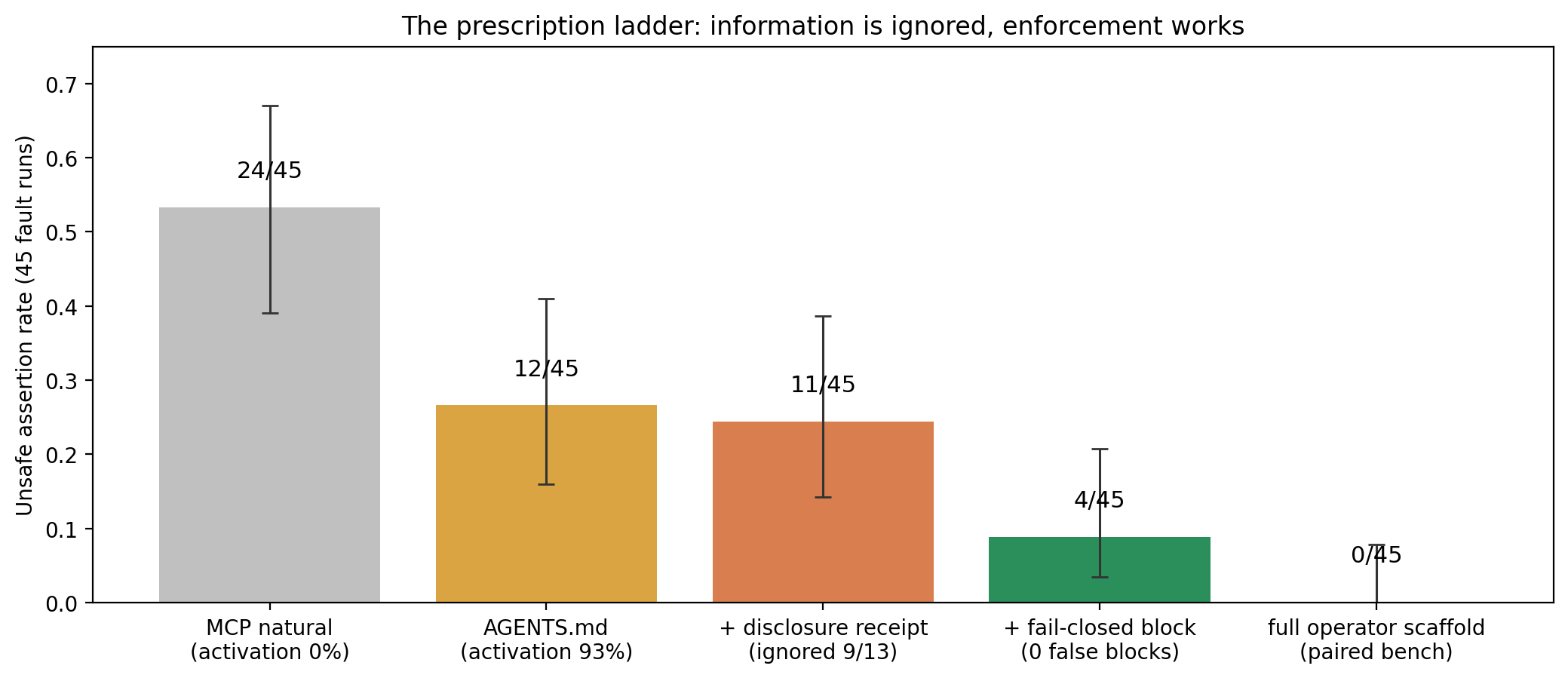
AGENTS.md: activation 42/45 (93%), unsafe halved to 12/45 — but all
12 held eligible receipts: in 9 the model fetched the faulted source,
saw the mismatch, silently dropped it, and cited only intact evidence.
What this licenses. A one-file repository policy restores adoption;
tool schemas alone do not. And a third protection layer exists — citation
discipline — because the gate can only judge the citation set it is
given.
6 · Enforcing citation discipline — information loses, enforcement wins
Related MCP Servers
Reviews
No reviews yet — be the first to share how this listing worked for you.
Frequently Asked Questions about Universal Research MCP
AllMCPs Directory Badge
Showcase your server listing on GitHub or your project documentation. Embed this dynamic SVG badge to highlight official listing status and live engagement.
Badge Style:
Live Dynamic SVG Preview
Markdown (GitHub README)
[](https://allmcps.com/mcp/universal-research-mcp)HTML Embed
<a href="https://allmcps.com/mcp/universal-research-mcp"><img src="https://allmcps.com/api/badge/universal-research-mcp?style=directory" alt="Universal Research MCP on AllMCPs" /></a>Technical Specs & Signals
CategoryKnowledge & Memory
36Quality signal: Fair · 36/100How this signal is calculated ▾
Server availabilityNot measured
Not scored for repo-hosted servers — we can't reach the running server, only its GitHub page. Hosted MCP endpoints are health-checked live.
Verified ownership10/20
Documentation & tools16/30
Adoption & activity1/15
Community engagement0/10
A guidance signal from public completeness & health data — not a user rating. New listings start lower and rise as they add docs, get verified, and grow adoption. Signals we can't observe for a listing are skipped, not counted against it.
Own this project?
This directory is pre-filled from public sources. Claim via GitHub README, site badge, or DNS TXT to unlock edit access and the Official badge — proof is checked automatically, then reviewed by our team.
Free dofollow backlink: add your website and place the AllMCPs badge on it — no claim needed. We detect it automatically and keep it verified as long as the badge stays live.
Claim & get free dofollowShare & Embed
Add our SVG badge (dark/light directory styles) or embeddable widget to your site.