Security-first MCP server that connects any OpenAPI, GraphQL, gRPC or SOAP API to AI agents.
Quick Install
Automated & IDE SetupCopy the AI prompt to install this server into Claude Code, Cursor, or another agent — or use 1-click editor setup below.
Not yet automatically verified
We haven't yet run this listing's install command through our automated sandbox check. This isn't a red flag — we're steadily working through the catalog.
Manual Client & Custom JSON ConfigExpand JSON ▾
Client Config & Setup
Choose your client or environment
Target File:
💡 Paste the JSON block into your client's configuration file under mcpServers, then restart the application.
Documentation Overview
Universal API Connector MCP
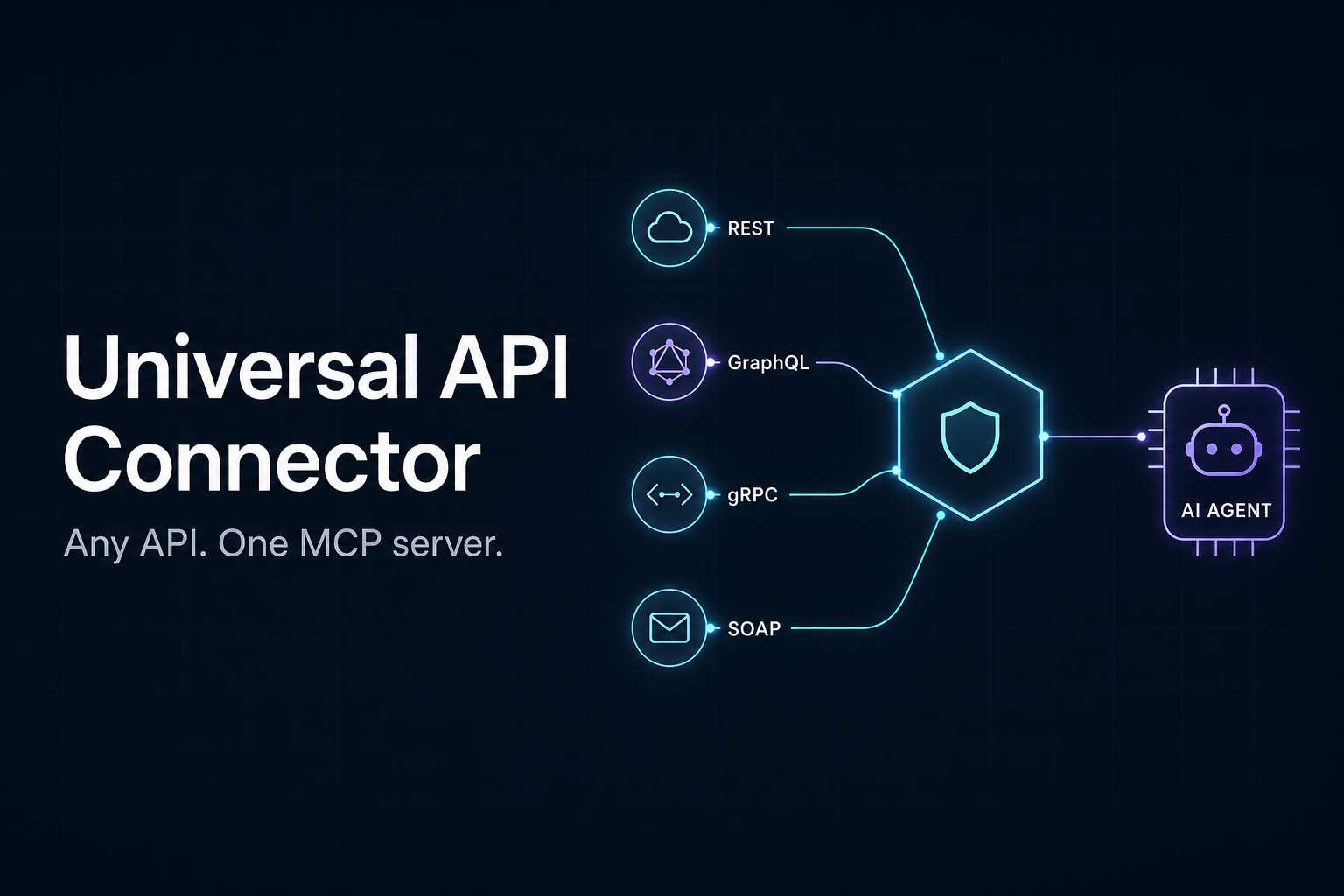
Any API. One MCP server.
Stop installing a new MCP server for every service: point this one at any OpenAPI/Swagger, GraphQL,
gRPC or SOAP spec - or pick one from the built-in catalog of 2500+ public APIs - and your AI agent
can call it. Securely, in fewer steps, with fewer tokens.



Installation · Meta-tools · API catalog · Examples · Configuration · Security

Why another one?
Most "universal API" MCP servers only speak REST/OpenAPI. This project is built around three differentiators:
- Truly universal - a normalized
Operationmodel with pluggable spec adapters (OpenAPI, GraphQL, gRPC, SOAP). Tools and executors never care which protocol produced an operation. - Security-first / local-first - a direct response to supply-chain attacks like the AgentBaiting / FakeGit campaign. Outbound requests are restricted to an allowlist, secrets never touch logs, responses are size-capped, and every call is audit-logged. No arbitrary code execution, no binary downloads, no telemetry.
- Built for context efficiency - field-level response filtering, chained and parallel execution, and response caching mean whole workflows fit in one tool call and responses stay small.
How it works
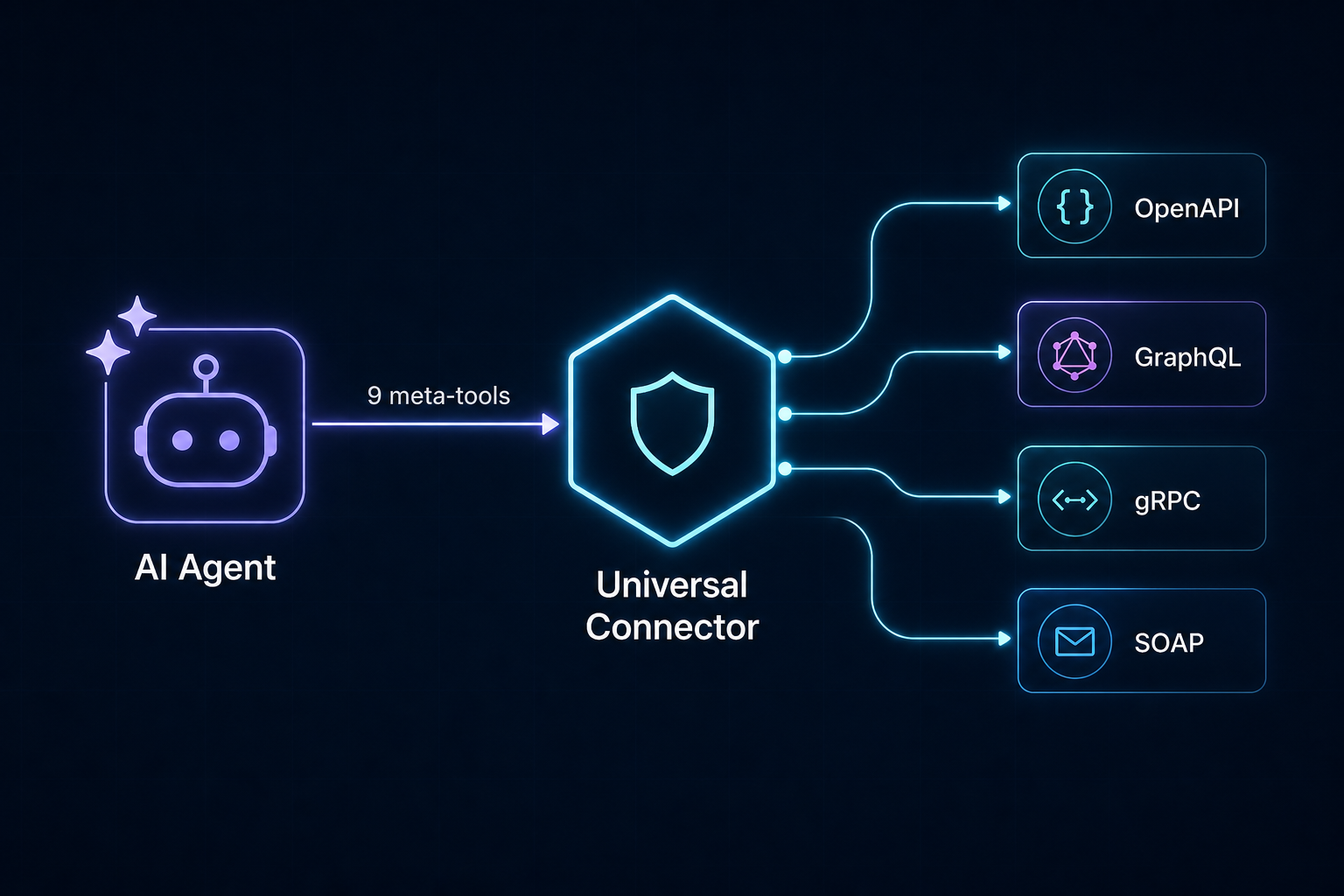
The agent explores APIs like a filesystem instead of loading hundreds of tools at once (which would blow up the context window on large APIs like Stripe). It searches for operations, inspects the ones it needs, then executes them.
Architecture (click to expand)
Meta-tools
| Tool | Purpose |
|---|---|
search_catalog | Find ready-to-load public APIs (curated list + APIs.guru directory, 2500+ specs) |
load_api | Register an API from a spec URL/file (protocol auto-detected) |
list_apis | List loaded APIs |
search_operations | Fuzzy-search operations across loaded APIs |
get_operation | Full parameter/response schema for one operation |
execute | Call an operation (auth + security guard applied); extract returns only the fields you ask for |
execute_chained | Run a sequence of operations in one call, piping results between steps; nested lists run in parallel |
execute_graph | Run a dependency graph of operations; order is inferred from ${id.path} references and independent nodes run in parallel automatically |
unload_api | Remove a loaded API |
audit_log | Recent outbound calls (method, host, path, status) |
Why fewer steps (and fewer tokens)
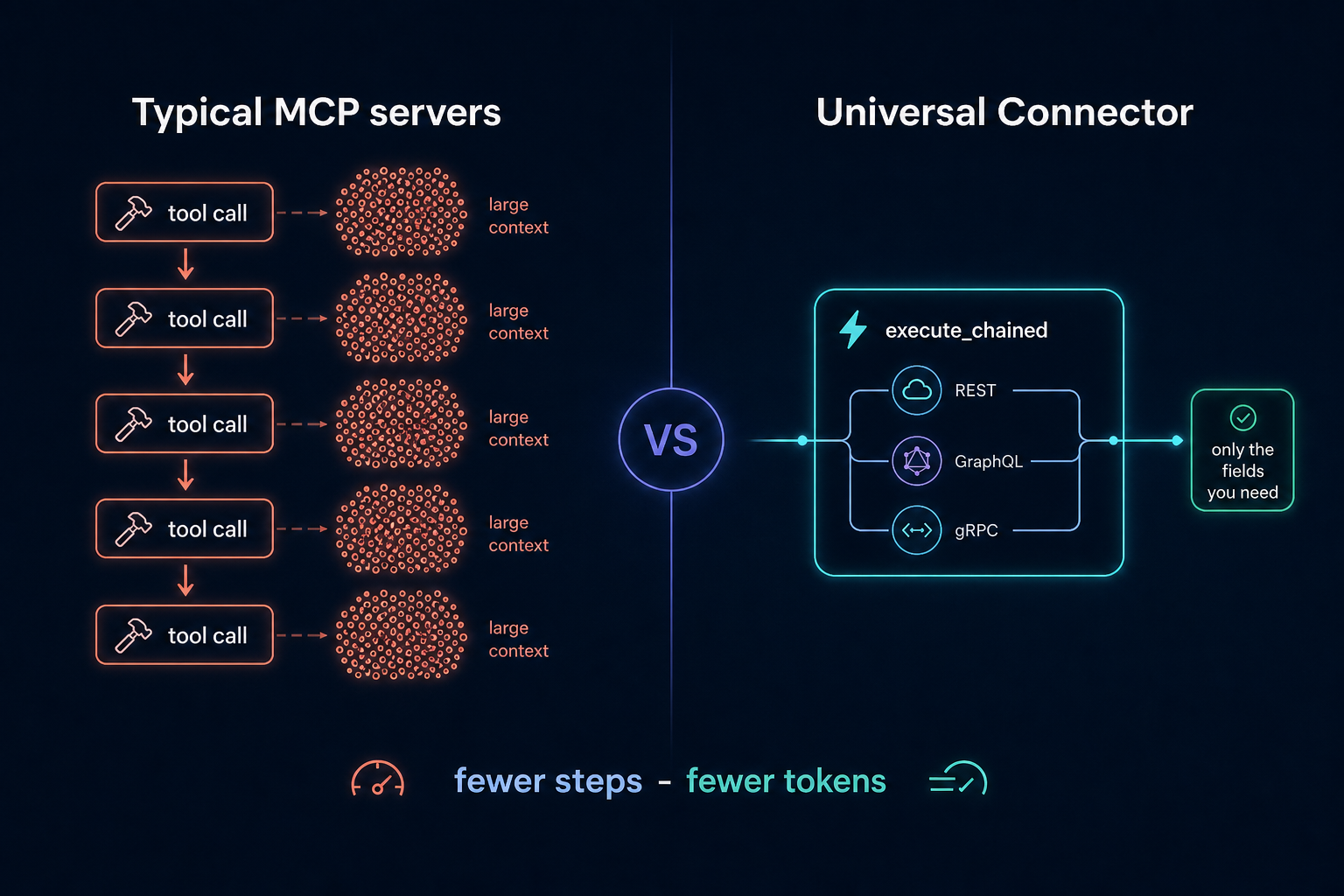
Where a per-API MCP server needs one tool round-trip per call - each returning a full JSON payload into the agent's context - this server collapses whole workflows:
extract-execute(..., extract=["items.*.name", "total_count"])returns just those fields instead of a multi-kilobyte response.*fans out over arrays.- Chaining -
execute_chainedpipes step results into later params via${save_as.path}references: one tool call instead of N. - Parallel groups - a nested list of steps runs concurrently, so "query three APIs and combine" is still one call:
- Response cache - successful GET/query results are cached for
UCMCP_CACHE_TTLseconds (default 60), so repeated lookups are instant and free; passfresh: trueto bypass. Successful mutations invalidate that API's cached reads.
Built-in API catalog
You don't need to hunt for spec URLs. search_catalog searches two sources:
- A curated list of verified free/popular APIs: GitHub, GitLab, Stripe, OpenAI, Wikipedia, Open-Meteo (weather, no key), a countries GraphQL API, httpbin and the Swagger Petstore. Entries carry working spec URLs, base-URL overrides and auth hints (e.g. "optional GITHUB_TOKEN").
- The APIs.guru directory - 2500+ community-indexed OpenAPI specs (Google, AWS, Microsoft, Twilio, NASA, ...), fetched once per session and searched locally.
The catalog is discovery-only: it returns spec URLs, never loads or executes anything itself, so the security guard still applies to everything you load from it.
Installation
The server runs in any MCP host via uvx - no manual install needed, the package is fetched from PyPI automatically (add [all] for GraphQL/gRPC/SOAP support):
From source (development): pip install -e ".[all,dev]" and use "command": "universal-connector-mcp" instead. Extras: graphql, grpc, soap, keyring, all, dev; the core install supports OpenAPI/REST only.
Cursor

One click via the badge above, or add the JSON block to .cursor/mcp.json in your project (shared with your team) or ~/.cursor/mcp.json (personal, all projects). See examples/mcp.json for a full config with credentials.
Claude Desktop
Add the same mcpServers block to claude_desktop_config.json (Settings > Developer > Edit Config).
Claude Code
VS Code (Copilot)
Add the server under "servers" in .vscode/mcp.json:
Windsurf / Cline / others
All major MCP hosts accept the same mcpServers block shown above in their respective config files (~/.codeium/windsurf/mcp_config.json, Cline's MCP settings, etc.).
AI agents installing this server for a user: follow llms-install.md.
Preloading APIs
Point UCMCP_APIS_CONFIG at a YAML file to auto-load APIs at startup - see examples/apis.example.yaml.
Managing APIs from chat
You never edit config files to manage APIs - just tell your agent:
- "Connect the Stripe API" - the agent finds it in the catalog and loads it.
- "What APIs are connected?" -
list_apisshows them. - "Forget GitHub" -
unload_apiremoves it (and from the remembered state).
When an API needs credentials, load_api tells the agent exactly which environment variable to set (e.g. STRIPE_API_KEY), whether it is already configured, and the agent relays copy-pasteable instructions - you add the variable to the env block of your MCP config and restart. Secrets are never typed into the chat.
Session persistence
The server remembers which APIs you loaded (their spec locations - never credentials or response data) in UCMCP_STATE_FILE and restores them automatically on the next start, so the agent can pick up right where it left off. Set UCMCP_STATE_FILE=off to disable.
Supported protocols
Related MCP Servers
Adoption & maintenance
Factual signals from GitHub, npm, and our automated checks — not a rating.
GitHub stars
4
Stargazers on the source repository.
Last commit
2mo ago
Most recent push to the default branch.
Directory activity
1 views
Config copies, upvotes, and views on AllMCPs.
Reviews
No reviews yet — be the first to share how this listing worked for you.
Frequently Asked Questions about Universal Connector MCP
AllMCPs Directory Badge
Showcase your server listing on GitHub or your project documentation. Embed this dynamic SVG badge to highlight official listing status and live engagement.
Badge Style:
Live Dynamic SVG Preview
Markdown (GitHub README)
[](https://allmcps.com/mcp/universal-connector-mcp)HTML Embed
<a href="https://allmcps.com/mcp/universal-connector-mcp"><img src="https://allmcps.com/api/badge/universal-connector-mcp?style=directory" alt="Universal Connector MCP on AllMCPs" /></a>Technical Specs & Signals
CategorySecurity
1/5 checks healthy over the last 45d
40Quality signal: Fair · 40/100How this signal is calculated ▾
Server availabilityNot measured
Not scored for repo-hosted servers — we can't reach the running server, only its GitHub page. Hosted MCP endpoints are health-checked live.
Verified ownership10/20
Documentation & tools16/30
Adoption & activity4/15
Community engagement0/10
A guidance signal from public completeness & health data — not a user rating. New listings start lower and rise as they add docs, get verified, and grow adoption. Signals we can't observe for a listing are skipped, not counted against it.
Supply-chain signal
No high-severity advisories surfaced by our automated scan.
Critical 0High 0Medium 0Low 0
Scanned 5d ago via OSV.dev · universal-connector-mcp (PyPI)
Own this project?
This directory is pre-filled from public sources. Claim via GitHub README, site badge, or DNS TXT to unlock edit access and the Official badge — proof is checked automatically, then reviewed by our team.
Free dofollow backlink: add your website and place the AllMCPs badge on it — no claim needed. We detect it automatically and keep it verified as long as the badge stays live.
Claim & get free dofollowShare & Embed
Add our SVG badge (dark/light directory styles) or embeddable widget to your site.