UISandbox README
The full upstream README, mirrored here for reference. Install config, tool schemas, adoption signals, and an original overview live on the UISandbox listing page.
UISandbox
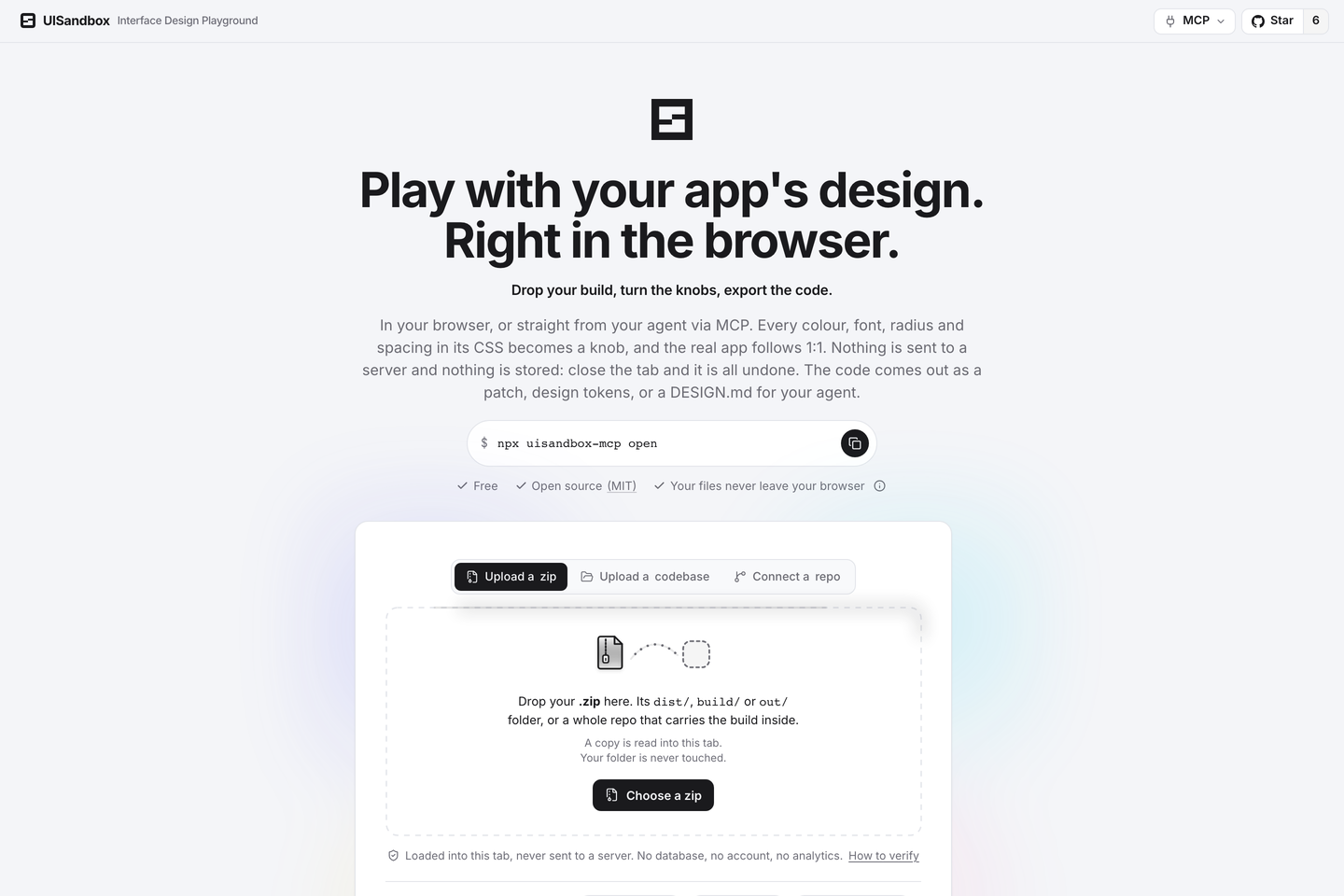
Play with your app's design. Right in the browser.
Drop your build, turn the knobs, export the code.
Restyle your app without rebuilding it: your build runs 1:1 in the tab, nothing is sent to a server, and closing the tab undoes all of it.
uisandbox.org · npm: uisandbox-mcp · MCP registry · Discussions · MIT


Or drop a zip on uisandbox.org — no build at hand? Try a sample under the drop zone (the Bootstrap docs, a VitePress site, an admin dashboard). Or, in Claude Code: /plugin marketplace add Ideelab/uisandbox → /plugin install uisandbox@uisandbox and say "open this app in UISandbox".
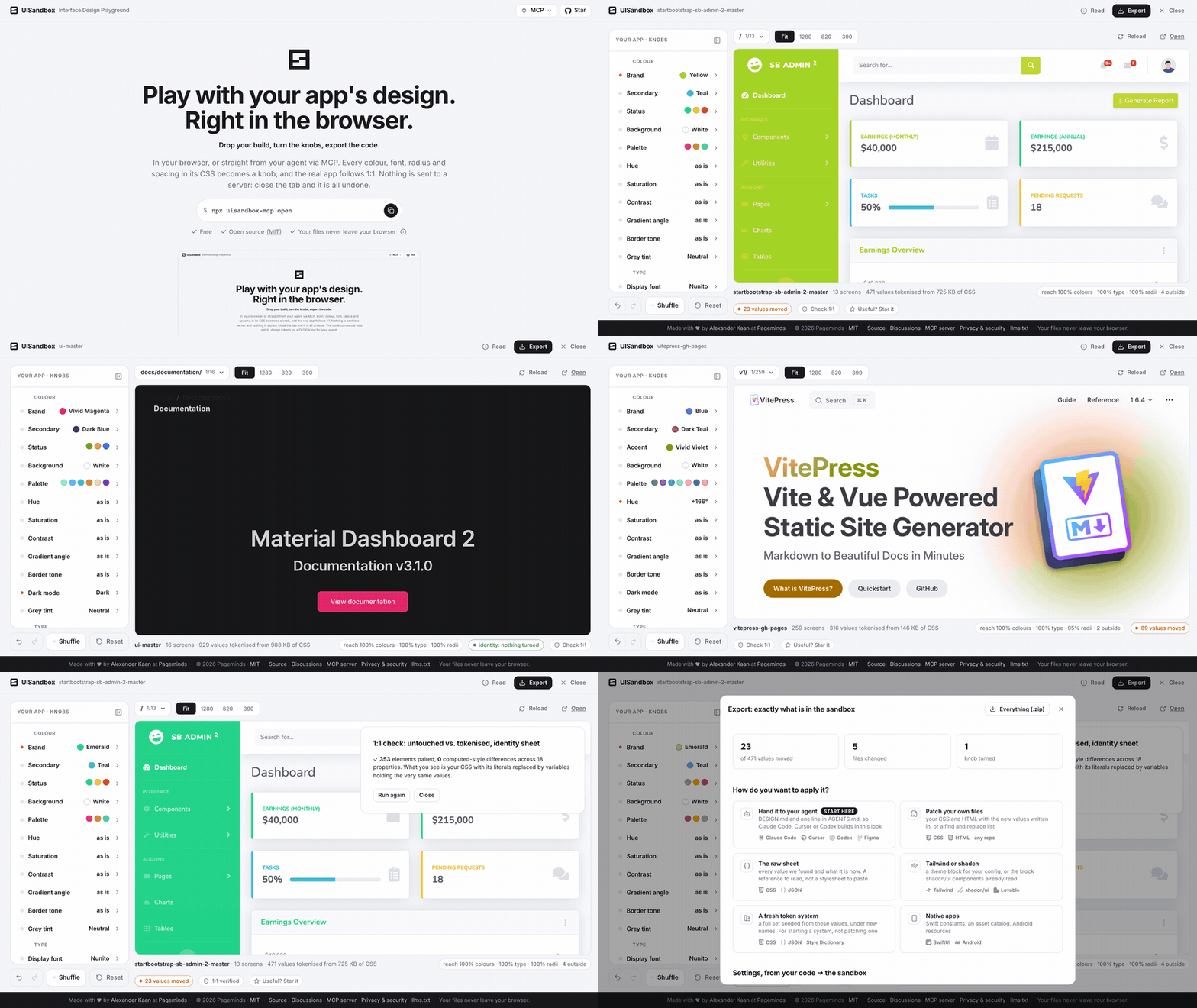
Four real builds from public repos, one knob each. Nothing staged.
What it does
- Bring the build — three ways in: a zip of
dist/,build/,out/(or a whole repo with the build inside); a folder (a build renders, a source folder is read for the knob stand); a public GitHub or GitLab repo URL (fetched as a zip through a same-origin route — the one thing that leaves the tab, seenotes/security.md). While it works, the door shows the stages with their numbers. Otherwise your files never leave your browser: files are read in the page and served to the frame by a service worker on this origin. - See it 1:1. Every colour, radius, font, size, spacing, line-height, letter-spacing, weight, border-width, duration, gradient angle and shadow literal in your CSS becomes a variable holding the very same value, so the page renders exactly as it was — runtime styles too (
style=""set by JS,<style>your framework appends,insertRule/replaceSyncfrom styled-components, Emotion, Lit, Ant's cssinjs; CDN stylesheets through a same-origin proxy; nested same-origin frames such as Storybook's). - Turn the knobs. Brand, and the colour families your CSS actually contains (secondary, accent, the status set, a palette row for what is neither); page background; grey tint and border tone; display and body font (yours listed first, then alternatives by character); dials for text size, line height, letter spacing, weight, spacing, radius, border width, elevation, motion and gradient angle — every dial with ×1 = as in your code at its centre; global hue, saturation and contrast that reach every colour, chart palettes and CSS-drawn icons included; your dark mode, switched on your own hooks.
- Export. Your values as CSS / JSON / a patch list, your files patched in place,
--k-*tokens for web (CSS, Tailwind, shadcn), Swift constants + an asset catalog for iOS,colors.xml+ Kotlin for Android.
Open one by link
uisandbox.org/?load= followed by a public GitHub or GitLab repository URL, or a
direct link to a .zip that allows CORS, opens straight into the sandbox. The
samples on the site load this way, and it is how you show somebody a build
without asking them to find it:
A repository URL goes through this site's repo route (GitHub and GitLab do not
send CORS on archives); a .zip URL is fetched by the browser itself. Either
way the archive is read in the tab, exactly as a dropped one is.
How to check it yourself
- You can check the 1:1 yourself. Check 1:1 loads the untouched build and the tokenised build side by side and diffs the computed styles of every element (18 properties, shadow roots and nested frames included). Zero differences or it says what differs.
- A reach meter in the stage foot says how much of what you see the knobs touch — painted colours, families, sizes, radii — and what lies outside (images, canvas, video).
- It says so when it can't help. iOS/Android projects, WordPress themes and source without a build get a clear message at the door; a page that asks for files the archive does not hold says so ("that usually means source, not the built output").
- A hostile archive cannot navigate the tool away, register its own service worker or unregister ours, or smuggle a zip-slip path back out of an export. What it can do — reach the tool's DOM, because the frames are same-origin by design — reaches nothing worth having: no server, no credentials, no state. Read
notes/security.md; deploy on an origin of its own.
Run it
http://localhost:5190/?load=<zip-url> loads a zip by URL (same-origin or CORS) — the door an agent uses.
Test it against real builds
pnpm holdouts runs every archive in fixtures/ (real builds from public repos — gitignored, notes/decisions.md says where each came from) through the app: load, Check 1:1, reach, and a host check (same origin, one worker). Verdicts are held against scripts/holdouts.expect.json; a fixture expected ok that is not fails the run. --only <name>, --record, --base <url> --fixtures <url> for a production build or the live site.
How it works
MCP
npx -y uisandbox-mcp (npm) — or pnpm mcp from a clone — runs the same engine as an MCP server (stdio): load a zip by URL or path, set knobs, export any format, verify the 1:1 check and screenshot in headless Chromium against the real app. See mcp/README.md for the tool list and the Claude/Cursor config. Claude Code plugin (skill + server in one): /plugin marketplace add Ideelab/uisandbox then /plugin install uisandbox@uisandbox — gives /uisandbox ("open this app in a sandbox", "try brand #e11d48") and the uisandbox MCP server. The skill alone is skills/uisandbox/SKILL.md (copy into .claude/skills/). Codex / Cursor / others: add the MCP server (npx -y uisandbox-mcp); the server sends its own instructions and prompts.
Deploy
One origin, one Cloudflare Worker (worker/index.mjs, wrangler.jsonc): static assets from dist/, the SPA fallback for ?load=, http→https and www→apex redirects, and the /__repo/ route that fetches a public GitHub zip for "Connect a repo" (nothing stored; same-origin callers only; a rate-limit rule in the zone). public/_headers keeps sw.js uncached and sets the security headers. Put nothing else on the origin — the sandboxed frames are same-origin by design (notes/security.md).
Contributing
The most useful thing you can send is a build that does not work. See CONTRIBUTING.md for the 1:1 gate a change to the rewriter is held to, and how to run it against the three real builds that ship in this repo.
Who made this
I'm Alexander Kaan, and I build open-source tooling for user interfaces. UISandbox came out of the design system generator I made before it: I could hand somebody a finished kit, but I could not show them what their own app would look like in it. This does that other half.
I won't pretend I knew what I was doing at the start. Every decision, and every
trap I fell into on the way, is in notes/decisions.md —
including the ones I had to undo. Issues and pull requests are welcome.
Roadmap
notes/roadmap.md: ship (uisandbox.org) · the intake as a front door · being found (SEO, llms.txt, analytics) · the MCP server · after launch.
Made with ♥ by Alexander Kaan at Ideelab · MIT · the decisions that shaped it, numbered: notes/decisions.md