Generate a design system from a brief, then verify your AI stays on it.
Quick Install
Automated & IDE SetupCopy the AI prompt to install this server into Claude Code, Cursor, or another agent — or use 1-click editor setup below.
One-click editor setup isn’t available for this listing yet — we don’t have a confirmed install command, and we’d rather show nothing than point your editor at the wrong package or host. Follow the project’s own setup instructions, linked above.
Manual Client & Custom JSON ConfigExpand JSON ▾
No confirmed setup config for this listing yet. We only publish a config block when the install details come from the project itself — its README, its docs, or a verified owner. We haven’t found those for UIcockpit, and we’d rather show nothing than a guess you’d paste into your client. Follow the project’s own setup instructions for the current steps.
Documentation Overview
UIcockpit
The open-source design system generator. Nine real UI kits on one screen, in your colours, before you commit to one.
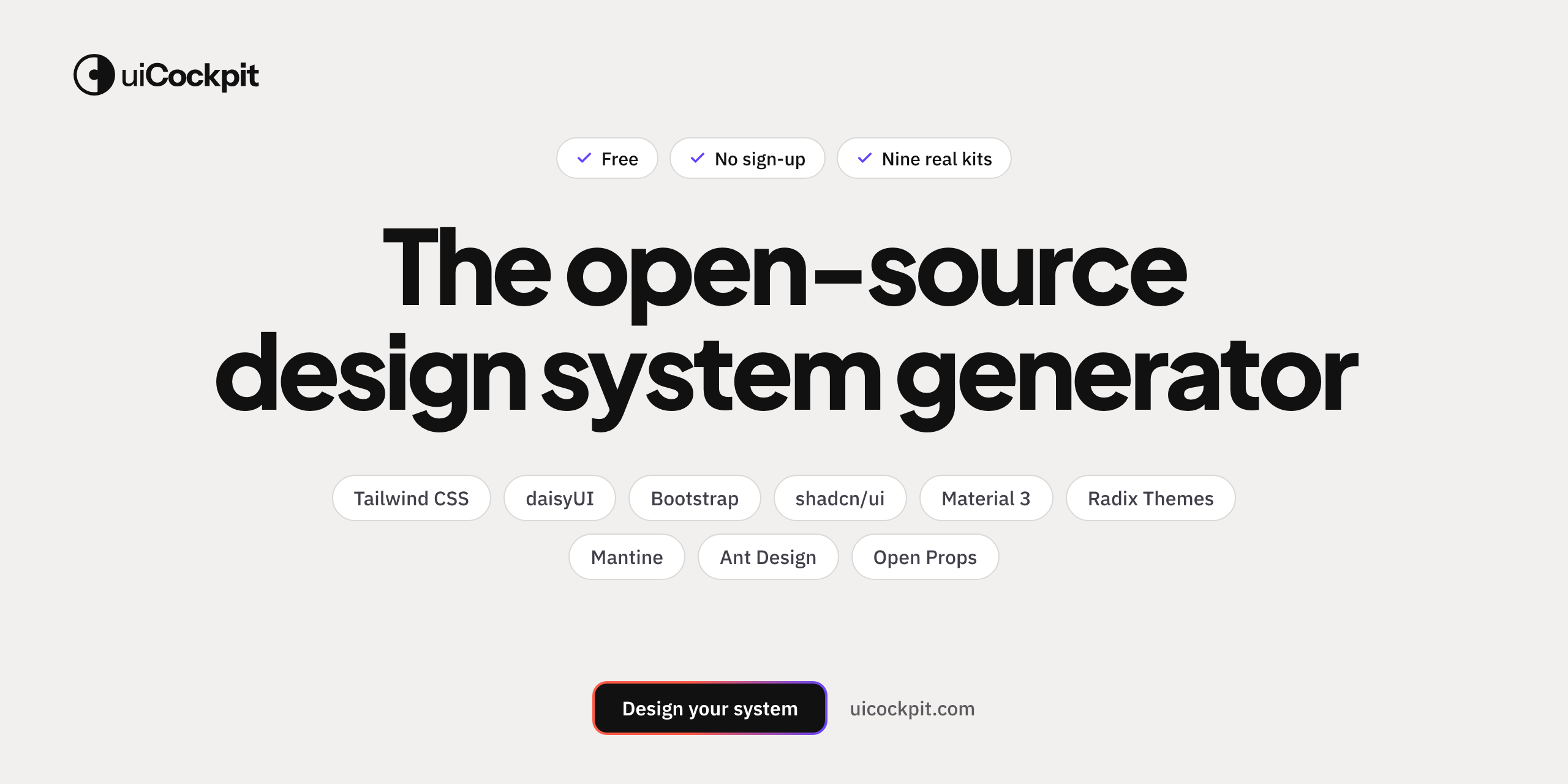

Pick a starting point, turn the knobs, and watch Tailwind CSS, daisyUI, Bootstrap, shadcn/ui, Material 3, Radix Themes, Mantine, Ant Design and Open Props render the same screens side by side. One set of values is routed into each kit's own vocabulary: its variables, its Sass, its tokens, its theme object. Keep the kit that fits, export the theme, and go build.
Everything runs in the browser. No account, no server, no telemetry. The
export is a zip: theme.css, DESIGN.md (to Google's design-system spec),
AGENTS.md, CLAUDE.md, .cursor/rules, install.md and a MANIFEST.md
that lists versions, licences, and what could not be done.
Nothing here is invented
The claim is not "it looks like Bootstrap". The claim is that it is Bootstrap: their compiled stylesheet, their class names, their components, read from the package they publish. That claim is enforced, not promised:
- Fidelity, counted. Every class the wall emits is looked up in the kit that should define it. The meter reads 100 per cent for all eight rendering kits, and a class their CSS does not define fails the build by name.
- Anatomy, verified. A real class in the wrong nest matches nothing and styles nothing, so a rendered sweep asserts that every class on every element is reached by at least one rule of its own kit's stylesheet in that exact DOM.
- Behaviour, exercised. The same sweep re-themes every kit at a second brand and asserts that every colour in the brand's hue family follows, that nothing painted is invisible against its backdrop, and that every checked control renders differently from its unchecked sibling.
- Gaps, declared. What a kit has no component for is named on the screen and in the manifest, never quietly substituted. Ant Design and Material are rendered by their own code; what cannot re-theme live says so.
- Their icons too. Tailwind draws Heroicons, Bootstrap draws Bootstrap Icons, Material draws Material Symbols, Radix draws Radix Icons, Mantine draws Tabler, Ant draws its own set, each read from the package that set publishes.
Run it
Plain Node, zero dependencies of our own:
The gates, if you change anything:
What this deliberately is not
There is no npm package, no CLI and no MCP server for this version. The zip
you export carries the agent-facing files itself, so nothing needs installing
to use what you made. The uicockpit and uicockpit-mcp packages on npm
belong to a retired earlier version of this project and are deprecated; that
product lives on in this repository at the tag archive/cockpit-2026-08-17,
and the A2UI catalog experiment that briefly lived beside this one is at
archive/a2ui-2026-08-24.
License
Related MCP Servers
Adoption & maintenance
Factual signals from GitHub, npm, and our automated checks — not a rating.
GitHub stars
2
Stargazers on the source repository.
Last commit
25d ago
Most recent push to the default branch.
Directory activity
1 views
Config copies, upvotes, and views on AllMCPs.
Reviews
No reviews yet — be the first to share how this listing worked for you.
Frequently Asked Questions about UIcockpit
AllMCPs Directory Badge
Showcase your server listing on GitHub or your project documentation. Embed this dynamic SVG badge to highlight official listing status and live engagement.
Badge Style:
Live Dynamic SVG Preview
Markdown (GitHub README)
[](https://allmcps.com/mcp/uicockpit)HTML Embed
<a href="https://allmcps.com/mcp/uicockpit"><img src="https://allmcps.com/api/badge/uicockpit?style=directory" alt="UIcockpit on AllMCPs" /></a>