Tweetkit X README
The full upstream README, mirrored here for reference. Install config, tool schemas, adoption signals, and an original overview live on the Tweetkit X listing page.
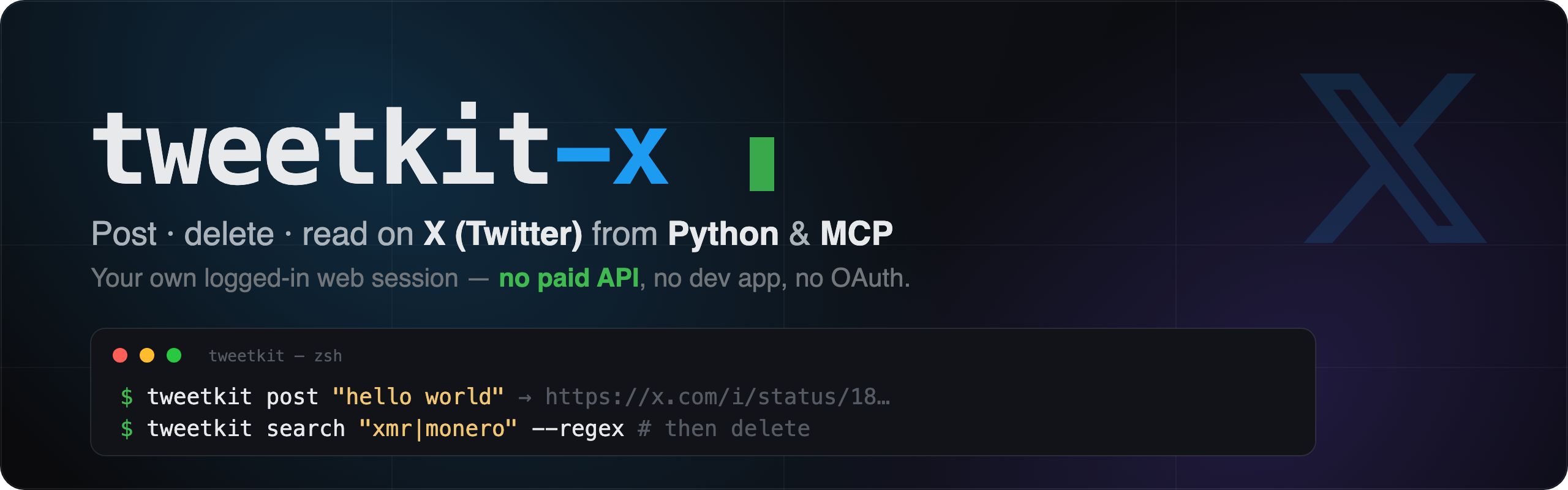
tweetkit-x
Post, delete & read on X (Twitter) — from Python and as an MCP server — using your own logged-in browser session.
No paid API. No developer app. No OAuth dance. Just your session cookie.





Quick start · Get your cookie · Python · CLI · MCP server · How it works · Disclaimer
Why
Since February 6, 2026, X's official API has no free tier for new developers — it's pay-per-use: ~$0.015 per post, ~$0.20 per post with a link, plus per-read charges. For publishing your own tweets (a bot posting your content, a scheduled thread, a cleanup script that deletes old posts), that's a recurring bill for something your browser already does for free.
tweetkit-x skips the API entirely. It replays the exact internal HTTP calls your browser makes when you click Post, Delete, or scroll your profile — authenticated with the session cookie you already have. Post, delete, and read the full timeline, at zero API cost.
⚠️ Automating your web session is against X's Terms of Service. This is a grey-area tool for personal automation. Account risk is entirely yours. See the Disclaimer.
Features
- ✅ Post — text, up to 4 images, GIF & video (with alt text), replies, threads, quote-tweets, long-form note tweets, and scheduled tweets
- 🗑️ Delete — one id, a list of ids, or "find matching & delete" cleanup loops
- ❤️ Engage — like, retweet, bookmark, follow, block, mute, pin — each with an undo
- 🌐 Search all of X — the real
SearchTimeline(operators likefrom:,min_faves:,filter:media), plus local regex over your own tweets - 📖 Read — your home feed, any timeline, a tweet's replies/conversation, followers/following, likers/retweeters, bookmarks, a user's likes, notifications, and full profiles
- 🔌 MCP server — 40 tools; drop into Claude Desktop / Claude Code / Cursor; tools that explain the cookie and set it up with one paste
- 🔑 Frictionless auth — paste a
Cookie:header, drop a HAR file, or a storage-dump zip; store in a file or the macOS Keychain - 🐍 Python API and a CLI (
tweetkit …) - 🪶 Tiny footprint — no headless browser, no Selenium
Quick start
Getting your session cookie
The only secret tweetkit needs is your X session cookie — the same Cookie: header your logged-in browser sends. It must contain at least two values:
| Cookie | What it is | Required | HttpOnly? |
|---|---|---|---|
auth_token | your login/session token | yes | yes (hidden from document.cookie) |
ct0 | CSRF token (sent back as x-csrf-token) | yes | no |
twid | your user id (u=<id>) — lets tweetkit read your timeline with no extra lookup | recommended | no |
guest_id, kdt, att, personalization_id | misc session state | optional | mixed |
❗
auth_tokenis HttpOnly, so adocument.cookiecopy in the JS console will NOT include it. Use one of the reliable methods below.
Method A — copy the Cookie: header (most reliable, one paste)
- Open x.com while logged in.
- Open DevTools (F12) → the Network tab.
- Click any request to
x.com(e.g.HomeTimeline). - Under Request Headers, find
cookie:and copy the entire value. - Feed it in:
Method B — an F12 "Preserve log" HAR file
- Open x.com logged in → DevTools (F12) → Network.
- Tick "Preserve log", then reload / click around so requests are captured.
- Right-click any request → "Save all as HAR" (or use the ⬇ export icon).
- Import it:
Modern Chrome can redact cookies from exported HARs. If tweetkit reports
auth_tokenmissing, either enable "Allow to generate HAR with sensitive data" in the Network settings, or fall back to Method A / Method C.
Method C — the storagedump browser extension (zip)
The easiest no-DevTools route. storagedump (a Chrome extension built by this project's author) exports a tab's browser storage — including the HttpOnly auth_token, which document.cookie can't reach — as a .zip containing cookies.json. On x.com (logged in), click the extension → export, then:
tweetkit reads the extension's native format, { "data": [ { "key": "...", "value": "..." }, ... ] }, and also accepts a plain list or a {name: value} map. Cookie-Editor / EditThisCookie JSON exports (--file export.json) work too.
Install: storagedump on the Chrome Web Store.
Where the cookie is stored
By default tweetkit import writes ~/.config/tweetkit/cookie.txt (chmod 600; also git-ignored). Prefer the macOS Keychain? Add --keychain <slug>:
Resolution order at runtime (first hit wins): explicit arg → TWEETKIT_COOKIE → TWEETKIT_COOKIE_FILE → ./cookie.txt → ~/.config/tweetkit/cookie.txt → Keychain (TWEETKIT_COOKIE_KEYCHAIN).
Python usage
Every write returns {'ok': True, 'id': '...', 'url': '...'} on success, or {'ok': False, 'status': ..., 'error': '...'} on failure — easy to log or retry.
See examples/ for a full "find my $XMR tweets and delete them" cleanup loop.
CLI usage
A thread.txt is just tweets separated by blank lines.
MCP server
tweetkit ships a first-class MCP server so an AI client can post/delete/read for you — and it walks the user through auth, explaining what the cookie is and setting it up with a single paste.
Configure your client
Claude Desktop / Claude Code / Cursor — add to your MCP config (claude_desktop_config.json, .mcp.json, …):
Already pip installed? Use the console script directly:
If you don't set any cookie env var, that's fine — the server starts unauthenticated and asks the user to set the cookie from inside the chat (below).
Frictionless auth, from inside the chat
The server describes each value and offers the lowest-effort path. A typical first run:
- The client calls
auth_status→ not authenticated. - The server’s instructions tell the assistant to ask you for your cookie and explain what
auth_tokenandct0are and how to copy them. - You paste the
Cookie:header once →set_session_cookie("<paste>")→ stored (Keychain or file) and activated. Or pointimport_cookie_from_file("~/Downloads/x.com.har")at a HAR / storage-dump zip.
The raw cookie is never echoed back.
Tools
| Tool | What it does |
|---|---|
auth_status | Is a valid session loaded? (call first) |
set_session_cookie(cookie_header) | Set auth from a pasted Cookie: header — explains exactly what to copy |
import_cookie_from_file(path) | Set auth from a HAR / storage-dump .zip / cookie JSON |
post_tweet(text, image_path?, reply_to?) | Post a tweet (optional image / reply) |
post_thread(tweets[]) | Post a thread |
quote_tweet(text, quote_tweet_id, image_path?) | Quote-tweet an existing tweet |
delete_tweet(tweet_id) / delete_tweets(ids[]) | Delete tweets |
like_tweet / unlike_tweet / retweet / unretweet / bookmark_tweet / unbookmark_tweet | Engage (each reversible) |
get_my_tweets(limit?) / get_user_tweets(username, limit?) | Read a timeline |
get_tweet(tweet_id) | Fetch one tweet by id |
search_my_tweets(query, regex?, limit?) | Find your own tweets (local filter — great for cleanup) |
search_x(query, latest?, limit?) | Search all of X (real search, supports operators) |
post_note / schedule_tweet / unschedule_tweet | Long-form note tweets; schedule / cancel |
follow_user / unfollow_user / block_user / unblock_user / mute_user / unmute_user | Social-graph actions |
pin_tweet / unpin_tweet | Pin / unpin to your profile |
get_home_timeline / get_replies / get_notifications / get_bookmarks | Feeds & conversations |
get_user_profile / get_followers / get_following / get_likers / get_retweeters / get_user_likes | People & profiles |
Not (yet) supported: DMs, polls (create/vote), Lists, profile editing, Spaces, hide-reply. These need a captured HAR of that exact action to pin down the endpoint — easy to add on request.
How it works
When you act in the browser, x.com calls a handful of internal endpoints. tweetkit reproduces them 1:1:
x-client-transaction-id— X requires an anti-bot header derived from the page'sondemand.sJS and a home fetch. Generated with the standalonex-client-transaction-idpackage.- Media upload (images) —
POST upload.x.com/i/media/upload.jsonasINIT→APPEND→FINALIZE, yielding amedia_id. - Write / delete —
POST /i/api/graphql/<queryId>/CreateTweetand.../DeleteTweet. - Read —
GET /i/api/graphql/<queryId>/UserTweets(paginated by cursor), plusUserByScreenNameto resolve@handles.
Auth is just your cookie + the public web bearer token (the same non-secret bearer embedded in x.com for every visitor) + the ct0 CSRF value echoed as x-csrf-token.
The GraphQL query IDs live in
tweetkit_x/constants.py. X rotates them every few weeks; if a call starts failing, refresh them from a fresh HAR (the file has step-by-step notes).
Security
- The cookie is the only secret. It's stored chmod 600 in
~/.config/tweetkit/cookie.txtor the macOS Keychain, and.gitignoreblockscookie.txt,.env,*.har, and*.zip. - tweetkit never prints the cookie value — importers report only which cookies were found and their lengths.
- The bundled bearer is X's public web bearer, identical for every visitor — not a secret.
Disclaimer
This project automates your own X web session for personal use. Automating the web session is against X's Terms of Service, and using it may put your account at risk of rate-limiting, suspension, or ban. You are solely responsible for how you use it. Provided as-is, without warranty. Not affiliated with X Corp.
License
MIT © 2026 ns0bj