Read-only time-series bootstrap server: diagnose a series and compute confidence intervals.
Quick Install
Automated & IDE SetupCopy the AI prompt to install this server into Claude Code, Cursor, or another agent — or use 1-click editor setup below.
Not yet automatically verified
We haven't yet run this listing's install command through our automated sandbox check. This isn't a red flag — we're steadily working through the catalog.
Manual Client & Custom JSON ConfigExpand JSON ▾
Client Config & Setup
Choose your client or environment
Target File:
💡 Paste the JSON block into your client's configuration file under mcpServers, then restart the application.
Documentation Overview


















📒 Table of Contents
- 🚀 Getting Started
- ⚡ Performance
- 📚 Articles
- 🧩 Modules
- 🗺 Roadmap
- 🤝 Contributing
- 📄 License
- 📍 Time Series Bootstrapping Methods intro
- 👏 Contributors
🚀 Getting Started
🎮 Using tsbootstrap
tsbootstrap exposes one typed entry point, bootstrap, configured with a method
specification. The same call works for every method.
Choose a method spec for the structure you need (block lengths default to the automatic Politis-White selection):
Inputs can be NumPy arrays, lists, or pandas / Polars DataFrames and Series. The
result is a BootstrapResult carrying the samples, provenance metadata, and
out-of-bag / in-bag primitives. For the sktime ecosystem, the same methods are
also available as estimator classes (MovingBlockBootstrap, ARResidualBootstrap,
SieveBootstrap, and the rest) under tsbootstrap.adapters.
Uncertainty quantification
The uq layer turns resampled series into prediction intervals. forecast_intervals
gives forward forecast bands for an AR model; EnbPIEnsemble produces out-of-bag
prediction intervals for an sklearn-style regressor, with calibrators for stationary,
volatility-clustered, and drifting data (static, sliding window, and the adaptive ACI,
AgACI, and NexCP schemes); and bootstrap_reduce streams a per-replicate statistic so
calibration scales to large replicate counts without holding every path in memory.
For a confidence interval on a statistic of one series, conf_int runs the bootstrap
and reads the interval in one call:
The conformal pieces (EnbPIEnsemble and the calibrators) need the uq extra
(scikit-learn). The interactive
tutorial gallery
works through every method on real and synthetic data, including a "which bootstrap
should I use?" decision guide.
MCP server
tsbootstrap ships a read-only Model Context Protocol
server so an MCP client (an LLM agent, an IDE) can diagnose a short series and compute a
bootstrap confidence interval without writing any Python. Run it with no install step:
It speaks the stdio transport and exposes exactly two read-only tools:
diagnose_series: serial-dependence and stationarity diagnostics, a recommended Politis-White block length, and the bootstrap methods the server supports for the series.bootstrap_confidence_interval: a percentile confidence interval for the mean, median, std, or variance, using an i.i.d. or block bootstrap.
Both tools accept at most 500 observations and run at most 500 replicates. For larger series, model-based methods, or the uncertainty layer, use the library directly in a local script.
📦 Installation
Requires Python 3.10 or higher.
The model-based methods import statsmodels lazily and raise a clear install hint if
the models extra is missing.
⚡ Performance
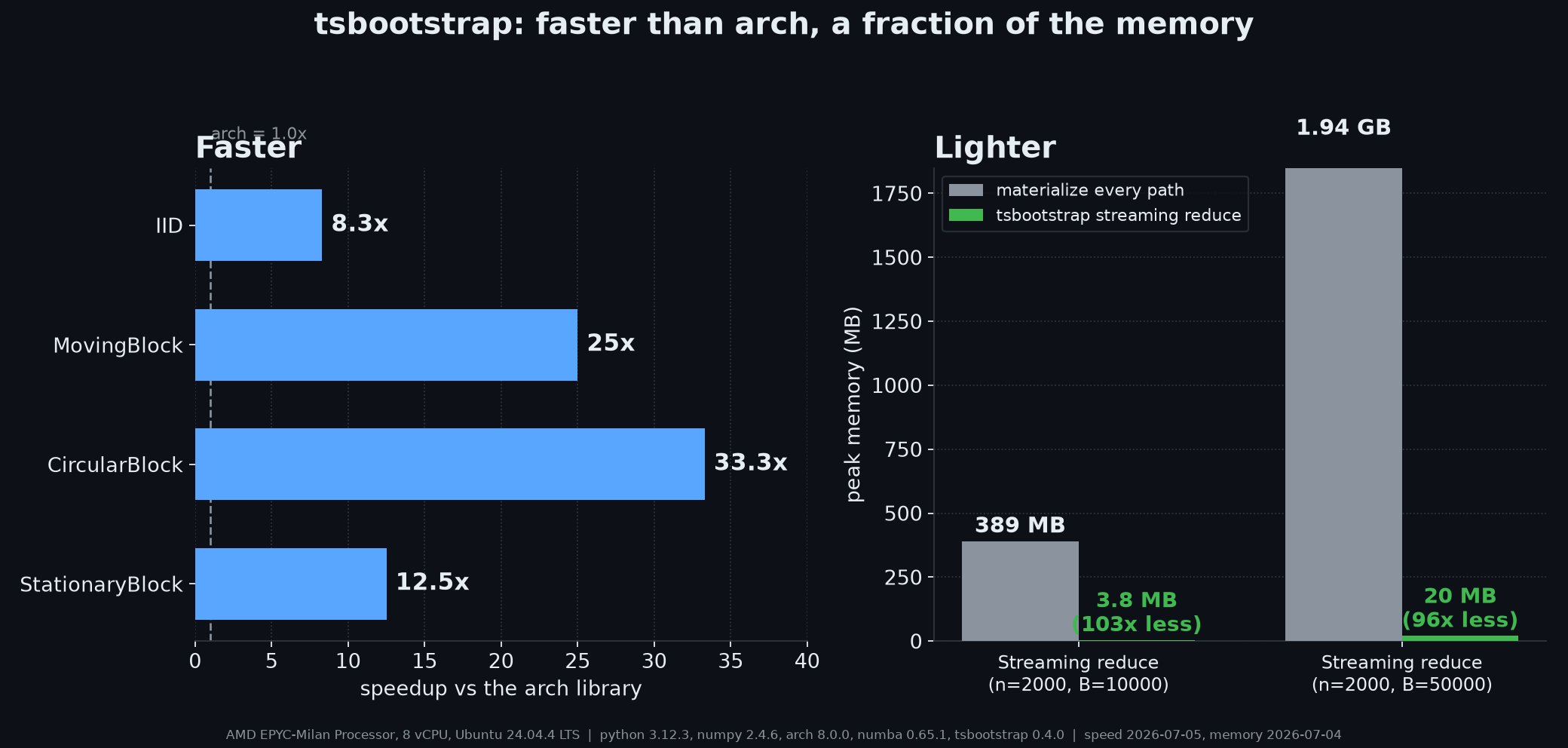
Left: speedup of the compiled reduce path over the arch library on the four overlapping methods. Right: peak memory before and after on the two headline reduce workloads (baseline = materialize every path, then reduce). The figure and the table below are generated from the committed benchmark data in benchmarks/results/; regenerate with python benchmarks/plot_launch.py.
tsbootstrap ships an optional compiled backend (backend="compiled", via the
[accel] extra) that is faster than the arch
library on every overlapping resampling method. The table below is the speedup of
the streaming reduce path over arch.apply on an 8-core CPU (higher is better),
read from benchmarks/results/vs_arch_ccx33_2026-07-11_settled.json
(the settled-min statistic; methodology in benchmarks/README.md).
| Method | n=200, B=999 | n=200, B=10000 | n=2000, B=999 | n=2000, B=10000 |
|---|---|---|---|---|
| IID | 15x | 19x | 4.7x | 8.6x |
| MovingBlock | 38x | 61x | 9.8x | 26x |
| CircularBlock | 41x | 66x | 13x | 33x |
| StationaryBlock | 19x | 24x | 6.8x | 12x |
Read these as sustained gains of roughly 4.7x to 33x on the larger n=2000
workloads; the very large small-n multiples come from arch's per-replicate
Python callback in bs.apply, whose overhead dominates its runtime when each
resample is cheap, so they measure that overhead as much as the compiled kernel.
Related MCP Servers
Adoption & maintenance
Factual signals from GitHub, npm, and our automated checks — not a rating.
GitHub stars
95
Stargazers on the source repository.
Last commit
2d ago
Most recent push to the default branch.
Reviews
No reviews yet — be the first to share how this listing worked for you.
Frequently Asked Questions about Tsbootstrap
AllMCPs Directory Badge
Showcase your server listing on GitHub or your project documentation. Embed this dynamic SVG badge to highlight official listing status and live engagement.
Badge Style:
Live Dynamic SVG Preview
Markdown (GitHub README)
[](https://allmcps.com/mcp/tsbootstrap)HTML Embed
<a href="https://allmcps.com/mcp/tsbootstrap"><img src="https://allmcps.com/api/badge/tsbootstrap?style=directory" alt="Tsbootstrap on AllMCPs" /></a>