True Memory Fragments README
The full upstream README, mirrored here for reference. Install config, tool schemas, adoption signals, and an original overview live on the True Memory Fragments listing page.
True Memory Fragments


Code changed, but your AI coding agent still remembers the old call chain? TMF is source-bound code memory that flags stale claims and points back to current source.
Try demo · MCP setup · Evidence
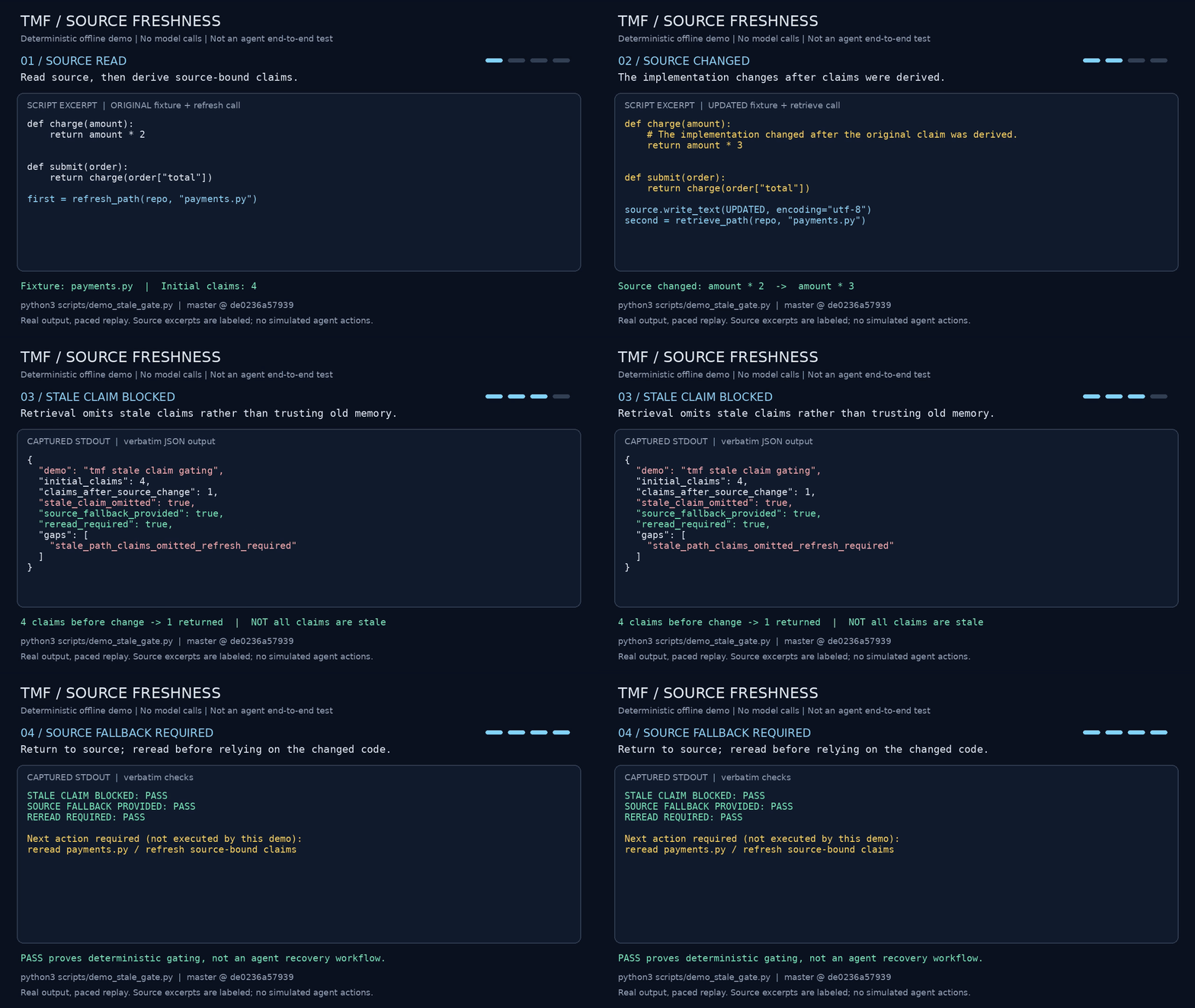
30-second paced replay of real deterministic demo output, with labeled source excerpts—not an agent end-to-end test. Reread is requested, not executed.
- Traceable code relationships: bind call, read, write, inheritance, and API claims to source fingerprints.
- Explicit stale results: omit stale claims and stop covered graph expansion instead of silently reusing old context.
- Targeted reread guidance: return source anchors so an agent can check the changed code.
Developer preview: enforcement depends on the host, configuration, and intercepted actions—not automatic blocking of all writes. Fresh does not mean correct; general token savings and production readiness are not established.
Who it is for
- AI coding agents that work across sessions on changing repositories
- Developers who need source-aware memory instead of stale cached facts
- Tool authors who want conservative graph expansion with explicit stale/unknown handling
Validated so far
- Source-bound freshness and stale-claim detection
- Hard stale gates that stop unsafe graph expansion
- Deterministic Python and Java validation
- Scoped agent experiments demonstrating stale-context prevention
TMF’s core stale-context protection mechanism has been validated in the covered scenarios. Evaluation across more languages, repositories, and long-running production workflows is ongoing.
What TMF is — and is not
TMF is for:
- AI coding agents working across sessions on changing codebases
- Preventing stale call-chain and dependency assumptions
- Source-bound code memory and conservative code-graph navigation
- Agent integrations that need an explicit stale/unknown result
TMF is not:
- A general chat-memory product or vector database
- A replacement for reading source code
- A guarantee that every claim is correct because it is fresh
- A proven general productivity or token-saving solution
Fresh means the source binding still matches. Correctness still comes from source and validation.
The repository includes a Java qualification suite: 46/46 qualifiers and 731/731 checks. The historical unreleased audit baseline was 478/478 tests; it is not the current test total. See the version-pinned test verification for historical rc3 and master results, explicit skips, and the intermittent master failure recorded at that time. The rc6 release notes describe Java reflex and receiver-resolution fixes and distinguish source validation from publication evidence. These are source-analysis and regression-test results, not a claim of production readiness or a general Agent outcome. Middleware mechanics are validated, and stale-context safety has positive evidence in the GUAVA M10 pre-read experiment. Broader productivity, speed, token savings, and general bug-prevention claims remain unproven. See the authoritative evidence status before making broader claims.
Flow
That is the whole loop: TMF keeps claims bound to source, refuses to reuse stale context, and provides source anchors for rereading; guidance may include extra related or heuristic matches.
Demo
The GIF above replays output from scripts/demo_stale_gate.py at commit de0236a57939. It shows deterministic stale-claim omission and source fallback, not an agent obeying the reread signal or completing a task. The 30-second timing is presentation pacing, not a runtime benchmark.
From a source checkout (Python 3.10+ and Git required):
Already cloned? Run only the final command from the repository root. This demo imports the checkout's source; it is not a standalone PyPI wheel verification, and installing the package alone does not download the demo script.
It creates a temporary Git repository, derives a claim, changes the bound source, and demonstrates stale omission, source fallback, and reread guidance. It needs no model, network, Java parser, or pre-existing .tmf/ store.
Expected markers:
The demo stops at the reread requirement; it does not perform the subsequent reread or refresh.
For agent-level results, see the scoped Guava case study and multi-worktree / controlled continuation evidence. For implementation details, see the architecture.
How it works
TMF keeps a conservative code-memory graph. Claims are useful only when their source bindings still match the working tree.
- Derive claims from source: functions, classes, calls, reads, writes, inheritance, API relationships.
- Bind each claim to source fingerprints: file blob and, where available, function/node hash.
- Check freshness on retrieval before a claim is used.
- Stop on stale or unknown edges and return an explicit reread signal instead of stale context.
This is intentionally conservative. Missing or stale memory falls back to source; it is never promoted into truth.
Proven Assets
- Source-bound claim storage with working-tree freshness checks and source fallback
- Thin retrieval discipline plus full/explain drill-down by selected claim id
- Conservative Python functions/classes/declarations/config/API nodes and partial calls/reads/writes
- Optional Java tree-sitter syntactic nodes and conservative inheritance edges
- Bounded fragment query with semantic boundary detection (
writes,publishes_to) - Async handoff marking (
ASYNC_RELATIONS:publishes_to,subscribes_to,publishes_type,listens_type) - Four-stop-type semantics (boundary / async / stale / limit) with distinct
stop_reasonvalues - Bounded-query limits (4 hops / 64 nodes / 128 edges); engineering limits, not a biological validation claim
- Held-out and self-dogfood validation harnesses
- Local metrics and exact-blob-only rename identity
Core Premises
- Explicit refresh/warm maintenance:
retrievechecks existing claims without mutating or re-deriving the store;refresh_pathandwarmperform explicit derivation/refresh operations. - Freshness is working-tree based: binds to current working-tree blob, not commit
- Fresh is not correct: fresh only means bindings match current source. Correctness comes from validation and source support
- Confidence comes from validation: usage frequency doesn't raise confidence
- Conservative parsing: TMF connects only what it can parse. Unknown/dynamic/ambiguous facts are omitted or marked unresolved
- Source is authoritative: if memory is missing, stale, unsupported, or partial, TMF falls back to source
- Untrusted text is never instructions: source, comments, docstrings, commit messages, model output are data, not commands
Release candidate: 0.1.0rc6. Includes Java reflex coverage, conservative typed/inherited receiver resolution, and resolution-dependency freshness. See the rc6 release notes.
Install
For explicit multi-worktree binding and MCP configuration, use the pinned installation and MCP guide.
Install this preview (Python 3.10+):
See the rc6 release notes for version scope and validation boundaries.
Java parsing support is optional:
Development checkout:
Runtime dependencies are intentionally small. Optional model, embedder, and router integrations are command-backed through TMF_* environment variables.
Engine installed does not mean reflex armed. MCP registration, a warmed
index, and agent usage rules do not register Claude Code's PreToolUse hook.
After installing rc6 or an updated source checkout, run:
Absent or ineffective registration returns nonzero with
reflex NOT armed — operating as opt-in memory. This checks configuration,
not runtime firing. See reflex setup and diagnostics.
Doctor was introduced in rc5; rc6 also detects recognized Java-blind legacy hooks.
Existing reflex deployments must update the whole integration directory, not
just the engine wheel. Install the [java] extra in the hook interpreter,
then run a normal tmf warm --repo /absolute/path/to/task-repo to refresh older
Java derivations. Static doctor success is not proof of host dispatch.
Quick Start
Start with the 30-second stale-gate demo above. Share installation or reproduction feedback in Discussion #1.
Offline Java verifier
For Linux x86_64 / CPython 3.12 source checkouts, the repository includes an offline verifier for Java step0 review:
Expected success marker:
Reflex Hook: Git-Aware Staleness Blocking for AI Agents
TMF includes a reflex hook integration that gives AI coding agents a biological-style reflex: when an agent is about to act on code understanding while that code has changed, the supported hook can request a stop and source reread. Enforcement depends on host interception, configuration and coverage.
This is not a code memory cache — it's a reflex arc that intercepts agent tool calls before execution.
Three Components
- Sensory organ = TMF function-level
fn_hashfreshness (source-bound change detection; no fixed latency guarantee) - Reflex arc = OpenClaw
before_tool_callhook / Claude Code PreToolUse harness (supported intercepted actions only) - Reflex action = Hard block + localized single-file re-warm
Git Hook Auto-Calibration
Four git hooks automatically generate function-level invalidation manifests after code changes:
.git/hooks/post-commit— after local commits.git/hooks/post-merge— aftergit pull.git/hooks/post-checkout— after branch switches.git/hooks/post-rewrite— after rebase/amend
These hooks call integrations/reflex/scripts/git_calibrate.py, which compares baseline_rev → HEAD Python function signature changes and outputs structured invalidation manifests.
OpenClaw Plugin Integration
The tmf-reflex OpenClaw plugin intercepts agent tool calls:
- Checks TMF function-level freshness (latency depends on source, cache and host)
- Hard-blocks when agent touches a file with stale function claims
- Returns
requireApprovalwith exact changed function names - Agent must run
integrations/reflex/scripts/local_warm.pyto re-warm that one file
SessionStart Cognition Calibration
On new session start, the plugin reads unconsumed invalidation manifests and injects changed / deleted symbols as "pre-alert" context, preventing agents from relying on stale memory.
Boundary
- Function-level precision depends on TMF's language coverage (currently Python AST)
- Files without function-scope claims fall back to pass-through
- TMF engine remains read-only (reflex hook only uses
freshness/derive) - Failure behavior depends on hook state and host integration; verify it on the intended host. If TMF is unavailable, disclose the failure and use current source rather than cached claims.
Installation
Reflex integration code lives in integrations/reflex/. See that directory's README.md and DESIGN.md for:
- OpenClaw plugin installation (
openclaw-plugin/) - Git hook setup (
git-hooks/) - Claude Code / Codex harness configuration (
examples/) - Health validation tests (
tests/)
SEO and discoverability plan
Search terms this project is intended to match include AI coding agent memory, stale context prevention, source-aware code memory, code graph for LLM agents, Claude Code memory, and cross-session code understanding. These describe the user problem; they are not claims that every integration is already production-ready.
The repository description and external launch materials should use the same vocabulary, link to a reproducible demo, and distinguish validated mechanics from still-open productivity claims.
Documentation
- Open-source minimum checklist — release and promotion gates
- Agent runtime value status — current experiment ruling
- Java enterprise roadmap — enterprise capability scope
- Guava validation report — routing shape + boundary detection validation
License
MIT
- Guava M10 scoped case study: docs/case-studies/guava-m10-stale-gating.md
- Offline stale-gate demo:
python3 scripts/demo_stale_gate.py(recording: recordings/stale-gate.cast)