Cli README
The full upstream README, mirrored here for reference. Install config, tool schemas, adoption signals, and an original overview live on the Cli listing page.

~alter CLI
Claim a name that is yours and get paid when someone reads it





What is ~alter?
Run alter register, choose a name and confirm you are eighteen or older. Your
own machine spends a few seconds proving there is a person behind the request,
and then ~yourname exists.
A second before that command there was no you on this protocol, and afterwards there is one that is yours. No browser opened, no password was set, no email address was asked for, and no card was taken.
~alter is what that name resolves to. ~yourname is an address, and behind it
sits a record of what you have actually done. Every command below reads or
writes some part of it, and anything else speaking the protocol resolves the
same address to the same record.
The step is that small, and it is the one everything else here runs from. Agents
you wire on this machine act under the name, so what they do in your stead
carries it. Anybody wanting more of you than the fact you exist pays for it on
terms you set first, and alter queries names each of them and what you kept.
Nothing else in the stack is where a name starts. The website argues the case, the runtime keeps a handle known on your own machine, and the SDK reads one from code you have written. Each of those begins with a name that already exists, and this is the command that makes one.
I want to know more
Your friends do not know you from a login. Neither does your family, or the people you work with, or your sports team. They know who you are from how you have shown up, over years. You may look and sound nothing like you did ten years ago and it is still you.
Software still asks the narrow question. A password at the login screen. A token in the app. Each one checks whether this is the right person, right now, at this exact spot, and then looks away. Everything in between is invisible to it, and that is almost all of your life. The AI tools made it worse, because one of them writes in your name now, and when somebody asks who allowed it, there is no answer anywhere on this machine.
One name, and the record under it is yours. ~yourname works at every tool that speaks the protocol, so nothing is set up twice and there is no key to paste, at any point. What is in the record was read from what you did, not typed into a box by you or guessed at by a model. You can cut off access to any of it with one command. No form, no review.
Being read pays you. Anyone can check for free that your handle exists. Reading further, past the fact of you, costs the reader money, that money goes to you, and you decide who gets to read what. Collectives hold a record on the same terms, because it is one record at every scale and the same form holds you, your team, and your country. A union, a club, a trade body, or a group of people who have never met can vouch for their own members and be read the same way you are.
Threads are how you get somewhere. A thread is something you are working towards. You take one on yourself, or ~Alter plants one from what it can already see, or a collective confers one on you. What gets read is the trail you leave while you are doing it, never a certificate at the end.
All of that is the short version of an argument set out properly, in eight chapters at truealter.com/origin. Its seventy-six predictions were each written so the data could come back and say no. Five of them did, and those five are still published alongside the rest.
I want to check it myself
None of it needs taking on trust. Hand this to the AI you already use and let it take you through in your own words.
What is ~alter CLI?
One binary, and every command in it runs under your own handle. Nothing to paste, no key to carry between machines, and no browser step at any point.
It covers six things. Holding a name that is yours and keeping it safe. Deciding who may read you, attribute by attribute. Connecting the sources it reads what you do from. Seeing who looked you up and what each read paid you. Running your agents under your handle, so what they do carries it. Asking the field for somebody when you know nobody who would know them.
Two of those need no account at all. alter audit reads this machine, prints
what ~Alter could learn from it, and stops. alter doctor loom checks a folder
for secrets, bad encoding and broken links, with no network. Both run before you
decide anything.
The rest of this page is the install, and the first five minutes.
Install
Nothing needs setting up first. The installer brings its own Node when the machine has none. Take the line for the shell you are in.
macOS, Linux and WSL
Windows PowerShell
What that puts on your machine
Four things land, and the rest of this section is what does not.
- The
altercommand, which is the npm package@truealter/cli, installed globally. - One directory on your
PATH, soalteris there in every shell you open. - Node, but only if this machine has none. macOS and Linux take the official
build, check it against the checksums nodejs.org
publishes, and unpack it into
~/.local/share/alter/node. Windows installs Node LTS through winget, or Chocolatey when winget is not there. Node already here is left alone. - A checksum for the installer itself, at
install.sh.sha256andinstall.ps1.sha256, so you can check the script before you run it.
Nothing runs under sudo. The installer refuses to run as root, because root
would own Node, npm and alter, and you would not be able to run the command at
all. macOS asks for a password once, to link the binary into /usr/local/bin,
and nothing else needs administrator rights on either platform. Nothing lands
outside your home directory.
No account is created and nothing is sent. When the install finishes ~Alter has
read nothing about you or about this machine. alter audit is the first command
that reads anything, and it reads locally. alter register is the first that
creates anything, and you run it yourself.
Homebrew, on macOS or Linux
- Take this one if you want Homebrew to own the copy on this machine and upgrade it alongside everything else you have installed.
- It brings its own Node.
Arch Linux, from the AUR
- Take this one on Arch or a derivative, so
pacmanknows about it like anything else on the machine. paruworks the same way, withparu -S truealter-cli.
npm, if you would rather not run a script
- Take this one when Node 20 or newer is already here and you would rather install the package yourself.
- It is the same package the installer above puts there, without the Node
and
PATHhandling.
The first five minutes
Run alter on its own.
The menu opens on the four commands that turn earning on.
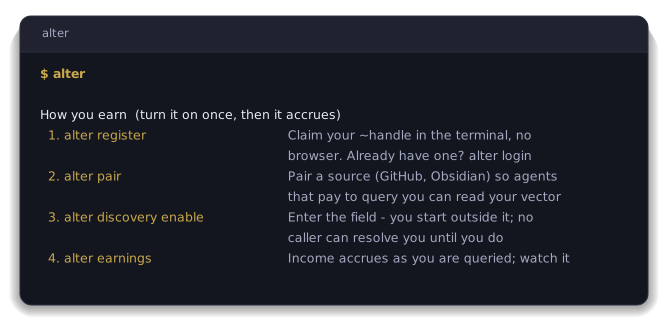
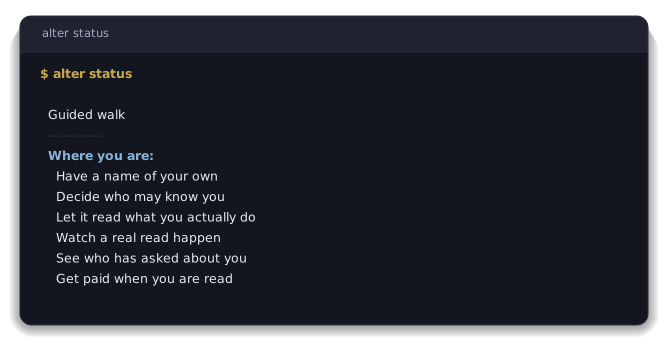
After that there is one command to remember. Start this today, get pulled away,
and come back next week not knowing what is left, and alter status names which
of six steps you are on and what to do next. Those six steps are the sections
below.
Read your own machine before anything is created
Run alter audit.
You have not decided anything yet and want to see what it would read off your own machine first. It reads this machine, prints what ~Alter could learn from it, and stops. Nothing is sent and nothing is created.
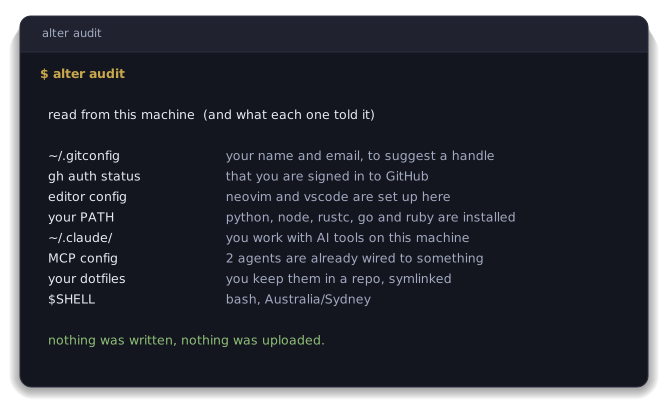
Close the terminal here and you are exactly where you started.
1. Register, and take the handle
Run alter register.
Free, and it asks for no account, no card and no application. Use
alter login instead if the handle is already yours.
Nothing is printed for you to write down. The handle is claimed, a member
credential is minted onto this machine, and the session is stored for you. The
secret worth keeping is the root seed, which alter key device register mints
and shows once, on the run that mints it. Run alter key seed export to see it
again on that machine and alter key seed import to put it on a new one. No
server holds it, so nobody can reissue it for you.
2. Preview the record a caller would get
Run alter discovery preview first.
Say you are happy to be found for the trade you do and for nothing else. This prints your record the way a caller would receive it, with the price on that read, before anybody is able to make one.
The levels are set by alter discovery preset recognition. There are four, and
they apply attribute by attribute.
| Level | What a caller gets |
|---|---|
hidden | Nothing. Not surfaced at all |
match_only | Counts toward a ranking. The value is never shown |
tier_label | A band, never the raw number |
exact | The literal value |
Three presets are the starting points, minimal, recognition and open, and
alter discovery set moves one attribute off whichever you picked.
3. Pair the places you already work
Run alter pair.
Run it with nothing after it and you get the menu. GitHub, GitLab, Discord,
Mastodon, Bluesky, ORCID, Steam, Lichess, a domain you control, an Obsidian
vault. Naming one, alter pair github, skips the menu. Neither route opens a
browser at you, both hand you a code to type in.
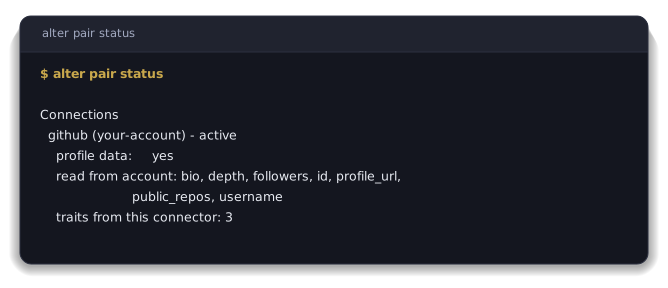
You already do the work somewhere. What comes back is what you did there, not
what you say about it. None of it belongs to the source, so it survives leaving
the source. Use alter connections to list them, alter pair status to see
what each returned, and alter unpair <id> to drop one.
4. Make the handle resolve
Run alter discovery enable.
Until you run it your handle does not resolve at all. After it, a caller gets
what step 2 allows and nothing else. Running alter discovery disable takes you
back out with the settings intact.
5. Every read, with the price on it
Run alter queries.
You have applied for nothing and somebody has looked you up anyway. Who asked,
what they paid, what you kept. It is the log itself, not a summary of it, and
yours costs nothing to read. Anybody's access ends from here with
alter consent revoke.
6. The balance, and the two things that open withdrawal
Run alter earnings.
The balance moves whether or not you can withdraw yet. Two things open withdrawal, and the readiness line in the menu says where each of them stands.
Your email has to be confirmed, because nothing accrues from a query against an
unconfirmed address, and a payout wallet has to be registered with
alter wallet register. Withdrawal opens at Augmented, the third of four levels,
and the balance keeps building until you reach it.
Wire the agents already on this machine
Run alter wire.
You use one of those every day and would rather not explain who you are to it
every time you open it. It finds the AI harnesses installed here and connects
each of them to the rail. What an agent does in your name then carries your
handle, and turns up in alter queries like any other read.
What people do with it
alter ask is the one to try first. It queries the field by situation instead
of by name, and it costs $1.00 a call, which is the same dollar landing in
somebody else's alter earnings when they are the answer. The whole economy in
one command, seen from both ends.
Somebody messages you offering work and signs off as ~sam, and you want to know
there is a person behind that before you answer. alter verify answers it and
costs nothing. So does alter doctor loom, which reads a folder you are about to
send somebody and tells you a password is not sitting in one of the files.
| You want to | Run |
|---|---|
| Find people by situation rather than by name | alter ask --trait ... |
| Check whether a handle is real, free | alter verify <handle> |
| Check a folder before you send it, offline | alter doctor loom ./folder |
| Let one peer query alignment with you | alter alignment grant ~peer |
| See how your traits have moved | alter traits, alter portfolio |
| Dispute something the field recorded about you | alter contest |
| Read your own signals as they land | alter signals tail |
What the commands cover
| What you want to do | The commands |
|---|---|
| Hold a name that is yours | register, login, handle, whoami, about |
| Keep the account safe | passkey, mfa, key, password, sessions, creds |
| Get paid | earnings, identity-income, portfolio, cash-out, queries, wallet |
| Show what you can do | pair, unpair, discovery, traits, signals |
| Control what is read, and see who read it | consent, forget, queries, audit |
| Agree terms with someone | accord, alignment, room, coord |
| Talk to people and agents | msg, email, thread, brief, ask |
| Run agents under your handle | wire, unwire, mcp-bridge, agent, hooks, skills, runtime |
| Check everything is healthy | doctor, status, config, style |
alter help lists every command, and the interactive menu groups them the same
way.
An accord is where two parties who have never met agree a paid job. Each side has a name, both sign the same terms, what gets done is recorded, and payment lands in USDC on those terms. No company sits in the middle holding the work, the money or the relationship.
Wiring the tools you already use
alter wire covers the harnesses on your machine. If you would rather connect
something by hand, or you are on a client that reads its own config, point it at
the hosted endpoint:
Codex reads that from its config file. ChatGPT takes it as a custom connector.
Where this goes
The six steps are only the start.
A thread is something you are working towards. You take one on, or one is planted from what the field can already see, or a collective confers one on you. What gets read is the trail you leave while doing it, never a certificate at the end.
A collective holds a record on the same terms you do, and can vouch for its own members. A team, a union, a club or a trade body, one record at every scale.
The runtime keeps your handle known on
this machine without the command line running, and alter help advanced covers
the MCP wiring.
The deep-dives are all in the terminal, at alter help getting-started,
alter help earning, alter help concepts and alter help advanced. None of
them send you to a web page.
Keeping it current
On the Homebrew path it is brew update && brew upgrade alter instead. Either
way you get the current release, and alter --version says which one you are
on.
If something goes wrong
Run alter doctor first. It checks the install, the session and the
connections, then tells you which one is unhappy.
If it reports a session problem, alter login is the answer. You will never be
asked to create, obtain or paste a token or a key to fix something. If any
message ever tells you to, that is a defect on our side, and it is worth
an issue.
The protocols underneath it
The record formats are open Internet-Drafts, so somebody else's implementation reads and writes the same records this one does without asking us. These are the drafts this repository actually rests on.
| Draft | What it specifies |
|---|---|
mcp-dns-discovery | The DNS records that publish a ~handle, the server that answers for it, and the signed envelope bound to it. |
alter-uri-scheme | The alter: URI, so a ~handle reference resolves, verifies and dispatches to a handler on the machine. |
identity-pronouns | Session-scoped references that resolve to a concrete handle on the client before anything reaches the wire. |
consent-settlement | Binding a paid read of somebody's identity to their own recorded consent, and settling part of that payment to them. |
Eighteen drafts make up the whole stack. The rest are on the IETF datatracker.
The rest of it
~alter is one identity rail with several ways in, and this command line is the
front door for a person.
| Name | What it is |
|---|---|
| cli | The command line, and the front door for a person. You are here. |
| homebrew-tap | That command line, packaged for macOS and Linux. |
| runtime | The daemon that keeps your ~handle known on your own machine. |
| sdk | Reading identity from your own code. |
| obsidian | ~Alter inside an Obsidian vault, on-device. |
| mcp-ollama | Local models, for work that should stay on the machine it runs on. |
| Where to read more | |
|---|---|
| Website | truealter.com |
| The reasoning behind it | truealter.com/origin |
| Getting started | truealter.com/build |
| What the tools do | truealter.com/docs/mcp/tools |
| The open specifications | the draft stack |
This repository is the public home of the released command line, and the npm
release runs from here. The source arrives on a separate branch written by
automation, so a pull request against it cannot be accepted.
Issues are the way to reach us.
Security reports go to security@truealter.com,
never a public issue, and SECURITY.md has the detail.
Apache-2.0, see LICENSE.
~alter is identity infrastructure. Your name is ~yourname and claiming one is free.