Serve a folder of Markdown notes as an MCP server: hybrid search, reading, and sourced answers.
Quick Install
Automated & IDE SetupCopy the AI prompt to install this server into Claude Code, Cursor, or another agent — or use 1-click editor setup below.
Manual Client & Custom JSON ConfigExpand JSON ▾
Client Config & Setup
Choose your client or environment
Target File:
💡 Paste the JSON block into your client's configuration file under mcpServers, then restart the application.
Documentation Overview
trip2g
Publish your Obsidian vault as a website. Self-hosted MCP memory for AI agents.
Write in Obsidian, press Sync, your notes are live. The same self-hosted hub serves readers a website and serves agents an MCP endpoint, publishes to Telegram, and gates paid content. Under the hood it is a Markdown Operating System: every note is a file, and one note is both a web page for a human and a tool call for an agent.


Why trip2g
- Your notes work twice. One markdown file renders as a page for readers and answers
search/note_htmlcalls from any MCP client. No export step, no copy of your knowledge locked in a vector store you can't read. - Your data stays yours. Plain markdown, a git-cloneable vault, every edit a readable diff. No SaaS in the middle, and you can move out any time with
git clone. - One process to run. A single Go binary on SQLite. It starts the same on a laptop, a small VM, or a container. MIT licensed.
Quickstart
See it work in 30 seconds. Add the public knowledge hub to any MCP client and ask it a question. It searches all connected bases and answers with sources:
Run your own hub:
Open http://localhost:8081, sign in with owner@example.com and code 111111, and download the preconfigured Obsidian vault from the home page. One container, files on local disk, full-text search — no other services needed.
Prefer no terminal? Get a free cloud instance. All the options (single binary, Docker Compose behind TLS, fly.io) are in the self-host guide.
Docs · Getting started · MCP tools · Self-host · Contributing
Everything is a note
Unix made everything a file. trip2g makes everything a note.
One global namespace, path-addressed, shared by humans and agents. A note is a markdown file: the frontmatter is its metadata, the body is its content. The same note is served as a web page (the display server) and over MCP (the agent's syscall surface), and every edit is snapshotted into note_versions and mirrored to git. So the history is a readable diff, not a binary blob.
The same hub serves the human (a website with subscriptions, RSS, Telegram) and the agent (MCP). Your data stays in plain markdown you can move out any time.
The map
trip2g borrows the operating-system vocabulary because the primitives line up. Each row is tagged by how real it is: shipped is running code on main, branch is running code on feat/agent-runtime, planned is a design doc.
| OS concept | trip2g primitive | Status |
|---|---|---|
| Filesystem | one path-addressed note namespace, humans and agents share it | shipped |
| Files | notes: markdown frontmatter (metadata) + body (content) | shipped |
| Overlay filesystem | frontmatter patches (Jsonnet) override notes without touching the source | shipped |
| Snapshots | note_versions + DB-canonical git mirror (gitapi) | shipped |
| Filesystem over git | git clone/pull/push the vault over Smart HTTP (/_system/git) | shipped |
| Syscalls | MCP tools: search, note_html, similar, federated_* | shipped |
| Network stack | federation: fan one query out to peer hubs | shipped |
| Virtual hosts | per-domain routing via route/routes frontmatter | shipped |
| Scheduler | cron webhooks (next_run_at) + goqite worker pools | shipped |
| Process dispatch | webhook delivery: note create/update/remove → POST | shipped |
| IPC | notes as an event bus: one agent's write fires the next | shipped |
| Display server | website rendering: default + Jet templates, mermaid, datachart | shipped |
| Page cache | anonymous rendered-page cache, version-keyed | shipped |
| Output target | publish notes to a Telegram channel, links preserved | shipped |
| Standard input | forms in frontmatter, submissions stored per note | shipped |
| Permissions (users) | subgraphs + subscription ACLs, admins, API keys | shipped |
| Auth providers | email magic-link, Google/GitHub OAuth, OIDC SSO | shipped |
| Permissions (agents) | per-webhook read_patterns/write_patterns in a scoped token | shipped |
| Credential store | encrypted secrets / federation_secrets (AES-256-GCM) | shipped |
| Capability ticket | HAT: signed short-TTL token, ae=true admin elevation | shipped |
| Control surface | kanban board note (layout: kanban) | shipped (layout), branch (agent wiring) |
| Kernel config | feature flags, validated at boot (panics on missing dep) | shipped |
| Process executor | internal LLM run loop (agentruntime), tool allowlist + caps | branch |
| Package manager | role-as-note: drop a note, fleet registers the agent | branch |
| Resource limits | non-overridable token + step caps per run | branch |
Syscalls: the MCP server
Built into every hub. An agent never touches the database directly. It calls a small set of tools over MCP, and access is scoped to the caller's subscription.
| Tool | Purpose |
|---|---|
search | Hybrid full-text + semantic search |
note_html | Read a note (or a section) by id, path, or match |
similar | Notes similar to a given note |
federated_search / federated_similar / federated_note_html | Same, fanned out to peer hubs |
instructions | Author-defined prompt for the agent |
Custom tools can be defined in note frontmatter (mcp_method:).
Network stack: federation
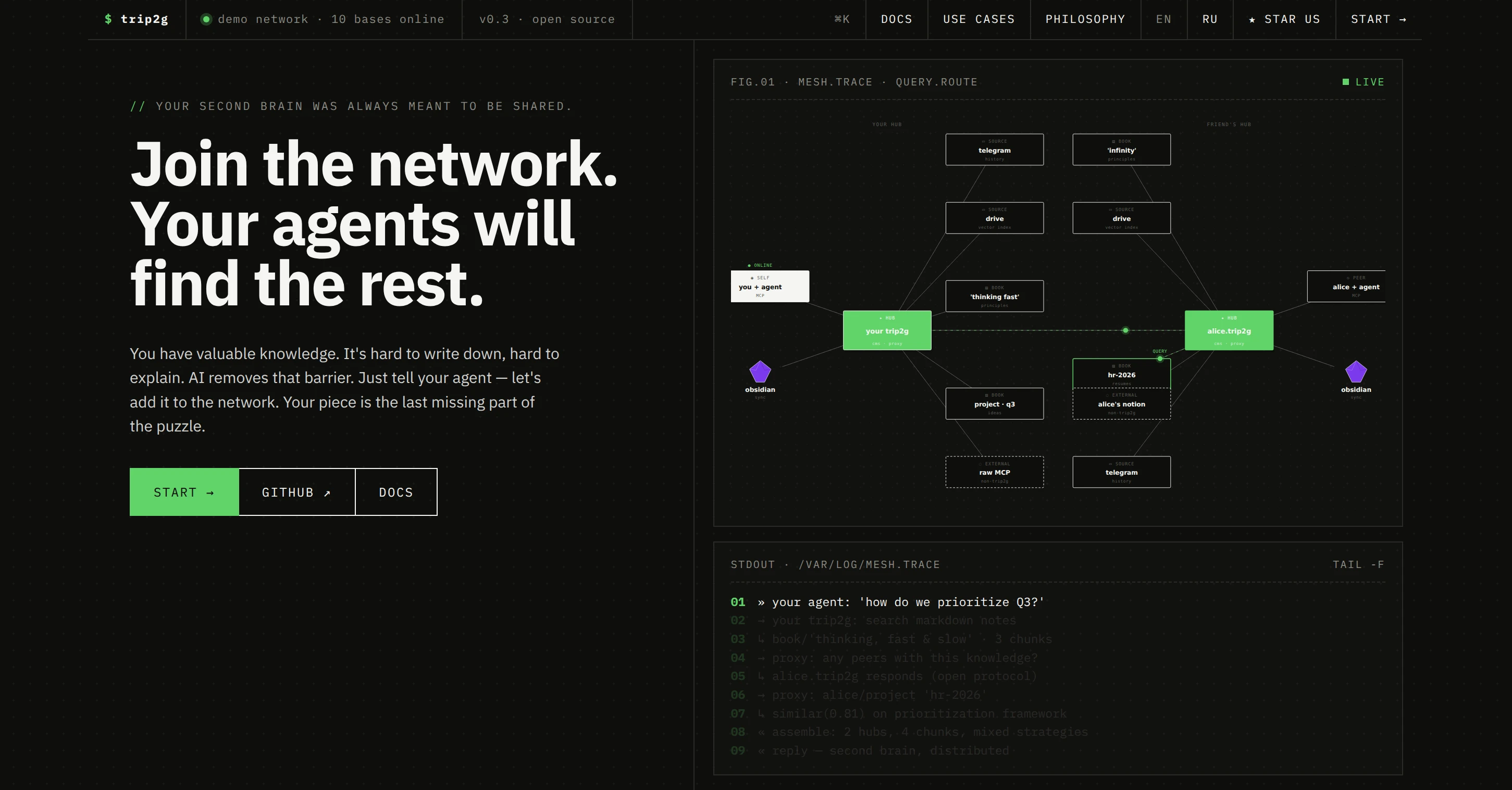
Peer hubs with trusted people or orgs. Each hub controls access per base. One agent question reaches the union of all connected knowledge. Loops are bounded the way IP packets are: each hub enforces max_depth against a per-hop counter (the X-MCP-Federation-Depth header), and every call carries a short-expiry, HMAC-signed token.
Each hub is itself a Markdown OS, so the network is a mesh between operating systems, the way the internet is a network between computers. The rows below are common shapes, not the only ones. The protocol does not assume a topology, so you can build any of them.
| Topology | Setup | Result |
|---|---|---|
| Solo | One hub, many bases | All your notes, books, courses in one query |
| Friends | Each person runs a hub, hubs peer | Union of everyone's knowledge |
| Company | Central hub + per-employee hubs | Tribal knowledge and docs, queryable |
| B2B | Two star topologies, one bridge | Shared knowledge without merging systems |
Process dispatch & scheduler: webhook agents
The kernel-side mechanism that runs an agent. Shipped on main.
- Change webhooks. A note create/update/remove POSTs to an agent, and the agent writes notes back via the API. Glob filtering picks which notes fire it, HMAC signs the delivery, and
max_depthstops recursion. - Cron webhooks. Run an agent on a schedule (
0 9 * * *). Anext_run_atcolumn plus a per-minute system cron drive it, and goqite worker pools give per-queue concurrency and priority. Sync or async, with optional instruction context.
The agent itself can live anywhere. These webhooks just deliver the event and accept note writes back.
Userland: the agent fleet
In development on
feat/agent-runtime, not yet onmain.
The core idea: a note edit spawns a scoped, server-side agent run. Unlike a local editor or a static builder, the agent runs on the hub, scoped to the note's glob patterns, not on your laptop.
An agent is a note. Its frontmatter is the config: model, tools, read_patterns/write_patterns, trigger_on, for_each, max_depth, timeout_seconds. Its body is the instruction, a Jet template that can reference the changed note(s). A fleet daemon watches an agents folder, parses each role note, and registers it as a change webhook pointed back at itself. Drop a note to install an agent, remove the note to uninstall it.
Related MCP Servers
Reviews
No reviews yet — be the first to share how this listing worked for you.
Frequently Asked Questions about Trip2g
AllMCPs Directory Badge
Showcase your server listing on GitHub or your project documentation. Embed this dynamic SVG badge to highlight official listing status and live engagement.
Badge Style:
Live Dynamic SVG Preview
Markdown (GitHub README)
[](https://allmcps.com/mcp/trip2g)HTML Embed
<a href="https://allmcps.com/mcp/trip2g"><img src="https://allmcps.com/api/badge/trip2g?style=directory" alt="Trip2g on AllMCPs" /></a>Technical Specs & Signals
CategoryKnowledge & Memory
27Quality signal: Emerging · 27/100How this signal is calculated ▾
Server availabilityNot measured
Not scored for repo-hosted servers — we can't reach the running server, only its GitHub page. Hosted MCP endpoints are health-checked live.
Verified ownership8/20
Documentation & tools11/30
Adoption & activity1/15
Community engagement0/10
A guidance signal from public completeness & health data — not a user rating. New listings start lower and rise as they add docs, get verified, and grow adoption. Signals we can't observe for a listing are skipped, not counted against it.
Own this project?
This directory is pre-filled from public sources. Claim via GitHub README, site badge, or DNS TXT to unlock edit access and the Official badge — proof is checked automatically, then reviewed by our team.
Free dofollow backlink: add your website and place the AllMCPs badge on it — no claim needed. We detect it automatically and keep it verified as long as the badge stays live.
Claim & get free dofollowShare & Embed
Add our SVG badge (dark/light directory styles) or embeddable widget to your site.