Local-first AI CLI usage analytics for agents.
Quick Install
Automated & IDE SetupCopy the AI prompt to install this server into Claude Code, Cursor, or another agent — or use 1-click editor setup below.
Not yet automatically verified
We haven't yet run this listing's install command through our automated sandbox check. This isn't a red flag — we're steadily working through the catalog.
Manual Client & Custom JSON ConfigExpand JSON ▾
Client Config & Setup
Choose your client or environment
Target File:
💡 Paste the JSON block into your client's configuration file under mcpServers, then restart the application.
Documentation Overview

TokenTrace CLI
Local-first AI CLI usage analytics for developers and coding agents.
TokenTrace answers one practical question before the next expensive AI CLI run: is your local usage evidence ready to trust? It scans local Claude Code, Codex, structured usage logs, and usage-shaped local databases, then labels token and cost data as exact, estimated, unknown, cached, or non-cache. The dashboard opens on Today, with direct paths into Sessions, Evidence, and Fix Data.
TokenTrace is designed for local development machines first, with macOS-oriented defaults. It does not require a cloud account and does not send telemetry or logs anywhere.
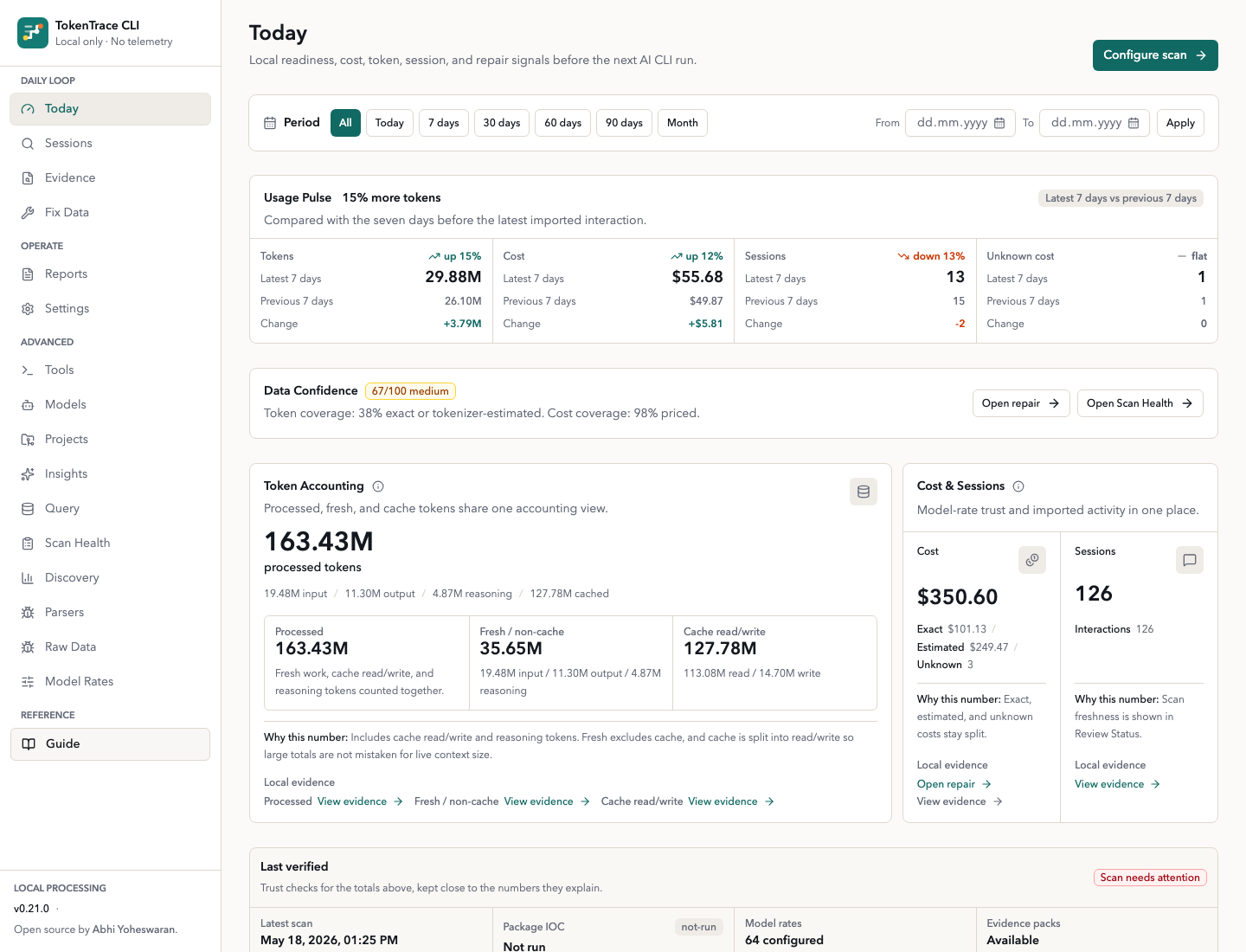
What TokenTrace Helps You Do
- Check readiness before another coding-agent run with
tokentrace preflight --jsonor MCPget_preflight. - See today’s local cost, tokens, sessions, confidence, anomalies, and repair signals in one first screen.
- Trace every important number back to local files, parser state, sessions, model rates, and confidence labels.
- Fix missing cost data through a guided repair queue without uploading prompts or message bodies.
Start In Seconds
Run without installing:
Or install globally:
The command starts the local dashboard, chooses an available localhost port starting at 3030, opens your default browser, and keeps the server running until you press Ctrl+C.
CLI commands:
For Coding Agents
Agents should start with the read-only discovery manifest:
The alias below returns the same manifest:
The manifest describes TokenTrace's local-first privacy model, safe JSON commands,
common workflows, Claude Code status-line setup, Codex sidecar fallback, and
guardrails such as never running tokentrace reset without explicit human
approval. The discovery command does not scan files, initialize the database, or
start the dashboard.
Package-level agent references are included for agents that inspect repository or npm package contents before invoking commands:
MCP-capable clients can start the local stdio server after installing or using the npm package:
Registry name: io.github.abhiyoheswaran1/tokentrace.
First MCP call for agents: get_agent_guide.
Self-test the local MCP entrypoint without scanning files:
The MCP server exposes the same local-first surfaces as tools: capabilities,
preflight, status, Scan Health, evidence, repair queue, reports, and an
explicit scan tool. It does not scan files on startup, and its scan tool requires
confirmLocalScan=true before reading local usage files or writing the local
database.
Before starting another long coding-agent run, use preflight:
In MCP clients, call get_preflight for the same proceed, caution, or blocked
decision with local scan freshness, confidence, guardrail, anomaly, and repair
findings. Preflight does not scan files or inspect raw prompts.
When the local dashboard is already running, agents can fetch the same manifest over localhost:
The Local Sources & Trust release handoff is also machine-readable:
Run From Source
Open http://localhost:3000.
Useful source commands:
Daily Loop And Trust
TokenTrace now organizes the product around the daily loop:
- Preflight: decide whether local evidence is ready before another agent run.
- Today: review cost, token, session, confidence, anomaly, and repair signals.
- Evidence: trace numbers back to source files, parser confidence, sessions, and model-rate state.
- Fix Data: resolve unknown cost, parser review, and model-rate gaps.
- Advanced: inspect Scan Health, Discovery, Parsers, Raw Data, Query, and Model Rates when you need the full diagnostic surface.
Trust surfaces include:
- native structured usage log and Cursor-style chat export ingestion
- Source Coverage in Scan Health for native, profile-assisted, fallback, and unsupported files
- privacy-safe Evidence Packs as JSON or Markdown
- local scan scheduling: manual, on-open, hourly, or daily
- project/model/tool scoped guardrails with warning thresholds
- Import Profile preview before saving matchers
- saved report exports for weekly usage, source coverage, guardrails, unknown cost, high-cost sessions, and confidence trends
- operating metadata export without raw usage records
Accuracy And Evidence
TokenTrace labels the trust level behind imported numbers:
- exact provider token counts
- tokenizer estimates for recognized OpenAI/Codex and Claude-family model names
- simple estimates when only text-like content is available
- source-provided costs from local SQLite histories
- unknown cost repair groups when model, token, or rate evidence is missing
The dashboard surfaces a Data Confidence score on Today, Projects, Sessions, and Session Timeline pages. Scan Health also includes a supply-chain IOC check so package trust is visible in the product, not only in release scripts.
Public releases require maintainer approval. See docs/RELEASE_CHECKLIST.md before bumping versions, tagging, creating GitHub releases, or publishing npm.
In local development, the SQLite database defaults to .tokentrace/tokentrace.db. Override it with:
Data Location
When installed from npm, TokenTrace stores runtime data outside the package folder:
- macOS:
~/Library/Application Support/TokenTrace/ - Linux:
~/.local/share/tokentrace/ - Windows:
%APPDATA%/TokenTrace/
The CLI sets TOKENTRACE_DB and DATABASE_URL automatically. You can override the base directory with:
Related MCP Servers
Adoption & maintenance
Factual signals from GitHub, npm, and our automated checks — not a rating.
npm downloads
614
Package downloads in the last 30 days.
Last commit
3mo ago
Most recent push to the default branch.
Reviews
No reviews yet — be the first to share how this listing worked for you.
Frequently Asked Questions about TokenTrace
AllMCPs Directory Badge
Showcase your server listing on GitHub or your project documentation. Embed this dynamic SVG badge to highlight official listing status and live engagement.
Badge Style:
Live Dynamic SVG Preview
Markdown (GitHub README)
[](https://allmcps.com/mcp/tokentrace)HTML Embed
<a href="https://allmcps.com/mcp/tokentrace"><img src="https://allmcps.com/api/badge/tokentrace?style=directory" alt="TokenTrace on AllMCPs" /></a>