
A complete Sigma detection engineering toolkit









RSigma is a complete detection engineering toolkit for the Sigma detection standard, including a parser, evaluation engine, rule conversion, streaming runtime, linter, CLI, MCP, and LSP.
RSigma parses Sigma YAML rules into a strongly-typed AST, compiles them into optimized matchers, and evaluates them against log events in real time. It handles stateful correlation logic in-process with memory-efficient compressed event storage. Or as Zack Allen put it in DEW #149, "RSigma is essentially a SIEM."
You can send events in many formats, including JSON, syslog (RFC 3164/5424), logfmt, CEF, EVTX (Windows Event Log), plain text, and OTLP (OpenTelemetry Protocol), with auto-detection by default. pySigma-compatible processing pipelines handle field mapping and backend configuration. OTLP support lets any OpenTelemetry-compatible agent (Grafana Alloy, Vector, Fluent Bit, OTel Collector) forward logs to RSigma via HTTP or gRPC for detection.
For rule quality and editor integration, a built-in linter validates rules against 85 checks derived from the Sigma v2.1.0 specification, and an LSP server provides real-time diagnostics, completions, hover documentation, and quick-fix code actions in any editor.
RSigma builds on open industry standards throughout: Sigma for detection rules, OpenTelemetry for log ingestion and detection export, and STIX and TAXII for threat intelligence.
Full documentation, including guides, CLI reference, and library API docs, lives at rsigma.io.
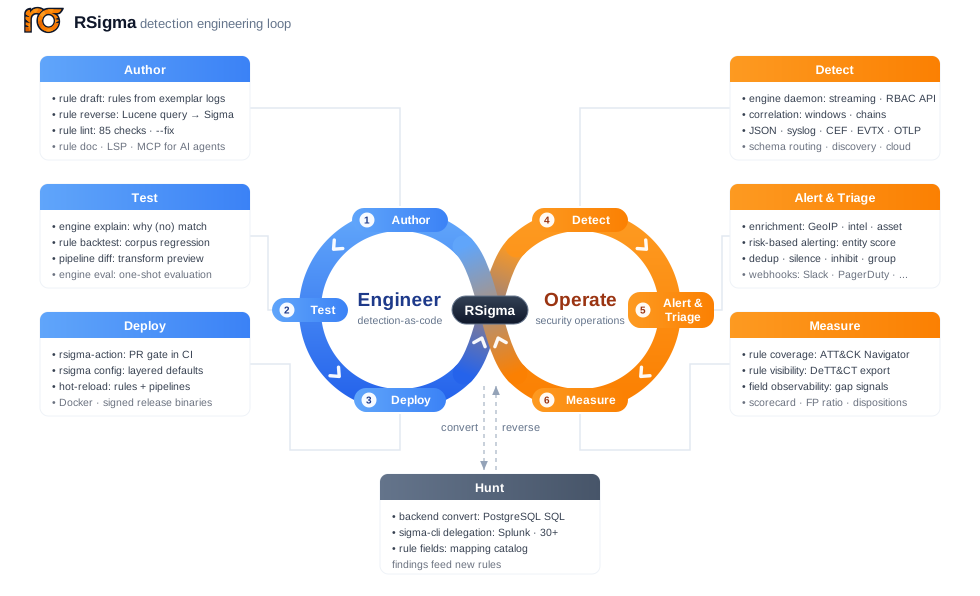
Supported Features
Author
- Sigma parsing: Parses Sigma YAML into a strongly-typed AST with support for detection, correlation, and filter rules
- Array matching (experimental): Matches members of arrays in nested event data with any/all-member semantics, same-element correlation, and positional indexing, opt-in via
sigma-version: 3 - Rule drafting: Drafts detection rules and temporal correlations from exemplar events contrasted against a baseline corpus with
rule draft - Rule tuning: Proposes a spec-native filter from false-positive events, verifies that every known true positive still fires, and refuses unsafe separators with
rule tune - Built-in linter: Validates rules with 85 checks, four severity levels, suppressions, custom tag namespaces, and auto-fix for 14 safe rules
- ADS metadata: Documents rules with Palantir ADS sections under
rsigma.ads.*, enforced by the linter and scaffolded withrule doc - LSP server: Provides real-time diagnostics, completions, hover documentation, document symbols, and quick-fix code actions in VSCode, Neovim, and any LSP-capable editor
- MCP server: Exposes the toolchain to AI agents (Cursor, Claude Code, ...) as structured MCP tools over stdio or Streamable HTTP with
rsigma mcp serve
Test
- Detection diagnostics: Explains why a rule did or did not match an event with
engine explain, diffs pipeline transformations withpipeline diff, and introspects live correlation windows - Corpus backtesting: Replays an event corpus against declared per-rule expectations with
rule backtest, emitting a JSON or JUnit XML report for CI - Output formats: Structured commands render JSON, NDJSON, table, CSV, or TSV with a TTY-aware default via a global
--output-formatflag; artifact and protocol commands keep their fixed wire format (see the per-command contract)
Deploy
- CI integration: Gates a rule repository in one pull-request check with the
timescale/rsigma-actionGitHub Action, wrapping lint, validate, fields-drift diff, backtest, and coverage - Configuration: Layers settings from YAML config files, environment variables, and CLI flags, managed with the
rsigma configcommand group - Signed artifacts: Ships multi-arch Docker images with cosign signatures, SBOM, and SLSA Build L3 provenance, plus prebuilt binaries for Linux, macOS, and Windows
Detect
- Rule evaluation: Compiles rules into optimized matchers and evaluates them against events in real time, with stateless detection and stateful correlation (sliding/tumbling/session windows, group-by, chaining, suppression)
- Streaming daemon: Runs as a long-lived detection daemon with hot-reload, Prometheus metrics, stdin/HTTP/NATS/OTLP/Unix-socket input, and async sinks (stdout, file, NATS, OTLP, webhook, Unix socket) with per-sink retry, DLQ, and a per-sink wire format (native NDJSON or OCSF Detection Finding JSON)
- Input formats: Ingests JSON, syslog (RFC 3164/5424), logfmt, CEF, EVTX (Windows Event Log), plain text, and OTLP logs with format auto-detection
- Processing pipelines: Maps fields and transforms rules with pySigma-compatible pipelines (transformations, conditions, finalizers)
- Dynamic pipelines: Populates any pipeline value from external sources (HTTP, files, commands, NATS) with template expansion, auto-refresh, and extraction via jq, JSONPath, or CEL
- Schema recognition: Recognizes which schema each event uses (ECS, Sysmon, CEF, OCSF, or user-defined) with
engine classify, watches a live daemon for unrecognized sources, and mines candidate signatures withengine discover-schemas - Schema routing: Builds one engine per pipeline set and dispatches each classified event to its engine, feeding a shared correlation store
- Logsource routing: Skips rules whose logsource conflicts with an event's declared
product/service/category, so a mixed-product stream only pays for the rules that can match - Eval prefilters: Prunes large rule sets before evaluation with a bloom substring prefilter and a cross-rule Aho-Corasick index
- NATS JetStream: Consumes and publishes over JetStream with authentication (credentials, mTLS), replay, consumer groups, and dead-letter queues
- OTLP integration: Receives logs from any OpenTelemetry-compatible agent (Grafana Alloy, Vector, Fluent Bit, OTel Collector) via HTTP or gRPC, and exports detections to an OTLP collector
- TLS termination: Terminates TLS in-process on the daemon API listener with optional mutual TLS and cross-platform certificate hot-reload
- State persistence: Persists correlation, alert-pipeline, risk, and disposition state to SQLite with
--state-dband restores it across restarts. The capture ring is not persisted. - Live operations: Inspects a running daemon with
engine status, records replayable fixtures withengine tap, and streams live detections withengine tail
Alert & Triage
- Enrichment: Injects context (asset info, IP reputation, identity, GeoIP, runbook URLs, ...) into detection and correlation results via
template,lookup,http, andcommandprimitives - Risk-based alerting: Scores each firing per entity (user, host, source IP) and raises a single incident when an entity's accumulated risk crosses a threshold
- Alert pipeline: Silences, inhibits, and deduplicates results, then groups the survivors into incidents, modeled on Alertmanager
- Webhook alerts: Delivers detections to Slack, Teams, Discord, PagerDuty, or any HTTP endpoint with templated payloads, HMAC request signing, per-webhook retry, rate limiting, and DLQ
- Triage feedback: Ingests analyst dispositions into a per-rule false-positive ratio that feeds the detection scorecard
- Verdict-driven corpora: Retains admitted
group_bydetection events and writes TP/FP bundles after an accepted disposition forrule backtestandrule tune --from-dispositions
Measure
- ATT&CK coverage: Exports an ATT&CK Navigator layer with
rule coverageand reports gaps against Atomic Red Team, the SigmaHQ baseline, and a target technique list - Telemetry visibility: Scores data-source maturity with
rule visibility, exporting DeTT&CT administration files and a Navigator layer that surfaces blind spots - Field observability: Surfaces which event fields no rule references and which rule fields never appear in events, live on the daemon or as a one-shot report from
engine eval - Detection scorecard: Fuses backtest, coverage, production-volume, and triage signals with
rule scorecardinto per-rule keep/tune/retire verdicts - Rule hygiene: Flags retirement candidates with
rule hygiene: silent, noisy, untagged, unowned, incomplete ADS, broken field coverage, or stale status
Hunt
- Rule conversion: Converts rules into backend-native queries via a pluggable backend trait, with native PostgreSQL/TimescaleDB, LynxDB, and Fibratus backends plus sigma-cli delegation for 30+ pySigma backends (Splunk, Elasticsearch, Microsoft Sentinel, ...)
- Hunt execution: Runs converted detection rules read-only against a PostgreSQL/TimescaleDB archive with
hunt runand streams matching rows back as exemplar-shaped NDJSON thatrule draft,rule tune,rule test, andrule backtestconsume directly - Field catalog: Lists every field a ruleset references, before or after pipeline mapping, with
rule fields
Crates
| Crate | Description |
|---|---|
rsigma-parser | Parse Sigma YAML into a strongly-typed AST |
rsigma-ir | Intermediate representation shared by evaluation and conversion |
rsigma-eval | Compile and evaluate rules against JSON events |
rsigma-convert | Transform rules into backend-native query strings |
rsigma-runtime | Streaming runtime with input adapters, log processor, and hot-reload |
rsigma-mcp | Model Context Protocol (MCP) server exposing the toolchain as tools for AI agents |
rsigma | CLI for parsing, validating, linting, evaluating, converting rules, field catalog, and running a detection daemon |
rsigma-lsp | Language Server Protocol (LSP) server for IDE support |
rstix | STIX 2.1 library: typed objects, bundle parse/stream, semantic validation, and pattern engine |
[!TIP] To learn more about RSigma, read these articles:
- Pattern Detection and Correlation in JSON Logs
- Streaming Logs to RSigma for Real-Time Detection
- Building a Detection Layer on PostgreSQL with Sigma Rules
- Security Observability with RSigma and the LGTM Stack
- Wiring Live Threat Intel into Sigma Detection with Dynamic Pipelines
- Cloud Detection at Scale on a Laptop
- The State of RSigma
- Detection-as-Code in One GitHub Action with RSigma
- The State of RSigma, Part Two: The Loop
[!NOTE] RSigma has been featured in:
- Detection Engineering Weekly #149 (March 2026) "Building a tool like RSigma is challenging because the Sigma specification has evolved into a robust domain-specific language over the years."
- tl;dr sec #320 (March 2026) "Accurately evaluating the full spectrum of what Sigma rules can express is quite complex, it's pretty neat to read about how RSigma handles all of these conditional expressions, correlating across rules, etc."
- The Deep Purple Sec by BlackNoise - March 2026 (April 2026) "Defensive teams can pipe logs through CLI commands, apply field-mapping pipelines, and chain correlations for multi-stage attack detection."
- Detection Engineering Weekly #154 (April 2026) "RSigma is not a SIEM, but it's an impressive feat to build a self-contained Rust binary that operates much like one. For teams doing pre-SIEM rule validation or forensics, it's a solid plug-and-play option."
- Detection Engineering Weekly #157 (May 2026) "Instead of hardcoding IOC values in rule YAML, you declare external sources in the pipeline config, and RSigma fetches and injects them at evaluation time. This works very similarly to how I've seen SIEMs implement threat intelligence pipelines, but since it's RSigma, it's self-contained within its ecosystem."
Installation
Prebuilt binaries for Linux, macOS, and Windows (amd64 and arm64), with SLSA Build L3 provenance, are attached to every GitHub release.
Or install from crates.io:
To build from source:
Docker
Multi-arch images (linux/amd64, linux/arm64) are published to GHCR on every release, signed with cosign and carrying an SPDX SBOM and SLSA Build L3 provenance. See the Docker deployment guide.
Run with full runtime hardening:
Verify the image signature:
Quick Start
See the Quick Start guide for a guided tour and the CLI README for complete documentation of all subcommands and flags.
MCP Server (AI agents)
Expose the toolchain to MCP-aware agents (Cursor, Claude Code, ...) over stdio:
The agent then calls structured tools (parse_rule, lint_rules, validate_rules, evaluate_events, convert_rules, list_fields, ...) and gets back JSON. Point --daemon-url at a running daemon to add the Operate-cycle tools. See the MCP server guide.
Library Usage
Use the crates directly from Rust:
Architecture
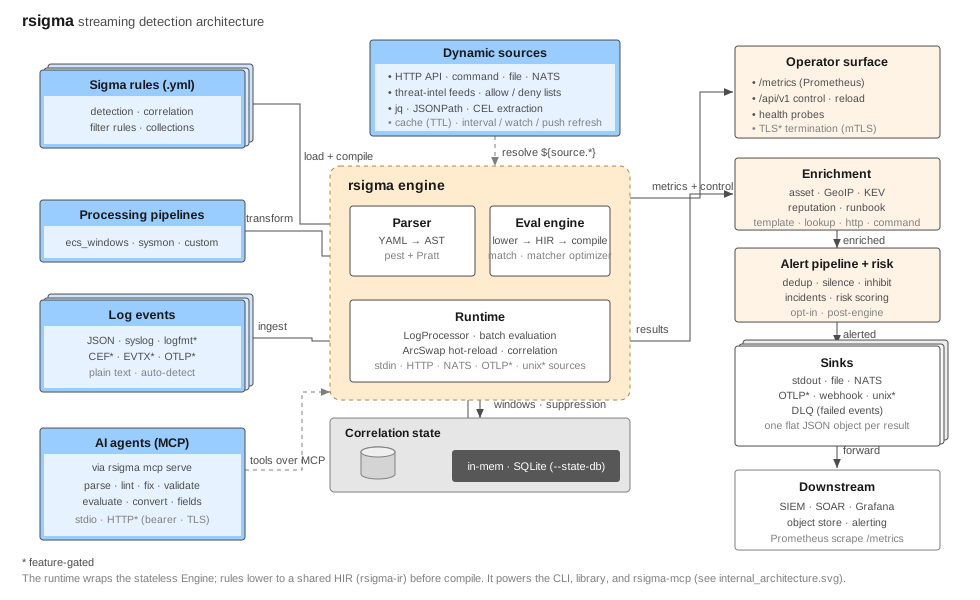
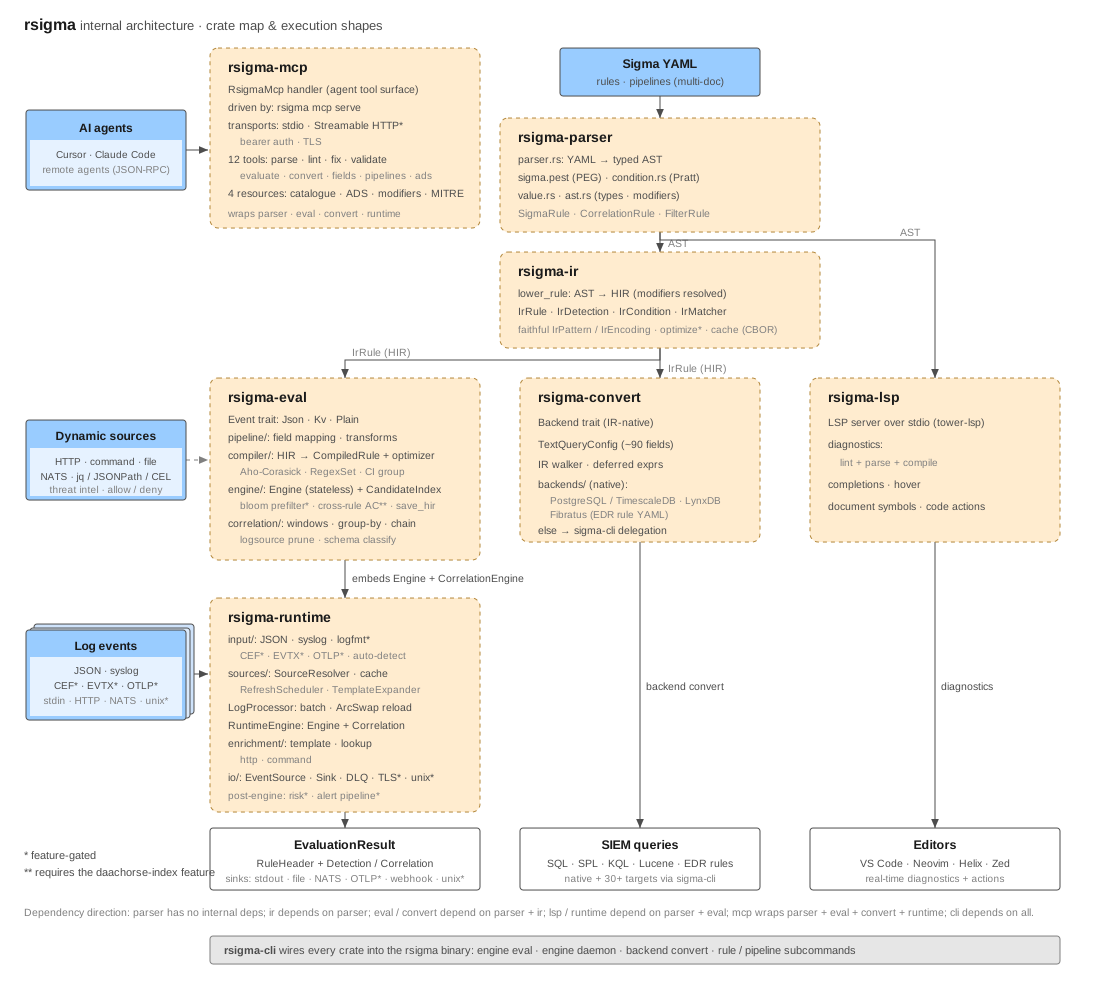
A Sigma rule is parsed into a strongly-typed AST (rsigma-parser), lowered into a shared intermediate representation (rsigma-ir), then compiled and evaluated against live events (rsigma-eval inside rsigma-runtime), converted into backend-native queries (rsigma-convert), or served to editors and AI agents (rsigma-lsp, rsigma-mcp). The evaluation library also powers exemplar-driven rule drafting and verified filter tuning through the CLI and MCP. The full walkthrough, covering every module and all four execution shapes, lives in the Architecture reference.
Performance
RSigma is designed for high-throughput detection. On an Apple M4 Pro:
- Parsing: 12.4 MiB/s for 1000 rules
- Detection: 1.12M events/sec (JSON runtime pipeline, 100 rules)
- Correlation: 501K events/sec (temporal + event-count)
- Dynamic pipelines: 2.85M events/sec once built (no per-event overhead)
See BENCHMARKS.md for full Criterion results across all subsystems.
Reference
- pySigma: reference Python implementation
- Sigma Specification V2.1.0: formal specification
- sigma-rust: Pratt parsing approach
- sigmars: correlation support patterns
- sigma_engine: official SigmaHQ Rust library for parsing and matching Sigma rules against events
- pySigma-backend-sqlite: SQLite backend for pySigma (inspiration for the PostgreSQL backend)
- pySigma-backend-athena: AWS Athena backend for pySigma (SELECT fields, CTE-based correlation, sliding window patterns)
License
MIT