Inspect Tidebase agent runs, resolve approval gates, and trigger recovery from your AI assistant.
Quick Install
Automated & IDE SetupCopy the AI prompt to install this server into Claude Code, Cursor, or another agent — or use 1-click editor setup below.
Not yet automatically verified
We haven't yet run this listing's install command through our automated sandbox check. This isn't a red flag — we're steadily working through the catalog.
Manual Client & Custom JSON ConfigExpand JSON ▾
Client Config & Setup
Choose your client or environment
Target File:
💡 Paste the JSON block into your client's configuration file under mcpServers, then restart the application.
Documentation Overview

Tidebase
Agent auth and credential brokering for AI agents, with checkpoints, queues, schedules, and approval gates. In your own Postgres.





Quick start · API · Storage contract · Scope
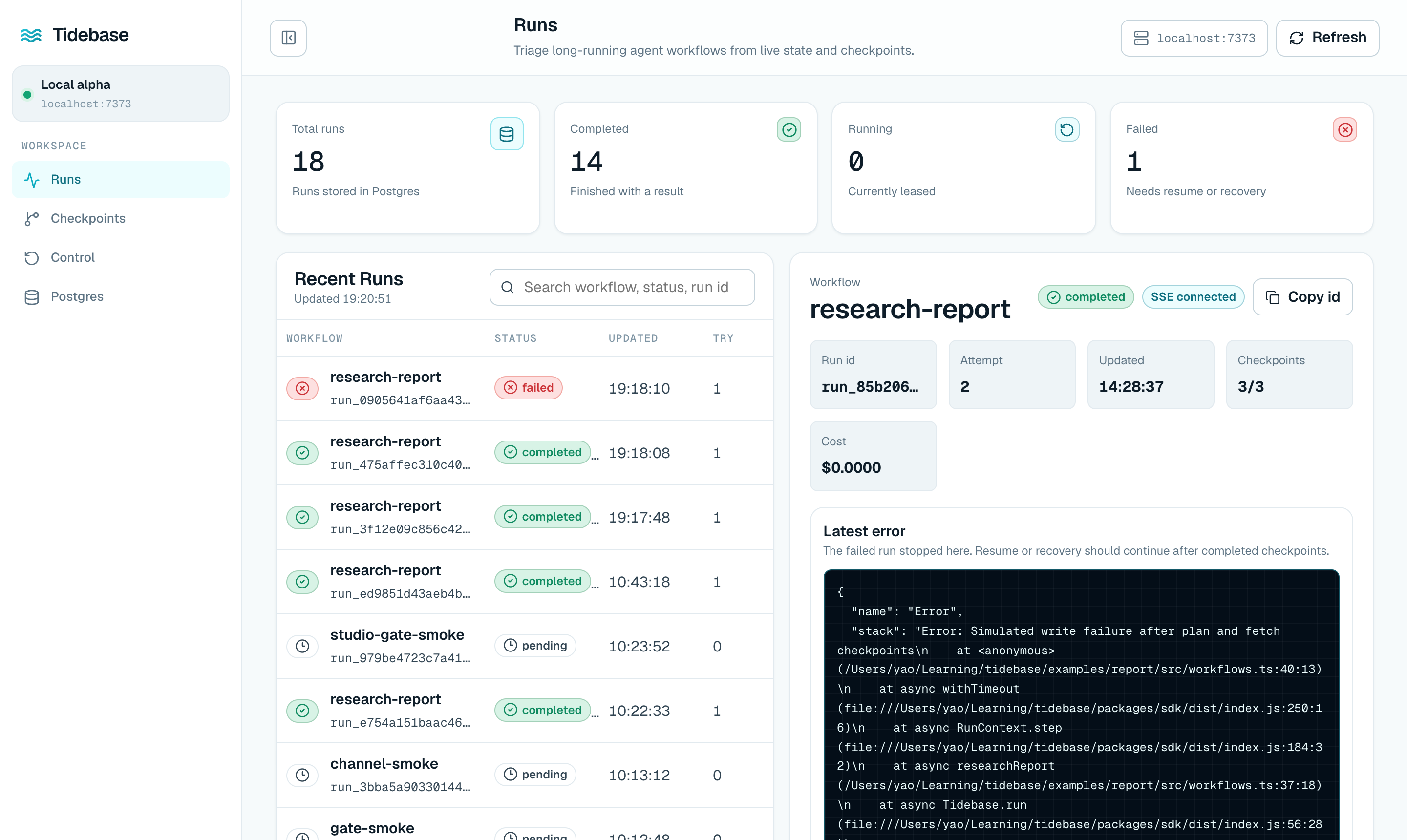
Tidebase gives your AI agents an identity and a vault. When an agent calls an API, the call goes through Tidebase, which injects the credential, so the agent and the model never see the key. You can scope it, audit it, and revoke it.
It also keeps the durable parts: checkpoints, live state, queues, schedules, and approval gates, all in your own Postgres. Your code still runs in your app, worker, or job process; Tidebase does not run it. So "this run died at step 7, is it safe to rerun?" has an answer, and "the agent has my GitHub token in plaintext" stops being true.
Docs: https://tidebase.dev · Community: Discord · For AI assistants: /llms.txt
Why Tidebase
Agent products usually grow the same operational plumbing:
- per-agent identity instead of one shared API key
- a vault for third-party secrets and OAuth tokens
- a way to call APIs without handing the secret to the model
- status tables for runs and steps
- checkpoint blobs for partial progress
- retry flags and manual-review states
- progress streaming to the UI
- approval gates for risky actions
- token and cost ledgers
- webhook glue for recovery and external review surfaces
Tidebase packages that layer around your existing code, plus a credential broker so agents act on real services without holding the keys. It does not run your code (your runtime stays yours), and it is not an LLM proxy or a hosted worker runtime.
Quick Start
Fastest path (no Node needed), prebuilt server image:
Then point any SDK at http://localhost:7373 (npm i @tidebase/sdk or pip install tidebase).
Dev setup (server + Studio from source):
Start Postgres:
Install dependencies:
Run the server and Studio:
- Server: http://localhost:7373
- Studio: http://localhost:5173
Run the example workflow:
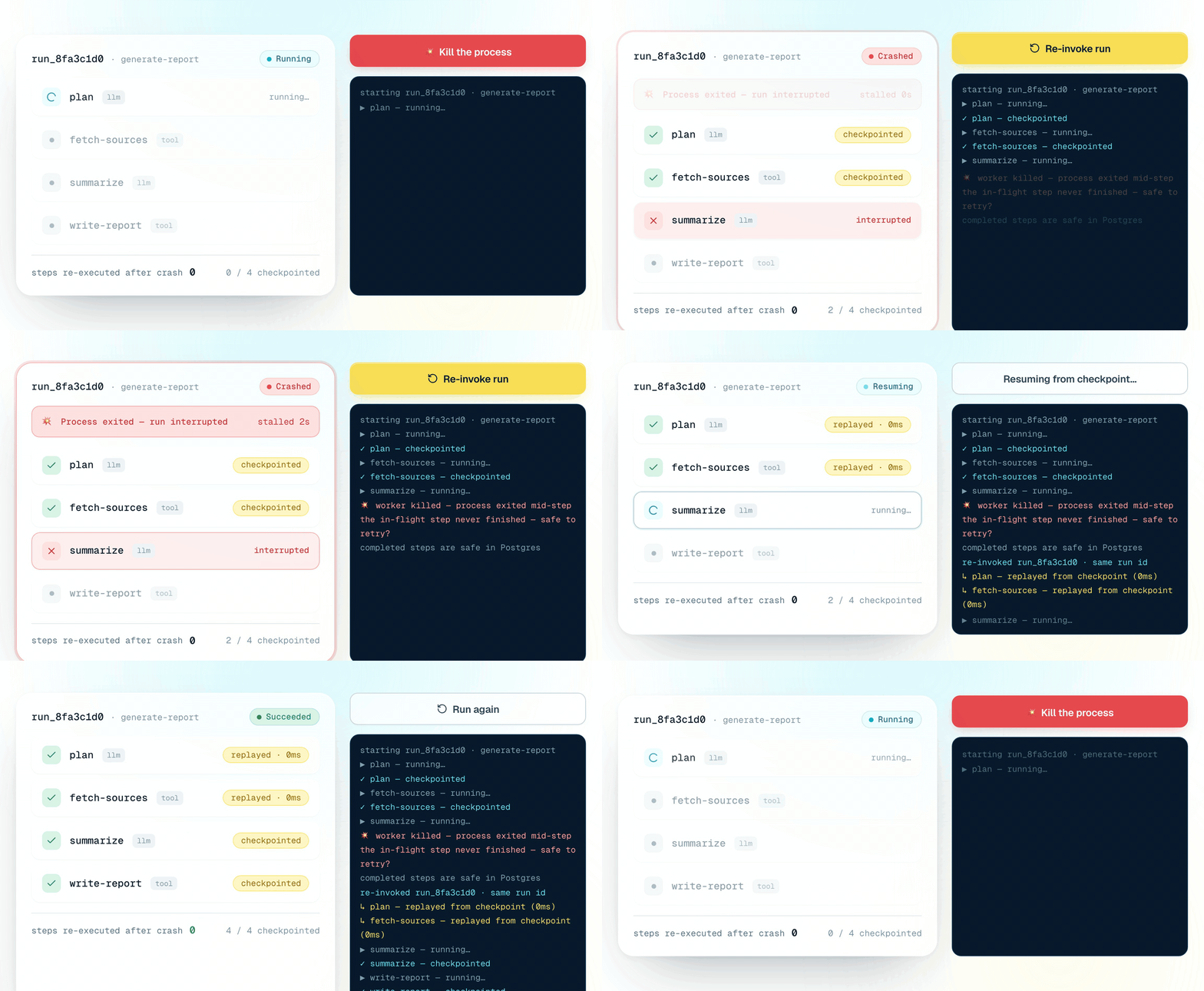
Force a failure after two completed checkpoints:
Copy the run id from Studio or the API, then resume:
The plan and fetch-sources steps are returned from checkpoints. Only write-report executes again.
Agent auth and credential brokering
Give an agent its own identity, vault a third-party secret, and let the agent call the API without ever holding the key. Tidebase makes the outbound call with the secret injected, and you can scope, audit, and revoke it.
Secrets are envelope-encrypted at rest (AES-256-GCM with a KMS-wrapped DEK). baseUrl pins the upstream and scopesAllowed caps any grant, so a leaked grant can't reach an arbitrary host. The proxy blocks private IPs and metadata hosts (SSRF defense), and GET /audit returns grant receipts with no secret material. For OAuth providers you can delegate custody to nango or openbao and Tidebase holds only an opaque connection reference.
Using Tidebase with AI coding agents
Make every AI session in your project use Tidebase correctly:
Give your assistant direct access to runs, gates, and recovery via MCP:
Or install the Claude Code plugin (skill + MCP server in one):
Agent-readable docs live at tidebase.dev/llms.txt; every docs page also serves a raw .md twin.
Queues, schedules, and cancellation (v0.5)
Tidebase can now decide when your code runs, while still never executing it:
Push-mode dispatch is also available: configure a queue with an invokeUrl and Tidebase delivers signed run.invoke webhooks to your app instead of waiting for a claim. A queued job IS a run, queued is a lifecycle state, not a second table, so status never drifts.
See docs/production.md for the full lifecycle, replay contract, worker-death recovery model, and deploy discipline (versioned migrations via pnpm migrate, TIDEBASE_AUTO_MIGRATE=0 for expand/contract deploys).
Testing
The suite (84 TypeScript tests + 9 Python integration tests, run in CI on every push) uses the same Postgres in an isolated tidebase_test database. It is invariant-driven rather than coverage-driven: every test asserts a durability or safety guarantee through the public API or SDK, against real Postgres, including concurrency probes for the guarantees that only matter under contention.
What it proves:
- completed steps replay from storage and never re-execute, including across crash + recovery-webhook resume
- step and run leases are mutually exclusive and fenced, zombie workers cannot write back stale results
- input-hash drift on replay is rejected before it can corrupt a run
- failure classification honors the resume contract: unkeyed external writes park in
manual_review, idempotency-keyed and read-only steps aresafe_replay - per-run event logs are gap-free and strictly ordered under concurrent writers
- gates resolve exactly once, require the resolve token, and replay their decision on resume
- child runs are idempotent by edge name, so resumed fanouts reuse children
- recovery webhooks and channel deliveries are HMAC-signed; the SDK rejects unsigned, tampered, or forged payloads
- a slow or hung channel endpoint never blocks other writers to the run
See docs/testing.md for the full invariant map and conventions.
API Shape
Session Runs
tide.run() fits work shaped like a function. For open-ended execution, a protocol gateway in front of an agent, a REPL, a run that spans many requests, attach to a run as a session instead:
Related MCP Servers
Adoption & maintenance
Factual signals from GitHub, npm, and our automated checks — not a rating.
GitHub stars
1
Stargazers on the source repository.
npm downloads
22
Package downloads in the last 30 days.
Last commit
3mo ago
Most recent push to the default branch.
Reviews
No reviews yet — be the first to share how this listing worked for you.
Frequently Asked Questions about Tidebase
AllMCPs Directory Badge
Showcase your server listing on GitHub or your project documentation. Embed this dynamic SVG badge to highlight official listing status and live engagement.
Badge Style:
Live Dynamic SVG Preview
Markdown (GitHub README)
[](https://allmcps.com/mcp/tidebase)HTML Embed
<a href="https://allmcps.com/mcp/tidebase"><img src="https://allmcps.com/api/badge/tidebase?style=directory" alt="Tidebase on AllMCPs" /></a>