Replicant MCP README
The full upstream README, mirrored here for reference. Install config, tool schemas, adoption signals, and an original overview live on the Replicant MCP listing page.
replicant-mcp
Let AI build, test, and debug your Android apps.




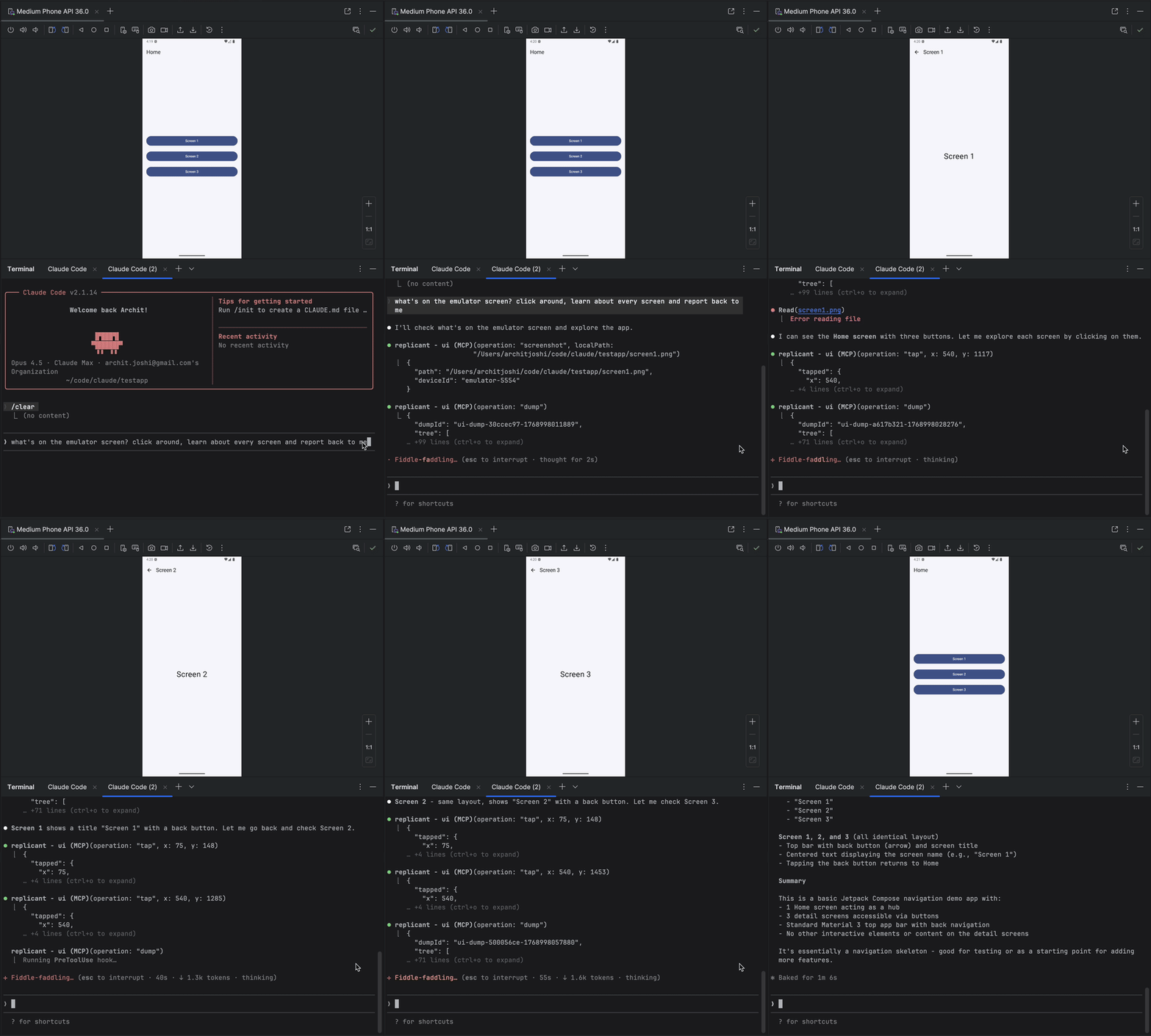
replicant-mcp is a Model Context Protocol server that gives AI assistants like Claude the ability to interact with your Android development environment. Build APKs, launch emulators, install apps, navigate UIs, and debug crashes—all through natural conversation.
Demo
Why replicant-mcp?
| Without replicant-mcp | With replicant-mcp |
|---|---|
"Run ./gradlew assembleDebug, then adb install, then adb shell am start..." | "Build and run the app" |
| Copy-paste logcat output, lose context | AI reads filtered logs directly |
| Screenshot → describe UI → guess coordinates | AI sees accessibility tree, taps elements by text |
| 5,000 tokens of raw Gradle output | 50-token summary + details on demand |
Features
| Category | Capabilities |
|---|---|
| Build & Test | Build APKs/bundles, run unit and instrumented tests, list modules/variants/tasks, test regression detection with baseline comparison |
| Emulator | Create, start, stop, wipe emulators; save/load/delete snapshots |
| Device Control | List connected devices, select active device, query device properties |
| App Management | Install, uninstall, launch, stop apps; clear app data |
| Log Analysis | Filter logcat by package, tag, level, time |
| UI Automation | Accessibility-first element finding, spatial proximity search, tap, text input, screenshots |
| Diagnostics | Environment health checks via replicant doctor; structured logging with configurable level and format |
Coming Soon
- Custom build commands (project-specific overrides, auto-detect gradlew)
- Video capture (start/stop recording, duration-based capture)
Quick Start
Prerequisites
- Node.js 18+
- Android SDK with
adbandemulatorin your PATH - An Android project with
gradlew(for build tools)
Installing prerequisites (macOS via Homebrew)
If you don't already have these tools, install them with Homebrew:
Node.js 18+
Physical-device only — just adb, sufficient if you never run an emulator:
adb lands directly on your PATH; no further config needed.
Full Android SDK — needed for emulator workflows or building APKs via the gradle-* tools. Run the steps in order:
Persist ANDROID_HOME and put the SDK binaries on your PATH by appending to ~/.zshrc (or ~/.bashrc):
Installation
After installation, run the built-in diagnostics to verify your environment:
Updating
Setup
Claude Desktop
Add to ~/Library/Application Support/Claude/claude_desktop_config.json (macOS) or %APPDATA%\Claude\claude_desktop_config.json (Windows):
Claude Code
Cursor
Add to ~/.cursor/mcp.json (global) or .cursor/mcp.json (project):
Windsurf
Add to ~/.codeium/windsurf/mcp_config.json:
OpenAI Codex CLI
Add to ~/.codex/config.toml:
Or via CLI:
Note: Ensure
adbandemulatorare in your PATH, or setANDROID_HOMEenvironment variable. On macOS:~/Library/Android/sdk, on Linux:~/Android/Sdk.
Example
Design
replicant-mcp uses progressive disclosure (summaries first, details on demand) to minimize token usage, and accessibility-first UI automation for faster, cheaper, more reliable interactions than screenshot-based approaches. See docs/architecture.md for details.
More Info
- Configuration: Set
REPLICANT_CONFIGfor advanced options. See docs/configuration.md. - Logging: Set
REPLICANT_LOG_LEVEL(error,warn,info,debug) andREPLICANT_LOG_FORMAT(jsonfor structured output) to control server logging. Logs are written to stderr. - Troubleshooting: Common issues and solutions in docs/troubleshooting.md.
- Tool documentation: Ask Claude to call
rtfmwith a category like "build", "adb", "emulator", or "ui".
Documentation
| Document | Description |
|---|---|
| Architecture | Design overview and progressive disclosure pattern |
| Configuration | Config file reference, environment variables, Gradle setup |
| API Stability | Tool API versioning policy and deprecation process |
| Security Model | adb-shell safety model, command denylist, threat boundaries |
| Support Matrix | Tested OS, Node.js, Android SDK, and emulator versions |
| Known Limitations | Accessibility gaps, timeouts, single-device focus, and more |
| Artifacts | .replicant/ directory contents and privacy considerations |
| Troubleshooting | Common issues and solutions |
| Changelog | Version history |
| Security Policy | Vulnerability reporting process |
| Support / Getting Help | How to report bugs and ask questions |
| Contributing | Development setup and guidelines |
Contributing
See CONTRIBUTING.md for development setup and guidelines.
Acknowledgments
- Inspired by xc-mcp for iOS
- Built on the Model Context Protocol
License
Questions? Open an issue