Long-term and multimodal memory for AI agents - character-aware, mem0-compatible, fully-local option
Quick Install
Automated & IDE SetupCopy the AI prompt to install this server into Claude Code, Cursor, or another agent — or use 1-click editor setup below.
Not yet automatically verified
We haven't yet run this listing's install command through our automated sandbox check. This isn't a red flag — we're steadily working through the catalog.
Manual Client & Custom JSON ConfigExpand JSON ▾
Client Config & Setup
Choose your client or environment
Target File:
💡 Paste the JSON block into your client's configuration file under mcpServers, then restart the application.
Documentation Overview

TeleMem: Building Long-Term and Multimodal Memory for Agentic AI






If you find this project helpful, please give us a ⭐️ on GitHub for the latest update.
🤝 Contributions welcome! Feel free to open an issue or submit a pull request.
TeleMem is an agent memory management layer that can be used as a high-performance drop-in replacement for Mem0 with one line of code (import telemem as mem0), deeply optimized for complex scenarios involving multi-turn dialogues, character modeling, long-term information storage, and semantic retrieval.
Through its unique context-aware enhancement mechanism, TeleMem provides conversational AI with core infrastructure offering higher accuracy, faster performance, and stronger character memory capabilities.
Building upon this foundation, TeleMem implements video understanding, multimodal reasoning, and visual question answering capabilities. Through a complete pipeline of video frame extraction, caption generation, and vector database construction, AI Agents can effortlessly store, retrieve, and reason over video content just like handling text memories.
The ultimate goal of the TeleMem project is to use an agent's hindsight to improve its foresight.
TeleMem, where memory lives on and intelligence grows strong.
Why TeleMem?
- 🎭 Character memory done right — the only open-source memory layer that automatically builds isolated, per-character memory profiles, built for role-play, companion AI, NPCs, and multi-persona assistants.
- 🎬 Memory for video, not just text — a full video → frames → captions → vector DB pipeline with ReAct-style multi-step video QA.
- 🏠 Fully local by default — runs end-to-end on your hardware (Qwen + FAISS); no cloud service, no paid tier, no data leaving your machine.
- 🔌 mem0-compatible API —
add()/search()accept the same arguments and return the same{"results": [...]}shapes, so existing Mem0 code keeps working.
📢 Latest Updates
- [2026-08-15] 🎉 TeleMem v1.10.0 adds first-class DeepSeek Harness support: an opt-in Cordis/MCP patch starts TeleMem with
uvx, registers all 8 memory tools undermcp__telemem__*, and securely forwards provider configuration. See the MCP server docs. - [2026-08-06] 🎉 TeleMem v1.9.0 is on the latest MCP standard: migrated to the official MCP Python SDK v2 (spec 2026-07-28) — all 8 tools now declare titles, behavior annotations, and structured output, while staying compatible with older MCP clients. See the MCP server docs.
- [2026-07-11] 🎉 TeleMem v1.8.0 — the "claims = contracts" release: character-memory extraction fix,
infer=False/prompt/memory_typenow fully honored, offline contract test suite, telemetry disabled by default, and a multi-NPC demo! - [2026-06-12] 🎉 TeleMem v1.7.1 is live on the official MCP registry — run the memory server with zero install:
uvx telemem! Also new: evaluation principles and a LongMemEval harness with built-in baselines. - [2026-06-12] 🎉 TeleMem is now on PyPI:
pip install telemem! v1.6.0 adds Ollama/DeepSeek/Kimi configs, LangChain & LlamaIndex examples, and a documentation site. - [2026-06-12] 🎉 TeleMem v1.5.0 has been released: true mem0 drop-in API, lightweight core install, and CI!
- [2026-06-11] 🎉 TeleMem v1.4.0 has been released with MCP support!
- [2026-01-28] 🎉 TeleMem v1.3.0 has been released!
- [2026-01-22] 🎉 TeleMem Tech Report has been updated to its 4th version!
- [2026-01-13] 🎉 TeleMem Tech Report has been released on arXiv!
- [2026-01-09] 🎉 TeleMem v1.2.0 has been released!
- [2025-12-31] 🎉 TeleMem v1.1.0 has been released!
- [2025-12-05] 🎉 TeleMem v1.0.0 has been released!
🔥 Research Highlights
- Significantly improved memory accuracy: Achieved 86.33% accuracy on the ZH-4O Chinese multi-character long-dialogue benchmark, 19% higher than Mem0.
- Doubled speed performance: Millisecond-level semantic retrieval enabled by efficient buffering and batch writing.
- Greatly reduced token cost: Optimized token usage delivers the same performance with significantly lower LLM overhead.
- Precise character memory preservation: Automatically builds independent memory profiles for each character, eliminating confusion.
- Automated Video Processing Pipeline: From raw video → frame extraction → caption generation → vector database, fully automated
- ReAct-Style Video QA: Multi-step reasoning + tool calling for precise video content understanding
📌 Table of Contents
- Project Introduction
- TeleMem vs Mem0: Core Advantages
- Experimental Results
- Quick Start
- Project Structure
- Core Functions
- Multimodal Extensions
- MCP Server
- Framework Integrations
- Data Storage Explanation
- Telemetry & Privacy
- Development and Contribution
- Acknowledgements
- Citation
Project Introduction
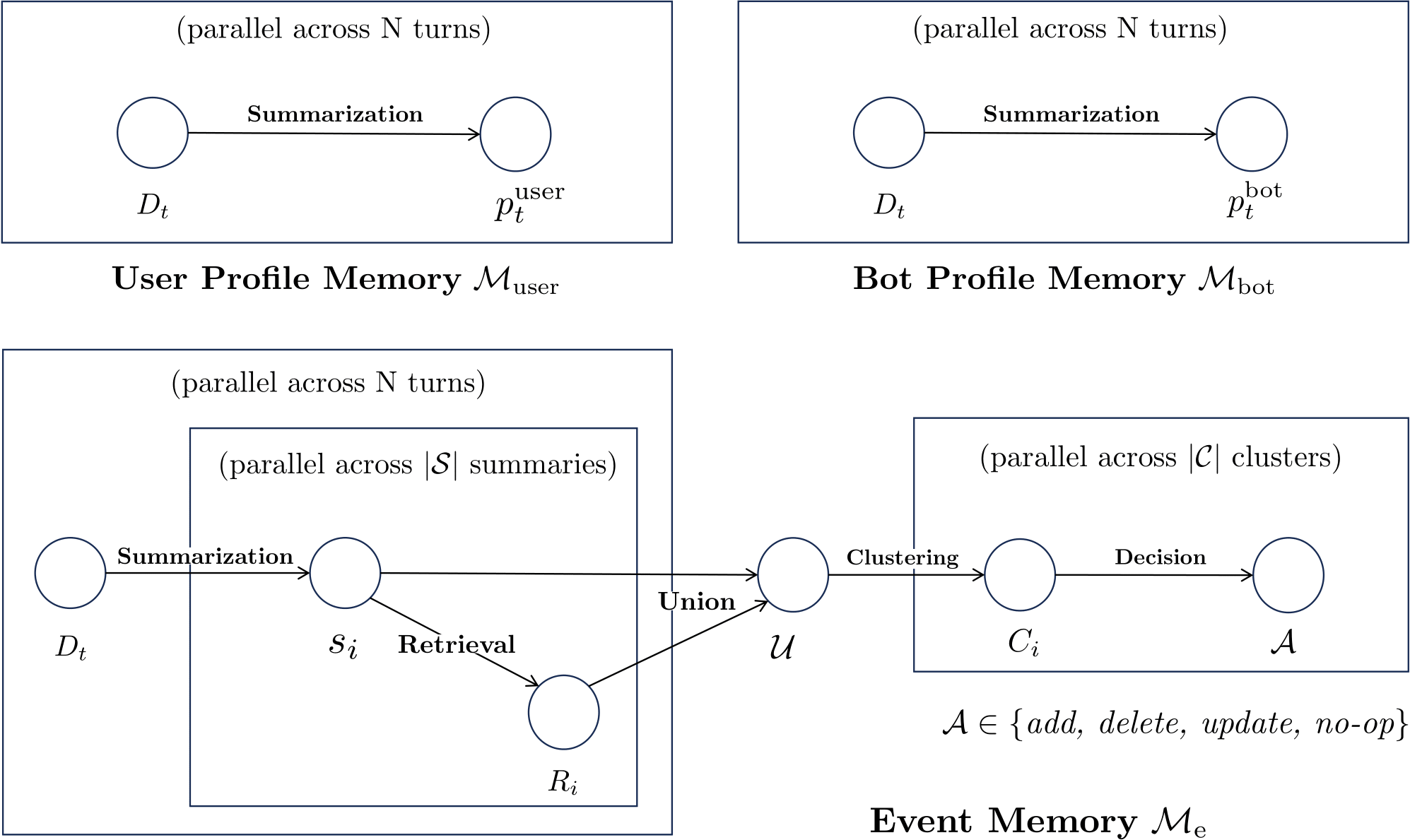
TeleMem enables conversational AI to maintain stable, natural, and continuous worldviews and character settings during long-term interactions through a deeply optimized pipeline of character-aware summarization → semantic clustering deduplication → efficient storage → precise retrieval.
Features
- Automatic memory extraction: Extracts and structures key facts from dialogues.
- Semantic clustering & deduplication: Uses LLMs to semantically merge similar memories, reducing conflicts and improving consistency.
- Character-profiled memory management: Builds independent memory archives for each character in a dialogue, ensuring precise isolation and personalized management.
- Efficient asynchronous writing: Employs a buffer + batch-flush mechanism for high-performance, stable persistence.
- Precise semantic retrieval: Combines FAISS + JSON dual storage for fast recall and human-readable auditability.
Applicable Scenarios
-
Multi-character virtual agent systems
-
Long-memory AI assistants (e.g., customer service, companionship, creative co-pilots)
-
Complex narrative/world-building in virtual environments
-
Dialogue scenarios with strong contextual dependencies
-
Video content QA and reasoning
-
Multimodal agent memory management
-
Long video understanding and information retrieval
TeleMem vs Mem0: Core Advantages
Related MCP Servers
Adoption & maintenance
Factual signals from GitHub, npm, and our automated checks — not a rating.
GitHub stars
492
Stargazers on the source repository.
Last commit
3d ago
Most recent push to the default branch.
Reviews
No reviews yet — be the first to share how this listing worked for you.
Frequently Asked Questions about Telemem
AllMCPs Directory Badge
Showcase your server listing on GitHub or your project documentation. Embed this dynamic SVG badge to highlight official listing status and live engagement.
Badge Style:
Live Dynamic SVG Preview
Markdown (GitHub README)
[](https://allmcps.com/mcp/telemem)HTML Embed
<a href="https://allmcps.com/mcp/telemem"><img src="https://allmcps.com/api/badge/telemem?style=directory" alt="Telemem on AllMCPs" /></a>Technical Specs & Signals
CategoryKnowledge & Memory
11/15 checks healthy over the last 46d
47Quality signal: Fair · 47/100How this signal is calculated ▾
Server availabilityNot measured
Not scored for repo-hosted servers — we can't reach the running server, only its GitHub page. Hosted MCP endpoints are health-checked live.
Verified ownership10/20
Documentation & tools16/30
Adoption & activity9/15
Community engagement0/10
A guidance signal from public completeness & health data — not a user rating. New listings start lower and rise as they add docs, get verified, and grow adoption. Signals we can't observe for a listing are skipped, not counted against it.
Supply-chain signal
No high-severity advisories surfaced by our automated scan.
Critical 0High 0Medium 0Low 0
Scanned 2d ago via OSV.dev · telemem (PyPI)
Own this project?
This directory is pre-filled from public sources. Claim via GitHub README, site badge, or DNS TXT to unlock edit access and the Official badge — proof is checked automatically, then reviewed by our team.
Free dofollow backlink: add your website and place the AllMCPs badge on it — no claim needed. We detect it automatically and keep it verified as long as the badge stays live.
Claim & get free dofollowShare & Embed
Add our SVG badge (dark/light directory styles) or embeddable widget to your site.