Telcoladder README
The full upstream README, mirrored here for reference. Install config, tool schemas, adoption signals, and an original overview live on the Telcoladder listing page.
TelcoLadder
Deterministic 5G / 4G / IMS signalling analyzer and call-flow correlator.
The correlation and root-cause layer on top of tshark: one subscriber across
every interface, every failure explained from a verified cause table, and
nothing generated.







For core-network SRE and R&D, RAN/core interoperability test, and third-line troubleshooting at vendors and operators. It assumes you already read signalling for a living.
What you get
Two outputs from one analysis. Mermaid you can paste into a ticket:
That is real output from tests/fixtures/ki-mismatch, not an illustration: a UE
provisioned with the wrong key, captured on a local Open5GS testbed. It is
not the MAC failure you would expect — a UE whose K does not match computes
an AUTS the network cannot resynchronise from, so you get #21 and then a bare
#111. The cause table says so because we ran it, not because it sounded right.
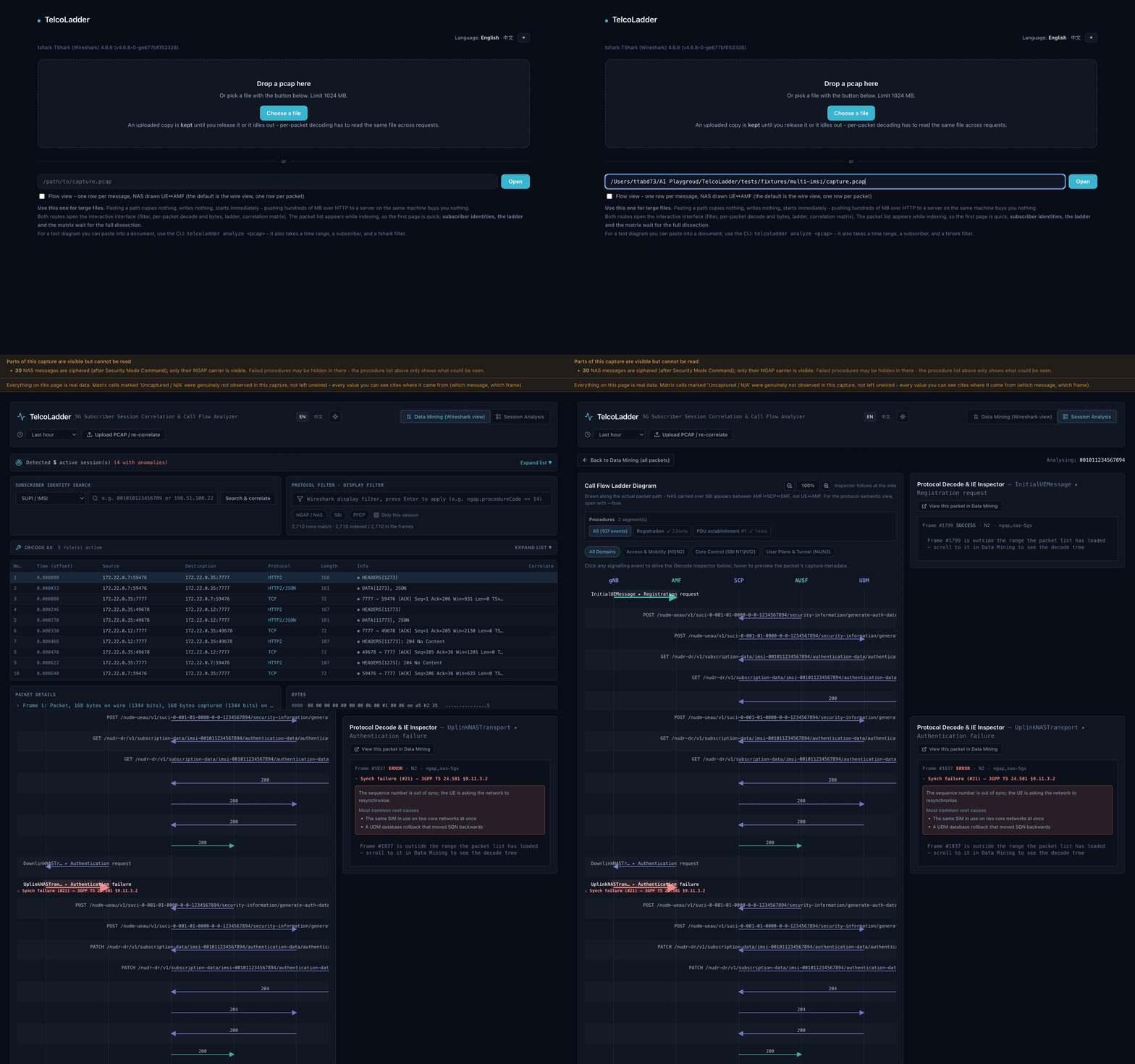
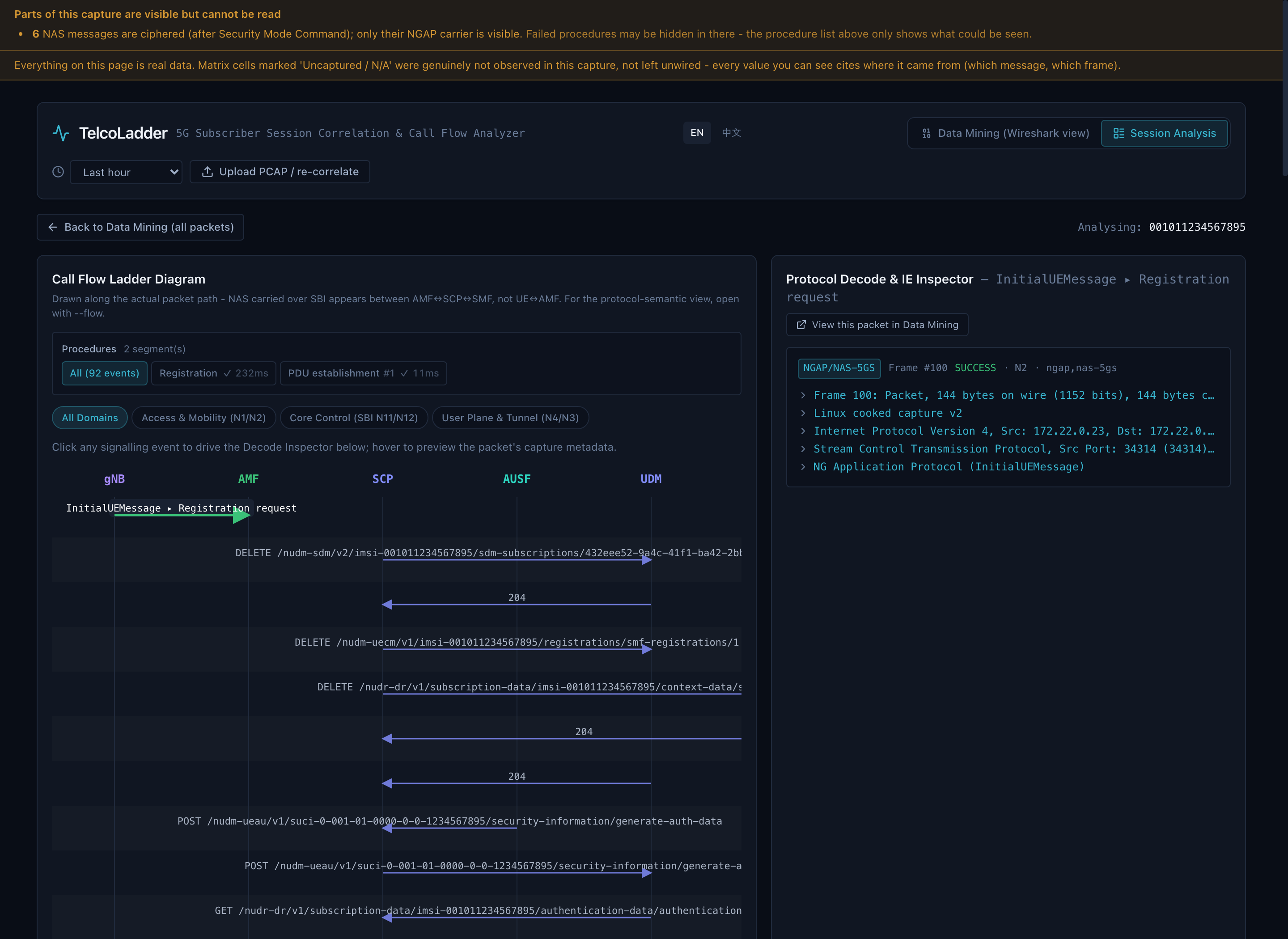
And the same capture in the browser: a packet list driven by real tshark
display filters, per-frame decode tree and bytes, the ladder with the initiator
and the cause on every failing event, and a per-PDU-session matrix where every
cell cites the frame it came from.
What it reads
| Generation | Protocols | Cause explanations |
|---|---|---|
| 5G core | NGAP, NAS-5GS, HTTP/2 SBI, PFCP, GTP-U | 206 |
| 4G / EPC | S1AP, NAS-EPS, GTPv2-C (S11, S5/S8, N26), SGsAP (SGs) | 236 |
| IMS | SIP (calls, KPIs), Diameter, H.248/MEGACO | 333 |
Every cause code is resolved through a hand-verified table to the specification
it comes from, what it means in plain language, and the root causes that
actually produce it in the field — 775 of them, every name taken verbatim
from tshark and re-checked against it by a test. Nothing is generated: a cause
the table does not carry is reported as not catalogued, and a clause number is
printed only where a person transcribed it. Every network function is named
rather than shown as an IP, with the evidence for that name on hover.
The pain, and what replaces it
| Today | With TelcoLadder |
|---|---|
| Copying UE IDs by hand between windows to follow one subscriber | One subscriber's whole lifetime in one flow: SUPI, 5G-S-TMSI, NGAP and S1AP UE IDs, TEIDs, Call-ID — with keys that are recycled treated as recycled |
| N2 and SBI in separate captures that never line up | N2, SBI and N4 stitched on one timeline; N4 joins through the GTP-U tunnel endpoint the UPF allocated and NGAP relayed |
| An N26 handover spread across NGAP, N26, S11 and S1AP | One segment across all four, joined through the S1-U SGW F-TEID the MME copies from Create Session Response into HandoverRequest |
| A bare cause number and a trip to the spec | 775 causes with the specification named, plain language and field root causes; clauses where a person checked them |
| RAN and core blaming each other for a dropped context | Every UE context release marked requested by the RAN or ordered by the core — a wire fact, not an opinion |
| A procedure that stalls for no visible reason | The gap named when it matches a NAS timer's default (T3560, T3460 …), and failures counted by TAC, cell, DNN and core element |
| VoLTE Gm signalling hidden inside IPsec ESP | NULL-encrypted ESP is detected and decoded, so the SIP and SDP inside join the subscriber's ladder. ESP that is really encrypted stays unreadable and is counted, not guessed |
| A B2BUA (an AS, or an SBC that keeps the charging ID) changes the Call-ID, so one call shows up as unrelated dialogs | Legs that share a charging ID (ICID) and overlap in time are one call, end to end — H.248, HSS, charging and ENUM attached only where evidence ties them to that call |
| Customer captures that must never leave the building | A command on your machine: no network listener beyond 127.0.0.1, no telemetry, no cloud, no model |
Quickstart: five ways in
Windows without Python? Skip
pipand jump to 4. Windows, no install — the only prerequisite is Wireshark.
4. Windows, no install. A standalone executable in a portable zip, built by CI from the tagged source. Nothing is installed and no registry key is written; it needs Wireshark 4.0 or newer on the machine, nothing else.
- Download and unzip. Get
TelcoLadder-Windows-x64.zip(about 10 MB) from the Releases page. - Double-click
check-environment.cmd. It findstshark.exein Wireshark's default install location under Program Files — or whereverTELCOLADDER_TSHARKpoints — and checks the dissectors. - Run it from that folder.
servelistens onhttp://127.0.0.1:3005: open it in your browser, drop a capture (up to 1 GB), or paste a path for anything larger.
5. Hand a capture to someone else. telcoladder anonymize in.pcap out.pcap
rewrites subscriber identities, addresses, hostnames, PLMN and cell identifiers
into keyed pseudonyms of the same length — TBCD, ASCII, JSON and HPACK-Huffman
alike — recomputes every checksum, then re-reads its own output and refuses to
keep it if any original value is still visible. The output walks the same
pipeline to the same procedures, roles and failures; only the names differ.
Same key, same pseudonyms across captures; the key is printed once and never
written down. Compressed HTTP/2 bodies cannot be rewritten in place and are
refused unless --blank-opaque-bodies.
Requires Python 3.11+ and tshark (Wireshark 4.0 or newer) for the pip
route. Neither the macOS nor the Windows installer puts tshark on your PATH;
TelcoLadder looks in the standard install directories and finds it anyway, or
takes TELCOLADDER_TSHARK. The venv-by-venv Windows walkthrough is in the
user guide.
Five things it does that a decoder does not
Cross-interface correlation. A subscriber is a union of identity keys, each with the right scope: NGAP and S1AP UE IDs are unique only within one association, TEIDs and TMSIs are reallocated and treated as episodes, and the GTP-U tunnel endpoint is one definition shared by NGAP, PFCP, GTP-U and now S1AP. The failure mode of a wrong key is two people in one flow with a ladder that still renders, so the key shapes are tested against captures built to provoke exactly that.
775 verified causes. Names from tshark -G values, re-checked by tests on
every CI platform; two Diameter number spaces kept apart; NGAP and S1AP cause
groups looked up in the group the message selected. Ordered-sequence rules
written by people — #21 followed by #111 is a key mismatch, not a sequence
problem — are matched and reported with the frames.
Fault attribution. UEContextReleaseRequest is only ever sent by the RAN
and the release Command only by the core; the ladder, the procedure list and
the xDR say which one started it. The reason still comes from the cause table;
there is no second verdict string.
Timer match and blast radius. An unanswered network request followed by a
release or reject a timer's default later is reported as consistent with that
timer — never as a proven timeout, because the capture shows timing and not the
AMF's state. With several subscribers, failures are counted by TAC, cell, DNN
and core-side element; an unknown location is a null row, not a dropped one.
Air-gapped by construction. serve binds 127.0.0.1 and checks the Host
header; the MCP server is stdio only; the browser bundle ships in the package
and loads nothing from the network; there is no telemetry and no model. What
the tool could not read — ciphered NAS, ECIES-protected SUCIs, TLS on SBI,
frames no dissector claimed — is counted and stated before any conclusion.
Three scenarios from the test captures
Each of these is a fixture in tests/fixtures/ you can run yourself.
- A key mismatch that does not look like one —
ki-mismatch. Synch failure (#21) then a bare protocol error (#111). The sequence rule in the cause table names the real cause and says what does not fix it: resetting the SQN.telcoladder summarize tests/fixtures/ki-mismatch/capture.pcap - A context released 6.000 s after an unanswered Authentication request —
5gc-context-release. The release is marked as ordered by the core, and the gap is reported as consistent with T3560's default. The second subscriber in the same file is released at the gNB's request after the radio link was lost, and is marked as such. - A 5GS → EPS handover the target eNB refuses —
n26-handover. Five elements on one ladder; the failure appears three times on the wire (S1AP HandoverFailure, the N26 Forward Relocation Response, the NGAP HandoverPreparationFailure) and is explained once, from the S1AP table, with the specification named and no clause invented.
What it does today
- Reads all three generations from one
pcap/pcapngviatshark. - Names the network functions and shows the IP when the evidence is ambiguous rather than guessing. Relays — a 5G SCP, a Diameter DRA, a SIP proxy — keep their own lane and are never credited with the services behind them.
- Correlates one subscriber across identifiers and across protocols, with the scopes described above. On a production trace with TLS on SBI and ECIES-protected SUCIs the N2 side still forms its own per-UE flow; what could not be read is counted and reported, not silently dropped.
- Splits a subscriber's traffic into scenarios — registration, attach, PDU session, service request (UE- or network-triggered), dedicated bearer setup, modification and release, deregistration, handover (including one that was cancelled, which is not a failure), idle mobility, IMS registration and call — each with outcome, cause, first failure, duration, and where applicable the initiator, the matched timer, or the handover preparation and execution times. The axis is what the subscriber was doing, not which protocol carried it: the S6a exchange inside an attach is part of that attach, the context release that ends a scenario is part of that scenario (its initiator and cause travel with it, and the xDR still lists the release as a row of its own), and an HSS answer of "unknown user" is that attach's failure. A Diameter exchange that belongs to no scenario stands on its own as an HSS-initiated one — under 4G for S6a/Gx and under IMS for Cx/Sh, which the Application-Id decides.
- Reads Diameter through the DRA: S6a/S6d, Cx/Dx, Sh, Rx, Gx, SWx and S6b, roles from who initiates which command, a request seen on both sides of a relay shown as one transaction with two hops, a relayed failure counted once.
- Treats a SIP call as a procedure with time to ring, to answer and talk
time, who released it and why, and a busy or declined callee as
ended-by-userrather than a failure — a classification that lives in the cause table, not in code. - Exports procedure records (
--xdr) and a pinned-field JSON summary, both byte-for-byte reproducible, sojqcan answer "what is the failure rate across this batch". - Speaks English or Traditional Chinese (
--lang zh_TW, or the switch in the browser), deliberately never the system locale: the same command must print the same words on two machines, because output gets pasted into tickets. - Needs to be told about non-standard ports. A capture that starts after
the TCP connections are up has no HTTP/2 preface for
tsharkto find; adapters declare the common cases and--decode-ascovers the rest.
On a large capture, narrow before you draw:
Whatever narrowing could not reach is listed explicitly, never silently
dropped. Dissection runs at roughly 0.19 s/MB and is linear (a 145 MB, 780k-frame
file in 28 s on one machine); tshark output is streamed, so memory follows the
messages kept rather than the file size.
Prior art, and why this exists anyway
These tools came first and are worth your time. TelcoLadder is not trying to replace them.
| Project | What it does | Why TelcoLadder still exists |
|---|---|---|
| telekom/5g-trace-visualizer | pcap → SVG sequence diagrams for 5GC (HTTP/2, NAS, PFCP). Deutsche Telekom, Apache-2.0. | Unmaintained since Aug 2023. PlantUML output needs plantuml.jar; driven from Jupyter notebooks with a large config surface aimed at k8s deployments. |
| irontec/sngrep | Excellent, actively maintained ncurses SIP flow viewer. | Terminal-only and SIP-only — you cannot paste its output into a document, and it does not touch 5G. |
| sipcapture/homer | Full capture platform: server, agents, database, web UI. | It is infrastructure you deploy and operate. TelcoLadder is a command you run against one file. |
| dgudtsov/pcap2uml | IMS call flows across SIP/Diameter/MAP/CAMEL → PlantUML. | The closest in spirit. No 5G support (no NGAP/NAS-5GS), PlantUML output. |
| agranig/pcap2mermaid | SIP → Mermaid, in Perl. | Two days of commits in January 2019, then nothing. It proved people want this; nobody picked it up. |
What none of them do together: 5G and 4G and IMS in one correlated diagram, Mermaid as the output, and a verified explanation of what went wrong.
Honest limitations
- SBI is verified against exactly one deployment, Open5GS with an SCP, and
only for null-scheme SUCIs and cleartext h2c. Production SBI is usually TLS:
those frames are counted in not visible, per port.
tsharkpreferences pass straight through (--tshark-pref tls.keylog_file:…), so a key log can be supplied as in Wireshark, but no TLS fixture exists here and that path is not covered by the tests. N2 is unaffected either way. - A fully transparent SCP that sends no
3gpp-Sbi-Target-apiRootis indistinguishable from the endpoint and falls back to an unlabelled IP. The correct failure direction, and a real gap. - Diameter covers seven interfaces with roles and curated causes (S6a/S6d, Cx/Dx, Sh, Rx, Gx, SWx, S6b); the rest — Rf included — decode and show their Application-Id with no role inference. Every Diameter fixture is written from RFC 6733, not captured: TCP only, no SCTP, invented timing.
- Four behavior rules have no capture behind them. S10 inter-MME handover, the Xn/X2 path switch, CS fallback and the Cx authentication delay inside a call are written from message names and covered only by synthetic tests; how they read a real capture is unmeasured. The chain shown before a failure is the order of messages within one segment, not proven causation.
- SIP alone does not name the core proxies. The UE and the P-CSCF come from
Gm itself — the security-agreement headers, or which address holds IPsec
associations with several peers, falling back to a
Contactthat carries a subscriber identity; an I-CSCF, S-CSCF or AS is named only when its Cx or Sh exchange is in the same capture. Gm is the only SIP reference point labelled — Mw and ISC are not, because no capture here has verified them. H.248 gets neutralMGC/MGWroles and no reference point, because the protocol alone cannot say whether it is Iq, Mn or Mp. - Calls and numbers join only on evidence. B2BUA legs become one call only
when they share a charging ID (ICID) and overlap in time — a B2BUA or SBC
that replaces the ICID leaves separate rows. A number joins HSS, charging and
ENUM records only in international form; a local-form number is never
completed with a guessed country code. VoLTE, VoNR and VoWiFi are shown only
where
P-Access-Network-Infodeclares them; without that header the access is reported as not declared. - Only 9 of the 21 cause tables cite a clause. The other 12 name the specification and stop. An absent clause is better than a wrong one.
- The 4G, IMS and handover fixtures are written byte by byte with
tsharkas the oracle: exact about the protocol, silent about any real deployment. Eachscenario.mdlists what its fixture cannot prove. UE radio capability is not parsed: the NR and LTE RRC containers are skipped during extraction because dissecting them is slow, and stay readable in the per-frame decode tree. - NAS after Security Mode Command is encrypted and its content is invisible; the packets still appear as their NGAP carrier. The same holds for IPsec ESP on Gm: only NULL-encrypted ESP is read, and encrypted ESP is counted as unreadable. GTP-U joins the subscriber but carries no throughput or loss KPIs; there is no RTP adapter; ISUP and CAMEL are recognised but not read.
- Joins through a tunnel an SBI message quotes are inferences. They bind by direction, inside a time window, never across a release, and never where they would give one flow two SUPIs; the summary counts each one. What remains: a stale forwarded quote that arrives after its tunnel was released, where the UPF reused that exact TEID within 10 s for a UE whose flow shows no SUPI, could still be joined. On a single capture point that order violates the protocol.
- Mermaid gets slow with very large flows. Use
--max-messages; truncation is always stated inside the diagram. anonymizeproves absence only for what tshark can name. Identities it never decoded stay where they are; TLS payloads are opaque; gzip bodies and bodies reassembled across DATA frames are refused rather than guessed at; IPv6 text and binary forms, and TAC text and binary forms, are pseudonymised independently. The report lists every one of these.
How it is verified
A flow missing three messages looks exactly like a correct one, so the suite
cross-checks against tshark as an independent oracle rather than only
asserting on its own parse: message counts, procedure and message names, every
cause table, and the identity keys of the fixtures built to provoke a wrong
merge. New tests are mutation-checked — the code is broken on purpose and the
test must go red. Every push runs the full suite on Python 3.11, 3.12 and 3.13
on Linux with tshark 4.2, and on macOS and Windows with tshark 4.6; the badge at
the top is live. What the badge does not cover is named at the top of
.github/workflows/ci.yml.
Air-gapped by construction
There is no network path out of this tool. The analysis is a child tshark
process reading a file; serve binds the loopback address only and refuses
other Host headers; the MCP transport is stdio; the browser bundle is packaged
with the code and references no external resource; nothing phones home and no
model is involved anywhere in the pipeline. Uploaded captures are kept in the
system temp directory with mode 0600 until released or idle-expired, and for
anything large you paste a path so nothing is copied at all.
Going deeper
The engine — streaming architecture and its measured throughput, the identity model and key recycling, the cause library and its oracle discipline, the N26 stitching, release attribution, timers — is written up in docs/deep-dive.md. The operating guide for real captures is docs/user-guide.md; the contract for adding a protocol is docs/plugin-contract.md; the contract for an agent using the tool is AGENTS.md.
Contributing, and reporting problems
CONTRIBUTING.md is short. It has two rules that matter
more than anything else in it: no real subscriber or customer data, anywhere,
and every spec clause is verified by a human, never generated.
Found a vulnerability? SECURITY.md — not a public issue.
License
PolyForm Noncommercial License 1.0.0. See LICENSE.
Free for personal, non-commercial, and educational research use. Commercial deployment, commercial distribution, or embedding into for-profit offerings requires a separate commercial licence: open a GitHub issue titled "Commercial licence" or contact the maintainer through the repository, and expect a reply on terms rather than a form.
Release 0.1.0 was published under Apache-2.0 and remains available under those
terms. Third-party material keeps its own licence: the browser bundle's
dependencies (MIT/ISC, listed in NOTICE) and the http2-multistream
fixture (Apache-2.0, Deutsche Telekom).