Tariff Resolver README
The full upstream README, mirrored here for reference. Install config, tool schemas, adoption signals, and an original overview live on the Tariff Resolver listing page.
tariff-resolver







An MCP server that turns your AI assistant into a US import duty research tool — built on official USITC Harmonized Tariff Schedule data (US Government public domain, 35,000+ tariff lines).
- 🔍 HTS code candidates from plain product descriptions, with CBP CROSS ruling links
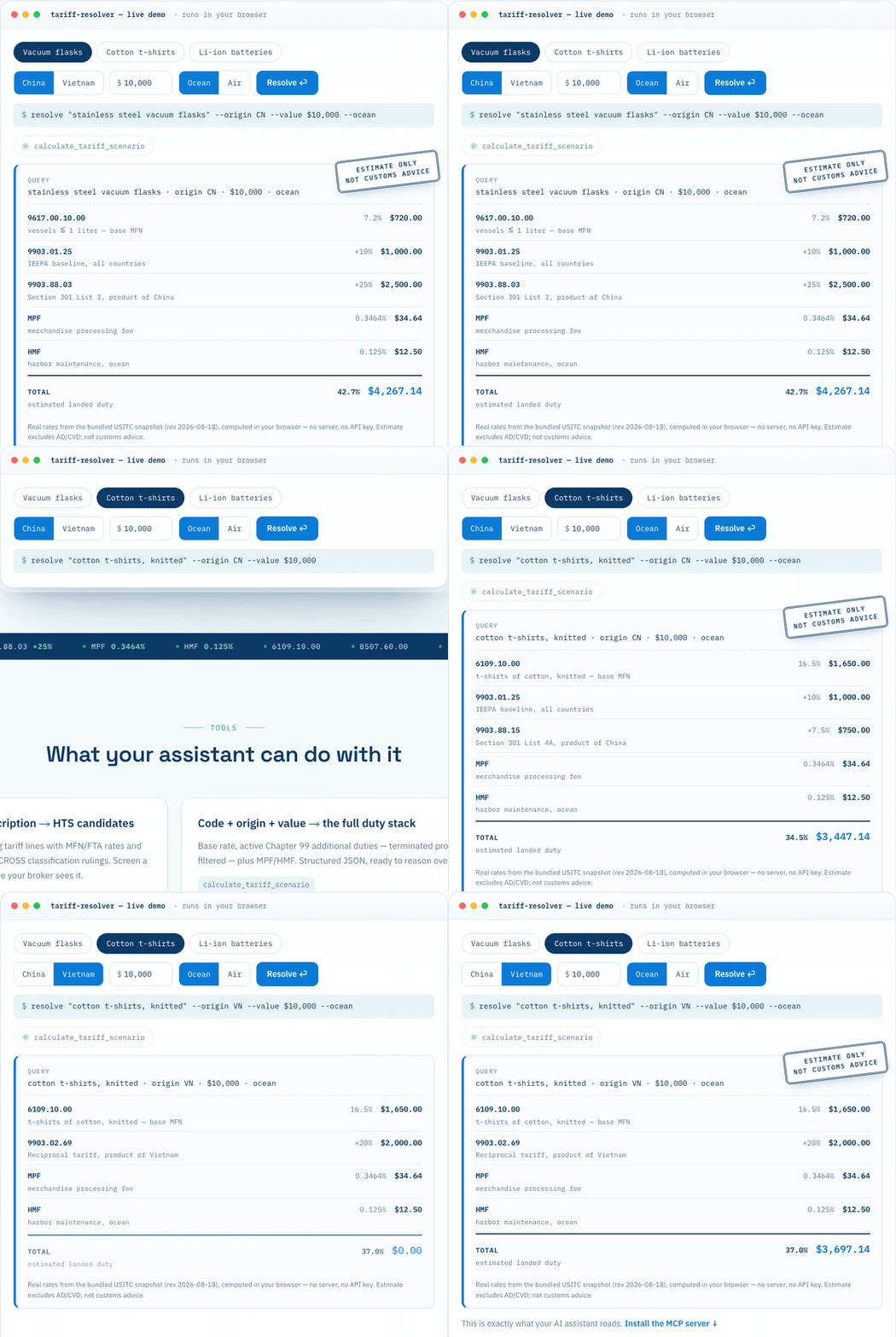
- 🧮 Landed-cost components: MFN/FTA base rates + Chapter 99 additional duties (IEEPA / Section 301 / 232) + MPF/HMF fees
- 📡 Tariff change tracking: watchlist your HTS codes, diff rates between HTS revisions
- 🤖 AI-optimized, hallucination-resistant: returns the actual Chapter 99 rule text with parsed rates, so your LLM reasons over real exception chains instead of inventing 2024-era numbers
Why now: since the de minimis exemption ended (Aug 29, 2025), every US-bound shipment needs an HTS code and duty payment — and 2025–26 rates keep changing by executive order.
Not affiliated with any government agency. Outputs are candidates/estimates for pre-broker screening — not customs, legal, or tax advice. Estimates exclude AD/CVD duties.
Install
Requires Node.js ≥ 18.
Or in any MCP client config:
Claude Desktop (one-click): download tariff-resolver-<version>.mcpb from Releases and double-click it — no terminal needed.
💡 Try these prompts
- Basic search: "Find the HTS code for a men's 100% cotton t-shirt."
- Full scenario: "Calculate the tariff scenario for HTS 6109.10.00, origin China, customs value $5,000, ocean freight."
- Sourcing decision: "I'm importing $10k of stainless steel vacuum flasks. Compare landed cost if I source from China vs Vietnam."
- Stay current: "Watch tariff changes for my catalog: 6109.10.00, 8507.60.00, 9617.00.10."
Tools
| Tool | What it does |
|---|---|
search_hs_candidates | Product description → top HTS candidates with rates + CBP CROSS ruling links |
calculate_tariff_scenario | HTS code + origin + value (+ weight) → structured JSON: base MFN/FTA rate, candidate Chapter 99 layers with per-layer match/confidence, sourced possibly_expired bucket, MPF/HMF |
watch_tariff_changes | Register HTS codes to a local watchlist |
check_tariff_updates | Diff current vs previous HTS revision — see exactly which rates changed |
dataset_info | Data revision date, row counts, source, license |
Design
The server does the retrieval; your LLM does the reasoning. Chapter 99 rules are returned verbatim (with parsed adder_pct where applicable) so the model reads the actual exception chains instead of trusting a black-box calculation. Rates for 10-digit statistical suffixes inherit from their parent rate line. Headings the schedule marks as dead — terminated, suspended, expired — are filtered out and counted, and the USITC's own compiler_note rides along with any rule that carries one.
Status overrides. data/status_overrides.json is a short, sourced list of Chapter 99 headings whose collection has stopped, expired, or been suspended even though the schedule still prints them. A layer matching an entry is returned under possibly_expired with the entry's status, reason, source URL and as_of date instead of in layers. Every entry carries a CBP, Federal Register or USITC source; pull requests adding entries must include one.
What the data cannot tell you. The published schedule is wrong in both directions at any given moment, so every result carries a stacking_warning and the snapshot date. Provisions whose collection has already stopped keep printing with no end date — IEEPA and Section 122 headings are the recurring case — and newly proclaimed actions appear in the schedule days after they take effect. Totalling every layer the schedule prints yields a rate nobody is charged. Treat the layers as candidates, and verify collection status against CBP CSMS messages before relying on a stack.
One core, two front doors. All duty logic lives in tariff-resolver/core (pure TypeScript, no filesystem or network): resolveDuty(dataset, { hts, origin, value_usd?, ocean? }) — origin takes an ISO-3166 alpha-2 code or an English country name — returns the base line, separate MPF/HMF, every candidate Chapter 99 layer with match and confidence, a sourced possibly_expired bucket, and the snapshot date. The MCP tool calls it; so can any Node or edge runtime. A country name that is not recognised returns the ORIGIN_UNKNOWN error rather than a partial match, so a misspelled origin can never quietly resolve to a thinner stack of layers.
Data
Ships with a full HTS snapshot, fetched from USITC's official JSON API (US Government public domain). Refresh anytime:
dataset_info reports the revision date your queries run against.
Privacy Policy
tariff-resolver runs entirely on your machine and collects nothing:
- Data collection: none. No queries, telemetry, analytics, or usage data are collected or transmitted.
- Usage and storage: your watchlist is stored in a local JSON file on your machine; all lookups run against the bundled local dataset.
- Third-party sharing: none. The server makes no network requests at runtime. (The optional
scripts/fetch_hts.pyrefresh script contacts only the official USITC API.) - Data retention: nothing to retain — delete the local watchlist file at any time.
- Contact: tom@opsloft.dev
Full policy: https://opsloft.dev/privacy
License
MIT. Tariff data is a work of the US Government (public domain).