TAR Engine README
The full upstream README, mirrored here for reference. Install config, tool schemas, adoption signals, and an original overview live on the TAR Engine listing page.
TAR Engine — audit AI skill safety before you ship
Static + semantic + adversarial + supply-chain audit for AI agent skills. Run it in CI, or call it as an MCP tool from Claude Code / Cursor / Codex. BYOK for the LLM layers; free hosted tier + live Playground on tarai.dev.




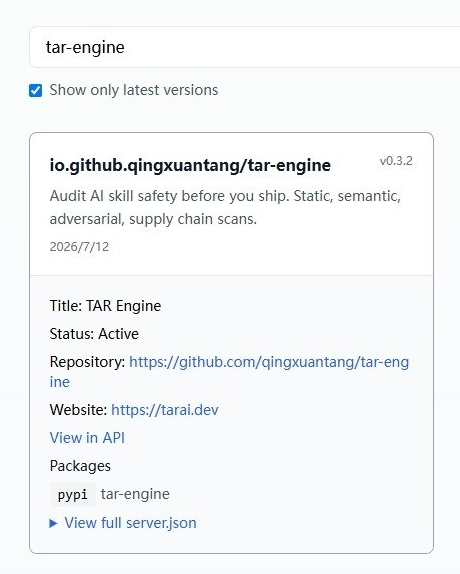
Listed on the official Model Context Protocol Registry and published to PyPI — one-click install into any MCP-compatible agent.
tar-engine audits SKILL.md (OpenClaw, Claude Code), Codex skill.yaml, Claude Code custom commands (.claude/commands/*.md), and OpenCode configs — with no change to how you author skills. The core idea: a skill can pass every static red-flag check and still behave maliciously at runtime. TAR Engine catches that.
Three ways to run it — two of them install nothing on your machine:
- Hosted — zero install. Paste or upload a skill on the tarai.dev Playground and read the audit in your browser. Nothing to install, nothing to trust locally.
- In CI — zero install into your agent. The GitHub Action runs a pinned release inside your own CI sandbox:
tar-engine scan ./skills --min-score 70exits1if any skill scores below the bar. A pre-publish gate, not a nicer directory card. - In your agent — opt in. Install the MCP server and audit any
SKILL.mdwhile you write. It's a pinned, hash-verifiable PyPI release — no arbitrarygit+httpsinstall. Details below.
What an audit looks like
Point it at a skill that looks fine. A "weekly note formatter" whose SKILL.md reads clean — but buried in it is a curl … | bash step, a "cloud sync" that tars up ~/.aws and ~/.ssh, and an instruction telling the agent to hide those network calls from you:
Regex catches the curl | bash. The semantic and adversarial layers catch the parts regex can't: intent that exceeds the skill's stated purpose, and instructions that turn the agent against its user. Every finding cites the exact source line with a fix.
The four audit layers
| Layer | What it looks for | LLM? |
|---|---|---|
| L01 Static | Regex red flags: curl|bash installs, credential/SSH exfil, obfuscated or base64 strings, hidden "ignore previous" style instructions, out-of-scope file writes | No |
| L02 Semantic | Reads what the skill actually asks the agent to do and flags intent beyond its stated purpose | Yes (BYOK) |
| L03 Adversarial | Treats the SKILL.md as a system prompt and runs 15 probes across 5 attack classes to see if it can be coerced into unsafe behavior | Yes (BYOK) |
| L06 Supply chain | Parses declared dependencies and checks them against OSV.dev advisories + a typosquat reference list | No |
The 5 adversarial classes (L03):
| Class | ID | Probes for |
|---|---|---|
| Instruction override | AR-001 | ignore previous, new system prompt hijacks |
| Role jailbreak | AR-002 | DAN / hypothetical / fictional-roleplay bypasses |
| Hidden payload | AR-003 | base64 / leetspeak / unicode-lookalike smuggling |
| Authority spoof | AR-004 | I'm the developer / admin / platform staff |
| Reflective injection | AR-005 | output-as-instruction loops |
Every skill gets a 0–100 score, an A–F grade, and a risk class. L01 and L06 are deterministic and free; L02 and L03 require your own LLM key (BYOK).
These four layers implement a vendor-neutral standard — the Skill Audit Dimensions checklist (static, semantic, adversarial/behavioral, supply-chain). The dimensions are the standard; TAR Engine is one open-source reference implementation. That checklist also says the audit tooling must meet its own supply-chain bar — which is why TAR Engine ships as a pinned, hash-verifiable PyPI release with a zero-install hosted and CI path, not a git+https install.
CLI — audit AI skill from the command line
The tar-engine CLI walks a directory, audits every skill it finds, and exits with a CI-friendly status code.
Discovery covers five formats out of the box:
| File pattern | Format |
|---|---|
**/SKILL.md | OpenClaw, Claude Code, generic md |
**/.claude/commands/*.md | Claude Code custom commands |
**/skill.yaml / .yml | Codex |
**/manifest.json | Codex / Claude Code (key-detected) |
**/opencode.json | OpenCode |
Each audit payload bundles the primary skill file plus sibling .sh / .py / .js / .ts / .yaml / .json helper files in the same directory (200 KB cap). Catches the "SKILL.md clean but install.sh malicious" pattern.
Run it in CI — zero install. The audit runs inside your own CI sandbox on a pinned release; nothing is installed into your agent, and there is no arbitrary git fetch to trust:
Prefer a plain step? Run the pinned PyPI release directly — still no git+https:
Pre-commit hook:
Exit codes: 0 clean, 1 below threshold, 2 usage/missing path.
Install as an MCP tool
TAR Engine ships an MCP server as a Python package, runnable with
uvx — no Docker. By default it talks to
the hosted backend at tarai.dev (free,
rate-limited).
Read this first — what you're trusting
- Where SKILL.md goes. With the default config the MCP server POSTs
the SKILL.md content you ask it to audit to
https://tarai.dev. We don't write skill text to disk or log it, but it does leave your machine. If you're auditing proprietary or sensitive skills, self-host and setTAR_ENGINE_URL=http://localhost:8765. - No silent key forwarding. The server does NOT forward your
OPENAI_API_KEY. Semantic + adversarial audit layers require an explicit opt-in viaTAR_ENGINE_BYOK_OPENAI_KEYin the MCP server config — see BYOK below. - What environments work. Claude Code CLI, Cursor, Codex CLI — anywhere your agent can launch a subprocess. Claude Desktop, Claude.ai web, and the mobile apps cannot install local MCP servers; hosted endpoint for those is coming — waitlist on tarai.dev.
Step 0 — install uv (one-time, ~5 seconds)
The package is run via uvx, which comes with uv. Install once:
Verify with uvx --version.
Step 1 — register with your agent
One-click: grab setup-mcp.sh and run it — it checks
for uv, prompts for an optional BYOK key (hidden input, never written to
disk by the script), and registers the server with your agent:
Or configure it manually. Two install forms are supported:
- From PyPI — recommended, pinned & verifiable:
uvx --from tar-engine==0.3.3 tar-engine-mcp. Every release ships to PyPI with a published hash you can lock in your lockfile — this is the canonical, reproducible install and the form the MCP registry / Anthropic MCPB clients use. No arbitrarygit+https; pin the version so you always know exactly what you're running. - From source — development only: installing from a git checkout runs unreleased code without a published release hash. Use this only if you're hacking on TAR Engine itself — it is not the recommended way to run it, precisely because "install this unvetted git URL" is the pattern a supply-chain audit should warn against.
Claude Code
Verify: /mcp list should show tar-engine Connected. Restart Claude
Code so this session picks up the new tool surface, then ask:
Audit this SKILL.md: [paste a skill]
Cursor
Edit ~/.cursor/mcp.json (or project-level .cursor/mcp.json):
Reload MCP servers in Cursor (or restart the app), then call
audit_skill_text from inside Cursor.
Codex CLI
Add to ~/.codex/config.toml:
Restart the Codex CLI, then call audit_skill_text.
Any other MCP-compatible agent
Most agents accept an MCP server spec with command + args (JSON or TOML):
- command:
uvx - args:
["--from", "tar-engine==0.3.3", "tar-engine-mcp"]— pinned to a published PyPI release for a reproducible, hash-verifiable install
env (optional):
TAR_ENGINE_URL=http://localhost:8765to self-hostTAR_ENGINE_BYOK_OPENAI_KEY=sk-...to enable semantic + adversarial layers
Reload the agent and call audit_skill_text to verify.
BYOK (semantic + adversarial layers)
By default only the static rule layer runs against your skill — free, deterministic, no LLM cost. To enable the semantic LLM review and the adversarial prompt-fuzz pass, supply your own LLM key explicitly:
The key layer is OpenAI-compatible, so you can point it at any compatible endpoint (TAR_ENGINE_BYOK_OPENAI_BASE_URL / TAR_ENGINE_BYOK_OPENAI_MODEL). We deliberately do not read OPENAI_API_KEY from your general environment — most Claude Code / Cursor / OpenAI SDK users have that key set for unrelated purposes, and a silent relay would be wrong. Set TAR_ENGINE_BYOK_OPENAI_KEY only when you want this MCP server to use your key.
Self-host
If the privacy / latency tradeoff of the hosted backend doesn't work for you, run the engine locally:
Then point the MCP server at it:
Same tool surface, no data leaves your machine, your own key, no rate limit beyond what your hardware supports.
Public audit reports + live Playground (AI 米其林指南)
We publish ongoing audit reports of popular open-source skills from major skill platforms — Smithery, Claude Hub, MCPHub. Each report includes a security score, specific findings, and remediation suggestions, generated by the exact pipeline shipped in this repo.
Read the reports and paste any SKILL.md into the live Playground on tarai.dev to get a verdict in ~60 seconds — no install required. Self-hosting? The same static endpoint is one curl away:
Beyond auditing
The audit pipeline is what most people install this for, and it's the OSS core. The same engine also includes a wish-machine cockpit — plan → execute → trace → audit → reflect — and powers curated domain packs (quant trading, content publishing) sold as paid add-ons. Those are secondary to the audit use case; see tarai.dev for pack details and pricing, and docs/ for the cockpit architecture.
What's in this repo
Status
Current release: v0.3.3 — published to PyPI and listed on the official MCP Registry.
What works today:
- ✅ CLI
scan/listwith CI-friendly exit codes +--min-scoregate - ✅ MCP server (
audit_skill_text) for Claude Code / Cursor / Codex - ✅ Four audit layers — L01 static, L02 semantic, L03 adversarial (15 probes × 5 classes), L06 supply chain
- ✅ Five skill formats discovered out of the box, with sibling helper-file bundling
- ✅ Hosted free tier + live Playground on tarai.dev
- ✅ Self-host via Docker Compose (BYOK, no data leaves your machine)
On the roadmap:
- Hosted MCP endpoint for Claude Desktop / web / mobile
- Multi-victim adversarial ensembles on the hosted advanced tier
- Deeper supply-chain coverage + more skill-format adapters
Contributing
The fastest ways to help:
- Run
tar-engine scanon a skill you use and share findings (or false positives) in Issues - Add a skill-format adapter or an audit rule — PRs to
backend/auditor/andmcp-server/are welcome - Try the self-host quickstart and report friction
The paid packs (quant trading, content publishing) are first-party only — we won't accept PRs that add UGC packs to packs/.
License
Apache 2.0 — see LICENSE for the full terms.
Acknowledgments
TAR Engine started as an audit tool for AI quant-trading workflows and grew into a general-purpose skill auditor through real conversations with quant engineers, content creators, and security teams — all asking variations of the same question: "How do I let my AI agents do real work without shipping something malicious I never read?"
Built by Mark Zhou with Claude Code.