Autonomous QA for iOS + web — agents get a deterministic ship/no-ship verdict, no test code
Quick Install
Automated & IDE SetupCopy the AI prompt to install this server into Claude Code, Cursor, or another agent — or use 1-click editor setup below.
Not yet automatically verified
We haven't yet run this listing's install command through our automated sandbox check. This isn't a red flag — we're steadily working through the catalog.
Manual Client & Custom JSON ConfigExpand JSON ▾
Client Config & Setup
Choose your client or environment
Target File:
💡 Paste the JSON block into your client's configuration file under mcpServers, then restart the application.
Documentation Overview
Tapp








Tapp lets coding agents verify UI changes on real iOS, Android, and web surfaces, then turns reviewed proof into deterministic CI checks. It can inspect and drive screens, explore for technical failures, and save important journeys as replayable tests.
Exploration reports findings, coverage, evidence, and limits. Only the repository-connected gate
returns pass, fail, or inconclusive. Tapp does not turn an autonomous crawl into a subjective
"ship-ready" score.
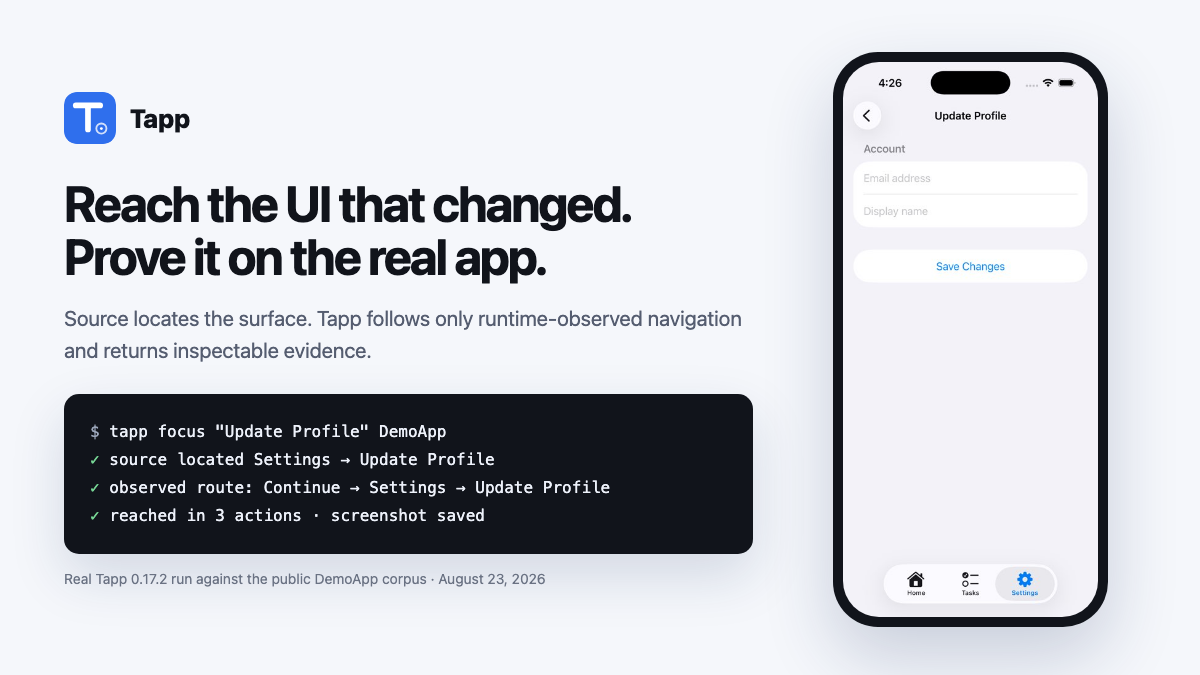
Real evidence, not a mock: this public DemoApp run reached the requested iOS surface in three observed route actions. Watch 45 seconds of autonomous exploration or inspect a complete sanitized web evidence report.
Supported targets:
| Target app | Runtime |
|---|---|
| iOS | Simulator on macOS with Xcode; driven through XCUITest and accessibility |
| Android | Connected emulator or device with adb; driven through UIAutomator |
| Web | Owned browser app in Playwright Chromium |
| Windows desktop | WPF, WinForms, and WinUI apps through Windows UI Automation — early runs are set up through the pilot |
Windows hosts Android and web testing when their prerequisites are installed, and is the home of the Windows desktop target.
Give Tapp to your coding agent
After setup, the whole user prompt is:
Use Tapp to test this app.
The official skill teaches the agent to choose the smallest useful operation, handle repositories with multiple app targets, inspect visual evidence, and keep exploration observations separate from gate decisions.
Claude Code, Codex, Cursor, Copilot, and other Agent Skills clients (recommended):
This installs the open Agent Skills workflow into the current project and lets the agent run the npm
CLI directly. Inspecting, focused evidence, autonomous exploration, deterministic replay, and gating
need no MCP server, plugin, account, API key, global Tapp install, or pasted prompt block. Add -g
for a user-wide install, or --agent claude-code, --agent codex, and similar selectors to constrain
the clients. Start or restart the agent from the application repository and use the short prompt
above.
Claude Code — optional enhanced skill and MCP tools:
The plugin bundles the same tapp Agent Skill with the matching npm-backed MCP server. Add it when
you want inline screenshot results or when the agent must interactively tap, type, and record an
arbitrary multi-step journey in one persistent session. It is not required for the core
skill-to-CLI workflow.
No agent integration: run the npm package directly from an app repository in one line:
VS Code: install Tapp from the Marketplace. It contributes the same cross-platform Agent Skill to Copilot plus focused iOS simulator tools and an auto-refreshing screenshot preview. The preview is not an embedded Simulator or video stream. Android and web remain available through the skill's CLI/MCP workflow.
Teams: Tapp's core stays MIT licensed. A small paid founding pilot is open for hands-on repository onboarding, important-journey setup, and CI integration in infrastructure you control. Apply without sharing private data.
npm CLI quickstart
Requirements: Node ≥ 18. iOS needs macOS + Xcode; Android needs adb plus a connected
emulator/device (and JDK 17 when Tapp builds source rather than installing an existing APK); web
needs Playwright + Chromium. tapp doctor reports these separately.
From the app repository, ground Tapp once, then use the smallest operation for later checks:
Source tells focus where the requested UI likely lives; only a route already observed in
.tapp/ui-map.json authorizes navigation. If a fresh repository has no such route yet, Tapp returns
the source evidence instead of guessing through the app.
Claude Code can read the saved image with its file-reading tool; Codex can open it with
view_image. The agent should report what the screenshot proves, relay the exploration findings
as-is (an observation, not a merge decision — tapp ci gates that), and link the HTML evidence
report. No Tapp server, account, global install, API key, or bundle id is required for this loop.
The platform runtime still needs to be installed, and repository onboarding can write reviewed
configuration under .tapp/.
The product, executable, and package leaf are all Tapp: npm distributes it as
@aarwitz/tapp, while the installed command remains tapp.
To bootstrap maintained release infrastructure, preview the repository model and grounded plan before Tapp writes anything:
Actor setup refuses to overwrite an existing actor. Repeat actor set with --replace only when
you intend to replace that actor's reviewed role, session, provisioning, or credential bindings.
In a repository containing multiple apps (for example, iOS plus web),
tapp init . --explore without an explicit target does not guess from detection order—even when a
prior choice is recorded. A human terminal gets a numbered
selector; a non-interactive CLI prints exact target-selection commands, while MCP also returns
structured choices. Neither builds or writes before the choice. After you choose one, the model
retains every detected target and records the choice as the default for the next bare tapp explore;
explicit init --explore continues to ask because it is the onboarding/refresh operation. Setup gaps
belonging only to unselected targets are shown as informational, not as failures of the selected run.
The baseline command writes only after exploration and every selected deterministic suite pass
conclusively. It stores .tapp/baselines/<platform>/<target-id>.json; the generated workflow
uses that exact target identity so two apps on the same platform never share a baseline. ci install writes .github/workflows/tapp.yml plus .tapp/ci.json, refuses unresolved build
configuration and existing-file collisions, and never commits, pushes, enables branch protection,
or creates GitHub resources. Review and pin the generated Tapp release reference to its immutable
commit SHA before production.
Every verb takes whatever you have: nothing (auto-detects the repo you're in, or the app
already on the simulator), a repo directory, a path/to/App.app, or a bundle id:
Related MCP Servers
Adoption & maintenance
Factual signals from GitHub, npm, and our automated checks — not a rating.
GitHub stars
2
Stargazers on the source repository.
Last commit
3d ago
Most recent push to the default branch.
Directory activity
1 views
Config copies, upvotes, and views on AllMCPs.
Reviews
No reviews yet — be the first to share how this listing worked for you.
Frequently Asked Questions about Tapp
AllMCPs Directory Badge
Showcase your server listing on GitHub or your project documentation. Embed this dynamic SVG badge to highlight official listing status and live engagement.
Badge Style:
Live Dynamic SVG Preview
Markdown (GitHub README)
[](https://allmcps.com/mcp/tapp)HTML Embed
<a href="https://allmcps.com/mcp/tapp"><img src="https://allmcps.com/api/badge/tapp?style=directory" alt="Tapp on AllMCPs" /></a>Technical Specs & Signals
CategoryDeveloper Tools
2/6 checks healthy over the last 45d
41Quality signal: Fair · 41/100How this signal is calculated ▾
Server availabilityNot measured
Not scored for repo-hosted servers — we can't reach the running server, only its GitHub page. Hosted MCP endpoints are health-checked live.
Verified ownership10/20
Documentation & tools16/30
Adoption & activity5/15
Community engagement0/10
A guidance signal from public completeness & health data — not a user rating. New listings start lower and rise as they add docs, get verified, and grow adoption. Signals we can't observe for a listing are skipped, not counted against it.
Supply-chain signal
No high-severity advisories surfaced by our automated scan.
Critical 0High 0Medium 0Low 0
Scanned 2d ago via OSV.dev · @aarwitz/tapp@latest (npm)
Own this project?
This directory is pre-filled from public sources. Claim via GitHub README, site badge, or DNS TXT to unlock edit access and the Official badge — proof is checked automatically, then reviewed by our team.
Free dofollow backlink: add your website and place the AllMCPs badge on it — no claim needed. We detect it automatically and keep it verified as long as the badge stays live.
Claim & get free dofollowShare & Embed
Add our SVG badge (dark/light directory styles) or embeddable widget to your site.