Tacitus MCP Server README
The full upstream README, mirrored here for reference. Install config, tool schemas, adoption signals, and an original overview live on the Tacitus MCP Server listing page.
Tacitus
Long-term memory for your AI agents — local-first, with provenance.


Tacitus is an MCP server that turns any folder of Markdown notes into an agent-native knowledge base. It gives AI agents (Claude Code, Claude Desktop, and any MCP client) three things they actually need:
- Memory with provenance — typed, queryable long-term memory. Every fact carries its source and is returned within a token budget; contradictions are surfaced, not silently resolved.
- Retrieval that fits the context window — search returns ranked snippets
(never whole notes) under a token budget;
get_notediscloses progressively (outline → frontmatter → full); the wikilink graph is a queryable API. Hybrid lexical + semantic search, with an optional neural embedder. - Safe write-back — propose a changeset, preview the diff, commit atomically, and revert by version. Read-only scope forbids mutations; every write is audited.
Notes stay as plain .md files in your folder. No cloud, no lock-in.
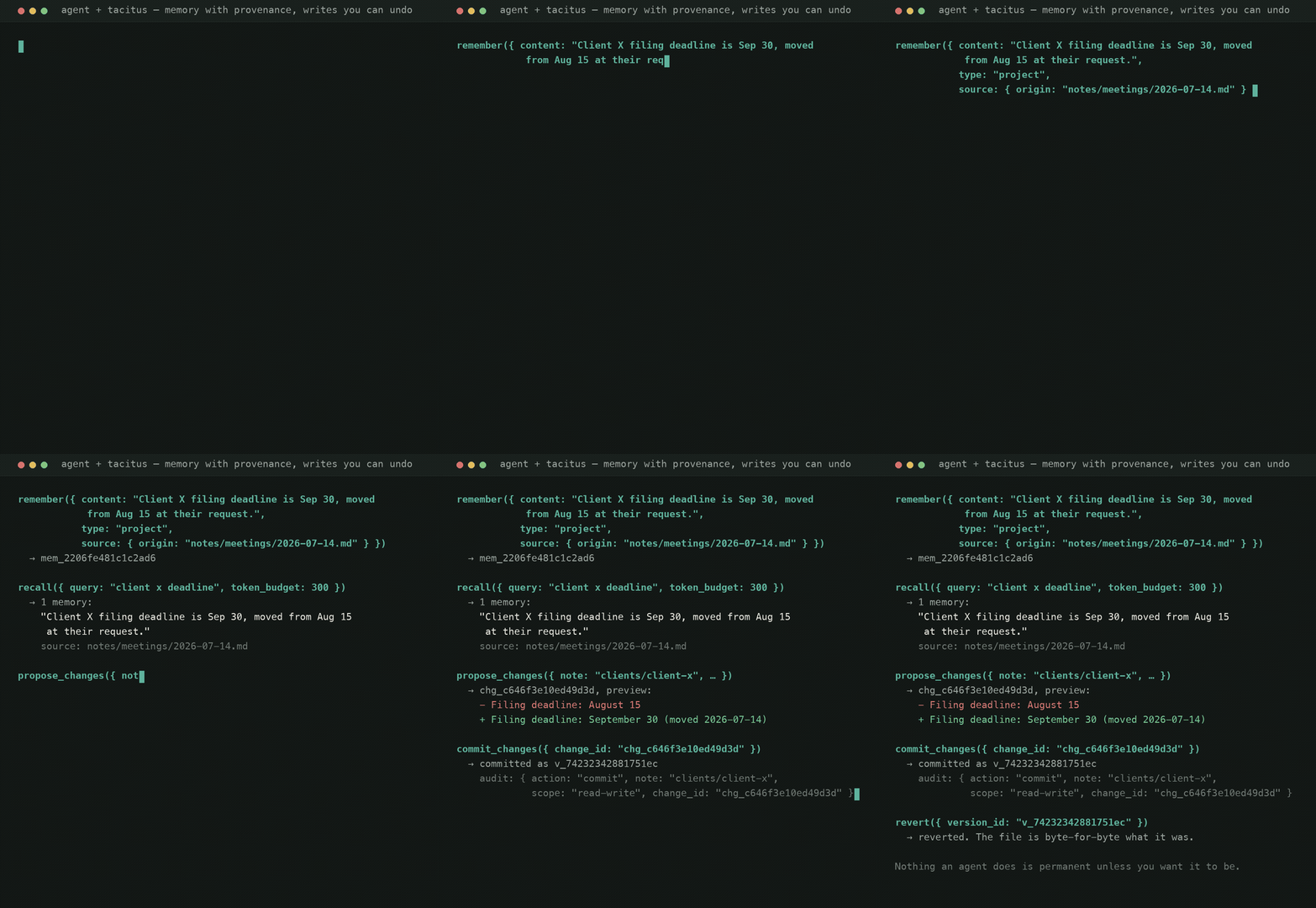
Recorded from a real session — the memory id, changeset id, version id and audit line above are what the binary actually returned (how).
Quick start
Claude Code
Claude Desktop (claude_desktop_config.json)
Native binary (no Node)
Prefer a single, zero-dependency binary? The Rust server ships prebuilt for macOS, Linux, and Windows on every release.
Or grab a .tar.xz / .zip for your platform from the
latest release.
Then point any MCP client at the binary instead of npx:
The native binary is the flagship server (25 tools; the npm server has the
core 16 — see the table below). Both share the same on-disk formats, so a
vault works with either. Set TACITUS_SCOPE=read-only to run the native
server without write permissions.
Tools
| Group | Tools |
|---|---|
| Memory | remember, recall, forget |
| Retrieval | search, get_note, graph_query, list_notes, properties_query* |
| Write-back | propose_changes, commit_changes, revert, rename_note, delete_note, get_version* |
| Convenience | create_note, update_note, link, tag, audit_log |
| Templates | list_templates, create_from_template |
| Tasks | list_tasks, toggle_task |
| Meta | capabilities |
* Native-Rust-server first (the npm server will catch up):
properties_query — Bases-like structured queries over YAML frontmatter
(filters eq|ne|contains|exists|not_exists|gt|lt|gte|lte, sort, select,
token_budget). Templates — Markdown files in .tacitus/templates/ whose
{{var}} placeholders form a schema; substitution happens before YAML
parsing so numeric vars stay typed, {{date}}/{{time}}/{{datetime}}
auto-fill, and creation is versioned + audited like any agent write.
Tasks — every checklist line (- [ ]) as a typed entity (done, due from
due:YYYY-MM-DD or 📅, #tags), queryable and toggleable; toggling takes
the task text as a concurrency guard so a stale caller gets a CONFLICT
instead of flipping the wrong task. rename_note retargets every wikilink
that resolves to the note (alias/heading kept) in one atomic changeset —
a single revert undoes the whole rename; delete_note is versioned too.
Every tool validates input with a schema and returns structured, actionable
errors ({ code, reason, suggestion }) rather than stack traces.
For developers: plugins & integrations
In Tacitus, a plugin is an MCP client — the tool contract above is the public API, with permission scoping, versioning, and audit built in.
- docs/PLUGINS.md — integration guide: connect an agent, write a plugin in Python/TypeScript, embed the Rust engine, plugin patterns
- TypeScript SDK —
@dashiro/tacitus-sdk: every tool as a typed method,{code, reason, suggestion}errors thrown asTacitusToolError: - Sandboxed WASM plugins (experimental) — crate
tacitus-pluginsruns guest wasm under Wasmtime with manifest-declared permissions (tool allowlist- scope), fuel and memory limits, no WASI:
tacitus.callistools/call. The native binary embeds the runtime:tacitus-mcp plugin list|runfor cron agents and scripts. See docs/PLUGINS.md §5
- scope), fuel and memory limits, no WASI:
- docs/MCP_API.md — full reference for all 25 tools (params, returns, error codes)
- Neural search (opt-in):
TACITUS_EMBEDDER=ollamauses a local Ollama daemon for embeddings (TACITUS_OLLAMA_EMBED_MODEL, defaultnomic-embed-text; needs an Ollama with embedding support). Vectors cached in.tacitus/vectors/; falls back to the deterministic hashing embedder when unavailable. - docs/SYNC.md — Sync (beta): E2E-encrypted CRDT sync
between devices (
tacitus-mcp sync init;sync statusshows how much of the relay quota a vault uses) - docs/DATA_FORMAT.md — the on-disk format
(
.tacitus/internals, stable ids, note conventions) - examples/ — three complete plugins (Python read-only analyzer, Node daily-note cron agent, sandboxed WASM guest), tested against the binary
What the sync relay can see
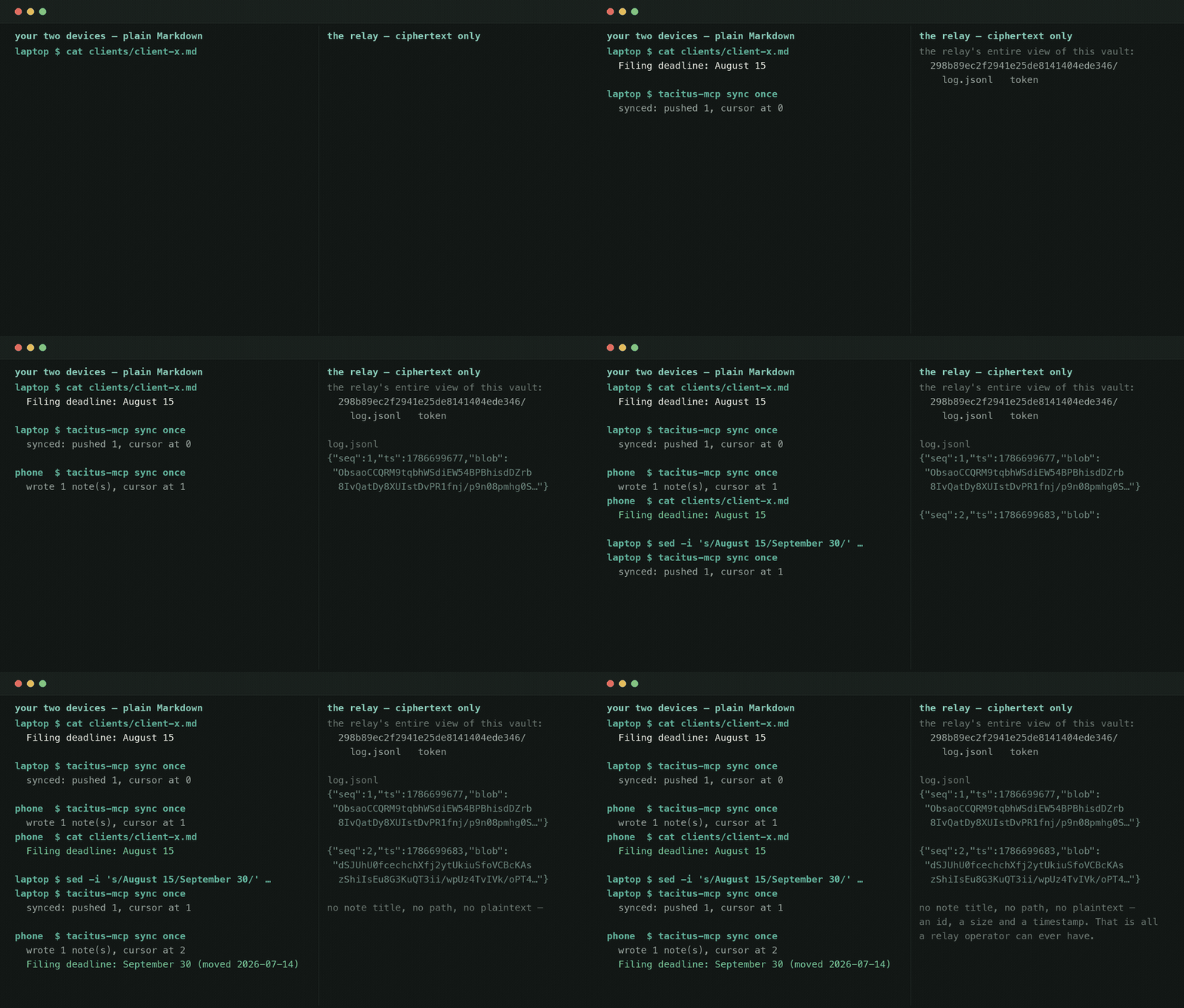
Left: two devices, plain Markdown. Right: everything the relay stores for that
vault. Those blobs were read out of a real log.jsonl after the recording —
no note title, no path, no plaintext. The vault code is the key and never
leaves your devices; lose it and the relay's copy is undecryptable forever.
Semantic search (optional neural embeddings)
search defaults to hybrid mode (lexical + a deterministic, offline
embedder that catches morphological variants). For synonym/paraphrase matching,
opt into a neural embedder:
Vectors are cached under .tacitus/vectors/. Falls back to the deterministic
embedder if the optional dependency or model isn't available.
How it stores things
Development
Polyglot monorepo. The reference server (shipped on npm) is TypeScript in
packages/mcp-server. A native Rust server in crates/ provides a
single-binary, zero-runtime-deps build (crates/tacitus-core engine +
crates/tacitus-mcp rmcp server) — a superset of the TS server (25 vs 16
tools). Its stable_id matches the TS engine byte-for-byte, so memory ids are
identical across both engines.
Cross-platform release binaries are built and published to GitHub Releases by
cargo-dist (dist-workspace.toml +
.github/workflows/release.yml) on every v* tag.
License
MIT — see LICENSE.