Supero README
The full upstream README, mirrored here for reference. Install config, tool schemas, adoption signals, and an original overview live on the Supero listing page.
Supero Apps
19 applications. Full source. Clone one onto your own domain and run it.
Every app in this repo is running live right now — and this is the code behind it. Multi-tenant, role-based, schema-driven. No npm, no build step. MIT app source, open SDK, your data exportable over the API — see how this works, honestly.
Live apps · Quickstart · Build with Claude · Platform docs


See it before you install it
lumen.supero.live is one of the 19, running the code in
apps/healthcare/lumen. The login page lists every demo account
with its role and password — click one and you are in. No signup, nothing to install.
Sign in as the front-desk user, then sign out and back in as the patient. The patient's
record is missing clinical_notes — and nothing in ui/app.js is doing that. The rule is
five lines in apps/healthcare/lumen/setup.py.
Or check it from a terminal in ten seconds, no signup, no clone of your own domain:
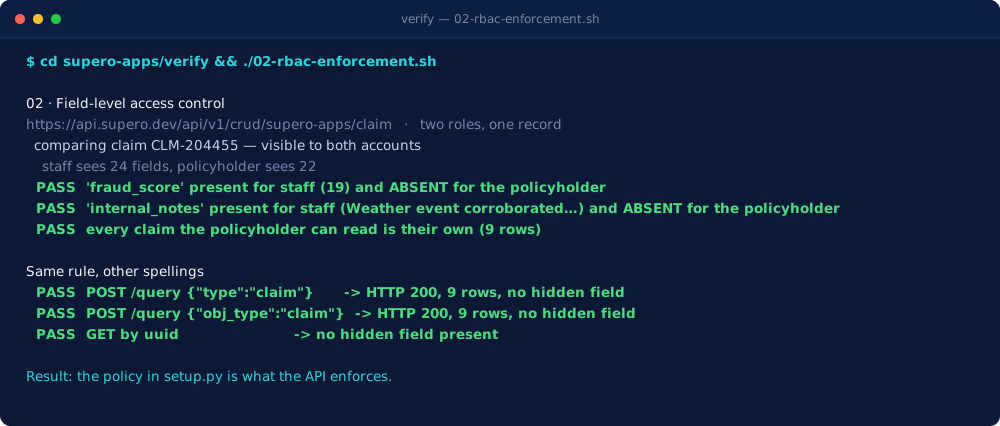
That script logs into the live insurance demo as a claims adjuster and as a
policyholder, finds one claim both can see, and compares the two responses. The
adjuster gets fraud_score and internal_notes; the policyholder gets the same
record without them. verify/ explains what it proves — and what it
does not.
Then run it yourself, in about two minutes
New here? Start with lumen — it is the smallest app in the repo and the one the docs
follow.
run.sh creates a venv, installs the supero SDK, registers your domain, uploads the
schemas, seeds demo data, wires up roles — then serves the app at http://localhost:5663.
That takes about 90 seconds on a cold machine with an empty pip cache — roughly 10
seconds of install and 60-odd of platform setup. Call it two minutes with the time it takes
you to fill in .env.
You do not need an account, an invite, or a credit card. Domain registration is open.
The name you put in SUPERO_DOMAIN becomes yours if it's free.
Prefer containers?
docker compose upworks identically.
The apps
Each one is a complete, multi-tenant application — public storefront and admin panel, with role-based access enforced on the server, not in the UI.
🩺 Healthcare & Life Sciences
| App | What it is | Live |
|---|---|---|
| Lumen Health | Book care online, e-sign consent, clinical notes kept provider-only via field-level access | lumen.supero.live |
| BrightSmile | Dental practice — online booking, treatment plans, provider-only clinical notes | brightsmile.supero.live |
| TrialCore | Clinical trials — public study registry, enrollment dashboards, adverse-event workflows | trialcore.supero.live |
💰 Finance & Insurance
| App | What it is | Live |
|---|---|---|
| Ledgerline | Billing — live MRR dashboards, automated dunning, multi-step expense approvals | ledgerline.supero.live |
| Sentinel | Insurance — two insurers on one deployment, public quote portal, claims approval sagas, insurer-only fraud scores | sentinel.supero.live |
🛍️ Commerce & Sales
| App | What it is | Live |
|---|---|---|
| Atelier | B2B wholesale marketplace — discovery storefront, multi-brand cart, net-terms checkout | atelier.supero.live |
| Summit CRM | Pipeline kanban, weighted forecasting, lead conversion, win-rate analytics | summit.supero.live |
| Amplify | Social marketing — connect channels, compose with AI, schedule, track engagement | amplify.supero.live |
🔐 Multi-tenant (one deployment, many organisations)
Every app above runs a single organisation. These four run several at once, and the isolation is enforced by the server: a user signed into one tenant cannot read another tenant's rows even by calling the API directly with their own valid token. Two of them also demonstrate field-level access control on top of that, so a row you can read still arrives with fields removed.
| App | What it is | Tenants | Live |
|---|---|---|---|
| Medora | Hospital network — appointments, encounters, prescriptions, labs, invoicing. A patient reads their own encounter with assessment and plan stripped server-side | 3 hospitals | medora.supero.live |
| Helix | Multi-site clinical trials — participants, visits, adverse events. The treatment arm is withheld from blinded investigators by the access policy, not by the UI | 3 sites | helix.supero.live |
| Lattice | Property management — units, leases, rent, maintenance, applications. Applicants cannot read the leasing team's screening notes | 3 managers | lattice.supero.live |
| Pulse | Multi-location gym — classes, bookings, memberships, check-ins | 3 locations | pulse.supero.live |
Sign in on any of them and the login page lists every demo account with its tenant, role and password — click a row to fill the form.
🏢 Operations & Services
| App | What it is | Live |
|---|---|---|
| Concierge AI | Support — AI help center grounded in your KB, agent console with suggested replies | concierge.supero.live |
| FieldOps | Dispatch board, mobile work orders, photo capture, on-site e-signature | fieldops.supero.live |
| Relay | Per-diem healthcare staffing — facilities post shifts, clinicians claim them, with credential verification and timesheets | relay.supero.live |
| Tavola | Restaurant — online ordering, reservations, loyalty, live kitchen board | tavola.supero.live |
| PulseFit | Gym chain — class booking, memberships, attendance, multi-location | pulsefit.supero.live |
🏡 Property & Media
| App | What it is | Live |
|---|---|---|
| Haven | Listings search, tour booking, offers with broker approval | haven.supero.live |
| Backlot | Film production — slate, cast & crew, call sheets, AI script breakdown | backlot.supero.live |
Build it with your AI
Every app ships a CLAUDE.md (and .cursorrules / .windsurfrules) so your assistant
understands the codebase before it touches a line.
You can also connect your editor directly to the platform over MCP — 64 tools that let an assistant design schemas, run CRUD, connect a database, and take an app from a sentence to a live URL:
Then just ask:
"Add a waitlist to the clinic app — patients join, staff promote them when a slot opens."
The interesting part is what the assistant is allowed to do. An MCP call carries your credential to the same API a browser would use — no service account, no elevated path. So the agent inherits your permissions rather than getting its own, and the row scoping and field hiding above apply to it identically. An agent you point at a customer's data is bounded by the same policy the customer is.
The server is live and you can inspect it without a key:
docs/mcp.md covers getting a key and the tool families. The complete reference, every parameter, is at docs.supero.dev/developers/mcp/tool-reference.
What you actually get
Two things, and it's worth being precise about which is which.
From schemas.py (95–270 lines, median 120), automatically — no code:
| You write | The platform generates |
|---|---|
| a data model | REST APIs, a typed SDK, validation, migrations |
access policies in setup.py | role-based access enforced server-side |
config.py | an admin panel, auth, and the services you switch on |
ui/app.js is the one part that's real code you own. It's the app's custom
storefront — 400 to 1,100 lines of React depending on the app, median around 800 — generated
as a working starting point, then yours to edit however you like. So you get the tedious 80% (APIs, auth, admin, RBAC)
for free, and a real front-end you control — not a locked template.
Access control is declared in setup.py, and the server applies it — not the UI. You
write row scoping (filter_field="owner_username") and field hiding
(hidden_fields=["clinical_notes", "diagnosis"]). A patient calling the API directly with
their own valid token — curl, browser closed, front-end out of the picture:
gets their appointments back with clinical_notes absent from the response body.
Nothing in ui/app.js is doing that — delete the entire front-end and the field still does
not come back. That's why lumen keeps clinical notes provider-only and sentinel hides
fraud scores from claimants without either app writing a line of access-control logic.
Two things worth being precise about, because they decide whether you can rely on this:
- It covers the entities you declare in your own schemas. Platform-managed types —
accounts, API keys, domains, projects, tenants — are governed by role permissions instead.
That is a different mechanism, and
hidden_fieldsdoes not extend to them. - It is a server-side response filter, not a database-level projection. The field is removed before the response is written, not withheld from the query.
Open their setup.py — the policy block is short, and it's the thing worth checking first.
Then check it against your own deployment rather than taking this page's word for it.
Zero build. React and Tailwind load from CDN. No node_modules, no bundler, no
npm install. Edit ui/app.js, refresh the page.
Each app carries five suites. Three are static validators that check the bundle's own
consistency and need nothing running. Two — crud_tests.py and e2e_tests.py — make real
HTTP calls against your domain, and are the ones that assert the access-control claims.
The live pair skip with a stated reason when no app is serving, so a fresh clone stays
clean:
How this works, honestly
This is open-core, and we'd rather say so plainly than have you find out.
- The app source in this repo is MIT — genuinely yours. Fork it, sell it, rip the UI out.
- The
superoSDK is MIT and open on PyPI. - The platform these apps call (
api.supero.dev) is a hosted service. Schema resolution, the multi-tenant runtime, RBAC enforcement, and orchestration run there. That part is not open source.
So an app here is a thin, portable client that calls the platform for schema resolution, RBAC, and orchestration. That's the trade: you skip building and operating a backend, and in return the backend is a managed service.
Your data and your exit. The domain, schema, and data are yours. Every record is
reachable through the same REST API the app uses, so export is a loop over
GET /api/v1/crud/{domain}/{type}
with your API key — nothing is trapped in a proprietary store you can't read. And for teams
that need to run inside their own network, self-managed / on-prem deployment is available
under an enterprise agreement (hello@supero.dev) — so "what if the vendor goes away" has a
real answer. See deploy.md.
Regulated data — read this first. These are reference applications, not certified
compliant systems. lumen and trialcore show the shape of healthcare access control;
they are not HIPAA-certified and ship with no BAA. Before putting real PHI, PII, or
regulated financial data into anything here, talk to us about compliance posture, data
residency, and a BAA — don't assume the demo covers it. See SECURITY.md.
Pricing. There's a free tier — enough to run everything in this repo — then usage-based beyond it. We don't publish the numbers yet. They're visible in the dashboard once you have a domain, which costs nothing to create, and you can ask us before you get that far. We'd rather say that plainly than link you to a page that isn't there.
Anatomy of an app
Everything else in ui/ — the component library, schema bindings, dev server — is restored
from the supero wheel on every run.sh. That's why it isn't committed here: it's a build
artifact, not source.
Docs
| Guide | |
|---|---|
| Quickstart | Clone an app onto your own domain |
| Build with Claude (MCP) | Connect Claude Code / Cursor / Copilot |
| How it works | The mental model: schema → API → RBAC, multi-tenancy |
| API reference | Auth, CRUD, services, connectors, files, MCP |
| Schemas | The data model, inheritance, field-level access |
| Services & workflows | AI, email, payments, approval chains |
| Admin panel | What you manage without writing code |
| Deploy | Where to run it: managed URL vs your cloud vs enterprise |
| Deploy to your cloud | Cloud Run, ECS/Fargate, Fly, Render — step by step |
FAQ
Do I need a Supero account?
No. ./run.sh registers the domain you name in .env. No signup wall.
Is my data locked in? No. It's your schema and your domain. Apps run on your machine, your cloud, or a managed URL.
What's the catch on the free tier? Usage limits. The current numbers aren't published — they're in the dashboard once you have a domain (free to create, no card), or ask us.
Can I use these commercially? Yes — the app source here is MIT. Build on it, sell it, fork it.
Where's the platform source?
The supero SDK is MIT and open. The hosted platform
(generation, multi-tenant runtime, orchestration) is a managed service.
Contributing
Issues and PRs welcome — app improvements, new verticals, doc fixes. See CONTRIBUTING.md.
Built something with Supero? Open a PR and add it to the gallery.
supero.dev · Live apps · Issues
App source in this repo is MIT licensed.