Human Survey vs Mdshare
A side-by-side look at the Human Survey and Mdshare MCP servers: transport, auth, tools, quality signals, and the config to install either one in Claude, Cursor, Windsurf or VS Code.
Verdict: choose Human Survey for workplace & productivity work as a local process; choose Mdshare for workplace & productivity as a local process. You can also run both side by side in one mcpServers block.
Which MCP server should you choose?
 Choose Human Survey when
- You need dedicated capabilities in the Workplace & Productivity domain.
- You prefer a local stdio subprocess transport.
- You have the keys it needs:
HUMANSURVEY_API_KEY. - You want tools like
login, get_catalog, list_forms.
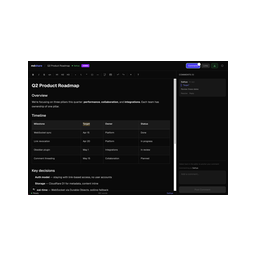 Choose Mdshare when
- You need dedicated capabilities in the Workplace & Productivity domain.
- You prefer a local stdio subprocess transport.
- Its auth model fits you: No auth required.
- You want tools like
upload_markdown, read_document, update_document.
Feature & specification comparison
Rows where the two servers differ are marked.
| Spec | ||
|---|---|---|
| Category | Workplace & Productivity | Workplace & Productivity |
| Quality signal | 60/100 · Good | 64/100 · Good |
| Install command | Confirmed | Confirmed |
| Transport | Local subprocess (stdio) | Local subprocess (stdio) |
| Auth | Not declared | No auth required |
| Pricing | Not declared | Free |
| Required env vars | HUMANSURVEY_API_KEY | None listed |
| Verified owner | Community listing | Community listing |
| GitHub stars | 1 | 8 |
| Directory activity | 2 views 0 installs 0 upvotes | 1 views 0 installs 0 upvotes |
| Tools | 10 | 14 |
| Full listing | View Human Survey | View Mdshare |
Tools & capabilities
Human Survey tools 10
loginSign in with an email address and store an API key on this machine. Called with only an email, it mails a six-digit code and returns nothing usable — the code has to come from the person, out of their inbox. Called with the email and that code, it stores a key at ~/.humansurvey/credentials and reports where it was written. The key itself is never printed. Signing in and signing up are the same act: an address that has never been used gets an account.get_catalogList the platforms HumanSurvey knows: the slug to use as catalog_slug, the display label, and which class of channel it is. These are the named channels a respondent can be shown — TikTok, ChatGPT, LinkedIn, Reddit and so on — plus the descriptive options that have no brand behind them, like "a friend or colleague told me". No API key needed.list_formsList the forms on this account: id, name, respondent URL, whether it is active or paused, whether it has been configured with questions yet, and how many responses it has collected.get_formRead one form: its settings, and the question configuration currently shown to respondents — every question, every candidate, and the order mode. Returns the configuration as JSON, because that is the exact shape a configuration write takes.create_formCreate a form and return its id, its respondent URL, and the iframe and postMessage listener to embed that URL in a host page. The form has no questions yet and shows nothing to respondents until it is configured. allowed_origins restricts which sites may embed it; leaving it empty allows any site, which means any site can spend this account’s response quota.configure_formSet the questions and candidates a form shows. Replaces the whole configuration and stores it as a new immutable version, so responses already collected keep describing the list they were actually shown. Re-sending an identical configuration reuses the existing version rather than making another. A form is one single-select question, optionally expanding into a second. Give a candidate an `expands` naming another question to reveal it when that candidate is picked — that is how "TikTok" becomes "which account". Candidate ids must be stable keys that survive a rename. Using a handle as an id splits that creator’s history in two the day they change it. Set catalog_slug to take a candidate’s label and logo from the platform catalog. Order defaults to "rotate", which randomizes per respondent and is what makes the reported shares unbiased; "fixed" keeps your order and accepts that earlier options get picked more often for being earlier.get_attributionWhat respondents said, aggregated. Reports, per question, how many completed responses named each candidate out of how many answered that question, the unresolved answers in the same list, how often a follow-up question failed to find an answer, and revenue where conversion events have been recorded. Computed fresh on every call, including any mappings made since — so a rollup of a past window can legitimately change between two reads.list_unresolvedThe answers respondents typed instead of picking from the list, grouped by the exact text and ordered by how often it was typed. Reports the spelling variants seen, when each was first and last typed, and whether a mapping already covers it. These are verbatim words. Two texts that read alike may be different people, and a text may name somebody who is not on the candidate list at all.remapRecord that a specific typed answer means a specific candidate. It applies to every response already carrying that text as well as every future one, so numbers reported for past windows change. The original text is never altered and a mapping can be revoked, but a report may already have been read. Only map a text whose meaning is established — a text that merely resembles a candidate’s name is not evidence that it is that candidate. One live mapping per text per question.revoke_remapStop a mapping from applying. The typed answers it covered return to the unresolved list — in past windows as well as future ones, because rollups join mappings when they are read rather than when they are made. Numbers already reported for those windows will therefore change. Nothing is deleted: the mapping is marked revoked and kept, so a report produced while it was live can still be explained. Revoking an already-revoked mapping is not an error and does not move the time it stopped applying. Mapping ids appear beside any text that is already mapped in the free-text listing, and in the confirmation given when a mapping is created.
Mdshare tools 14
upload_markdownUpload markdown to mdshare and receive a shareable link. The response contains a read/comment/edit share link (default permission: comment) that the user can share with others. The admin credential (full control) is stored locally in ~/.mdshare-mcp/documents.json and is NOT returned in this response — if the user explicitly asks to see or save the admin URL, call get_admin_url. PREFER file_path over content for files already on disk — reads directly from disk without transmitting content through this conversation, which is dramatically faster for files larger than ~1KB.read_documentRead a markdown document from mdshare. Returns the content. If the document was uploaded via this MCP server, 'key' is optional — the admin key will be loaded from local storage. PREFER output_path over inline reading for large documents — writes directly to disk and returns a small summary, dramatically faster than echoing content through the conversation.update_documentUpdate the content of an existing mdshare document (full replace). Requires edit or admin permission. If the document is in this MCP server's local store, 'key' is optional. PREFER file_path over content for files already on disk — reads directly from disk without transmitting content through this conversation. If both file_path and content are provided, file_path wins. For small edits to large documents, consider patch_document instead — keeps version history granular.patch_documentApply find/replace operations to a document without rewriting the full content. More efficient than update_document for small edits to large documents. Each find string must be unique unless replace_all is set. If the document is in this MCP server's local store, 'key' is optional. PREFER file_path over operations for batches of operations stored in a JSON file on disk — bypasses inline transmission. If both file_path and operations are provided, file_path wins.generate_linkGenerate a share link for a document with specific permissions. Requires admin access. If the document is in this MCP server's local store, 'key' is optional.list_linksList all share links for a document, including status (active/revoked), permission, and label. Requires admin access. If the document is in this MCP server's local store, 'key' is optional.revoke_linkRevoke a share link, making it permanently inactive. Use list_links first to find the token of the link to revoke. Requires admin access. If the document is in this MCP server's local store, 'key' is optional.list_commentsList all comments on a document, including replies and resolution status. If the document is in this MCP server's local store, 'key' is optional.post_commentPost a comment on a document, optionally anchored to specific text. Can also reply to an existing comment. If the document is in this MCP server's local store, 'key' is optional.resolve_commentResolve or unresolve a comment. Requires edit or admin permission. Key must be provided explicitly because comments are addressed by comment_id — the MCP server can't look up the parent document.get_versionsGet the edit history of a document — who edited, when, and via what. If the document is in this MCP server's local store, 'key' is optional.list_my_documentsList documents you've previously uploaded via this MCP server on this machine. Returns document_id, title, share_url, share_permission, created_at, and expires_at for each — does NOT return the admin credential. Use this to help the user find and resume older documents without re-pasting admin URLs. Does NOT include documents created via the mdshare web UI or via direct API calls from other clients — only those created by this MCP server. Returns an empty array on a fresh install or after the local store has been cleared.- +2 more on the listing page
Ready-to-paste client configs
Paste either block (or both) into your client config, e.g. claude_desktop_config.json or ~/.cursor/mcp.json. We only show a config when the install command is confirmed.
Human Survey
{
  "mcpServers": {
    "sunsiyuan-human-survey": {
      "command": "npx",
      "args": [
        "-y",
        "humansurvey-mcp"
      ],
      "env": {
        "HUMANSURVEY_API_KEY": "YOUR_HUMANSURVEY_API_KEY_HERE"
      }
    }
  }
}
Mdshare
{
  "mcpServers": {
    "urbanmorph-mdshare": {
      "command": "npx",
      "args": [
        "-y",
        "mdshare-mcp"
      ]
    }
  }
}
Frequently asked questions
Human Survey is categorized under Workplace & Productivity and uses a local stdio subprocess. Mdshare belongs to Workplace & Productivity and uses a local stdio subprocess. Pick Human Survey for workplace & productivity work and Mdshare for workplace & productivity.
Copy the mcpServers block from the config section on this page into your client's config (for example claude_desktop_config.json or ~/.cursor/mcp.json), then fully restart the client.
Human Survey has no declared pricing — check the project's own site. Mdshare is listed as free. Auth: no auth required. If a server needs environment variables such as API keys, define them under the env key in your client's MCP config.
Yes. MCP clients support multiple servers: add sunsiyuan-human-survey and urbanmorph-mdshare as separate keys in the same mcpServers object, and your assistant will call tools from either one.
On AllMCPs, Human Survey has a quality signal of 60/100 (Good) with 2 views, 0 installs and 1 GitHub stars. Mdshare has 64/100 (Good) with 1 views, 0 installs and 8 GitHub stars.