Solucortex MCP README
The full upstream README, mirrored here for reference. Install config, tool schemas, adoption signals, and an original overview live on the Solucortex MCP listing page.
SoluCortex MCP




Official Model Context Protocol server for SoluCortex — living technical memory for AI agents.
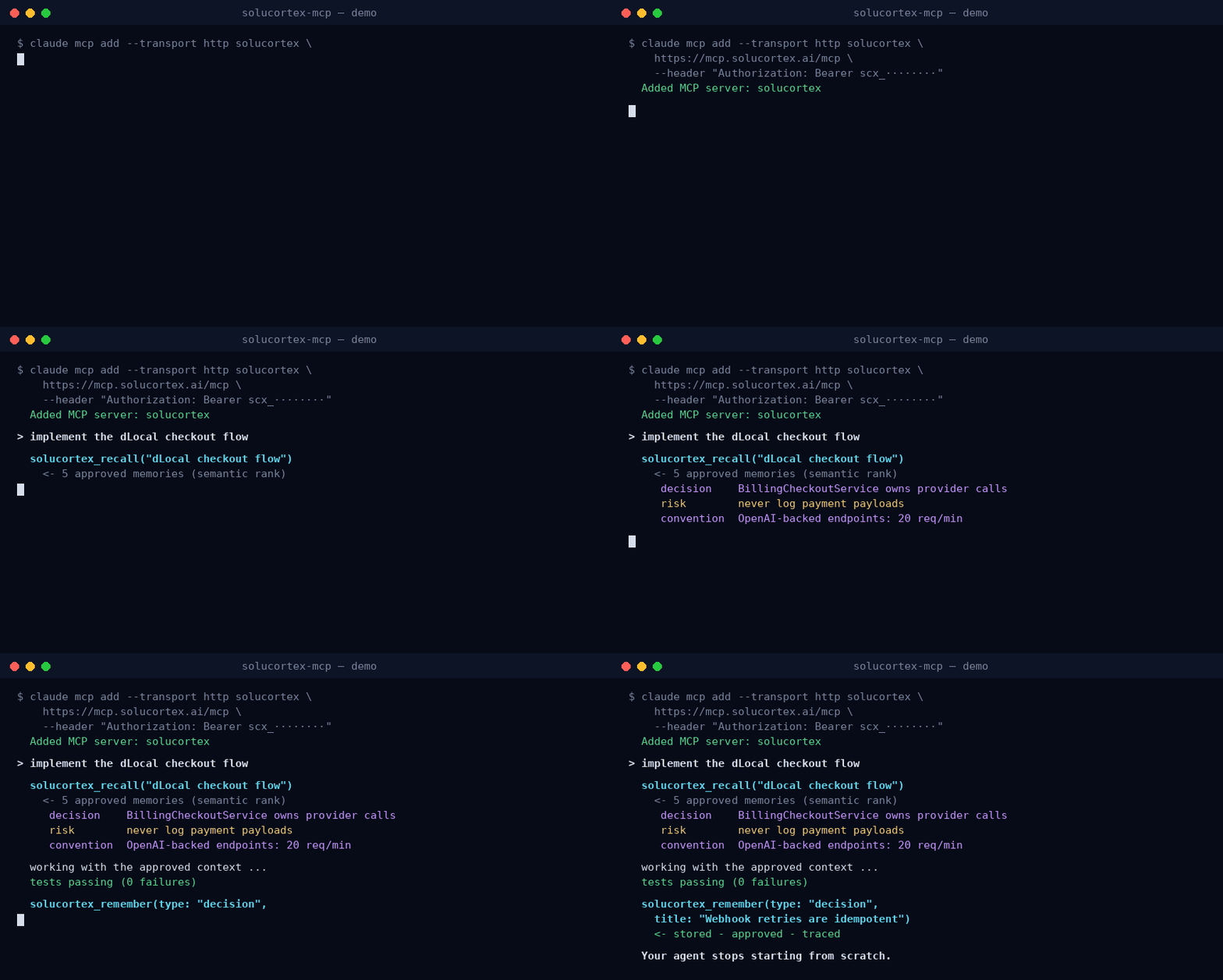
Connect any MCP-compatible agent (Claude Code, Claude Desktop, Cursor, Codex, Cline, …) to your SoluCortex project so it can recall the decisions, conventions, risks and architecture that matter before it works, and remember what it learns when it's done.
Website: solucortex.ai ·
Setup guide: solucortex.ai/docs/mcp ·
Tools reference: solucortex.ai/docs/mcp-tools ·
PyPI: solucortex-mcp ·
MCP Registry: io.github.soluai-spa/solucortex-mcp
Tools
| Tool | What it does | When to use |
|---|---|---|
solucortex_recall | Builds living context for a task (ranked by semantic similarity + importance) | At the start of a task, before touching code |
solucortex_search | Ad-hoc semantic search over the project's memories | Specific questions mid-task |
solucortex_remember | Records a memory (stored approved + traced as an authorized agent) | At close, or on a relevant technical decision |
solucortex_update_memory | Corrects an existing memory — the edit returns it to pending for human re-approval in the panel | When a memory is right in spirit but wrong in detail |
solucortex_flag_memory | Flags a memory as outdated/incorrect with a reason; a human resolves it in the panel | When a memory should be reviewed, archived or deleted |
solucortex_list_memories | Lists memories without semantic search | Quick inspection / audit |
Governance by design: agents propose, humans govern. Agents can never change a memory's
status, rewrite its metadata, or delete it — edits go back to pending and deletions only happen from the SoluCortex panel.
Requirements
- A SoluCortex account and a project API key (prefix
scx_) — get it from your SoluCortex dashboard. - One of:
uv(recommended), Python ≥ 3.10, or Docker.
Configuration
stdio mode (default, local)
The server is configured entirely through environment variables:
| Variable | Required | Description |
|---|---|---|
SOLUCORTEX_API_KEY | ✅ | Project API key (scx_…) |
SOLUCORTEX_PROJECT_ID | optional | Default project UUID; if omitted, the backend infers it from the API key |
SOLUCORTEX_URL | optional | API base URL. Default https://solucortex.ai |
HTTP mode (remote, multi-tenant)
Run with MCP_TRANSPORT=http (or --http) to serve Streamable HTTP on $PORT
(default 8080) — the mode behind https://mcp.solucortex.ai. Credentials travel with
each request and the environment is ignored:
| Header | Required | Description |
|---|---|---|
Authorization: Bearer scx_… | ✅ | The caller's project API key (401 without it) |
X-Solucortex-Project | optional | Default project UUID; if omitted, the backend infers it from the API key |
GET /health (and /healthz locally; Cloud Run's frontend intercepts /healthz) responds without auth. The MCP endpoint is
/mcp, runs stateless, and shares nothing between requests/tenants.
Never commit your API key. Keep it in your MCP client config's env block or a local .env
(see .env.example).
Install
Remote (recommended — nothing to install)
The hosted server at https://mcp.solucortex.ai/mcp speaks Streamable HTTP; your key
travels with each request:
Or in any client with remote MCP support:
Claude Code (local, stdio)
Claude Desktop / Cursor / Cline (JSON config)
Add to the client's MCP config (claude_desktop_config.json, Cursor mcp.json, etc.):
From a local clone
Docker
Prebuilt image on GHCR:
Or build it yourself:
The server speaks MCP over stdio, so clients launch it as a subprocess (-i keeps stdin open).
Development
Notes
- Memory
typevocabulary: the canonical set isarchitecture, decision, risk, convention, bug_history, tech_debt, sensitive_module, learning, external_integration. Some backends accept an older set (technical_decision, historical_bug, current_state, task_closure). The server passestypethrough and surfacesHTTP 422so you can retry with the other set. - Never store real secrets in a memory. Record location, type, severity and action taken instead.
License
MIT — see LICENSE.