SolidPing README
The full upstream README, mirrored here for reference. Install config, tool schemas, adoption signals, and an original overview live on the SolidPing listing page.

SolidPing
Distributed, self-hostable uptime monitoring. 40 check types, multi-region workers, private agents, status pages, incidents and on-call escalation — in a single Go binary.









From docker run to the first result
https://github.com/user-attachments/assets/471694b0-b136-4764-86c1-5f85615c45f4
The whole thing, start to finish: docker run, the first sign-in and its forced password change, an HTTP check created against https://solidping.io/api/mgmt/health, and its first response times plotted from two regions. Regenerated from the live dashboard with make showcase — nothing here is a mock-up. The same cut plays on the Tour page if the player above does not load.
Screenshots
| Checks list | New-check form | Check detail |
|---|---|---|
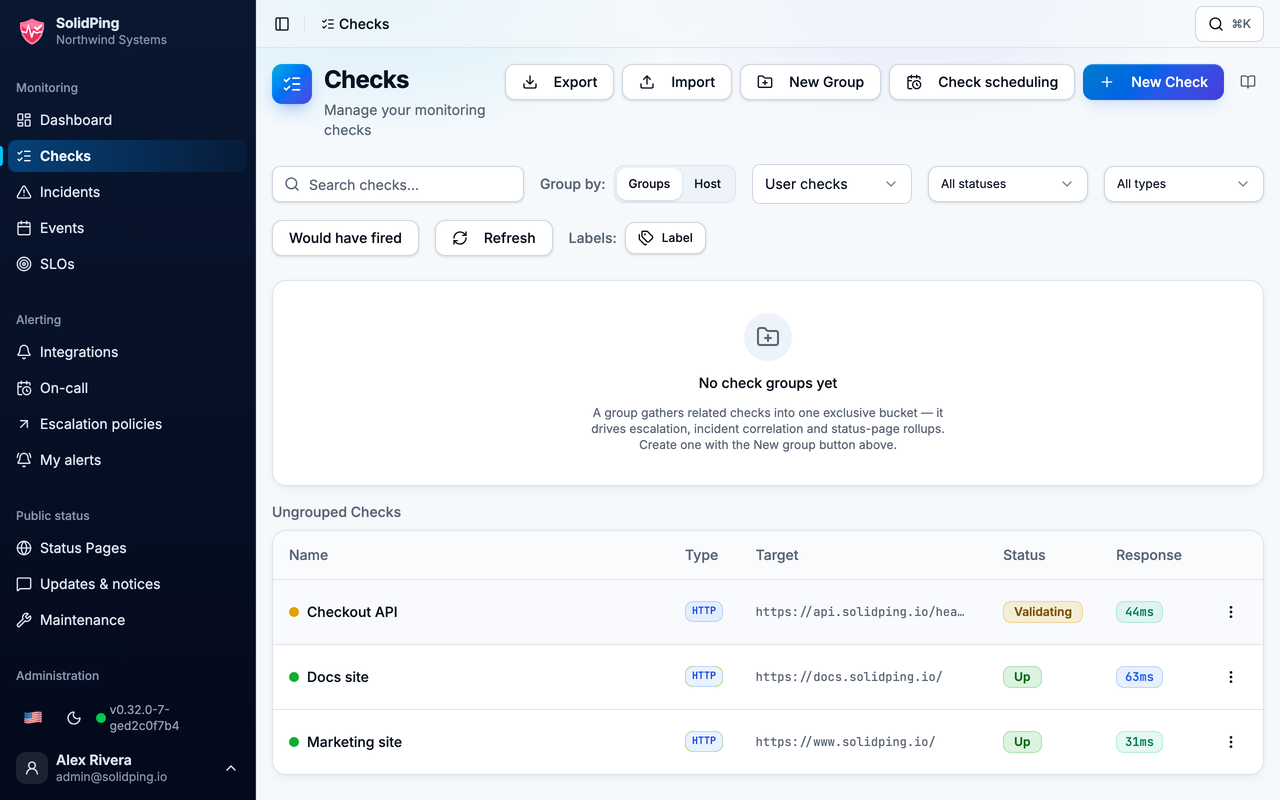 | 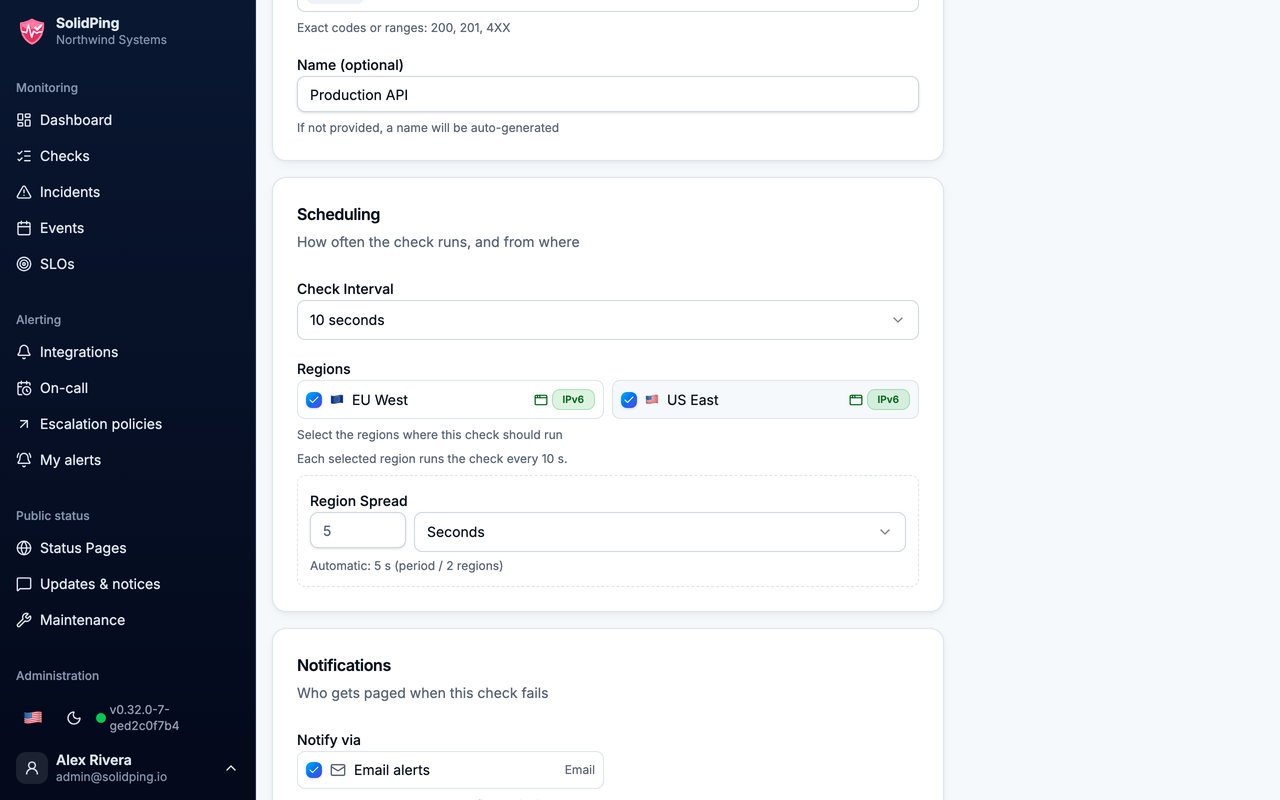 | 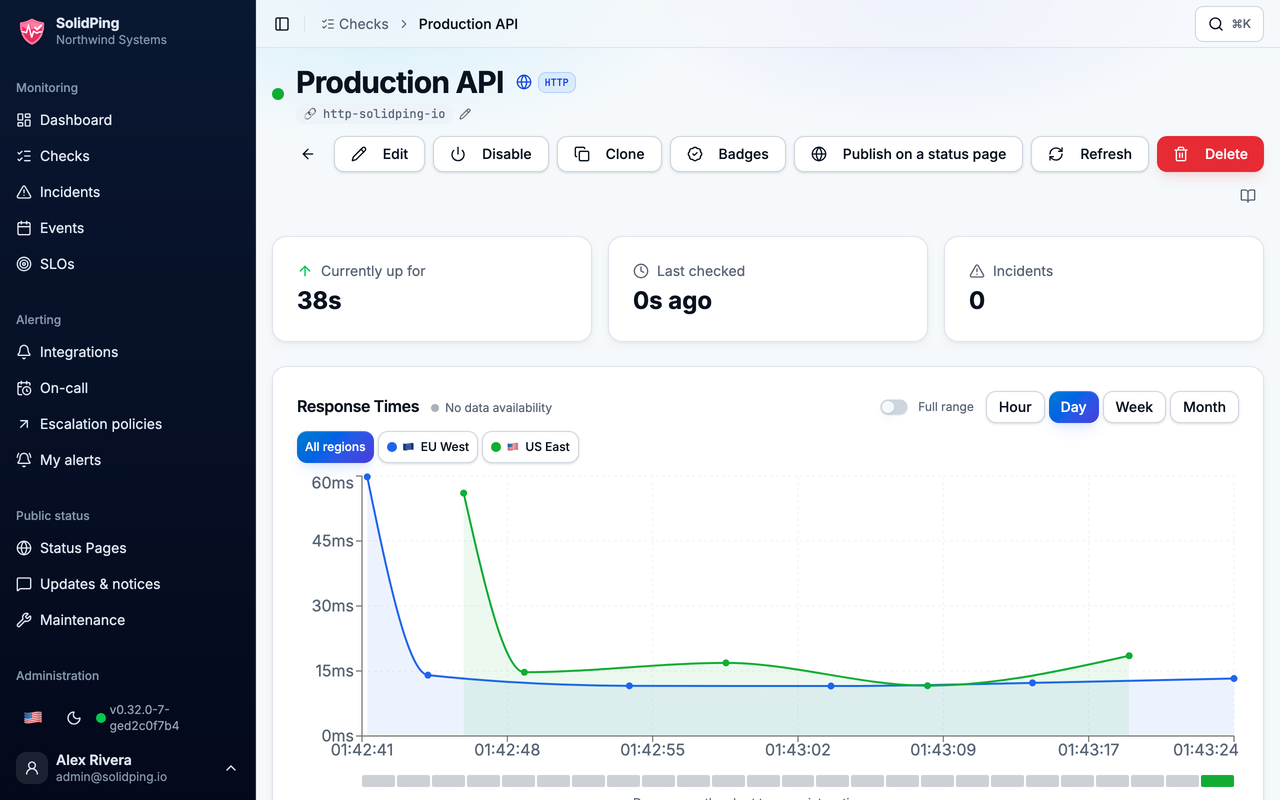 |
Try it
| Hosted | www.solidping.io — sign up, no card needed |
| Live status page | status.solidping.io — a real SolidPing instance watching the production one, from another provider in another country |
| Documentation | docs.solidping.io |
| Self-host | docker run -p 4000:4000 --hostname solidping ghcr.io/fclairamb/solidping — SQLite by default, no other service needed. First login is admin@solidping.io / solidpass, and you must change it (see Default Credentials). Prefer a bare binary? Every release also publishes one for Linux, macOS and Windows — see the installation guides. |
Overview
SolidPing is a multi-tenant monitoring system that enables organizations to monitor their infrastructure through distributed workers executing health checks. It's designed for low resource consumption and easy self-hosting.
Key Features
- 40 check types: HTTP, TCP, UDP, ICMP, DNS, DNSBL, NTP, SSL/Domain, SSH, RDP, FTP/SFTP, SMTP/POP3/IMAP, Email (JMAP passive inbox), WebSocket, SIP, gRPC, Prometheus, 7 databases (Postgres, MySQL, MSSQL, Oracle, ClickHouse, MongoDB, Redis), 3 message queues (Kafka, RabbitMQ, MQTT), Docker, Kubernetes, SNMP, Freebox line, game server (Source/A2S, Minecraft), headless browser, custom JS, heartbeat
- Distributed workers: Multi-region check execution with lease-based scheduling, per-region check periods with spread control, and per-org check-rate quotas
- Private locations: Deported agents run checks from inside your own network over an outbound WebSocket, with per-org agent quotas
- Multi-tenant: Organization-scoped data isolation, RBAC, 2FA (TOTP), labels with autocomplete
- Low footprint: Single binary; SQLite, embedded Postgres, or external Postgres
- Fast checks: Sub-minute frequencies supported
- Notifications (10 native): Slack (OAuth + threads + Marketplace install), Discord (OAuth + webhook), Email, Webhooks, Google Chat, Mattermost, Ntfy, PagerDuty, Pushover, Web Push (VAPID)
- Incidents: Adaptive resolution with cooldown, group-incident correlation (one alert per outage, not per check), acknowledgment, snooze, manual resolve, and per-incident comments
- Check groups: Organize checks into groups with grouped pagination and group-level incident correlation
- On-call & escalation: Rotation schedules with overrides, multi-step escalation policies (user / schedule / connection / all-admins targets, repeats)
- Credentials encryption at rest: Envelope encryption with out-of-band master key; secrets never echoed back to the dashboard
- SSH tunnels: Reach otherwise-unreachable targets through SSH jump hosts
- Status pages: Sections, resources, public availability metrics, locale-aware date formatting
- Maintenance windows: Recurring suppression of alerts
- JavaScript scripting: Sandboxed custom monitoring logic
- Browser monitoring: Headless Chrome via Rod
- MCP server: AI/LLM tool access via Model Context Protocol
- SSO / OAuth: Google, GitHub, GitLab, Microsoft, Slack, Discord, plus generic OIDC, SAML, and LDAP / Active Directory (per-provider enable toggle, with self-service token revocation)
- Observability: Prometheus
/metrics, Sentry integration, OpenTelemetry - CLI client: Manage checks and results from the terminal
- i18n: Multi-language dashboard (English, French, German, Spanish)
Quick Start
Prerequisites
- Go 1.24+
- PostgreSQL 15+
- Docker (for development)
- Bun (for frontend development)
Development Setup
Default Credentials
- Email:
admin@solidping.io - Password:
solidpass - Organization:
default
Both halves of that pair are published here, so the first login on a fresh
database must set a new password before the account can do anything else.
The dashboard takes you straight to the form; over the API the login succeeds
and every endpoint except POST /api/v1/auth/change-password,
GET /api/v1/auth/me and POST /api/v1/auth/logout answers 403 with code
PASSWORD_CHANGE_REQUIRED until you rotate it.
API Example
Supported Check Types
Network
| Protocol | Description |
|---|---|
| HTTP/HTTPS | Status codes, body matching, JSON assertions, Basic Auth |
| TCP | Port connectivity |
| UDP | Port reachability |
| ICMP | Ping |
| DNS | Record resolution |
| DNSBL | DNS blocklist (RBL) membership |
| NTP | Time server reachability and clock drift |
| WebSocket | Connection check |
| SIP | VoIP SIP server (OPTIONS ping) |
Security & Certificates
| Protocol | Description |
|---|---|
| SSL/TLS | Certificate validity and expiration |
| Domain | Domain name expiration (WHOIS) |
| Protocol | Description |
|---|---|
| SMTP | Server connectivity, STARTTLS, AUTH |
| POP3 | Server availability |
| IMAP | Server availability |
| Email (JMAP) | Passive inbox monitoring — receive a known message via JMAP and assert delivery |
Databases
| Protocol | Description |
|---|---|
| PostgreSQL | Connection + query execution |
| MySQL/MariaDB | Connection + query execution |
| MSSQL | Connection + query execution |
| Oracle | Connection + query execution |
| ClickHouse | Connection + query execution |
| MongoDB | Ping command |
| Redis | PING command |
Remote Access
| Protocol | Description |
|---|---|
| SSH | Server availability |
| RDP | Pre-auth RDP negotiation handshake (no credentials) |
| FTP | Server availability |
| SFTP | Server availability |
Message Queues
| Protocol | Description |
|---|---|
| Kafka | Broker connectivity |
| RabbitMQ | Broker connectivity |
| MQTT | Broker connectivity |
Infrastructure
| Type | Description |
|---|---|
| Docker | Container health |
| Kubernetes | Cluster / API server health |
| SNMP | Device monitoring |
| gRPC | Service health |
| A2S | Source / Steam game server query (Valve A2S) |
| Minecraft | Minecraft server query |
| Prometheus | Scrape a Prometheus endpoint and assert on a metric |
Specialized
| Type | Description |
|---|---|
| Heartbeat | Passive monitoring via incoming pings |
| JavaScript | Sandboxed custom monitoring logic |
| Browser | Headless Chrome (Rod) — JS, CSS, full render |
| Freebox Line | Freebox xDSL/fiber line quality (via connected Freebox) |
Configuration
Everything is configured with SP_-prefixed environment variables. Precedence:
environment variables > config.local.yml > config.yml > defaults.
You only need the database settings to get started — the defaults cover the rest.
SQLite (the default — good for a single instance)
Nothing to configure. The image already stores the SQLite database and every
uploaded blob (org logos, status-page assets, screenshots) under /data, so a
single mounted named volume is enough:
--hostname solidping is not optional: the worker name is derived from the
hostname and must match ^[a-z][a-z0-9-]{2,20}$. Docker's default hostname is
the random container ID, which starts with a digit most of the time, and the
server then refuses to start. Pass --hostname, or set SP_NODE_NAME instead.
If you use a bind mount instead of a named volume (-v ./solidping-data:/data),
the host directory keeps its own ownership, which is usually not writable by
the image's nonroot user (uid/gid 65532). Either chown 65532:65532 the
host directory first, or run with -u "$(id -u):$(id -g)". A named volume, as
used above, doesn't have this problem — Docker seeds it from the image with
the right ownership.
PostgreSQL (recommended for production)
Schema migrations run on first boot, so point it at an empty database and let it create its own tables:
sslmode=disable is right for a database on the same private network, and is
what a stock postgres container accepts — it serves no TLS, so sslmode=require
fails against one with SSL is not enabled on the server. For a managed or
remote database, use sslmode=require (or verify-full) instead.
The variables you actually need
| Variable | Default | Description |
|---|---|---|
SP_DB_TYPE | sqlite | sqlite or postgres |
SP_DB_URL | — | PostgreSQL connection string (required when SP_DB_TYPE=postgres) |
SP_DB_DIR | /data in the image, . for the bare binary | Where the SQLite file lives — set it to a volume |
SP_SERVER_LISTEN | :4000 | Listen address |
SP_BASE_URL | http://localhost:4000 | Public URL, used in links and notifications |
SP_NODE_NAME | the hostname | Worker name, ^[a-z][a-z0-9-]{2,20}$. Set it, or pass --hostname — the server will not start if the hostname does not match |
SP_LOG_LEVEL | info | debug, info, warn, error |
That is the whole getting-started surface. Everything else — authentication and SSO, email and the other notification channels, custom domains and TLS, multi-region workers, data retention, storage — is optional and documented at docs.solidping.io:
| Configuration overview | every variable, grouped by area |
| Database | connection strings, SSL modes, pooling, backups |
| Authentication | OAuth providers, OIDC, SAML, LDAP, 2FA |
| Notifications | Slack, Discord, email, webhooks and the rest |
Architecture
Core Components
- API Server: REST API for managing checks, incidents, and results
- Dashboard (
web/dash0): Admin UI (React + TanStack Router + shadcn/ui) - Status Page (
web/status0): Public-facing status dashboard - Workers: Distributed agents executing monitoring checks
- Notifications: Slack, Discord, Email, Webhooks, Google Chat, Mattermost, Ntfy, PagerDuty, Pushover, Web Push
- Database: PostgreSQL (partitioned results) or SQLite
Technology Stack
- Backend: Go 1.24+, go-chi/chi v5, Bun ORM, koanf
- Frontend: React 19, TypeScript, Vite, TanStack Router/Query, Tailwind CSS, shadcn/ui
- Database: PostgreSQL (production), SQLite (development/single-node)
Project Structure
Development
Commands
CLI Client
Goals
Primary
- Many protocols and test types
- Low memory footprint
- Fast execution (sub-minute checks)
- Easy self-hosting (single binary + PostgreSQL)
- Cross-platform (Linux, macOS, Windows)
- Public status pages
Non-Goals
- Multi-step transactional / scripted user-flow testing (use Playwright directly for that)
- Application Performance Monitoring / RUM (use Datadog, New Relic, or Site24x7)
Inspiration
- uptime-kuma - Great self-hosted monitoring tool
Contributing
Bug reports and pull requests are welcome — see CONTRIBUTING.md
for local setup and PR conventions. Found a security issue? See
SECURITY.md rather than opening a public issue.
License
AGPL-3.0 - See LICENSE.