Solana Nft MCP README
The full upstream README, mirrored here for reference. Install config, tool schemas, adoption signals, and an original overview live on the Solana Nft MCP listing page.
solana-nft-mcp
The NFT APIs I tried return an empty ownership history for a Metaplex Core asset, and an AI reading that empty answer tells you the card has never traded. solana-nft-mcp reads the chain itself: who owned it, who can freeze it, what sold and for how much, and where the deals are. Read-only, no sign-up, nothing collected, runs on your machine.




Why
Ask an assistant about a Solana card today and it answers from memory. It will say a card "never traded", because the mainstream NFT APIs return an empty history for Metaplex Core assets while the transfers sit on chain the whole time. It will compare two floors quoted in two currencies as if they were one.
solana-nft-mcp hands the same assistant live, labelled data instead: the chain for supply, ownership, provenance and custody rules, Magic Eden without a key, and OpenSea through a free key the server issues itself. Each number comes back with its marketplace, its currency, its read time, and what the source could not see.
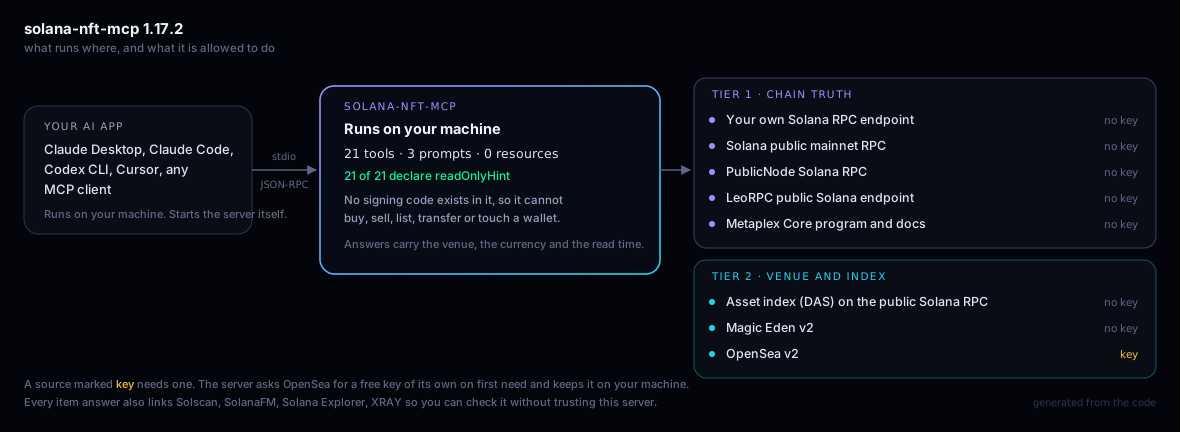
The server runs on your machine and your AI app starts it. There is no hosted service and no
account between you and the data. The picture is generated from the running server, so the
counts cannot drift from the code: npm test fails if they do.
Install
Node 22 or newer. Two ways to run it.
From npm, no clone. Wherever a client asks for a command, give it npx with the arguments
-y solana-nft-mcp. The first start downloads the package; later starts reuse it.
From source. Build once, then point the client at dist/index.js:
Claude Code
Claude Desktop. Settings -> Developer -> Edit Config, add the block below, then quit the
app fully and reopen it. Or install the .mcpb bundle from the latest release by dragging it
onto Settings -> Extensions.
Other clients. Tested: Claude Desktop, Claude Code, Codex CLI 0.153.4
(codex exec -c 'mcp_servers.solana-nft.command="node"' -c 'mcp_servers.solana-nft.args=["/absolute/path/to/dist/index.js"]').
Cursor, Windsurf, Gemini CLI, Zed, Cline and VS Code take the same command / args pair in
their own config; the server is plain stdio with no client-specific code, but those have not
been tested here. ChatGPT on the web and Grok cannot run a local process.
Did it work? Your app lists the tools near the message box (Claude Code: /mcp). You should
see 21, starting with identify. If none: the path must be absolute and end in dist/index.js,
npm run build must have run, and the app must be fully quit and reopened.
OpenSea is on without any setup. The first question that needs it makes the server ask
OpenSea for a free agent key, stored at ~/.solana-nft-mcp/opensea-key.json and renewed before it
expires. The key is never logged or printed into an answer. A collection's OpenSea slug is found
from its on-chain address, or by name and then proved against that address; pass openseaSlug
to override. Options, set in the config's env block (clients launch the server with a clean
environment):
OPENSEA_API_KEY- your own key, overrides the self-issued one.SOLANA_NFT_MCP_NO_AUTO_KEYS=1- never request a key; OpenSea is off unless you set one.SOLANA_RPC_URL,DAS_RPC_URL- a private endpoint, neither required. A key in the URL is registered and redacted from every answer (details in docs/FAQ.md).SOLANA_NFT_MCP_NO_UPDATE_CHECK=1- skip the one startup request to npm for a newer version.
Ask it anything
Nobody types a tool name. These are asked in plain words and the assistant picks the calls.
- Who has owned this card since it was minted, with dates and the marketplaces involved?
- Is it true this card has never traded?
- Can the project still freeze, move or burn what is in my wallet?
- What is in wallet 7HHs3..., and does that wallet flip or hold?
- What is the cheapest Legendary listing in that DC collection right now?
- Any Superman or Batman DC comic #1 or #100 for sale, and are any close to floor?
- What did Shohei Ohtani cards sell for this week, and how many changed hands?
- Are the Magic Eden and OpenSea floors for this collection even comparable?
- What would it take to build a sales bot on this, and where would it fail quietly?
A collection name, a player name, a card number or a trait is enough to start. Names resolve against a bundled snapshot of the Magic Eden directory, against OpenSea's Solana index, and against the marketplace itself, and a fuzzy match is offered as a candidate with the mismatch stated, never presented as the answer. Long answers are sized to arrive whole: a client that caps a tool result gets fewer per-row details before it gets fewer rows, and the answer says what it left out.
What it reads
| Source | Answers | Key |
|---|---|---|
| Solana RPC (three public endpoints, rotated) | supply, current owner from decoded Core account bytes, transfer history, wallet age | none |
| Asset index (DAS) on the public RPC | a second, independent opinion on ownership and wallet contents | none |
| Magic Eden v2 | floors, listings, sales, activity, top traders, trending | none |
| OpenSea v2 | second-marketplace floors, sales, supply, royalty, wallet transfers | self-issued |
No account, no sign-in, no telemetry, no log of your questions, and no signing code anywhere in
the repository; every tool declares readOnlyHint. What leaves the machine: the public address,
symbol or name you asked about, sent to the source that can answer it; one startup request to
npm for the latest version number; one request to OpenSea for a free key, the first time a
question needs it. One file is written, the key file above, at permissions 600. Nothing else
touches disk. To remove everything: uninstall or delete the clone, then delete
~/.solana-nft-mcp/.
Tools
21 tools. Names are frozen: agents reference them in prompts, and a rename breaks integrations without raising an error.
| Tool | Back |
|---|---|
identify | what an address or name is, where it trades, which tool to call next |
verify_claim | confirmed, contradicted or unverifiable, with the numbers seen and how to re-check |
get_asset_trust | Core plugins decoded from bytes: delegates, frozen state, enforced vs advisory royalties, mutable metadata, editions |
get_integration_recipe | endpoints, pacing, running cost, skeleton and the silent failure modes for a given build |
search_collections | name lookup across the Magic Eden directory and the OpenSea Solana index, saying which layers were read |
get_collection_stats | chain supply, floors per marketplace, and a reconciliation that refuses to rank SOL against USDC |
get_collection_holders | census of a Core collection from the chain's asset index, each holder with a role (issuer, marketplace escrow, wallet), capped and saying so |
get_floor_prices | current floor and listed count for up to 10 collections, Magic Eden only |
get_recent_sales | latest completed fills with buyer, seller, price, mint and signature |
get_asset | three readers for one item: the marketplace, a byte-level decode, and the chain's asset index, with owner agreement reported |
get_asset_provenance | bounded ownership history of a Core asset, dated, marketplaces named, every unread hole marked in place. historyComplete says every transaction was read; mintObserved says the mint itself was decoded. They are different claims |
get_wallet_holdings | holdings from two independent readers, with the gap between them named |
get_wallet_profile | holdings by collection, share of wallet and of supply, listed and compressed counts, floor ceiling with assumptions, wallet age |
get_wallet_activity | buys and sells, net flow, marketplace split, every flip with hold time and P&L, a behaviour label with its reason |
get_collection_sales | sales over a window: count, volume, median, buyers, sellers, per-day series, per-name breakdown, how far back the feed was read |
find_in_group | one edition number hunted across a whole family of collections, each match against its own floor |
find_listings | cheapest-first listings, trait filters, a name filter that says what it matched, a lowest-serials mode, each ask against its trait floor on both marketplaces |
get_top_traders | the largest wallets in a collection by Magic Eden volume |
get_trending | Magic Eden's trending list, with an explicit note when the marketplace publishes nothing |
explain_mechanics | escrow, freezing, delegates, royalties, wash trades and migrations, per standard and marketplace, each entry citing its source |
get_source_status | every source pinged live: tier, fallback, what it cannot see, credential state |
Three prompts: getting_started, collection_report, wallet_report. No MCP resources, on
purpose: everything they would carry is reachable by a tool the assistant calls itself.
Trust and limits
- Buying, selling, listing and signing are absent. No code exists for them.
- Provenance and trust decoding cover Metaplex Core only. Legacy SPL and compressed NFTs are reported as named gaps, never as empty lists. Holdings and activity cover both.
- Magic Eden and OpenSea only. Tensor has no self-serve keys; Rarible's Solana coverage is unconfirmed. Both are catalogued with the condition that would add them.
- Every money figure names its currency and the API it came from, on the summary and on every
priced row, and counts keep their coverage flags beside them (
truncated,stale,historyComplete). A program should refuse to act on a row whose flag says the read was partial. - Two error surfaces. Input that fails a tool's schema is refused before the handler runs:
isError: true, nostructuredContent. Every failure inside a handler carriesstructuredContent.error, a stable category (not-found,wrong-kind,escrow,source-unsupported,bad-input,upstream-unavailable,upstream-rate-limit,error). - No valuations and no currency conversion. Solana only.
Full detail: docs/TRUST-AND-LIMITS.md.
Security
Minting is permissionless, so a collection name is attacker-controlled text. Every name and every field from a chain or a marketplace is checked against the shape it claims to have before a model sees it, and every credential this process has sent is redacted from every answer. Covered by the offline suite. Reporting: SECURITY.md.
Development
CI runs a full-history secrets scan on every push to every branch; the offline suite, lint, the
tarball check and npm audit on main, pull requests and release tags; and the live check weekly.
Docs
- Under the hood: why it exists, how it works, what was tested
- Every data source, tiered
- Questions people ask, and which ones it can answer
- Fifteen ways people use it and things people build with it
- What can change under this server, FAQ, Contributing
About
Built and maintained by P1xel (p1xel.app, @P1xelCollector), a long-time Solana collector. The story of why it exists is in docs/DEEP-DIVE.md.
Running on the same decoding

CandyScan tracks the Candy Digital collections on Solana: supply, holders, migrations and sales, kept current. It is where the Core decoding was written first, and this repository is the keyless half of that pipeline. Each project shaped the other.
Shipped something on top of solana-nft-mcp? Open an issue and it goes here.
Independent project, not affiliated with the Solana Foundation. SOLANA and SOL are trademarks of the Solana Foundation. They appear in this project's name and documentation for one reason only: to say which chain the server reads. Nothing here is endorsed, sponsored or reviewed by the Solana Foundation, and no affiliation is claimed or implied.
License
MIT. See LICENSE.