Mcpproxy Go README
The full upstream README, mirrored here for reference. Install config, tool schemas, adoption signals, and an original overview live on the Mcpproxy Go listing page.




📺 Watch the full walkthrough · 📚 Read the docs · 🌐 mcpproxy.app
The demo above shows the embedded web UI. The MCPProxy core is a single binary for macOS, Linux, and Windows — the web UI ships inside it, with no extra service to run. On macOS, an optional menu‑bar app adds one‑click convenience (start/stop, server health, quarantine, logs).
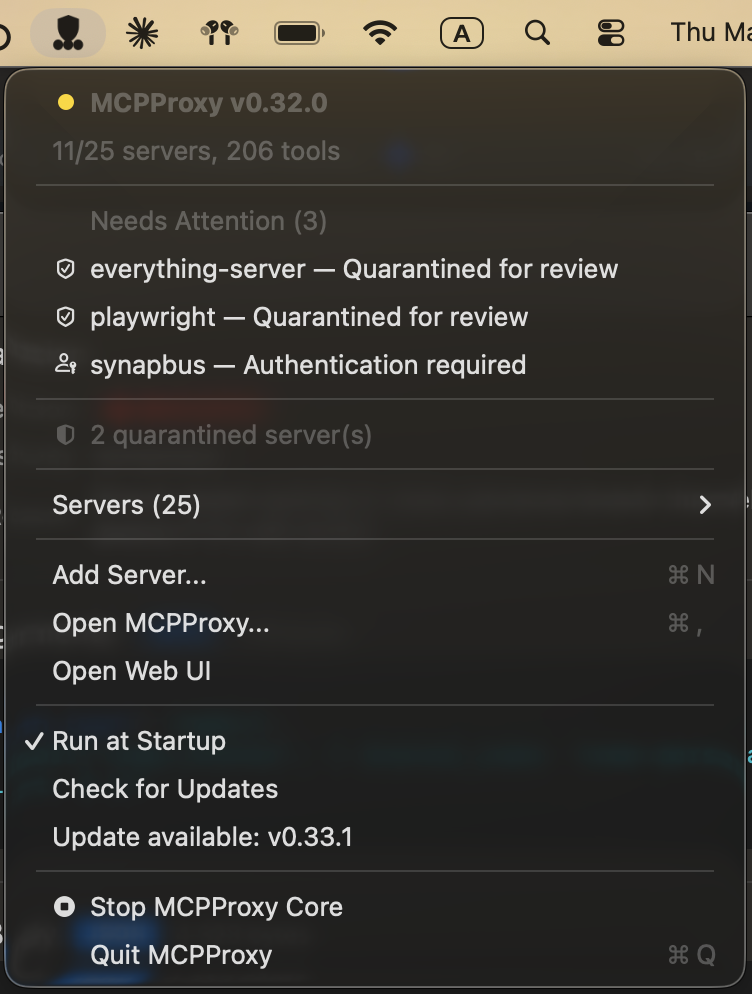
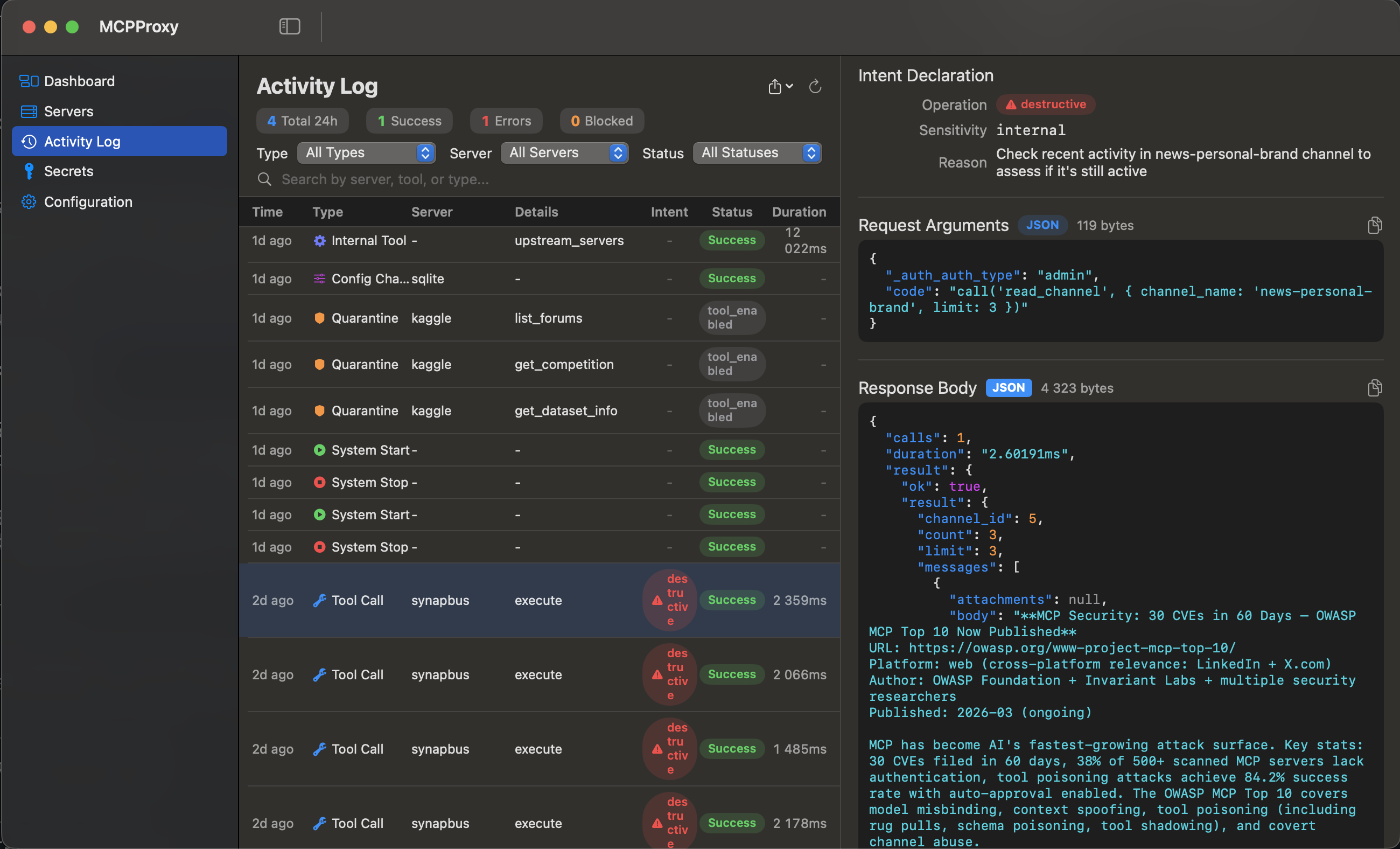
macOS menu‑bar app · Activity log & audit in the macOS app
Why MCPProxy?
- Scale beyond API limits – Federate hundreds of MCP servers while bypassing Cursor's 40-tool limit and OpenAI's 128-function cap.
- Save tokens & accelerate responses – Agents load just one
retrieve_toolsfunction instead of hundreds of schemas. Research shows ~99 % token reduction with 43 % accuracy improvement. - Advanced security protection – Automatic quarantine blocks Tool Poisoning Attacks until you manually approve new servers.
- Pluggable security scanners – Run Snyk, Semgrep, Trivy, Cisco, and other Docker-based scanners against quarantined servers before you approve them; findings are normalized to SARIF with a composite risk score. See Security scanner plugins.
- Works offline & cross-platform – A single core binary for macOS (Intel & Apple Silicon), Windows (x64 & ARM64), and Linux (x64 & ARM64), with the web UI embedded. macOS additionally ships an optional menu-bar app.
Quick Start
1. Install
macOS (Recommended - DMG Installer):
Download the latest DMG installer for your architecture:
- Apple Silicon (M1/M2): Download DMG →
mcpproxy-*-darwin-arm64.dmg - Intel Mac: Download DMG →
mcpproxy-*-darwin-amd64.dmg
Windows (Recommended - Installer):
Download the latest Windows installer for your architecture:
- x64 (64-bit): Download Installer →
mcpproxy-setup-*-amd64.exe - ARM64: Download Installer →
mcpproxy-setup-*-arm64.exe
The installer automatically:
- Installs both
mcpproxy.exe(core server) andmcpproxy-tray.exe(system tray app) to Program Files - Adds MCPProxy to your system PATH for command-line access
- Creates Start Menu shortcuts
- Supports silent installation:
.\mcpproxy-setup.exe /VERYSILENT
Alternative install methods:
macOS (Homebrew):
The cask installs the menu-bar app (bundles the CLI); the formula is the CLI binary only. Both update via brew upgrade.
Linux (Debian/Ubuntu) — apt repository, auto-updates via apt upgrade:
Linux (Fedora / RHEL / Rocky / AlmaLinux) — dnf repository, auto-updates via dnf upgrade:
Arch Linux (AUR): mcpproxy-bin
The apt and dnf packages ship a hardened systemd unit and start the service automatically. Repository signing key fingerprint: 3B6F A1AD 5D53 59DA 51F1 8DDC E1B5 9B9B A1CB 8A3B.
For one-off .deb / .rpm downloads (air-gapped installs), grab them from the latest release.
Manual download (all platforms):
Prerelease Builds (Latest Features):
Want to try the newest features? Download prerelease builds from the next branch:
- Go to GitHub Actions
- Click the latest successful "Prerelease" workflow run
- Download from Artifacts:
dmg-darwin-arm64(Apple Silicon Macs)dmg-darwin-amd64(Intel Macs)versioned-linux-amd64,versioned-windows-amd64(other platforms)
Note: Prerelease builds are signed and notarized for macOS but contain cutting-edge features that may be unstable.
- macOS: Intel | Apple Silicon
Anywhere with Go 1.25+:
2. Run
3. Add your first server
Create or edit ~/.mcpproxy/mcp_config.json:
See Configuration and Upstream Servers for the full reference.
4. Connect to your IDE/AI tool
📖 Complete Setup Guide - Detailed instructions for Cursor, VS Code, Claude Desktop, and Goose
Add proxy to Cursor
One-click install into Cursor IDE

Manual install
- Open Cursor Settings
- Click "Tools & Integrations"
- Add MCP server
How AI Agents Work Through MCPProxy
Once connected, your agent sees a handful of built-in MCPProxy tools instead of hundreds of upstream schemas. A typical session has three beats — discover, call, audit — plus an optional preflight gate for unattended automations.
1. Discover — spend one query, not your context window
The agent asks for what it needs in plain keywords via retrieve_tools:
MCPProxy runs a BM25 search across every connected server and returns only the top-ranked matches — each with a call_with hint recommending the right call variant for its annotations:
This is where the token savings come from: the schemas of the hundreds of tools the agent didn't need never enter its context. The agent loads full schemas on demand with describe_tool (batch up to 5 ids) only for the tools it's about to use.
2. Call — with declared intent
The agent executes the tool through the variant matching its intent (call_tool_read, call_tool_write, or call_tool_destructive), addressing it as server:tool:
MCPProxy validates the intent against the tool's annotations (a "read" call can't reach a destructive tool), checks quarantine and approval state, and scans arguments and responses for sensitive data before anything leaves the machine.
3. Audit — every call is on the record
Every call lands in the local Activity Log with a request ID, so you can reconstruct exactly what an agent did:
Gate automations before they burn tokens
For recurring headless jobs (cron, CI, n8n), don't let the agent discover a missing tool the expensive way. One preflight command checks that every required tool is ready — without contacting any upstream server — and reports exactly why when it isn't (server quarantined, tool changed since approval, OAuth expired, typo'd id):
See Required-Tools Preflight for the full reason taxonomy, REST endpoint, and GitHub Actions / n8n recipes.
🔐 Optional HTTPS Setup
MCPProxy works with HTTP by default for easy setup. HTTPS is optional and primarily useful for production environments or when stricter security is required.
💡 Note: Most users can stick with HTTP (the default) as it works perfectly with all supported clients including Claude Desktop, Cursor, and VS Code.
Quick HTTPS Setup
1. Enable HTTPS (choose one method):
2. Trust the certificate (one-time setup):
3. Use HTTPS URLs:
- MCP endpoint:
https://localhost:8080/mcp - Web UI:
https://localhost:8080/ui/
Claude Desktop Integration
For Claude Desktop, add this to your claude_desktop_config.json:
HTTP (Default - Recommended):
HTTPS (With Certificate Trust):
Certificate Management
- Automatic generation: Certificates created on first HTTPS startup
- Multi-domain support: Works with
localhost,127.0.0.1,::1 - Trust installation: Use
mcpproxy trust-certto add to system keychain - Certificate location:
~/.mcpproxy/certs/(ca.pem, server.pem, server-key.pem)
Troubleshooting HTTPS
Certificate trust issues:
Claude Desktop connection issues:
- Ensure
NODE_EXTRA_CA_CERTSpoints to the correct ca.pem file - Restart Claude Desktop after config changes
- Verify HTTPS is enabled:
mcpproxy serve --log-level=debug
Documentation
Getting Started
Configuration
Features
- Search & Tool Discovery
- Security Quarantine
- Security Scanner Plugins
- Docker Security Isolation
- Secrets & Keyring Integration
- OAuth Authentication
- Code Execution
- Activity Log
- Required-Tools Preflight
- Agent Tokens
- Sensitive Data Detection
CLI Reference
API
Contributing
We welcome issues, feature ideas, and PRs!
Development Setup
Pre-commit Hooks
We use prek to catch issues before they reach CI:
| Hook | Stage | What it does |
|---|---|---|
gofmt | pre-commit | Auto-formats staged Go files |
trailing-whitespace | pre-commit | Removes trailing whitespace |
end-of-file-fixer | pre-commit | Ensures files end with newline |
check-merge-conflict | pre-commit | Detects merge conflict markers |
swagger-verify | pre-push | Fails if OpenAPI spec is out of date |
go-build | pre-push | Verifies the project compiles |
Run hooks manually: prek run --all-files