Mirror and drive the iOS Simulator: token-efficient UI snapshots, gestures and a live viewer.
Quick Install
Automated & IDE SetupCopy the AI prompt to install this server into Claude Code, Cursor, or another agent — or use 1-click editor setup below.
One-click editor setup isn’t available for this listing yet — we don’t have a confirmed install command, and we’d rather show nothing than point your editor at the wrong package or host. Follow the project’s own setup instructions, linked above.
Manual Client & Custom JSON ConfigExpand JSON ▾
No confirmed setup config for this listing yet. We only publish a config block when the install details come from the project itself — its README, its docs, or a verified owner. We haven’t found those for SimMirror, and we’d rather show nothing than a guess you’d paste into your client. Follow the project’s own setup instructions for the current steps.
Documentation Overview
SimMirror
Mirror and drive the iOS Simulator from Claude Code, CLI agents and the browser.



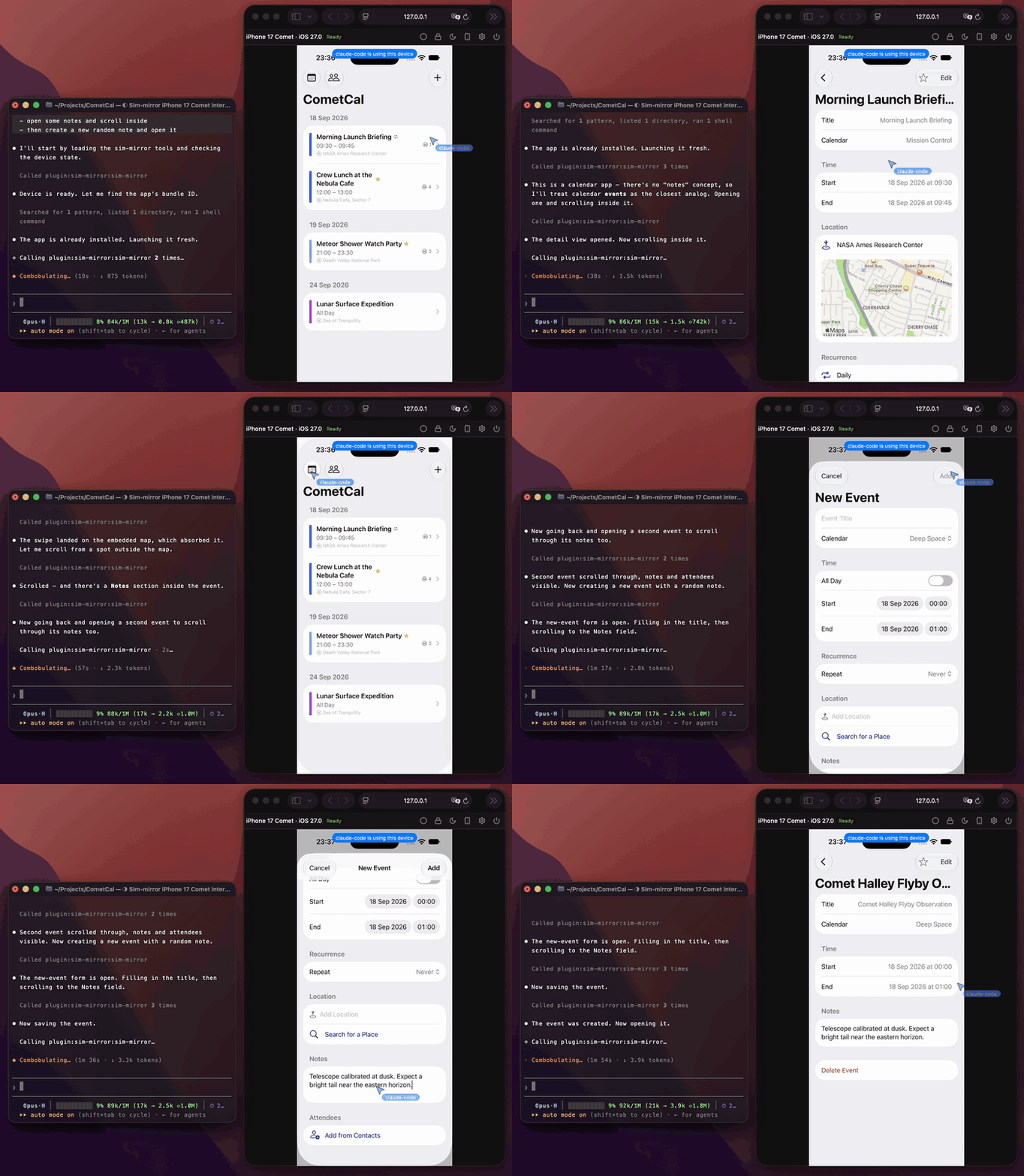
A real session, sped up four times. The whole recording runs 1m 39s.
A live iOS Simulator in any browser tab or web page, an animated cursor that shows exactly what your AI agent is about to tap, and token-efficient UI snapshots so agents read the screen as compact text instead of screenshots. Works with Claude Code, Codex, Cursor and any other MCP client.
Status: 1.2. The agent tools, the viewer, the protocol and the embedding API are stable, and a check holds every 1.x release to what SimMirror promises not to break. 1.2 drives simulators with SimMirror's own helper, reads a screen from its pixels when accessibility says nothing, and lets an app share its own views.
Why SimMirror
- See the simulator anywhere. A live H.264 or JPEG stream in a Chrome tab, an iframe or a
<sim-mirror>web component, with touch, scrolling, typing, hardware buttons and light and dark mode. - Watch what the agent does. Every agent gesture is announced before it lands, and the viewer's cursor glides to the spot first -- so you can follow along, and step in: an agent waits for your hand to be still.
- Spend fewer tokens. Agents read accessibility snapshots with stable element refs and diffs between screens, act in batches with waits, and reach for a screenshot only when a question is visual.
- Read screens accessibility cannot. A game or a canvas reads from its pixels, and an app under development can share its own views, so icon-only buttons and hand-drawn controls read by name.
Install
Claude Code, with the plugin (tools, a skill that teaches snapshot-first use, and /sim-mirror:open):
Any MCP client, as a stdio server:
Configurations for Codex, Cursor and other clients.
The command, for sim-mirror open, doctor and the rest:
The viewer library, for your own pages: npm install @andrewkochulab/sim-mirror
(npm). SimMirror itself is
on PyPI and in a Homebrew tap.
Requirements: an Apple Silicon Mac, Xcode 26 or later, and uv or Homebrew. Nothing else: SimMirror drives a simulator with its own helper, which comes in the package. Details in Installation.
Quickstart
Then ask your agent:
Open Settings → General → About and tell me which iOS version this simulator runs. Use sim_snapshot rather than screenshots.
Getting started explains what happens along the way.
Features
Live viewer. H.264 through WebCodecs where the page can decode it, JPEG otherwise, negotiated per connection. Touch, drag, scroll, typing and paste, Home and Lock, light and dark, and a device picker. It reconnects by itself after a blip and says plainly when the simulator is off.
Agent cursor. Every agent gesture -- tap, long press, swipe, drag, typing -- reaches the viewer before it lands, and
the viewer's own pointer glides there first (agent.cursor_lead_ms). Never the Mac's pointer.
Screen understanding. A snapshot is a few lines -- e2 button "General" (201,319) -- with refs that stay with their
elements across scrolls, a digest, and diffs. sim_act plays up to 20 steps in one call and waits for text, its
absence, or the screen to settle -- past a spinner or a pulsing dot that never stops. See
Screen understanding.
Reading pixels. A screen whose accessibility says nothing -- a game, a canvas, an app still loading -- reads as the
text macOS's Vision finds in it, with refs to tap and text to wait for, and the viewer can outline what was read
(perception.ocr). See Read from pixels.
App SDK. An app under development can link SimMirrorKit, a small Swift package, and call SimMirror.start():
in a Debug build on the simulator it shares its own UIKit and SwiftUI views, so an icon-only button, a card with a tap
gesture or a hand-drawn control reads by name, and .simMirror("Settings") names a SwiftUI view. Optional, and nothing
of it is in a Release build. See The app SDK.
Connectors. SimMirror's own native helper gives full control with nothing to install; idb_companion still can,
and the simctl connector mirrors the screen view-only when neither is there, and says why. auto uses the fastest that
works and falls back when one fails. More connectors plug in through an entry point. See
Connectors.
Embedding. An iframe with a one-shot ticket, the
<sim-mirror> element themed with CSS custom properties, or SimMirror
inside a Python application with its own sign-in.
Settings panel. sim-mirror open --settings puts every setting a click away in the viewer, a tab per section,
saved for one project or all of them and applied before it says so. Settings that decide what runs or who may reach
the daemon wait for a code from sim-mirror settings confirm. See The settings panel.
Doctor. Checks Xcode, its Simulator frameworks, runtimes, the native helper and idb_companion, Device Hub and the desktop session, the text reader and an app's shared hierarchy, then proves a tap reaches a simulator. See the doctor.
Security. Loopback only, a Host allowlist, exact Origin checks, CORS and framing only for origins you list, hashed scoped tokens, and one-shot codes in URL fragments. See Security.
Build and test. sim_build_run and sim_test build with xcodebuild for the agent's simulator, install and
launch, and answer with only what failed and where -- each failing test named so it can be run again alone, and on
another simulator when asked. Off by default, since they run commands: sim-mirror config set build.tools true.
Measure the token cost
benchmarks/tool_budget.py calls each read-only tool through the same MCP relay a client uses and prints each answer's
bytes, estimated tokens and latency on your own screens; see the token budget example. On
an iPhone 17 Pro simulator (iOS 26.5, idb connector) showing Settings → General, 5 calls each (2026-09-16):
| Call | Tool | Bytes | Tokens (est.) | p50 ms | p95 ms |
|---|---|---|---|---|---|
| device info | sim_device | 265 | 46 | 2.9 | 3.6 |
| snapshot, full | sim_snapshot | 561 | 112 | 64.8 | 76.4 |
| snapshot, diff of an unchanged screen | sim_snapshot | 83 | 5 | 63.2 | 64.8 |
| screenshot, 400 px wide | sim_screenshot | 62222 | 469 | 8.2 | 8.9 |
| screenshot, 1200 px wide | sim_screenshot | 276472 | 4181 | 20.4 | 21.9 |
Bytes are the whole answer, an image's base64 included; tokens are estimates (text at about 4 characters a token, an image at about 750 pixels a token).
Compatibility
| Expected to work | |
|---|---|
| macOS | 26 (15 with Xcode 16.4, view-only) |
| Xcode | 26 and 27 |
| Connectors | native helper (full control), idb_companion 1.5 (full control), simctl (view-only) |
| App SDK | Debug builds on the iOS Simulator, iOS 16 or later |
| Clients | Claude Code, Codex, Cursor, any stdio MCP client |
| Browsers | Chrome, Safari, Firefox, Edge |
Rows checked on real hardware are marked verified, with the date, in Compatibility.
From 1.0 the tools, the protocol, the embedding API, the viewer package, settings and the command line are held to what SimMirror promises not to break: a 1.x release adds, and never breaks. Connectors are the exception, and pin a minor version.
Documentation
Everything: getting started, clients, embedding, screen understanding, connectors, security, architecture, and the reference for tools, configuration, the command line and the protocol.
Roadmap
Related MCP Servers
Reviews
No reviews yet — be the first to share how this listing worked for you.
Frequently Asked Questions about SimMirror
AllMCPs Directory Badge
Showcase your server listing on GitHub or your project documentation. Embed this dynamic SVG badge to highlight official listing status and live engagement.
Badge Style:
Live Dynamic SVG Preview
Markdown (GitHub README)
[](https://allmcps.com/mcp/simmirror)HTML Embed
<a href="https://allmcps.com/mcp/simmirror"><img src="https://allmcps.com/api/badge/simmirror?style=directory" alt="SimMirror on AllMCPs" /></a>