Bilingual (EN/ES) AI-writing detection that shows the evidence, plus originality checking.
Quick Install
Automated & IDE SetupCopy the AI prompt to install this server into Claude Code, Cursor, or another agent — or use 1-click editor setup below.
Not yet automatically verified
We haven't yet run this listing's install command through our automated sandbox check. This isn't a red flag — we're steadily working through the catalog.
Manual Client & Custom JSON ConfigExpand JSON ▾
Client Config & Setup
Choose your client or environment
Target File:
💡 Paste the JSON block into your client's configuration file under mcpServers, then restart the application.
Documentation Overview
✍︎ Signs of AI Writing









Are you a teacher? Start here → — what this does and what it cannot do, in plain language, with the error rate drawn rather than tabulated. No badges, no interval notation, nothing to install. English & Spanish.
Try the live demo → — English & Spanish, runs in your browser. No signup, and the analysis uploads nothing.
Use it in your editor → — an agent skill for
Claude Code, Codex, Gemini CLI and Cursor, in one line: npx skills add peopleworks/SignsofAI -g.
It edits by the same rules this engine scores by, and it never invents a number.
Download the Windows app → — the same tool in a window. Nothing to install alongside it: the .NET runtime is bundled.
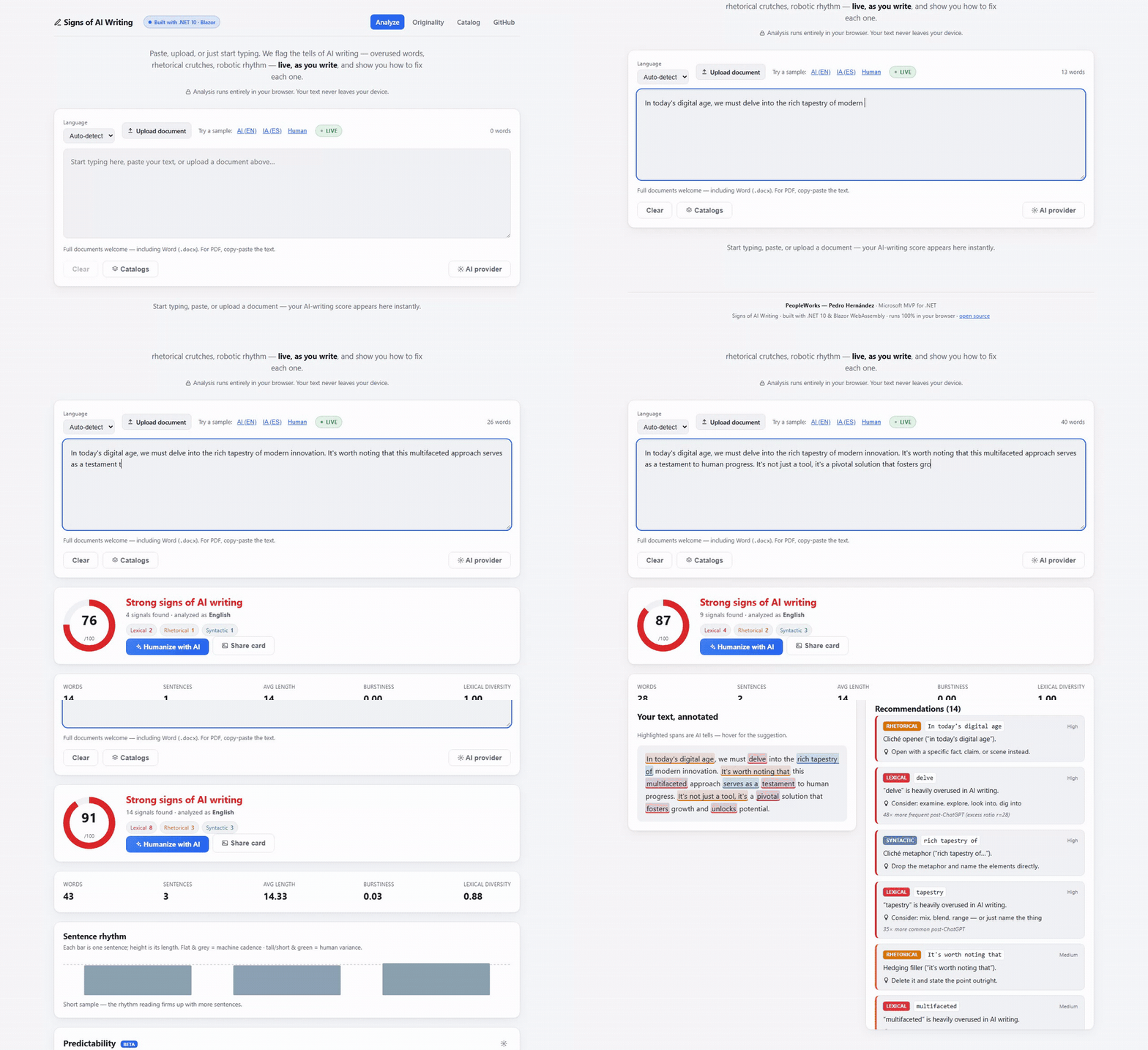
Real recording of the live demo — the score updates as you type, and every highlight comes with a suggested fix.
Rather watch than read? The two-minute explainer: English · Español
A free, privacy-first toolkit for academic and writing integrity. It does two things:
- De-AI-ify linter — flags the tells of AI-generated writing (overused vocabulary, rhetorical crutches, robotic sentence rhythm) and, for every finding, tells you how to fix it.
- Originality checker — "did they write it, or copy it?" Compares documents against each other and surfaces the passages they share — verbatim copies, reworded paraphrases (even across languages), and a whole-cohort overview — as evidence a human judges. Not a black-box verdict.
🔒 The analysis runs entirely in your browser, and nothing is uploaded to run it. No account, no telemetry, no server that sees your text.
Four features can send text off the device, and not one of them runs unless you turn it on, each disclosed in the interface at the moment you choose it: the paraphrase check and the perplexity measurement (both call a server you or we host), the live rewrite when you supply your own API key — the key stays on your device, the text goes to the provider you picked — and the optional web spot-check for a distinctive phrase, which exists only if the operator configured a search provider.
Everything else — every rule, the score, the character scan, the citation cross-check, the writer baseline, the report — is computed locally and stays there. In the desktop app, the perplexity measurement is local too.
The Windows app can also check whether a newer version has been published, because it has no auto-update and never will. That is not one of the four: it sends no text, no account and no identifier — one request to GitHub's public release list, the same one a browser would make. It asks before its first check, at most one a day, and it never downloads or runs anything for you.
Built with .NET 10 and Blazor WebAssembly by Pedro Hernández (PeopleWorks), Microsoft MVP for .NET — for the .NET and Microsoft developer community, por y para la comunidad educativa.
Repo: https://github.com/peopleworks/SignsofAI
English and Spanish are supported in two independent ways:
- The interface switches EN ⇄ ES instantly from the toolbar — no page reload, remembered per browser, and it follows your browser's language on a first visit. Translations are plain JSON files anyone can contribute: see Translating the interface.
- The analysis runs against a per-language rule-pack, auto-detected or selectable. The Spanish rule-pack is an original derivation of AI-writing markers for Spanish.
The two are separate on purpose, so findings stay in the language of the text being analyzed: advice about English prose is given in English even when the interface is in Spanish, because that's the language the advice is about.
How often is it wrong about a human?
Every AI detector gets asked this and almost none of them answer. Docs/CALIBRATION.md
is the answer, measured against 296 texts written before 2022 — open-access
research articles, pre-2022 encyclopedia revisions in both languages, and 206 classroom essays by
adult learners of English, one per student, from a corpus collected between 2006 and 2012.
At a threshold of 30/100 it flags 2 of them: an observed 0.7%, with a 95% interval reaching 2.4%. The recommendation is made from the uncertain end of the interval rather than the flattering one, so it stays cautious while the corpus is small, and it follows the data in whichever direction they move as the corpus grows.
The learners are the group this whole category is accused of harming — studies report that other detectors flag 61% of their essays — and they are the reason the boundary sits at 30 rather than the 25 it sat at before they joined: at 25 the tool flagged 9 of their 206 essays, 4.4%, and none of the 90 published texts. That figure is on the page, by group, rather than averaged away. It is far below the numbers reported for other tools, and it is not zero.
It is deliberately not an accuracy figure. Accuracy needs a collection of machine-written text, which is a sample of whichever models were around that month; a false-positive rate needs only human writing, and it measures the harm this category actually causes — studies report that detectors flag 61% of essays by non-native English speakers, and none of them publish that about themselves.
The report also names which rules misfire, ranked. That list is uncomfortable and it is the most useful thing the exercise produces.
The corpus is a JSON manifest anyone can extend, the tool that builds and measures it is in
tools/SignsOfAI.Calibration, and the whole thing re-runs in one command. See
Docs/Calibration/README.md — Spanish academic writing is the most
wanted contribution.
For teachers: the part that is not software
A detector is not what you need first. Docs/Teaching/ is syllabus
language you can paste, a one-page sheet to hand students before anything goes wrong, and a procedure
for the day a question becomes formal — all bilingual, all free of any licence, attribution or
permission.
None of it requires this tool. It exists because the hard part of AI writing in a classroom was never detection; it is what you do on the morning you suspect something and have nobody to ask. All three documents are built on the same rule: a score is never the reason for a decision about a student, and a conversation about the work settles what no software can.
1. The AI-writing linter ("Analyze")
Unlike black-box detectors that only spit out a score, this is an explainable, actionable, educational
linter. Paste, upload (.docx / .txt / .md), or just start typing — the 0–100 score, highlights,
statistics, and per-finding fixes update as you write.
| Category | Examples |
|---|---|
| Lexical | delve, tapestry, multifaceted, nuanced, pivotal, underscore, showcase, testament… (weighted by post-ChatGPT excess frequency) |
| Rhetorical | Negative parallelisms ("it's not just X, it's Y"), cliché openers ("in today's digital age"), hedging ("it's worth noting that"), false ranges, rule-of-three |
| Syntactic | Copula avoidance ("serves as a…", "a testament to…"), inflated constructions ("plays a crucial role") |
| Statistical | Burstiness — sentence-length uniformity. Machine text hovers at 0.0–0.2; human prose 0.6–0.8 |
Related MCP Servers
Adoption & maintenance
Factual signals from GitHub, npm, and our automated checks — not a rating.
GitHub stars
22
Stargazers on the source repository.
Last commit
2d ago
Most recent push to the default branch.
Reviews
No reviews yet — be the first to share how this listing worked for you.
Frequently Asked Questions about Signs of AI Writing
AllMCPs Directory Badge
Showcase your server listing on GitHub or your project documentation. Embed this dynamic SVG badge to highlight official listing status and live engagement.
Badge Style:
Live Dynamic SVG Preview
Markdown (GitHub README)
[](https://allmcps.com/mcp/signs-of-ai-writing)HTML Embed
<a href="https://allmcps.com/mcp/signs-of-ai-writing"><img src="https://allmcps.com/api/badge/signs-of-ai-writing?style=directory" alt="Signs of AI Writing on AllMCPs" /></a>Technical Specs & Signals
CategoryDeveloper Tools
43Quality signal: Fair · 43/100How this signal is calculated ▾
Server availabilityNot measured
Not scored for repo-hosted servers — we can't reach the running server, only its GitHub page. Hosted MCP endpoints are health-checked live.
Verified ownership10/20
Documentation & tools16/30
Adoption & activity6/15
Community engagement0/10
A guidance signal from public completeness & health data — not a user rating. New listings start lower and rise as they add docs, get verified, and grow adoption. Signals we can't observe for a listing are skipped, not counted against it.
Own this project?
This directory is pre-filled from public sources. Claim via GitHub README, site badge, or DNS TXT to unlock edit access and the Official badge and attach your website — proof is checked automatically, then reviewed by our team.
Free dofollow backlink: add your website and place the AllMCPs badge on it — no claim needed. We detect it automatically and keep it verified as long as the badge stays live.
Claim & get free dofollowShare & Embed
Add our SVG badge (dark/light directory styles) or embeddable widget to your site.