MCP server exposing Signet cryptographic signing, verification, and content hash tools over stdio.
Quick Install
Automated & IDE SetupCopy the AI prompt to install this server into Claude Code, Cursor, or another agent — or use 1-click editor setup below.
Not yet automatically verified
We haven't yet run this listing's install command through our automated sandbox check. This isn't a red flag — we're steadily working through the catalog.
Manual Client & Custom JSON ConfigExpand JSON ▾
Client Config & Setup
Choose your client or environment
Target File:
💡 Paste the JSON block into your client's configuration file under mcpServers, then restart the application.
Documentation Overview
Signet
Don't just log agent actions. Prove them.
Cryptographic trust and authorization evidence for every AI agent action — identity, delegation, policy, receipts: signed, hash-chained, offline-verifiable. Independent of any provider.







TypeScript packages:
@signet-auth/core ·
@signet-auth/mcp ·
@signet-auth/mcp-server ·
@signet-auth/mcp-tools ·
@signet-auth/node ·
@signet-auth/vercel-ai


▶ Try the live demo — sign a tool call in your browser, change a field, and watch verification fail. (mirror: GitHub Pages)
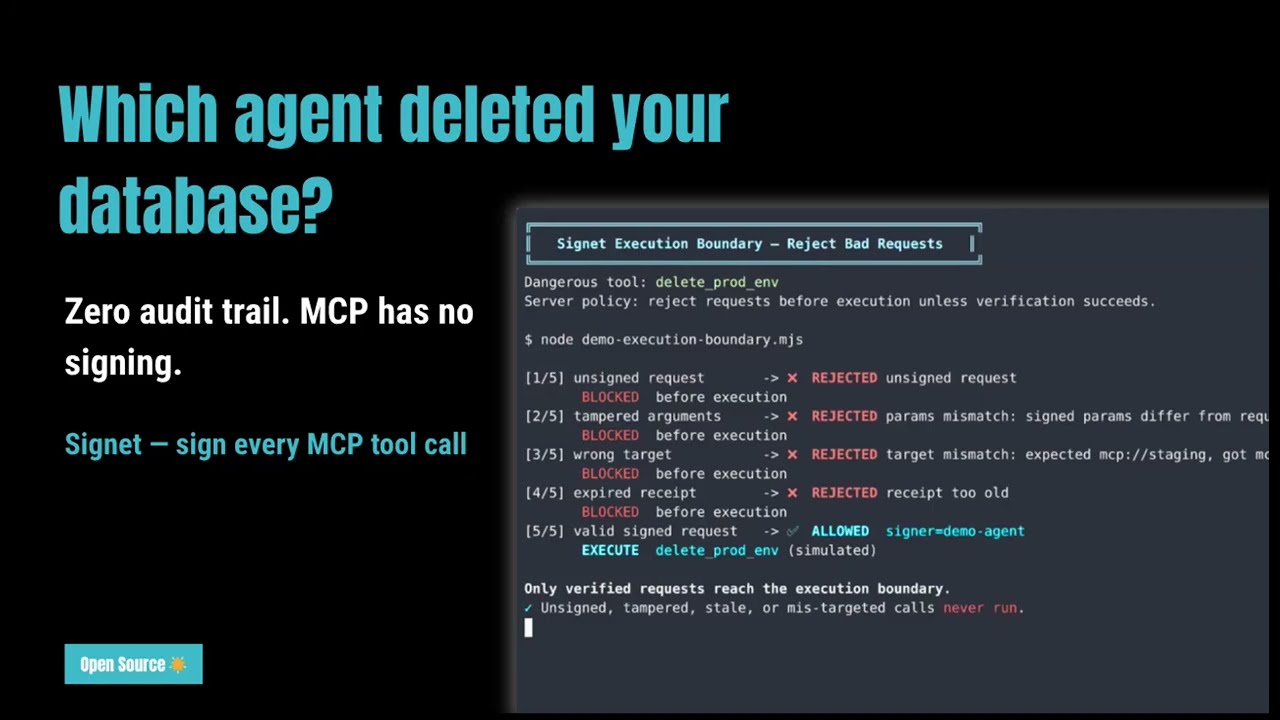
▶ Walkthrough: signing, audit log, and verification · ▶ Demo: execution boundary & MCP integration
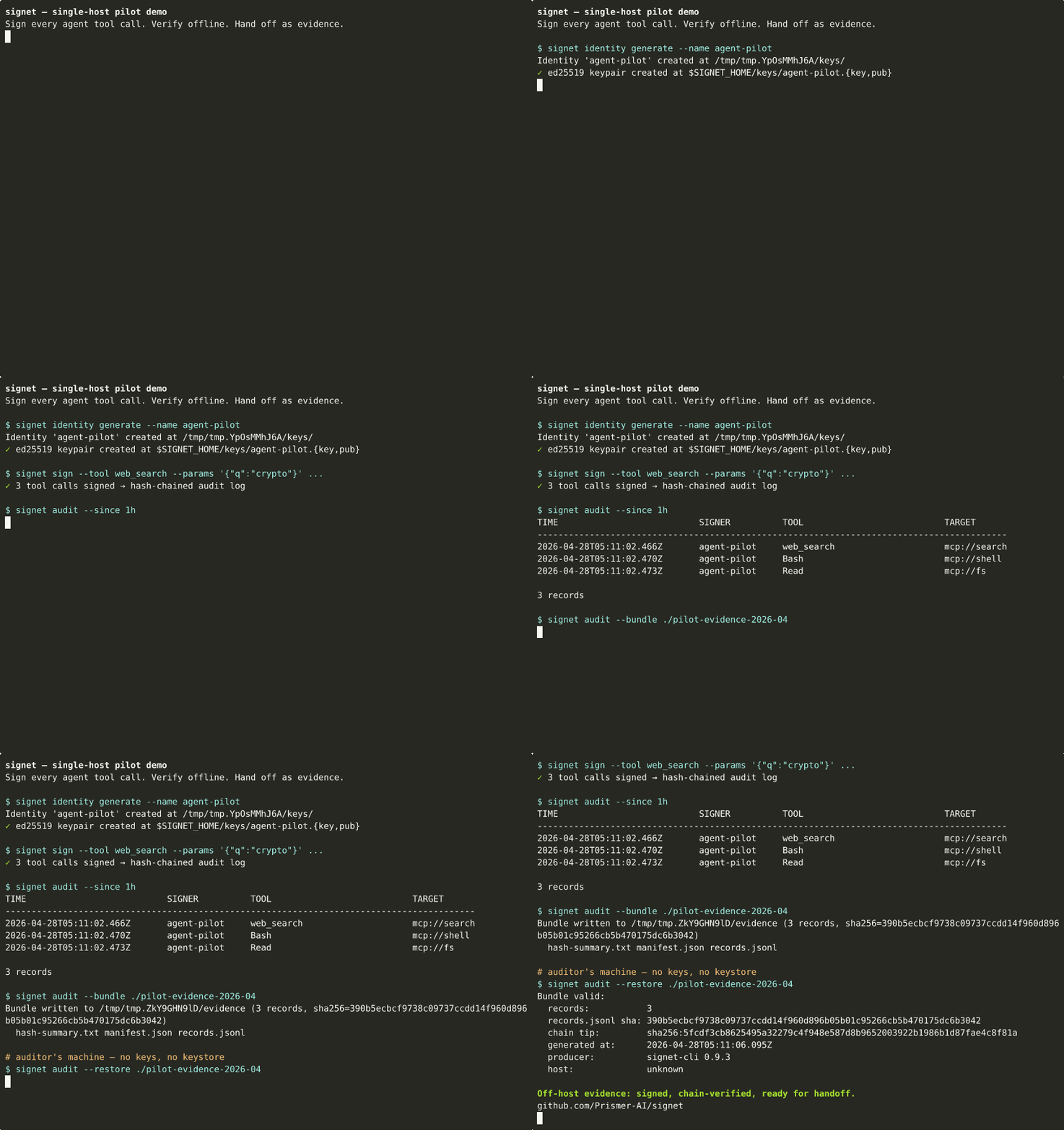
Single-host pilot flow: sign every tool call, hand off a signed evidence bundle, re-verify on any machine — no signet keystore required. Pilot runbook →
Your AI agent just placed an order, deleted a row, sent an email, merged a PR. Can you prove exactly what it did — to an auditor, a customer, or yourself after an incident?
Signet is the independent trust layer for agent actions. Every tool call gets a signed receipt that anyone can verify offline, without trusting the platform that hosted the agent or the vendor that stored the logs — and since 0.11, the authorization behind an action carries its own proof: who the agent is (principal), who let it act (delegation), and who allowed this specific action (authority-signed decision).
Your agents run on their infrastructure. The proof belongs to you.
Why Not Just Logs?
Traditional logs tell you what a platform says happened. They're mutable, provider-dependent, and unverifiable without trusting the party that wrote them.
Signet receipts are different. Modify any field — tool name, parameters, timestamp, signer — and the Ed25519 signature breaks. Delete or reorder entries and the SHA-256 hash chain breaks. Verification requires only the public key. No network call, no API, no login.
| Ordinary logs | Signet receipts |
|---|---|
| Provider says it happened | Anyone can verify it, offline |
| Mutable after the fact | Signature breaks on tamper |
| No ordering proof | Hash chain breaks on delete/reorder |
| Trust the log host | Verify with the public key |
| One-sided claim | Bilateral co-signing available |
Use logs for observability. Use Signet when you need evidence.
Who Is This For?
- MCP builders — wrap any MCP server with
signet proxy, sign everytools/call, no code changes - Security / compliance teams — tamper-evident audit trail that satisfies EU AI Act Art. 12, SOC 2 CC7.2, ISO 27001 A.8.15
- Enterprise agent platforms — prove what the agent did, who authorized it, which policy was in force
- Framework users — LangChain, CrewAI, Claude Code, Codex, OpenAI Agents, Vercel AI SDK — all supported
- Agent-to-agent deployments — bilateral co-signing when both sides hold keys
If a tool call cannot be verified independently, it should not be trusted unconditionally. This matters when an auditor asks for proof, when an incident happens on infrastructure you don't control, or when the question isn't "what does the console say" but "what actually happened."
Each agent gets an Ed25519 identity. Every tool call can be signed, appended to a hash-chained audit trail, verified offline or before execution, co-signed by the server, bound to a delegation chain, and optionally bound to a policy decision.
The video above shows the full flow. The SVG below shows the CLI signing details, or jump to See It Reject Bad Requests to watch the server block bad requests before they run.
This first demo shows signing + audit receipts. See also the MCP flow diagram.
What Signet Adds
Signet adds a lightweight trust layer for agent actions:
- Sign every tool call with the agent's cryptographic key
- Verify requests offline or at the execution boundary before they are trusted
- Proxy any MCP server transparently — sign requests without touching agent or server code, with local bilateral audit co-signing in the proxy path
- Co-sign server responses with bilateral receipts when you control both sides
- Trace multi-step workflows by linking receipts with
trace_idandparent_receipt_id - Authorize agents with scoped delegation chains that prove who allowed the action
- Attest policy by embedding a signed
PolicyAttestationwhen a YAML policy is satisfied - Inspect locally with an append-only audit log and dashboard, no hosted control plane required
What's New In 0.11
- Canonical principals: every identity can carry a scoped principal URI (
agent://prismer/deploy-bot), signed inside receipts and delegation tokens;acting_forclaims are machine-corroborated by the chain root. - Authority-signed authorization decisions:
signet authorizepre-approves one intent;signet sign --decisionproduces a receipt backed by it (or--authority-keydoes it in one step). A decision binds to the action viaintent_hash, so replay onto a different action is refused. - Revocation:
signet revokeinvalidates delegation tokens and decisions with an issuer-signed record. Verification reports an explicit status —revokedfails,unknownis never reported as authorized (--require-revocation-knownfor strict mode). Evidence bundles carry revocation records. - Conditions and limits: policy rules carry typed obligations (
require_approval,sandbox, …); delegation scopes carry constraints (--max-calls,--spend-limit). Sign paths enforce call-count budgets and the narrowing invariant (a grant can shrink a delegation, never widen it). - Hardening:
verify()now correctly verifies v4 receipts; rate-limited policy rules fail closed when no state is supplied; delegation expiry binds to wall clock (backdating a receipt timestamp no longer dodges it).
Compliance
Signet provides the technical controls that auditors look for when assessing AI agent operations. See the full Compliance Mapping for details.
Related MCP Servers
Adoption & maintenance
Factual signals from GitHub, npm, and our automated checks — not a rating.
GitHub stars
38
Stargazers on the source repository.
npm downloads
217
Package downloads in the last 30 days.
Last commit
4d ago
Most recent push to the default branch.
Reviews
No reviews yet — be the first to share how this listing worked for you.
Frequently Asked Questions about Signet MCP Tools
AllMCPs Directory Badge
Showcase your server listing on GitHub or your project documentation. Embed this dynamic SVG badge to highlight official listing status and live engagement.
Badge Style:
Live Dynamic SVG Preview
Markdown (GitHub README)
[](https://allmcps.com/mcp/signet-mcp-tools)HTML Embed
<a href="https://allmcps.com/mcp/signet-mcp-tools"><img src="https://allmcps.com/api/badge/signet-mcp-tools?style=directory" alt="Signet MCP Tools on AllMCPs" /></a>Technical Specs & Signals
CategoryDeveloper Tools
11/13 checks healthy over the last 45d
47Quality signal: Fair · 47/100How this signal is calculated ▾
Server availabilityNot measured
Not scored for repo-hosted servers — we can't reach the running server, only its GitHub page. Hosted MCP endpoints are health-checked live.
Verified ownership10/20
Documentation & tools16/30
Adoption & activity9/15
Community engagement0/10
A guidance signal from public completeness & health data — not a user rating. New listings start lower and rise as they add docs, get verified, and grow adoption. Signals we can't observe for a listing are skipped, not counted against it.
Supply-chain signal
No high-severity advisories surfaced by our automated scan.
Critical 0High 0Medium 0Low 0
Scanned 1d ago via OSV.dev · @signet-auth/mcp-tools (npm)
Own this project?
This directory is pre-filled from public sources. Claim via GitHub README, site badge, or DNS TXT to unlock edit access and the Official badge — proof is checked automatically, then reviewed by our team.
Free dofollow backlink: add your website and place the AllMCPs badge on it — no claim needed. We detect it automatically and keep it verified as long as the badge stays live.
Claim & get free dofollowShare & Embed
Add our SVG badge (dark/light directory styles) or embeddable widget to your site.